







Table of Contents

Key Takeaways:
- Evaluate store managers using consistent role criteria and evidence, not raw store sales rankings alone.
- Keep district manager review ownership, local goals and transfer dates explicit across locations.
- Require live demonstrations of twelve multi-store workflows, including approval, confidentiality and reporting exceptions.
- Use location context to interpret results, and allow managers to respond to disputed evaluations.
- Verify supported integrations, audit trails and employee-level reporting before selecting retail performance review software.
Multi-store HR should ask performance review vendors to demonstrate how store managers are evaluated using consistent role standards, store-specific business context, clear district-manager ownership and auditable approval workflows. Software that simply ranks stores by revenue can miss whether a manager coached their team, handled staffing constraints or improved controllable service practices. A useful demo links job-relevant evidence to a fair manager review without pretending every location operates under identical conditions.
Consider a retailer with a high-traffic city store, a seasonal tourist location, a newly opened suburban store and a mall store experiencing inventory shortages. Each has a store manager. HR needs a shared definition of strong store leadership, but cannot fairly score all four people from one unadjusted sales target. The software must keep each manager's objectives, supporting evidence, review owner, location history and development actions traceable across the cycle.
This is a buyer-specific checklist, not a claim that PerformSpark currently has every listed retail workflow. It gives multi-store HR teams 12 live vendor demonstration tests, a synthetic four-store scenario, RFP questions and decision criteria. It extends the frontline performance software buyer checklist while keeping the separate topic of multi-location performance management focused on wider operating models.
What should a fair retail store manager review measure?
Evaluate results that are relevant to the manager's assignment and observable behaviors that help explain those results. Examples might include service coaching, schedule and staffing planning, inventory-process follow-through, employee development, escalation of store issues, visual merchandising execution and response to customer feedback. Retail operational metrics such as sales, customer traffic and availability can provide context, but a raw store result is not automatically proof of an individual's contribution.
For example, a city store may have more foot traffic than a smaller seasonal outlet. A temporary corporate stock allocation issue may suppress sales at one location, and a store opening can create unusual staffing demands. A retail operations review by YOOBIC, updated in November 2026, distinguishes store dashboards from the responsibility to assign action and verify results. Our buyer question goes further: what can an HR reviewer legitimately conclude about the store manager's own performance?
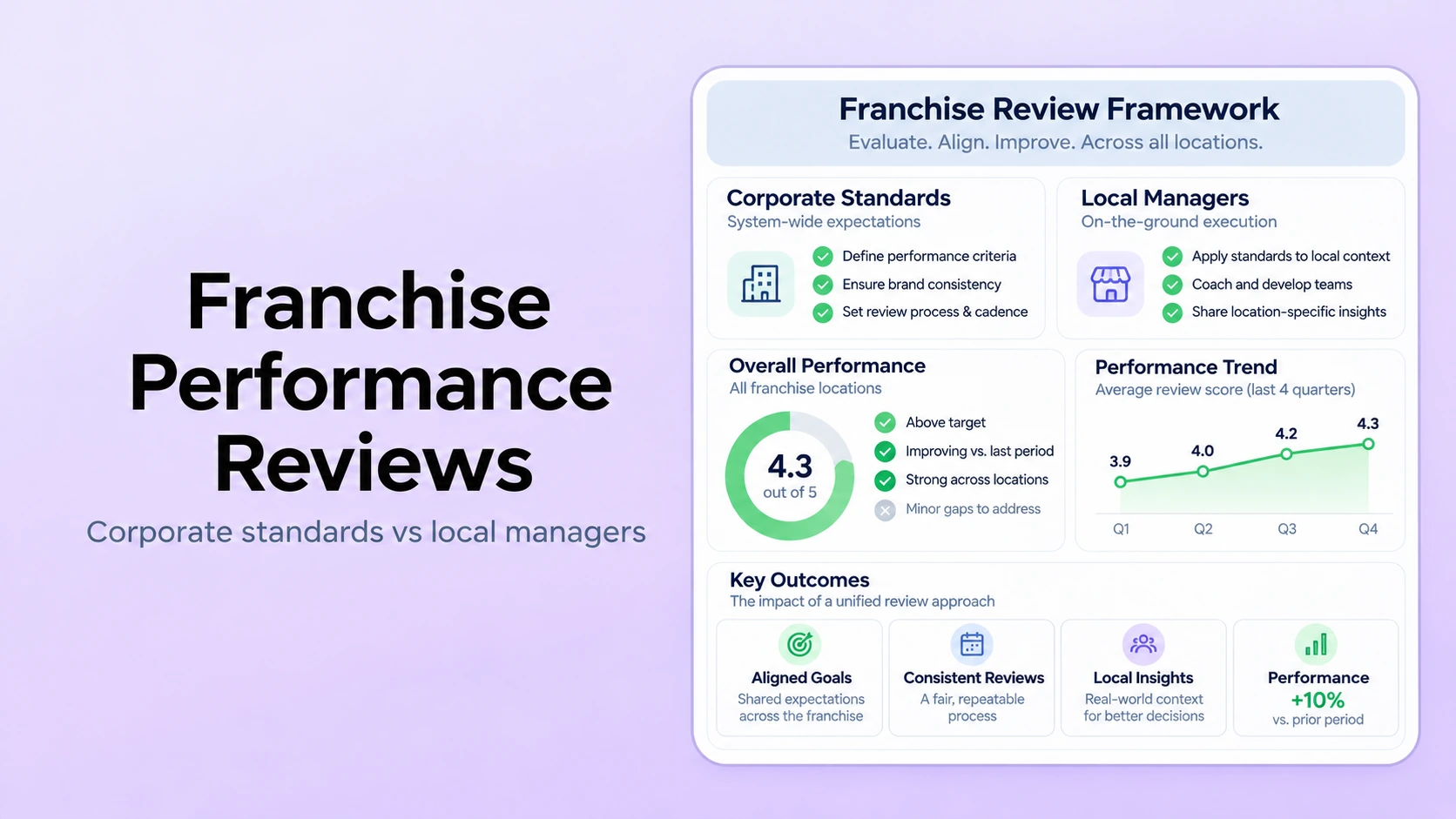
Before purchasing performance review software, define portable role competencies and which goals legitimately vary by location. The EEOC's guidance for conducting evaluations advises employers to communicate standards, apply them consistently and support judgments with relevant facts. A retail software setup should make those practices easier to verify, not turn an automated sales comparison into an unsupported employment decision.
Who owns a store manager's review across multiple locations?
The employer should designate the accountable line manager, often a district or area manager, as the final reviewer. Store operations specialists, regional leaders and HR may contribute evidence or approve decisions under policy, but the system should show who provided observations and who owns the final evaluation. A district manager with eight stores might need to gather evidence from site visits and agreed goals; they should not be asked to manufacture daily observations they did not make.
In manager review workflows, test separate permissions for evidence contributor, final reviewer and second-level HR approver. If a store manager is temporarily assigned to another district, the ownership change should have an effective date and not erase the earlier reviewer history. Compare the relevant process with review approval software tests before choosing a platform.
12 vendor demonstrations every multi-store HR team should request
1. Apply one store-manager rubric without flattening local job conditions
Setup: create four store managers in the same role family, one per location. Give all four common criteria for coaching quality, operational execution, communication and people leadership. Add location-specific objectives that accurately reflect each assigned store. Demonstrate: the district manager opens two reviews and can distinguish shared standards from local targets, including when a target changed. Pass: historical criteria remain intact and HR can tell which version applied during the review period. A review template that retroactively rewrites completed evaluations fails.
Ask whether goal management supports the proposed objective ownership and changes. A vendor must demonstrate its current configuration rather than promise that templates can be copied between stores.
2. Keep store outcomes separate from a manager's controllable work
Setup: one store misses a sales target because several key items were unavailable, while a second store meets its target with unusually high customer traffic. Add documented actions by each manager. Demonstrate: a reviewer can see the operational context, evaluate the manager's actions and explain the conclusion without automatically mapping revenue to a final performance score. Pass: performance commentary distinguishes controllable behaviors from broader store results. Fail: a mandatory formula assigns a poor rating from gross sales alone without an exception or evidence path.
Use role-based appraisal criteria to build a rubric, not a universal sales score for every retail position.
3. Show district-manager workload and completed-review ownership
Setup: a district manager is responsible for eight stores, with store manager reviews due in two different weeks. Another district manager has temporarily covered two of those locations. Demonstrate: each review shows an accountable owner, assigned contributor, due date, status and approval route. Pass: HR can identify overdue work and transfer responsibility without creating duplicate completed reviews. See whether smart notifications reach the right people after reassignment rather than the former owner.
4. Verify manager feedback from visits, not just back-office metrics
Setup: add a documented site visit, one customer-service improvement example and a coaching follow-up from a district manager. Demonstrate: the review captures the date, source, relevant role criterion and approved visibility of each observation. Pass: firsthand evidence remains attributable, and subjective comments can be supported or corrected. A dashboard that displays only point-of-sale totals is insufficient. Ask about practical manager check-ins and feedback collection rather than assuming generic notes can be used as approved evidence.
5. Handle a store transfer in the middle of a review cycle
Setup: manager R-104 moves from the mall store to the suburban store midway through the quarter. The prior district manager has already submitted feedback; the new one has two weeks of exposure. Demonstrate: the same employee keeps the earlier record, reviewer attribution and both assignments' dates. The final reviewer is selected according to policy. Pass: no duplicate employee profile, lost observations or automatic assumption that the new manager saw the entire cycle. Ask the vendor to show the transfer in the actual retail reporting hierarchy, including historical manager input, effective assignment dates and the current approval owner.
6. Support seasonal, probationary and annual cycles without double work
Setup: a newly hired manager has a probation review; another manager has quarterly coaching and an annual evaluation; a store opening changes one review deadline. Demonstrate: overlapping cycles, different forms and meaningful reminders without contradictory final ratings. Pass: each task has a clear purpose, and HR can explain which outcome is the official review. Test alongside multiple review-cycle buying questions, including missed deadlines.
7. Capture associate development without treating the store manager as every employee's reviewer
Setup: the store manager has coached two associates on service practices, while the district manager evaluates the manager's coaching responsibilities. Demonstrate: the store manager's review can reference appropriate development evidence without exposing unrelated confidential associate records. Pass: the employee, store manager and district manager each see only approved information, and a development plan has an assigned owner. Review the employee-facing workflow separately when associates need to complete their own reviews.
8. Test permission boundaries between store, district and HR roles
Setup: sign in as a store manager, a district manager covering selected stores, regional HR and an unrelated district leader. Add one HR-only performance note and a finalized review. Demonstrate: who can view, edit, approve, reopen, export and share each record, including after reassignment. Pass: an unrelated store manager cannot access another manager's private evaluation, and approved regional reporting does not imply unrestricted personal-record access. Ask for the specific security and access documentation and use confidential-review permission tests.
9. Include the manager's response and handle disputes appropriately
Setup: a district manager states that R-104 failed to improve staffing stability. The store manager submits evidence of approved headcount restrictions and challenges the conclusion. Demonstrate: an employee response, an impartial HR review route and a traceable correction when warranted. Pass: the system preserves original authorship and dates while supporting authorized resolution. The EEOC's guidance on complaints about evaluations emphasizes prompt, thorough and impartial investigation when discrimination concerns arise. A survey comment alone is not proof of misconduct.
10. Reconcile cross-store reporting without miscounting transfers
Setup: use twelve managers across four stores, with one person transferring between stores during the review cycle. Leave one review incomplete and one awaiting approval. Demonstrate: a district-level completion view, a regional overview and an export containing unique employee IDs, assignment periods, cycle status and final-review owner. Pass: employees are counted once in the companywide population, with site attribution explained. Use reporting and analytics and the reporting reconciliation test script to validate numbers.
11. Examine rating consistency without forcing identical store scores
Setup: have one district manager rate every store manager at the top level and another use a wider range. Provide examples with unequal quality and different store circumstances. Demonstrate: HR can review the criteria and evidence, request clarification and record any authorized adjustment. Pass: source notes and changes remain traceable; a forced curve is not assumed to be necessary. Performance calibration may support the discussion, but a deeper cross-store rating calibration method belongs to a separate evaluation rather than this broad software shortlist.
12. Verify data imports and exceptions before promising integration
Setup: simulate an HRIS employee roster, store assignments and a point-of-sale summary, including a missing location code and a reassigned district manager. Demonstrate: what can actually be imported or synchronized, who corrects mismatches and whether a failed update leaves stale values visibly flagged. Pass: the vendor identifies supported fields, data owners, update frequency, security controls and manual alternatives. The PerformSpark integrations overview is a starting point, not proof that a specific POS, scheduling or retail workforce-management platform is already connected.
A four-store demo scenario to give every shortlisted vendor
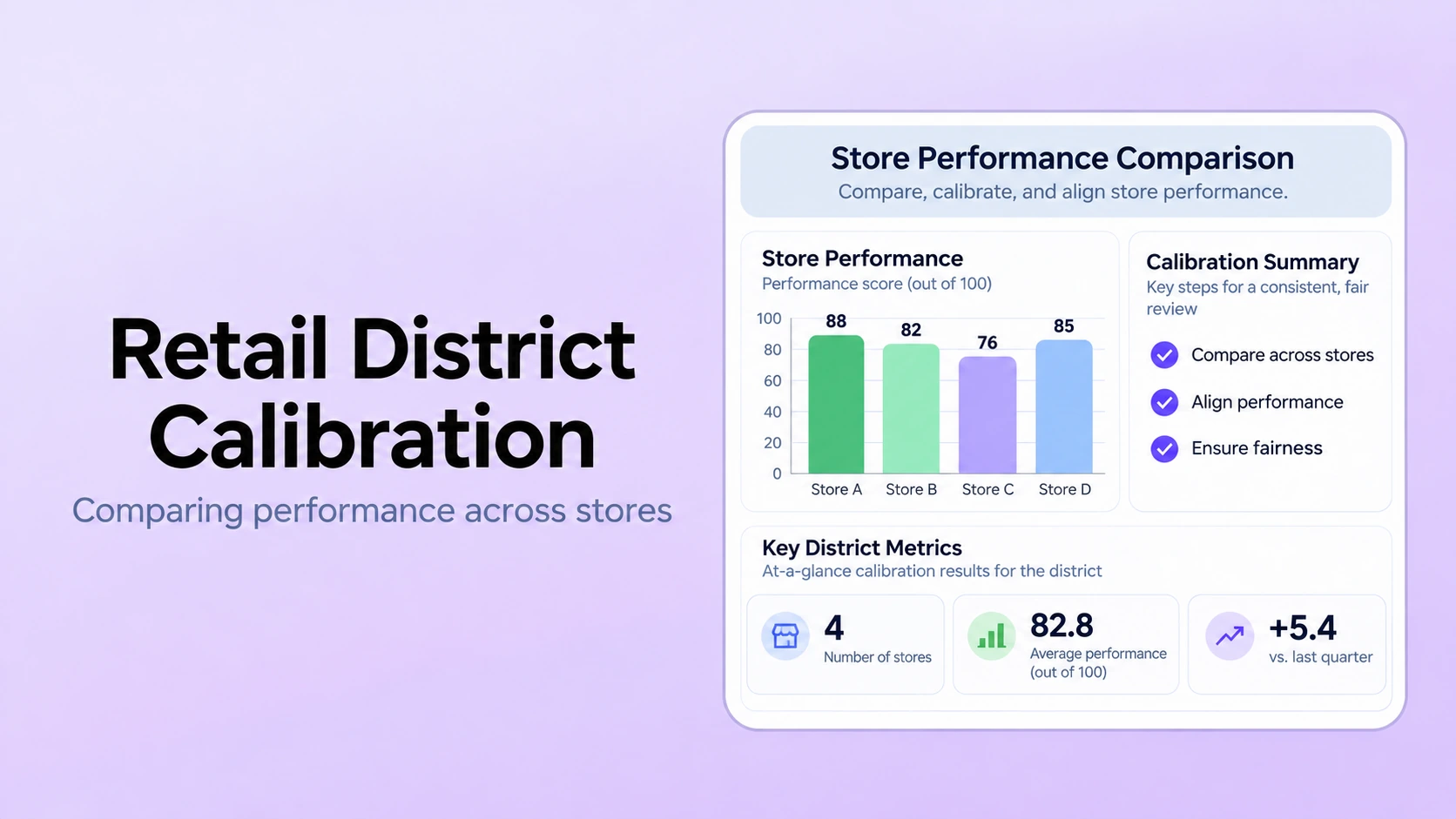
Illustrative company: Northline Retail manages four stores. Downtown has strong foot traffic but staff turnover; Lakeside is seasonal; Brookfield is newly opened; and Westgate has a temporary supplier shortage. Each location has a store manager. District managers D-1 and D-2 share coverage during a leadership transition. Manager R-104 transfers midway through the quarter, and a regional HR partner approves the final review decisions.
Ask the vendor to create these fictitious records, apply one shared store-manager rubric and four documented location goals, enter two field-visit observations, reassign R-104, simulate a disputed performance comment and complete the approval process. Review the visible evidence as the store manager, district manager and regional HR user. Finally export store and district review statuses to check counts and ownership.
Use the same synthetic data for every vendor. Give a vendor credit only for an observed feature or a clearly documented and testable configuration. This is a proposed buyer exercise, not evidence that PerformSpark or another provider has already passed the twelve tests. The 30-day software pilot guide can help extend the demonstration into a realistic operations test.
Retail Store Manager Reviews
Test multi-store manager review workflows
Bring four sample stores, a district-manager reassignment and your review criteria. Confirm which manager workflows, approvals and reporting the current product can demonstrate.
How to score the retail vendor demonstrations
Mark each test Passed when the workflow was shown end to end with the required user roles and evidence; Conditional when a necessary configuration or manual step was demonstrated but still needs validation; and Not demonstrated when the vendor offered only a feature description or roadmap statement. Record the specific observation, user account, source record, exception and commercial dependency.
Set non-negotiable controls before producing any total score: no unauthorized personnel-record access, no untraceable changes to review evidence, one accountable final reviewer and employee records that survive store transfers. A vendor that fails these cannot compensate with extra dashboards or an attractive mobile interface. Avoid claiming a scoring method is an industry benchmark; it is a suggested procurement structure.
Shortlist only products that solve the organization's actual constraints. A retailer with many temporary store managers may value effective-dated assignments and delegated approval more than a complex objective-weighting model. A high-growth chain opening many locations may prioritize scalable role templates and auditability. A company with no current data integration may need a documented secure import process before automated analytics are practical.
Questions multi-store HR should include in the RFP
- Can regional HR apply one store-manager competency framework while allowing justified differences in local goals?
- Who is the final reviewer when district managers share a store or a manager transfers districts?
- How does the product distinguish a store's operational results from the manager's directly attributable actions?
- Can a field-visit observation be stored with a source, date, author and correction history?
- What happens to an unfinished review, outstanding approval and coaching action during a reassignment?
- Can a store manager respond to or dispute a consequential review comment through an approved HR route?
- How do confidentiality restrictions differ for store, district, regional HR and enterprise reporting?
- Can the system reconcile manager headcount, review completion and reporting attribution after transfers?
- Which POS, scheduling and HRIS integrations are actually supported in the proposed package?
- What costs, administrative duties or limitations accompany custom reporting and review workflows?
Send these with a broader performance management RFP checklist. Multi-store retail requirements should not crowd out standard questions about implementation, accessibility, customer support, data ownership and contract exit.
How PerformSpark belongs on the retail HR shortlist
PerformSpark publishes pages covering performance reviews, goals, manager check-ins, feedback, calibration and reporting. These product areas make it relevant for a multi-store HR evaluation. Their presence does not establish that every retail-specific store hierarchy, POS integration, location goal rule, district approval exception or report described above works out of the box.
Ask PerformSpark to use the Northline Retail test records in a live walkthrough and separate currently demonstrated capabilities from configuration work, integration dependencies and unsupported requirements. The buying decision should rest on observed behavior and the employer's documented policies, not an assumption that a performance system automatically interprets store revenue fairly.
Final recommendation: make the review explainable at every level
A sound multi-store manager review connects role expectations, location context, firsthand field observations, district ownership, HR governance and a development follow-up. It should allow HR to answer why two store managers received different ratings without comparing revenue alone, and it should allow each manager to understand the evidence and next steps.
Use the twelve vendor tests as a practical shortlist filter. Require an end-to-end demonstration with a store transfer, a disputed comment, a regional approval and a reconciled export before treating the retail review workflow as proven.
Multi-Store HR Teams
Evaluate store manager reviews across every location
Explore role-based review criteria, district manager approvals, store-specific goals and performance reporting with PerformSpark. Bring the twelve retail vendor tests and verify current capabilities.
Book a PerformSpark Demo →Bring your four-store evaluation scenario