






Table of Contents

Key Takeaways:
- Define must-pass workflows and access requirements before the pilot starts.
- Test employee and manager review tasks with realistic participants.
- Include reviewer changes, overdue tasks, permissions and accurate reporting.
- Use a structured, evidence-based scorecard to identify configuration gaps.
- Treat 30 days as an evaluation example, not a guaranteed vendor trial period.
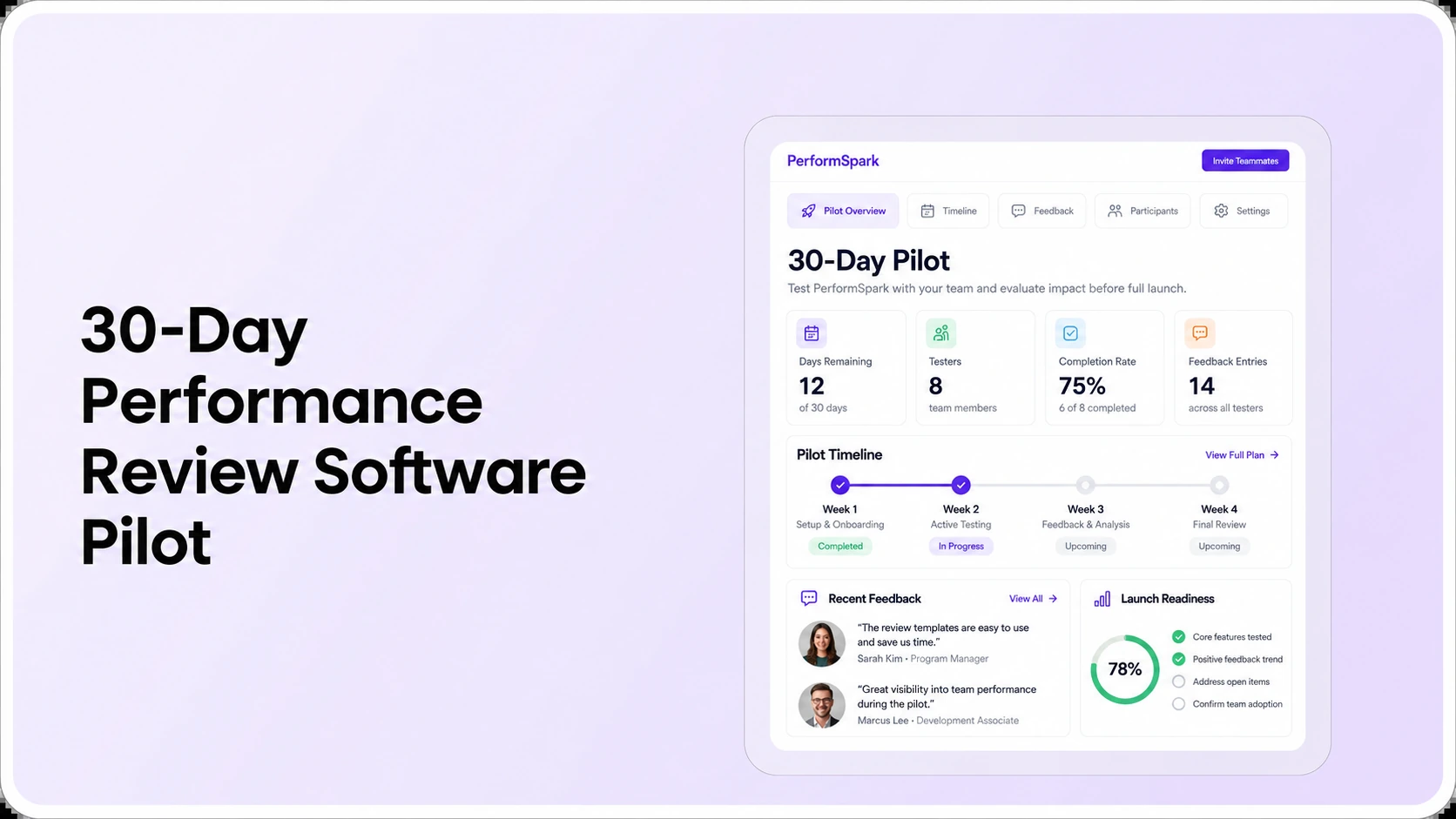
A 30-day performance review software pilot is a structured evaluation, not a full company rollout. In four illustrative weeks, HR and a small group of managers and employees test whether a vendor's review workflow, access controls, reminders, reporting and development follow-up meet agreed acceptance criteria. The result should be a documented proceed, retest or reject decision, not a claim that software will improve performance in 30 days.
Use a realistic test population and include at least one exception: a manager change, an overdue review, or an employee who cannot access an assigned task. Those cases reveal more than a polished presentation. Thirty days is a planning example for this guide, not a guaranteed PerformSpark trial length or implementation commitment. Confirm available trial arrangements directly with any vendor.
This guide is for HR directors, people operations managers and software selection teams planning a performance review software pilot. It focuses on real task performance after an initial shortlist. For deciding what belongs on that shortlist, use the performance management software RFP checklist and the broader software buying guide.
What should a performance review software pilot prove?
A pilot should answer five buyer questions: Can the employee submit a review? Can the manager complete it using relevant evidence? Can HR resolve exceptions? Can only authorized roles see the records? Can the resulting completion report be independently reconciled? Add requirements that matter specifically to your organization, such as supported HRIS fields or a mandatory approval stage.
The pilot should separate workflow success from business impact. Completing test tasks is evidence that a configuration works for the tested roles. It cannot, by itself, demonstrate a change in employee engagement, retention, review quality or return on investment.
Official Microsoft Dynamics 365 Human Resources documentation illustrates how performance processes connect goals, journals, ratings, review details and sign-offs. It is an example of the kinds of interconnected activities to test, not evidence that PerformSpark follows the same implementation or has identical controls.
Choose the participants, scope and pass criteria before Day 1
Who should participate?
- HR pilot owner: defines the approved process, expected statuses, employee populations and pass criteria.
- One HR administrator: sets up a sample cycle, assigns users, investigates exceptions and checks reports.
- Two representative managers: evaluate different team workflows and an ownership change rather than only watching the vendor demonstrate them.
- A small sample of employees: test actual sign-in and self-review tasks, ideally covering different job groups or locations.
- An IT or privacy reviewer: validates identity fields, permissions, exports and integrations where those are part of the purchase.
Use fictional or appropriately authorized test records. Real employee evaluations contain confidential information, so access, storage and deletion expectations should be agreed before any production data is shared. The vendor's security and access-control information is a starting point; request current documentation for your exact environment.
Define six measurable acceptance criteria
- Employee completion: a sample employee can locate, submit and review their assigned self-assessment.
- Manager completion: the manager can prepare an assessment, provide feedback and finalize authorized tasks.
- Exception resolution: a manager change or overdue assignment has a clear recovery path without losing appropriate history.
- Access protection: a user outside the permitted reporting line cannot see the sample employee's private review.
- Reporting accuracy: the dashboard agrees with the known number and status of assigned reviews.
- Development continuity: one agreed next step can be documented for follow-up after the review.
For each criterion, identify who performs the test, the expected result, the evidence to capture and whether a failure is negotiable. If unauthorized access is a non-negotiable security issue, it should fail the gate rather than merely reduce the vendor's average score.
Week 1 (Days 1–7): Configure and validate the test environment
Start with one representative review cycle. Map the employees in scope, their managers, key deadlines, questions, rating definitions, approval roles and expected final status. Build the test using the vendor's demonstrated configuration rather than selecting an unrelated template because it is easier.
- Create sample employee and manager profiles with known reporting relationships.
- Choose the approved review cycle and role-appropriate evaluation form.
- Connect one objective from goal management that a manager can discuss during assessment.
- Compare employee, direct manager and HR access to the same sample record.
- Check whether identity and reporting-line data must be added manually or sourced through an HRIS integration.
- Record any configuration effort the vendor performs on your behalf and whether your own administrator can repeat it.
Do not rate the product as fully configured until your HR administrator can explain how assignments are created, changed and closed. Week 1 should produce a verified setup checklist, an approved set of sample data and a list of unresolved dependencies.
Week 2 (Days 8–14): Test the employee and manager experience
The core pilot should include an unscripted end-to-end review. Give the participants their roles and goals, then let them complete tasks without a presenter clicking through the interface for them. Note where instructions, extra permissions or administrator intervention are required.
- Have an employee open the assigned review and complete a self-assessment.
- Have the manager inspect authorized goals and prior check-in notes before composing the assessment.
- Request relevant input using feedback and survey workflows if your pilot includes feedback providers.
- Complete the manager assessment and demonstrate the required acknowledgment or sign-off.
- Document the development action resulting from the conversation using individual development plans.
- Ask the employee which step was unclear and ask the manager how much of the assessment required duplicate entry.
Measure task completion, observed friction and required support separately. A manager's preference for a screen layout is useful feedback, but it should not outweigh a demonstrated inability to finish a required review or apply the correct permission.
Week 3 (Days 15–21): Deliberately test exceptions and reporting
Real review cycles do not follow a perfect sequence. Change a sample employee's manager while the review remains open, move one deadline and leave another assignment unfinished. Ask what happens to task ownership, reminders, private comments and the HR view.
- Manager reassignment: demonstrate how the remaining task changes owner while authorized prior evidence stays intact.
- Overdue reviews: show whether smart notifications direct a relevant task to the correct person and stop after the task is complete.
- Approval exception: test an unavailable sign-off owner if your policy requires multiple approvals.
- Multi-cycle assignment: include an employee appearing in an annual and short milestone cycle, if applicable; use the multiple review cycle buyer guide to define how the assignments should be counted.
- Report reconciliation: use a known test population to validate performance reporting and analytics and determine whether manager and HR views agree.
- Permission check: attempt an unauthorized view or export using a sample account and record what actually happens.
For example, if your pilot has 10 assigned review tasks, six completed, three in progress and one not started, the completion rate is 6 ÷ 10 = 60%. That is a hypothetical test dataset, not product or customer data. The vendor should clarify how canceled tasks, transferred employees and reviews awaiting approval affect its denominator.
If the pilot includes rating comparisons, inspect performance calibration and whether the software preserves reviewer evidence. A distribution chart may prompt discussion but does not establish that an employment decision is fair or correct.
Week 4 (Days 22–30): Score evidence and make a go/no-go decision
Use the last phase to replay failed tasks, close information gaps and agree on implementation responsibilities. A bug that was corrected in the test environment should be demonstrated again by the people affected. A product feature that still needs development or a custom integration should remain conditional rather than be counted as a passed current capability.
A five-level scorecard for the pilot
- 4, demonstrated independently: the required participant completes the scenario without vendor-driven actions.
- 3, demonstrated with normal configuration: an administrator can repeat the required setup and the workflow meets the requirement.
- 2, workaround required: the requirement is possible only with an ongoing manual step or material constraint.
- 1, unverified: the vendor asserts support, but the team has not demonstrated the requirement.
- 0, not met: testing shows that a required workflow or access control does not meet the agreed standard.
The scores are an illustrative purchasing tool, not published research. Record a separate pass/fail gate for permission and data requirements. The HR team should also document the owner, severity and proposed resolution for every unresolved problem. A product with a high average score can still fail a critical privacy or operational gate.
Check first-year and renewal cost using the current pricing information, including implementation, manager training, support, integration services and data export. For technical questions, consult available integrations and ask for field-level documentation. Neither a connector logo nor a pilot login proves that a required employee lifecycle workflow is supported.
Eight workflow tests to run during the 30-day evaluation
Use this condensed checklist as the meeting agenda with each finalist. Require actual actions and screenshots or redacted test logs rather than accepting yes/no feature claims.
- Test 1: Employee access. A participant can sign in and find the correct review assignment.
- Test 2: Manager review. A supervisor completes an assessment and references permitted performance evidence.
- Test 3: Goal context. A goal or competency remains meaningful in the review record.
- Test 4: Review handoff. The task moves to the authorized next step after submission.
- Test 5: Manager replacement. A supervisor change does not expose inappropriate records or strand an open task.
- Test 6: Overdue notification. A late assignment reaches the correct responsible role without revealing confidential comments.
- Test 7: Reconciled report. The HR dashboard reports the same completed and pending counts as the sample records.
- Test 8: Export and follow-up. An authorized user can verify the resulting record and record a development action.
For deeper vendor comparison, see the 25-question performance management RFP checklist; it covers procurement requirements beyond a short pilot, including commercial terms and data portability.
Pilot Evaluation
Test the workflows that matter before buying
Bring your pilot acceptance criteria, manager review scenario, and an access-control test. Ask to see which workflows can be demonstrated with your team.
What should HR avoid during a performance software pilot?
- Using only power users: include ordinary managers and employees who reflect the team's expected access and workload.
- Calling the vendor's demonstration a trial: distinguish what participants did themselves from what a presenter showed.
- Entering sensitive production data without an access plan: begin with synthetic records and documented permissions.
- Ignoring failed reminders or reviewer changes: exception handling is often where ongoing HR work accumulates.
- Reporting a made-up ROI: a 30-day workflow test cannot establish retention changes, cultural improvement or long-term productivity gains.
- Failing to preserve an exit path: ask how test records are removed and how organizational data can be exported if the company does not buy.
Because performance reviews can influence employment decisions, buyers should use evidence-based standards and appropriate human oversight. The U.S. Equal Employment Opportunity Commission's evaluation guidance addresses consistent, job-related expectations and factual explanations. The pilot checklist is educational procurement guidance and not legal advice.
When is a 30-day pilot enough, and when should it be extended?
A month can be useful when requirements are limited, test participants are available, and the vendor can configure a representative workflow. It may be insufficient for a complex HRIS connection, large data migration, multiple location-specific approvals, or a review cycle that takes months to complete. Do not claim that a sample run validates a production process over an entire year.
Extend or repeat a specific test when a critical issue remains unverified. For example, an unresolved manager reassignment problem needs another controlled run. A required integration that cannot be tested with sample data needs technical evidence and a project plan, not an optimistic score. The right question is whether purchasing risk has been reduced to an acceptable, documented level.
How PerformSpark fits a performance review pilot
PerformSpark's public pages describe structured review cycles, goal management, check-ins and 1-on-1s, reporting, reminders and development workflows. Those pages establish which product areas to investigate, but they do not guarantee a 30-day trial, every approval configuration or support for an unverified integration.
Bring an approved pilot scope, fictional review data, an access-control scenario and your reporting definitions to the PerformSpark team. Ask the product specialist to show the workflow and clarify what is standard, configurable, partner-delivered or unavailable for your environment. The outcome should be a defensible buying decision, not merely a successful sales presentation.
30-Day Review Pilot
See how PerformSpark fits your evaluation plan
Bring your review cycle, manager reassignment, HR report and integration requirements to a focused PerformSpark demonstration.
Book a PerformSpark Demo →Run your pilot checklist with the team