
.svg)





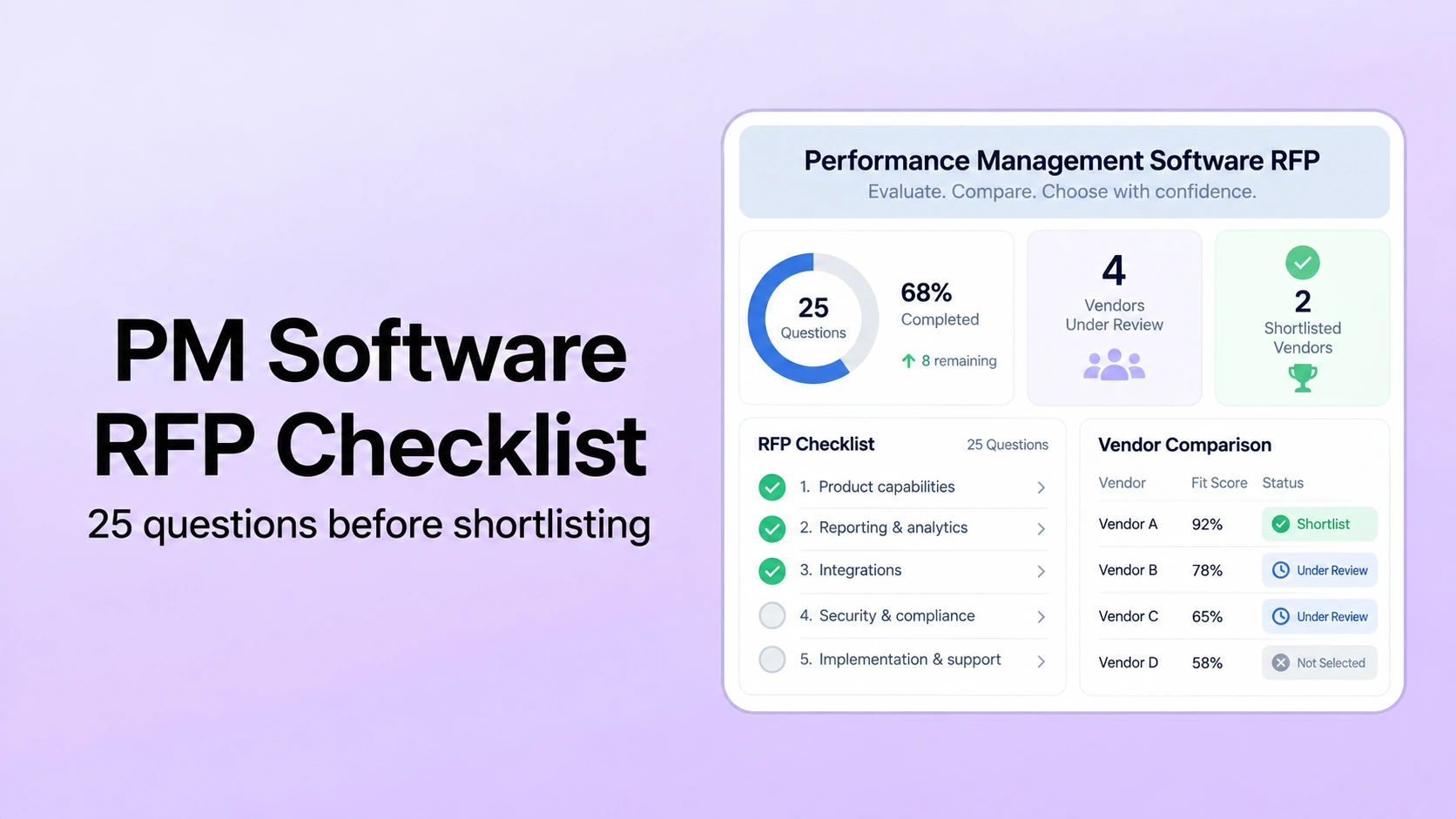
Table of Contents

Key Takeaways:
- Write the RFP around real workflows and hard requirements before vendor demonstrations influence the criteria.
- Use the same 25 questions for every vendor and require evidence for important answers.
- Score importance separately from evidence quality, and keep non-negotiable requirements as hard gates.
- Evaluate AI, integrations, security, implementation, total cost, and exit terms alongside review features.
- Use the RFP to create the shortlist, then run the same controlled workflow test with every finalist.
A useful performance management software RFP should force every vendor to answer the same operating questions with evidence, not just confirm that a feature exists. Before you shortlist vendors, define the workflows you need to run, the people who need access, the data that must move, the controls your organization requires, and the commercial terms that affect total cost.
The 25 questions below are designed for that pre-shortlist stage. They cover workflow fit, reviews, goals, feedback, calibration, reporting, AI, integrations, security, implementation, support, pricing, and exit terms. The goal is not to find the vendor with the longest feature list. It is to identify which products can demonstrate the specific performance-management operating model your organization intends to use.
If the buying team has not yet agreed on the broader requirements, start with this guide to choosing performance management software without overbuying, then use the RFP questions below to make vendor responses comparable.
Performance Management Software RFP Checklist at a Glance
| Evaluation category | Questions | Decision to make | Evidence to request |
|---|---|---|---|
| Business fit and workflow | 1-4 | Can the product run your real performance process? | Configured workflow using your roles, cadence, exceptions, and approval logic |
| Reviews and manager experience | 5-8 | Can managers and HR run reviews without side systems? | Live review cycle, manager reassignment, reminders, and completion views |
| Goals, feedback, and 360° | 9-11 | Does continuous performance context carry into formal reviews? | Goal, check-in, feedback, and multi-rater workflow demonstration |
| Calibration, reporting, and development | 12-14 | Can HR govern ratings and act on results? | Calibration case, leadership report, and development follow-through |
| AI and automation | 15-17 | What is automated, controllable, and reviewable? | Feature demonstration plus data-use and administrative-control documentation |
| Integrations, security, and data | 18-21 | Will the product fit your HR stack and access model? | Connector documentation, field map, identity controls, security evidence, exports |
| Implementation and support | 22-23 | Who gets the system live and keeps it working? | Implementation plan, ownership matrix, support scope, escalation process |
| Pricing, contract, and exit | 24-25 | What is the real commercial commitment? | Complete quote, contract terms, data-export and termination terms |
Before You Send the RFP: Define the Evaluation Rules
Do not start with vendor names. Start with the operating model. Document the review cadence, populations, manager roles, approval steps, goal process, feedback process, calibration requirements, development follow-up, reporting needs, integrations, identity controls, and implementation constraints.
Separate requirements into three groups: must have, important, and optional. A must-have should describe a business or control requirement, not a preference for a particular interface. For example, “HR must be able to reassign a review after a manager change without recreating the cycle” is more useful than “the system should have a modern workflow screen.”
Map the primary workflow against performance management software capabilities, then validate the detailed review process through the performance review workflow.
Business Fit and Workflow: Questions 1-4
- Can the platform reproduce our actual performance-management process without requiring a parallel spreadsheet or manual side workflow?
Ask the vendor to configure one representative cycle using your employee groups, reviewer roles, timeline, approvals, exceptions, and finalization rules. - Which parts of the workflow are configurable by HR administrators, and which changes require vendor services?
Separate normal administration from paid implementation or technical support. This becomes important when review formats change after launch. - Can different employee populations use different cadences, templates, rating models, and approval paths at the same time?
Test the hardest combination you expect to operate, not a generic annual-review example. - How does the platform handle organizational changes after a cycle has started?
Ask the vendor to demonstrate a manager change, employee transfer, leave, termination, and reviewer reassignment without losing history.
Reviews and Manager Experience: Questions 5-8
- What review types and reviewer relationships are supported natively?
Confirm self-reviews, manager reviews, peer input, skip-level input, project-based reviews, or other formats your process actually requires. - How are reminders, overdue tasks, extensions, and exceptions administered?
Automation matters only if HR can see status, intervene, and resolve exceptions without rebuilding the tracking layer outside the platform. Compare the workflow with PerformSpark's performance management notifications. - What context does a manager see while writing a review?
Test whether authorized goals, prior check-ins, feedback, achievements, or development actions are accessible when the manager needs them rather than scattered across modules. - What does the employee and manager experience look like on desktop and mobile?
Ask both personas to complete a realistic task. The manager workflow should be evaluated separately from the HR administration workflow.
Goals, Feedback, and 360° Reviews: Questions 9-11
- How do goals connect to check-ins and formal reviews?
Ask the vendor to create, update, and close a goal, then show how that history appears later in the review. Use the goal management workflow as a reference for the level of continuity you need. - How does the product support ongoing 1-on-1s and feedback between formal review cycles?
Test structured 1-on-1s and check-ins plus employee feedback, including permissions and how relevant context is carried forward. - How are 360° or multi-rater reviews configured and governed?
Verify reviewer selection, invitations, reminders, visibility rules, anonymity settings where applicable, aggregation, and follow-up. Do not stop at a “360 supported” checkbox. Test the complete 360 review workflow.
Calibration, Reporting, and Development: Questions 12-14
- How does the platform support performance calibration?
Ask the vendor to prepare a distribution, review an outlier, change one rating, capture the rationale, and finalize the approved result. Compare that experience with a dedicated performance calibration workflow and these calibration best practices. - Can the system answer the leadership questions we actually report after a cycle?
Bring three real questions and make the vendor answer them in the product. Validate filters, populations, trend logic, exports, and role-based access using the reporting and analytics requirements your team needs. - How do review outcomes become development actions rather than static records?
Test whether approved review outcomes can lead into individual development plans, skills management, coaching actions, or other follow-through without manual re-entry.
RFP Evaluation
Turn your 25 questions into a live workflow test
Bring your review cycle, calibration case, manager workflow, reporting questions, and integration requirements to a PerformSpark walkthrough.
AI and Automation: Questions 15-17
- What specific tasks does AI assist with, and where is human review required before output affects an employee record or decision?
Avoid a generic “AI-powered” answer. Ask for the exact workflow, input, output, review step, and administrative control. This AI performance review software guide provides a useful evaluation framework. - Can administrators control or disable individual AI features by workflow, population, or role?
Some organizations may allow drafting or summarization while restricting other uses. The vendor should explain configuration rather than treating AI as a single on/off capability. - How is customer data handled when AI features are used?
Ask where data is processed, what is retained, which subprocessors are involved, whether customer content is used to train shared models, what administrators can control, and what documentation is available for security review.
Integrations, Security, and Data Governance: Questions 18-21
- Which exact HRIS connections support our required employee fields and lifecycle events?
Request connector documentation, a field map, sync direction, frequency, error handling, and ownership. Use this HR software integration checklist instead of relying on integration logos. - Which authentication, provisioning, deprovisioning, and role-based access controls are supported for our environment?
If SAML, OIDC, SCIM, MFA, or another control is required, name it explicitly and ask for a technical demonstration. Review current security documentation rather than relying on sales descriptions. - What data can we export or access through APIs, and what happens to data when the contract ends?
Test a real export of approved review, goal, or reporting data. Confirm format, attachments, historical records, retention, deletion, and contract-end access. - What audit, permission, and administrative evidence is available when something changes?
Ask to see how administrators trace rating changes, reviewer changes, access changes, workflow edits, and other events that matter to your governance process.
Implementation and Support: Questions 22-23
- What implementation work is included, who owns each task, and what must be complete before the first live cycle?
Request a responsibility matrix covering data preparation, configuration, integrations, templates, testing, training, launch, and post-launch support. Review common performance management implementation mistakes before accepting a timeline. - What support model applies after go-live?
Clarify support channels, coverage hours, escalation, response expectations, administrator training, customer-success scope, and which services require additional fees.
Pricing, Contract, and Exit: Questions 24-25
- What is the complete cost for our expected population and required scope?
Ask for subscription, minimum commitment, implementation, migration, integrations, premium modules, support, training, professional services, renewal terms, and any usage-based charges. Compare the response with this performance management software pricing guide and current PerformSpark pricing. - What are the renewal, termination, data-export, and transition terms if we later change vendors?
Confirm notice periods, renewal mechanics, data-export access, file formats, deletion process, and assistance available during transition. Exit terms should be evaluated before the contract is signed, not after the organization decides to leave.
How to Score RFP Responses Without Letting the Demo Decide
Use a scoring model that separates importance from evidence quality. Do not give the same weight to every question unless the requirements really are equally important.
| Score | Meaning | Evidence standard |
|---|---|---|
| 0 | Does not meet requirement | Capability is unavailable or the proposed workaround does not satisfy the requirement |
| 1 | Unverified or roadmap | Vendor describes future capability, custom work, or cannot demonstrate current behavior |
| 2 | Partially meets requirement | Current capability exists but needs a workaround, manual step, or meaningful constraint |
| 3 | Meets requirement | Current capability is demonstrated and fits the documented requirement |
| 4 | Meets requirement with strong operating evidence | Vendor demonstrates the workflow using your scenario and provides relevant documentation, controls, exports, or implementation evidence |
Then apply your own importance multiplier. For example, a must-have requirement can receive a higher multiplier than an optional feature. Document the reason for the weight before vendor responses arrive so the committee does not change the scoring model to favor a preferred vendor after the demos.
The final score should support judgment, not replace it. A vendor can score well overall and still fail a non-negotiable security, integration, data-portability, or workflow requirement. Mark hard gates separately so a high score in lower-priority categories cannot offset a critical failure.
What Evidence to Request With Each RFP Response
Ask vendors to label each answer as currently available, configurable, custom, partner-delivered, or roadmap. For important requirements, request evidence such as:
- A short product demonstration using the scenario you supplied.
- Current product or administrator documentation.
- Connector documentation and supported-field details.
- Security or data-handling documentation relevant to your review.
- Example exports or reports using non-sensitive sample data.
- An implementation responsibility matrix.
- A complete commercial quote and contract assumptions.
- Reference conversations when they are appropriate to the buying process.
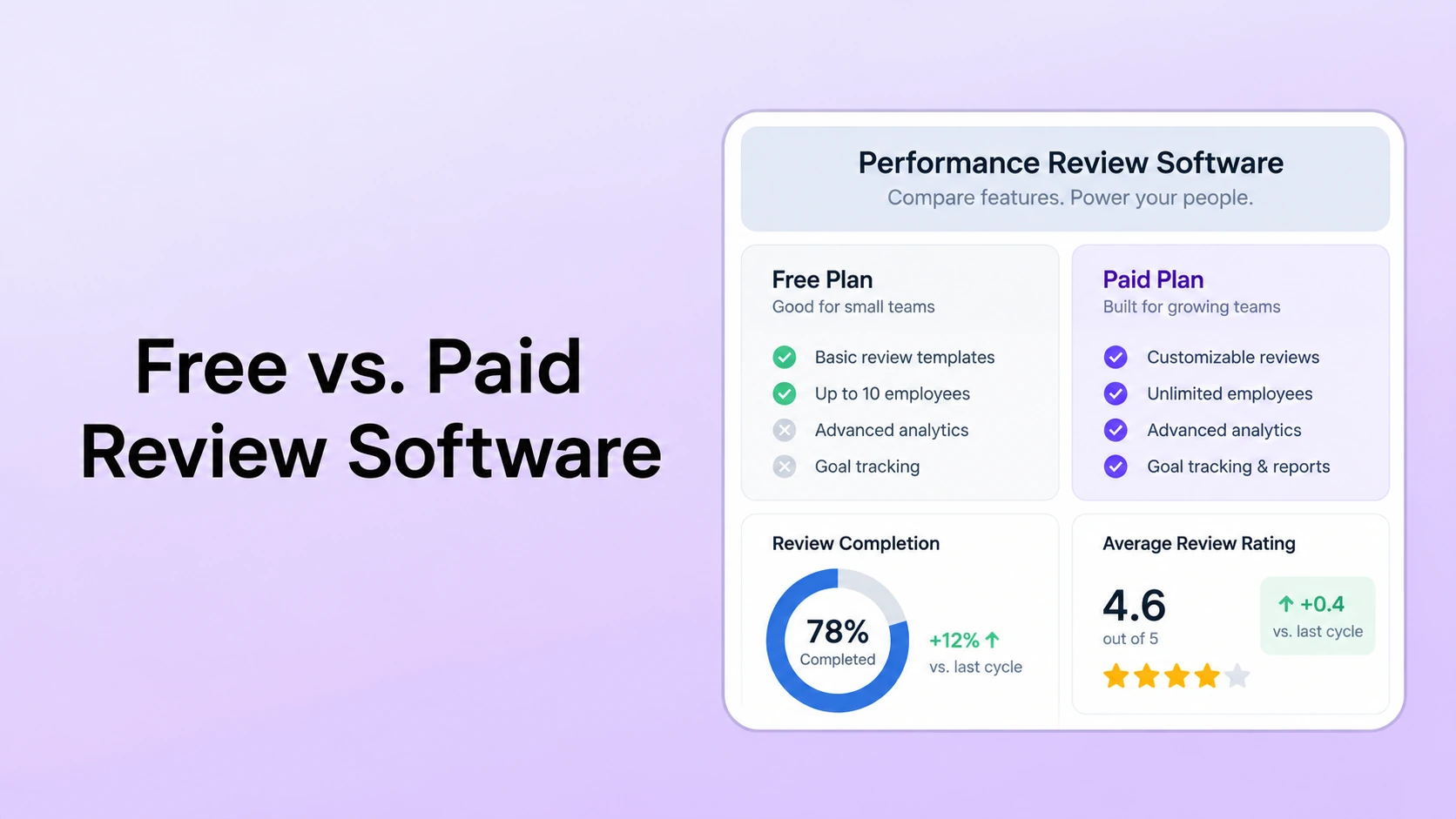
If the committee is comparing paid platforms with lower-cost or free options, use the same operating criteria in this guide to free versus paid performance review software. The price model should not change the evidence standard.
Common RFP Mistakes to Avoid
- Scoring feature names instead of workflows. A checked box does not show whether the feature supports your roles, exceptions, permissions, or reporting process.
- Writing vendor-specific requirements too early. Requirements should describe the business need before they describe one vendor's interface or terminology.
- Accepting roadmap answers as equivalent to current capability. Track roadmap items separately from functionality available during the buying process.
- Ignoring manager usability. HR can select the platform, but managers carry much of the recurring workflow.
- Leaving integrations and security until after shortlisting. Technical blockers discovered late can invalidate otherwise strong candidates.
- Comparing subscription price without implementation and operating cost. Include migration, integrations, training, support, administration, and contract terms.
- Failing to test exit conditions. Data portability and transition terms matter even when the current buying team expects a long relationship.
When the scoring needs executive or finance approval, translate the requirements into implementation risk, operating effort, and expected business use with this performance software business-case guide.
Use the RFP to Create the Shortlist, Then Test the Shortlist
The RFP should narrow the field to vendors that appear capable of meeting the documented requirements. The next stage should verify those claims using the same controlled workflow for every finalist.
Ask each shortlisted vendor to create a review cycle, change one manager, show reminders and exceptions, connect goals and feedback, run a calibration case if required, answer three leadership reporting questions, demonstrate the required integration and access controls, and export the data you would need at contract end.
If the team is still comparing broader product categories, this guide to the best performance review software for small companies can help frame the shortlist. For ongoing measurement after implementation, define the reporting plan using these performance management metrics.
Bottom Line
A strong performance management software RFP makes vendor claims comparable before the sales process starts shaping the evaluation. The 25 questions should reflect how your organization actually runs reviews, goals, feedback, calibration, development, reporting, integrations, security, implementation, and support.
Set hard gates, weights, and evidence standards before vendor responses arrive. Then require the finalists to demonstrate the same workflows. That gives the buying committee a repeatable basis for shortlisting rather than a decision driven by the most polished demo.
Performance Management RFP
See how PerformSpark answers your 25 questions
Bring your must-have workflows, hard gates, scoring model, and integration requirements to a focused vendor evaluation walkthrough.
Book a PerformSpark Demo →Use your own RFP criteria in the walkthrough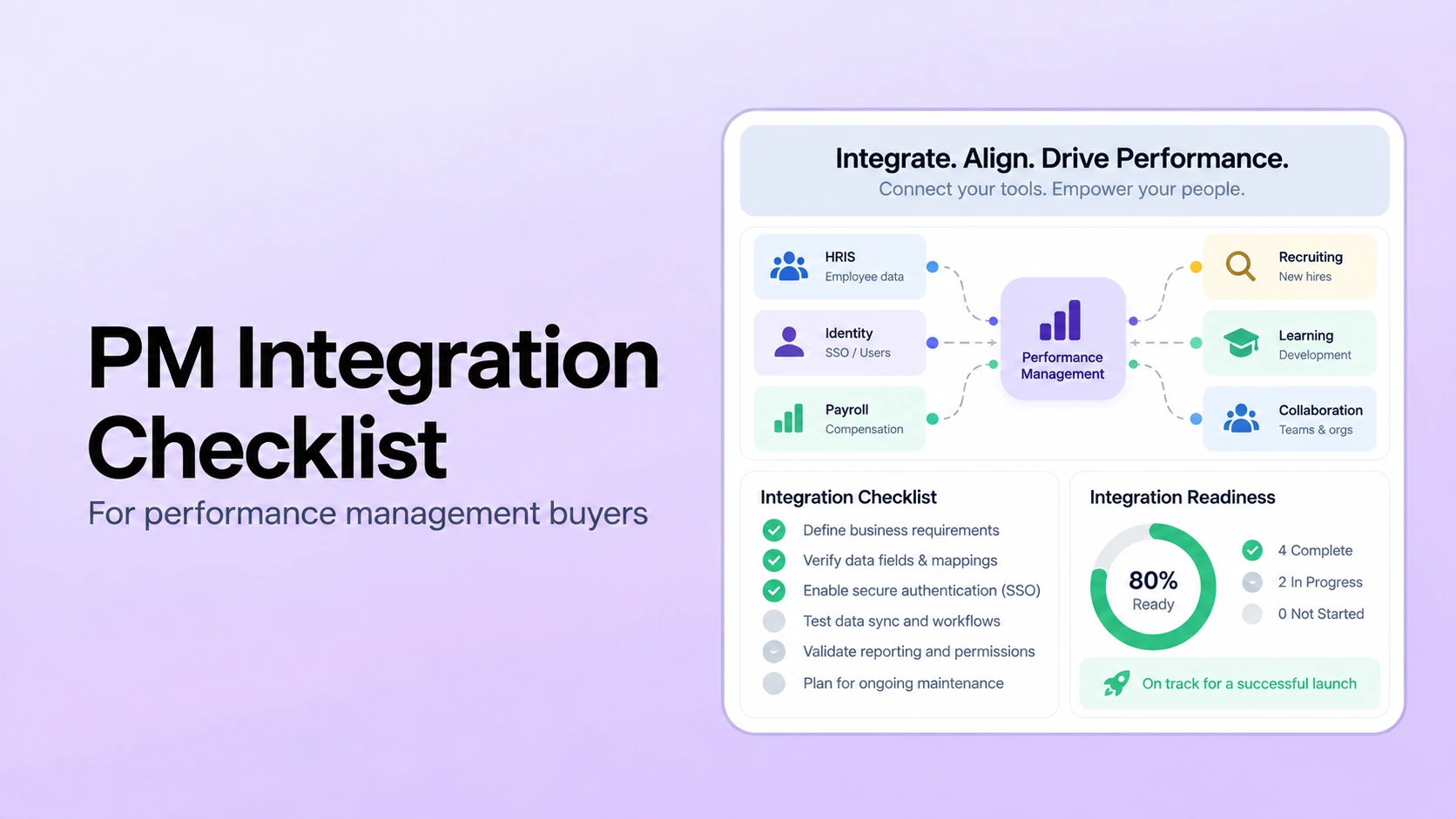



.svg)

.svg)
.svg)