






Table of Contents

Key Takeaways:
- Preserve legacy employee IDs, reviewer evidence, rating definitions and historical form versions during merger integration.
- Introduce common future review standards with clear effective dates rather than changing old scores retroactively.
- Test twelve multi-entity workflows covering migrations, unfinished cycles, ownership, permissions and rating comparisons.
- Reconcile employee counts and approval history across predecessor companies without creating duplicate records.
- Require a controlled pilot, documented data mapping and rollback before migrating actual personnel reviews.
After a merger, HR should preserve the original performance review evidence, establish one reliable employee identity, document which manager owns each unfinished review, and introduce shared rating standards prospectively. A merged dashboard is not enough. The software must distinguish legacy company records from current reporting relationships, avoid duplicate employees and prevent an old rating from being reinterpreted as though it were earned under a new scale.
Suppose two organizations combine while one uses a five-point annual review and the other uses a four-level semiannual process. Some employees move to new managers on the transaction date, others remain in their original teams, and several reviews are already awaiting approval. Simply importing two spreadsheets into one performance review system could produce duplicate tasks, misleading comparisons and unauthorized access to historical personnel notes.
This guide provides a 12-point multi-entity HR software checklist, practical vendor demo tests, a synthetic two-company migration case and a staged implementation plan. It is specifically about mergers and acquisitions, rather than ordinary multi-site administration. For recurring geography and organization complexity, see our multi-location performance management buyer guide; here, the key question is how two previously independent evaluation histories and policies become one controlled process.
What changes in performance reviews after a merger?
The acquiring and acquired organizations may differ in review calendars, role definitions, performance scales, HR approval authorities, goal-setting methods and access controls. Employees may retain their original legal employer for a transition period even when they work under new operational leadership. The software should not assume that the legal entity, payroll company, reporting line, business unit and system tenant are the same thing.
The post-merger HR plan needs two decisions before migration: what historical records must remain intact, and which rules will apply to future evaluations. The former is a data governance and employment-record obligation; the latter is an organizational policy decision that must be communicated clearly. SHRM's May 2026 change-management discussion highlights the importance of clarified expectations, agreed performance measures and regular check-ins during restructuring. No software can make those decisions for leadership.
The EEOC advises employers to communicate performance expectations, apply standards consistently and provide relevant factual reasons. That matters when formerly separate groups are compared for the first time. A worker should not receive a lower retrospective score just because their new parent organization defines “exceeds expectations” differently.
Three records to keep separate during integration
Employee identity and assignment: a stable person ID, the original company or legal entity when relevant, effective-dated role and location assignments, manager history and employment status. Preserve both predecessor IDs as aliases when necessary, with a controlled mapping to the new canonical identifier.
Historical review: the form and rating scale actually used, period dates, original reviewer, employee response, approval state and any correction record. Completed evaluations should not silently change when HR introduces a new form or new corporate terminology.
Future review plan: the approved job framework, manager ownership, new cycle calendar, goal assignments and development commitments. Align those rules in goal management and individual development planning without overwriting what previously occurred.
Do not equate a companywide view with unlimited companywide access. The merged business may require enterprise-level reporting while maintaining access restrictions between subsidiaries, business units and HR roles. The security information and a live permission test must support that distinction.
12 multi-entity HR software requirements to test before migration
1. Match legacy employee IDs without merging the wrong people
Vendor demo: create synthetic employee A-104 in the first legacy HR system and employee B-556 in the second, including one intentionally similar name and one person who moved between the companies before close. Map both systems to a controlled new person identifier. Attempt an import with an unmatched ID and a collision.
Pass: approved identity mappings remain auditable, duplicates and conflicts are flagged for human review, and no records are silently attached to the wrong worker. A name-and-birthdate heuristic alone is not an acceptable substitute for an approved migration procedure. Ask who operates the mapping and how rollbacks work. A vendor's integration overview is only a starting point.
2. Preserve the original review scale, period and form version
One company used four rating levels; the other used five. Upload a completed review from each entity, with the old score labels, dated criteria and author. Then create a new common form for a future cycle. Pass: old results still display the correct original scale, while new evaluations use the approved rules. A software system that silently converts “3 of 4” to “3 of 5” without method, context or disclosure fails this test.
Compare template version control with job-specific appraisal criteria; a historical review is evidence of the policy that was applied at that time, not a blank template to repurpose.
3. Handle overlapping annual, midyear and probationary cycles
Set up an annual review due in December for Company A and a midyear review due in January for Company B. Include an employee whose review is already in progress as the merger closes. Ask whether HR can finish the legacy process under the authorized policy, cancel an unnecessary duplicate task, and schedule the employee for the new program at the agreed time.
Pass: no lost drafts, duplicate final ratings or mysterious overdue tasks. Verify the difference between old and future cycles using the multiple review-cycle buyer guide and the actual configured workflow.
4. Reassign reviewers while keeping original authorship
A manager leaves during restructuring, and a successor now owns an employee's unfinished review. Have the old manager submit one observation, change the assigned reviewer with an effective date, and finish the cycle through the approved approval workflow.
Pass: submitted evidence keeps its original author, unsubmitted tasks move only to authorized users, and the employee has one accountable final reviewer. Test the permission boundary as the former manager as well. The next supervisor should not inherit a private personnel record merely because they joined a new department.
5. Separate legal entity, operating unit, reporting manager and HR approver
Some business units may consolidate operationally before their employing entities or policies change. Build a synthetic employee in Entity B who reports operationally to an Entity A functional lead but whose personnel approval remains with a designated Entity B HR manager.
Pass: each role and effective date is represented independently; the application does not grant every cross-entity supervisor blanket read or approval authority. For dual-reporting scenarios, adapt the two-supervisor evaluation tests, keeping final employment responsibility explicit.
6. Enforce entity-level access even inside one tenant
Sign in as a legacy Entity A supervisor, an Entity B supervisor, regional HR and an approved corporate HR administrator. Try to open historical ratings, private manager notes, responses and development actions for employees outside each user's authority. Repeat after a role transfer and revocation.
Pass: actual records and exports respect authorized scope, not just a dashboard filter. The NIST Cybersecurity Framework's access principles cover least privilege and review of rights when people change roles. This is security design guidance, not a claim that all private employers must implement one exact control. Use our confidential review permissions tests for a deeper script.
7. Harmonize goals without retroactively judging earlier work
Company A measures project delivery against quarterly milestones; Company B measures service quality using agreed role behaviors. Establish new goals for the combined organization, but keep the employee's historical deliverables and conditions intact. Test a goal abandoned because the merger discontinued a product line.
Pass: an obsolete goal can be closed with the appropriate reason, and a new goal receives its own start date and owner. The employee is not penalized automatically for corporate strategy changes outside their control. Review the handoff through manager check-ins rather than presenting a new goal as though it applied to the entire past cycle.
8. Calibrate ratings carefully across predecessor companies
Use a synthetic sample of two employees in comparable jobs. One received the top rating under a four-level scale; another received the top rating under a five-point scale. Ask how the system explains the different definitions, displays supporting evidence and documents any authorized review discussion.
Pass: HR can compare communicated expectations and work evidence without pretending that legacy scales are directly interchangeable. Any conversion, if needed for reporting, must be clearly labeled as a separate analytics methodology rather than changing source evaluations. Calibration is an appropriate workflow to evaluate, but it should not impose an unsupported forced distribution across the merged workforce.
9. Preserve feedback, employee responses and corrections
An employee challenges an outdated statement in a legacy review after the acquisition. Show how the company records the employee's response, checks supporting facts and corrects the material through its approved process. Test what the source author, current reviewer and employee can see.
Pass: original and corrected records are distinguishable, with dates, roles and decision ownership preserved. The EEOC's guidance on evaluation complaints emphasizes prompt, impartial investigation of potentially discriminatory performance-review concerns. Routine review corrections do not replace a formal complaint process.
10. Migrate development actions without carrying obsolete commitments
Employee B-556 has a development action supported by a previous manager. A new role removes that task but adds a relevant skill requirement. Show the original plan, the reason it was closed, the employee's discussion and the next action. Pass: the development record shows continuity without treating an ended assignment as an ongoing failure. If an existing improvement process applies, keep it within the employer's authorized performance improvement plan procedures rather than triggering a disciplinary process automatically.
11. Reconcile employee counts, review completion and old entity codes
Give the vendor synthetic records for eight employees across two predecessor entities, with one transfer, one completed historical review, one open review and a single employee with two separate project contributions. Ask for entity-level and combined reporting by employee ID, review period and current assignment.
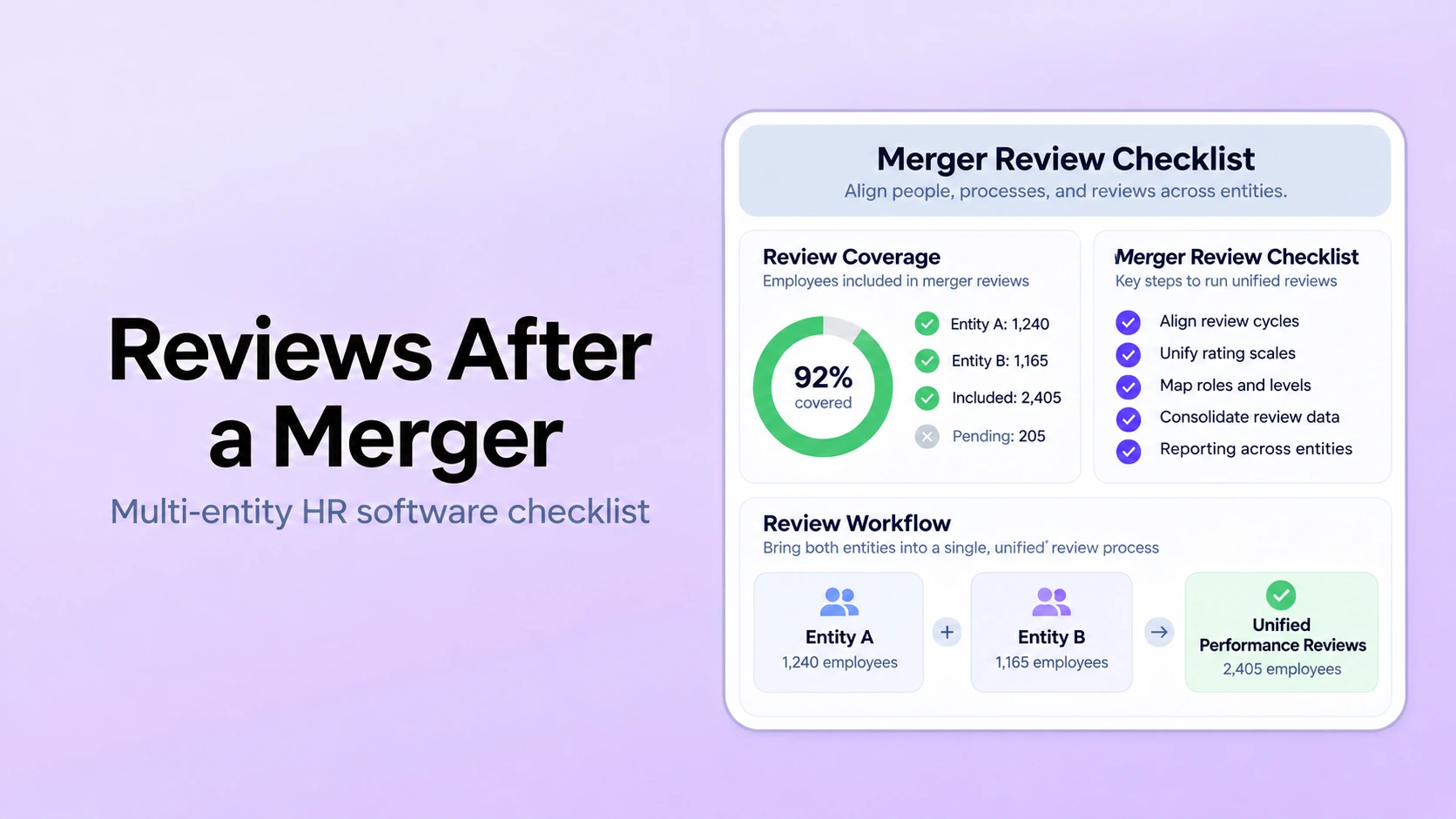
Pass: the corporate dashboard counts eight distinct people, identifies legitimate multiple input records, and explains whether a review was completed before or after close. An impressive “92% complete” graphic is meaningless without a denominator and inclusion rules. Use reporting reconciliation tests alongside reporting and analytics.
12. Prove export, retention, audit history and rollback
Ask for a full export of synthetic pre-merger and post-merger review data, including employee mapping, form version, original rating, response, approvals, document references and correction history. Simulate a rejected migration and a rollback. Confirm how source systems remain accessible during transition and who can authorize deletion.
Pass: the employer can reconstruct who said what and when, preserve relevant historical records and recover a failed migration without corrupting final evaluations. EEOC recordkeeping guidance describes retention obligations for covered employers; particular periods may depend on the record, legal holds and applicable law. Confirm requirements with qualified counsel instead of imposing a single blanket deletion date.
A two-company example that exposes hidden merger review problems
Illustrative buyer scenario: Atlas Operations acquires Beacon Services. Atlas uses annual five-point appraisals, while Beacon uses a four-level semiannual process. Both companies have an employee called Jordan Lee in different departments; their identities must not be merged. Beacon employee B-556 transfers to an Atlas operations team before their old review closes. The former manager has entered a dated observation, and the new manager has only three weeks of direct exposure.
Give every shortlisted vendor that same scenario. Ask an authorized migration administrator to map IDs, import the two historical scales, preserve the old comment, start the new reporting relationship and resolve a duplicate review task. Then ask HR to compare ratings without altering their original definitions. Finally, export a report that shows one person per approved identity and flags any conflicting assignment data.
The expected outcome is not a perfectly uniform scorecard. It is a transparent record: one accurate employee identity, two separately defined policy histories, correctly scoped supervisors, a documented final approval, and future goals that take effect on the correct date. The case is fictional and does not represent a PerformSpark customer or a real merger.
Post-Merger Performance Reviews
Test two legacy review systems before migration
Bring two legacy rating scales, an unfinished review and a changing reporting line. Ask PerformSpark to demonstrate current workflows and document migration dependencies.
Six stages for integrating performance reviews after an acquisition
- Inventory existing policies and data. List the two review calendars, scales, job frameworks, completed records, open tasks, managers, employment entities and retention requirements. Assign an accountable business owner to each system.
- Approve identity and record mapping. Define a canonical person ID, approved legacy aliases, organizational effective dates, duplicate-resolution workflow and data-quality acceptance thresholds. Never infer legal employer solely from a department label.
- Choose transition rules before import. Decide whether legacy cycles finish under old policies, when future common criteria begin, who approves changes and how employees will be informed. Ensure HR and legal leadership review consequential choices.
- Pilot with synthetic exceptions. Run transfers, duplicate IDs, conflicting ratings, incomplete reviews and restricted access. Retain evidence of failed tests and document corrections before importing real personnel data.
- Validate reporting and employee experience. Test the employee view, manager view, reminder ownership through notifications, and consolidated reporting with independently reconciled employee counts.
- Release in controlled waves. Migrate approved cohorts, verify post-import records and review permissions, monitor exceptions and maintain a rollback plan. Review remaining legacy dependencies and the next common review cycle before shutting down old access.
Sequence this process to match the organization's risk, transaction agreements and available staff. These are implementation stages, not promised migration duration or a claim that PerformSpark offers all migration services. A controlled software pilot can help structure tests before enterprise rollout.
How should HR compare ratings from different legacy scales?
Begin with the original descriptors and evidence, not the numbers alone. A top score at Beacon might require exceptional customer impact, while a top score at Atlas might represent consistently exceeding agreed objectives. Even if the highest numeric rating looks similar, those definitions are not automatically equivalent. HR should decide whether ratings need to be compared for a specific purpose and whether meaningful, job-relevant comparisons are possible.
For a board report or retrospective analysis, a carefully documented analytical crosswalk might group legacy categories without editing source records. State what the method assumes and what it cannot support. Do not use an arbitrary conversion to decide pay, layoffs or promotions. The EEOC's performance evaluation guidance favors communicated, consistently applied criteria and relevant facts rather than unexplained score conversion.
When the two organizations have genuinely different job expectations, preserve separate categories until HR establishes common future standards. The purpose of calibration discussions is to assess whether decisions are justified, not to manufacture identical rating distributions across predecessor organizations.
What to require in a post-merger software RFP
Ask vendors to describe the exact import path, identity mapping owner, rollback process, form versioning, role-based permissions, treatment of open review cycles, and reporting denominators. Request a written distinction between supported current functionality, configuration work, integrations, and unsupported needs. An API reference is not evidence that a tested migration connector exists.
Include the underlying performance software RFP questions for support commitments, export formats, commercial terms, accessibility and implementation accountability. For each merger requirement, capture a demonstrable pass criterion and the environment in which it was observed.
The organization should also maintain continuity for appropriate feedback records and project assignments without treating the general project closeout workflow as a full merger data strategy. Affected managers and employees need clear communications about who has authority over their next review and which standards now apply.
Where PerformSpark fits in a multi-entity HR evaluation
PerformSpark offers product information about reviews, goals, check-ins, calibration, development plans, and reporting. Those product areas make it relevant to a post-merger performance process evaluation. They do not prove that the platform supports every legacy-system migration, tenant separation rule, cross-entity approval path or automatic scale conversion described here.
Bring the Atlas and Beacon synthetic records to a walkthrough and ask the PerformSpark team to show which steps work in the current product. Require separate documentation for imports, identity rules, security permissions, implementation responsibilities and any missing functionality. For this buying decision, traceable data continuity matters more than a unified dashboard mockup.
Final recommendation: unify the future without rewriting the past
The strongest post-merger review software process retains the original meaning of completed evaluations while building a clear and consistent framework for work going forward. HR should be able to explain whose evidence was collected, which employer policy applied, who approved the outcome and when the employee's next goals became effective.
Use the twelve tests to evaluate vendors before migrating live personnel data. Protect historical records, resolve ownership and access, and demand reporting that reconciles to actual employees. This article is educational and not legal advice; involve qualified HR, security and legal leaders in consequential migration and employment decisions.
Post-Merger HR and People Teams
Build a more reliable post-merger review workflow
Explore review ownership, historic evaluation context, calibration and reporting with PerformSpark. Bring your twelve multi-entity tests and verify which workflows are supported today.
Book a PerformSpark Demo →Bring your two-entity migration and review scenario