






Table of Contents

Key Takeaways:
- Calibrate store manager ratings against comparable job standards and evidence, not raw store sales or identical district averages.
- Document differences in customer traffic, stock availability, staffing and review periods before changing ratings.
- Use a six-stage review process to examine preliminary ratings and preserve authorized adjustments.
- Require twelve vendor tests covering reviewer history, evidence, privacy, approvals, employee responses and reconciled reporting.
- Do not accept automated rating normalization or an attractive dashboard as proof of a fair decision.
Retail district manager calibration should compare store managers against the same job-related performance definitions while accounting for differences in store format, staffing, demand, inventory and work observed. District leaders and HR should use preliminary ratings to identify questions, examine the underlying evidence and document any justified change. They should not require every store to have the same average rating or automatically convert sales rankings into individual performance scores.
Consider four stores in one district. One serves commuters, another depends on weekend tourism, a third is newly opened and a fourth faced a supplier shortage. Their results are not interchangeable. Yet store managers may share expectations for team coaching, customer issue escalation, schedule planning and operational follow-through. The calibration challenge is deciding what a rating such as “exceeds expectations” means in those roles, then checking whether different district managers and store leaders have applied that meaning consistently.
This guide gives retail HR leaders 12 vendor software tests, a four-store calibration example, a six-stage meeting workflow and evidence-based RFP questions. It covers rating governance and comparison, not the broad store manager review setup addressed in our retail store manager review software checklist. For performance management across industries and locations, use the separate multi-location buyer guide.
What is district manager calibration in retail?
District manager calibration is a structured review of preliminary employee or store manager performance ratings across stores, with authorized participants checking the consistency of expectations, evidence and decision-making. In a common model, each district manager proposes ratings for the store managers they supervise; regional HR or a leadership panel reviews comparable roles and notable differences before final approval. An individual store manager still needs an accountable final reviewer under the employer's policy.
The EEOC's employer performance evaluation guidance recommends informing employees about standards, applying them consistently and using relevant facts to explain decisions. A calibration meeting can help HR test those principles. It does not provide a legal guarantee that the ratings are fair, and it must not replace a proper response to discrimination concerns.
Research on calibration committees also warns that more discussion does not automatically mean better evidence. A study published in Human Resource Management examined rating calibration and found that supervisors' incentives can affect the information they share. See the research on calibration committee behavior. A sound process therefore asks reviewers to identify firsthand observations and explain adjustments, rather than rewarding the most persuasive participant in the room.
Use PerformSpark's calibration product information to plan relevant vendor questions, but insist on seeing the current configuration. A product page alone does not prove that every cross-store evidence comparison, rating history or approval rule is supported.
Compare store manager performance, not just store performance
Store results can contribute relevant context. Sales conversion, labor schedules, stock availability, customer feedback and turnover may indicate where a manager needs support or has improved practices. They do not, in isolation, establish how well an individual managed the store. A manager could document strong coaching and escalation during a stock shortage; another could benefit from exceptional customer traffic without consistently coaching employees.
Research in the Journal of Retailing examines relationships among regional leadership, store managers and store outcomes, reinforcing that store performance is influenced by more than an isolated manager score. See Store Manager–Store Performance Relationship: A Research Note. Do not infer a precise effect size or causal conclusion for your own stores from that study.
For a meaningful comparison, define four types of evidence: the assigned role standard, the manager's observed actions, the operating conditions, and the period covered by the reviewer. Role-specific appraisal criteria can inform the evaluation categories, while goals document what the manager was expected to accomplish during that period.
A common error is comparing one store's gross revenue with another's without considering format, trading hours, traffic or product availability. Another is comparing a new manager's first six weeks with a colleague's full-year record as if they had equivalent observation periods. Ask the software vendor how those differences remain visible to the calibration panel.
An illustrative four-store calibration case
Planning example, not customer data: Ridgeway Retail operates four stores in one region. Riverside is a high-traffic urban store; Bayside draws seasonal visitors; Meadow is newly opened; and Hillcrest experienced a documented product allocation problem. Two district managers each oversee two stores, with a regional HR partner responsible for calibration governance.
At the start of the meeting, Riverside's store manager has a proposed rating of 4 out of 5 supported by documented coaching, service recovery and schedule planning. Bayside's manager also has a proposed 4 but the evidence covers only part of the season. Meadow's manager has a proposed 3 with a strong store-opening execution record and an unresolved concern about team development. Hillcrest's manager has a proposed 2, largely attributed to weak sales during the allocation problem, although the manager documented the shortage and executed approved customer communication.
The panel does not average all four ratings or change one simply because Hillcrest's store is smaller. It checks whether the same standard was used, whether each reviewer observed enough work, and whether sales outcomes reflect employee-controllable actions. Hillcrest's score might change if the underlying rationale is not supported; Meadow's rating might remain unchanged if the documented evidence warrants it. A conclusion is a judgment based on verified facts, not a formula derived from sample store data.
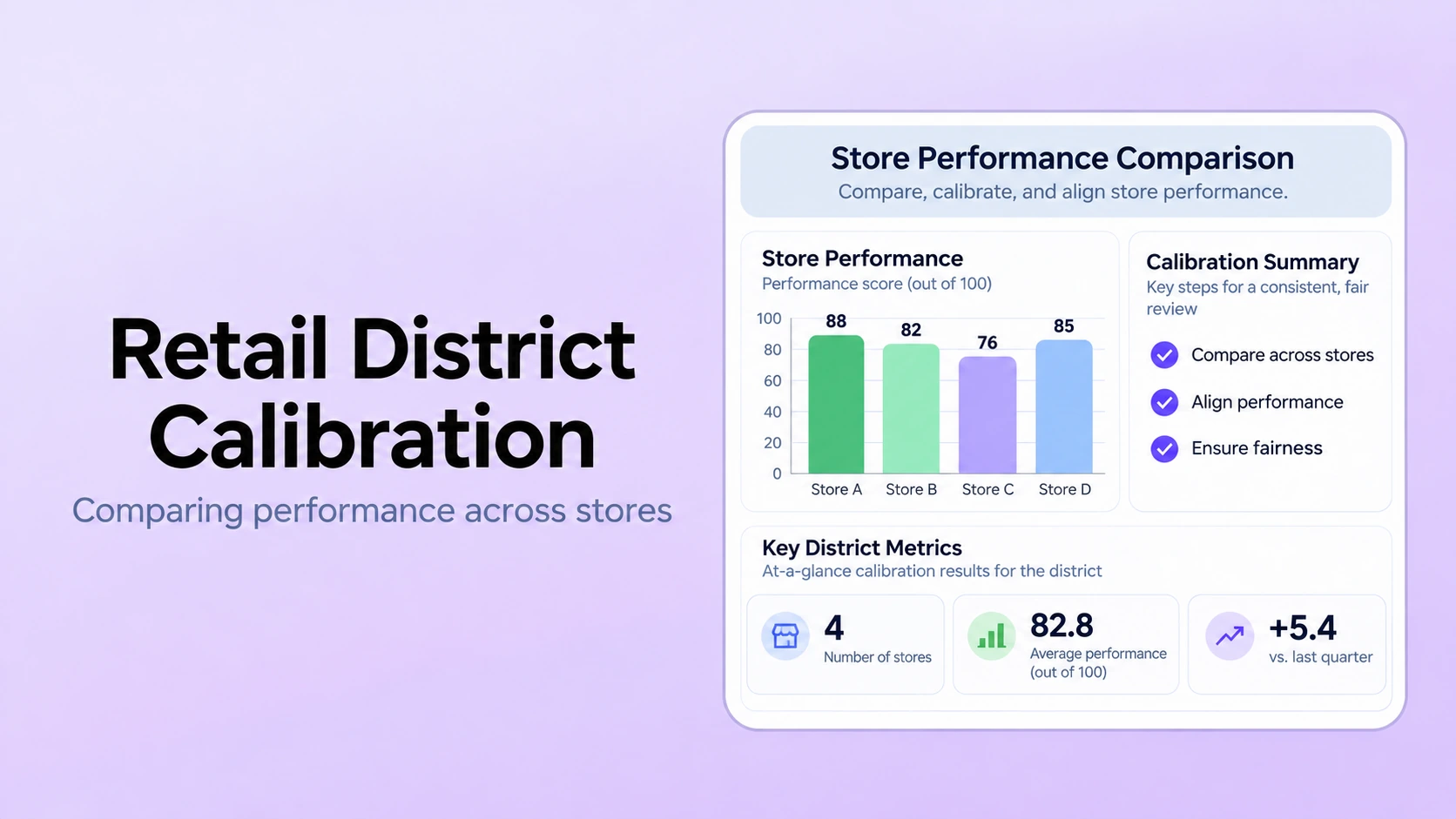
All employee names, scores and locations in this scenario are fictional. The percentages and “+5.4” shown in the uploaded thumbnail are illustrative artwork and must not be presented as measured customer results or calibration gains.
Six stages of a fair retail district calibration meeting
1. Freeze the review criteria and define comparison groups
Agree on the applicable rating scale, role expectations and review period before viewing outcomes. Compare store managers with comparable responsibilities; do not force an assistant manager, store manager and regional operations leader into one role ranking. Record permitted local goals separately from shared competencies, and preserve historical forms if policies changed mid-cycle. Consider calibration best practices for the general process.
2. Collect preliminary ratings and supporting records
Require the district manager to submit a proposed rating with dated work examples and relevant context. Use manager check-ins or appropriately sourced feedback and surveys for supporting observations when available. Record missing evidence explicitly rather than assuming an undocumented score is justified.
3. Inspect differences between managers and stores
Review unusual rating distributions, different interpretations of shared criteria and incomplete records. A district whose managers all receive top ratings may deserve a closer look, but this does not establish leniency or improper behavior by itself. Ask whether the results are supported by comparable evidence and opportunities to demonstrate the standard.
4. Challenge the evidence and distinguish operating context
Ask what the store manager did, what was expected and what obstacles mattered. Compare a store-opening objective to a new-store target, not an established store's full-year revenue. Where the panel disagrees, record which facts remain unresolved. A strong meeting improves information quality; it is not a contest between district leaders.
5. Document any rating change and authorized approval
Retain the original score, proposed adjustment, evidence, explanation, author and approval date. The accountable reviewer should understand the final conclusion and the employee's response path. Use approval workflow evaluation tests to check that a panel member cannot secretly overwrite a completed appraisal.
6. Complete the conversation and follow through
Once authorized, communicate the approved evaluation using the employer's process. Create appropriate coaching and development actions rather than treating calibration as a score-cleanup exercise. Verify that reporting reflects both the final status and a separately auditable history of adjustments.
12 buyer demo tests for district manager calibration software
Test 1. Compare like-for-like store manager roles
Demo: create the Riverside and Hillcrest store managers in the same job family with common competencies and documented site-specific goals. Add a different job level that should not be ranked in the same peer group. Pass: HR can choose a defensible comparator group without silently treating distinct positions as equivalent. Verify that job or review-template changes do not rewrite past assessments.
Test 2. Keep initial and final ratings separate
Have two district managers submit preliminary ratings. Let an authorized panel discuss a possible adjustment, then finalize one record. Pass: the original rating remains visible to approved reviewers with a timestamp and source, and the approved result is clearly labeled. Fail: the software replaces the preliminary decision without a trace. Use performance review functionality as the starting point for the demonstration.
Test 3. Show evidence behind an unusual score
One district manager gives the highest rating to every store manager. Ask the panel to open dated observations, feedback and role criteria rather than merely view a bar chart. Pass: the team can identify evidence gaps or substantiated strong performance, without being forced to lower scores to meet a distribution target. A high average is a question for investigation, not proof of bias.
Test 4. Separate location operational outcomes from individual behavior
Show Hillcrest's weaker sales during a supplier allocation problem alongside evidence that its manager escalated shortages and helped customers find approved alternatives. Pass: authorized reviewers can explain the operational context separately from the employee's own actions. The final evaluation should not be determined automatically by revenue or conversion alone.
Test 5. Preserve evidence when managers change districts
Move Meadow's store manager to a different district during the cycle. The prior district manager has eight months of observations; the new manager has four weeks. Pass: the software retains dated, source-attributed evidence, identifies one authorized final reviewer and prevents duplicate completed appraisals. Compare multi-store manager review ownership requirements with this calibration-specific handoff.
Test 6. Detect incomplete review periods and missing sources
Create a proposed 4 out of 5 with only one informal note from the final week, plus a complete year-long evidence record for another manager. Pass: the reviewer can see coverage gaps and request additional input before finalizing. A dashboard should not treat one note and a full evidence history as equally reliable merely because both have a rating field.
Test 7. Restrict who can see, challenge or change ratings
Sign in as a store manager, their district manager, an unrelated district manager, a regional HR approver and an enterprise analytics user. Attempt to view individual rating notes, salary-related comments, proposed adjustments and confidential evidence. Pass: access matches approved roles and the employer's policy; reporting permission does not imply unrestricted personnel visibility. Test confidential review permissions and security controls in the actual product environment.
Test 8. Handle disagreements without an unexplained average
One panel participant proposes a 3 and another proposes a 4 for the same manager. Ask the software to show where their reasoning, supporting observations and final authorized conclusion are recorded. Pass: the reviewer can explain any adjustment. An automatic arithmetic average is not proof that the evaluation is consistent or fair.
Test 9. Check approval ownership and deadlines
Hold one record pending clarification and let another proceed to final approval. Change a district manager's account permissions midway through the calibration window. Pass: the correct reviewer or HR approver receives the outstanding task, and notifications do not continue prompting the former owner. Ask for the exact supported routing and exception rules.
Test 10. Capture an employee response and correction
The Hillcrest manager objects that the evaluation attributed stock availability to them despite written evidence of a supplier decision. Add their response and a factual correction, then follow the employer's approval policy. Pass: original statements, the employee response and approved correction remain reconstructable. The EEOC's guidance on complaints about performance evaluations emphasizes prompt, impartial investigation when discrimination concerns are raised.
Test 11. Reconcile district distributions and employee counts
Create twelve synthetic store managers across two districts, one transfer, one unfinished review and two separate contributions about the same employee. Generate district-level rating distributions and companywide completion reporting. Pass: the figures reconcile to twelve distinct employees, exclude unfinished ratings from finalized counts as defined, and disclose relevant filters. Use review reporting demo tests to check exports and denominators.
Test 12. Export the decision record and test ongoing ownership
After calibration, export each test employee's final score, applicable criteria, initial rating, change rationale, approver history and review period, subject to approved access. Reassign a district manager and open the next cycle. Pass: historical records remain traceable and authorized next-cycle ownership is correct. For any feeds from a point-of-sale or HRIS system, verify integration availability and how data errors or changed assignments are handled.
Retail District Calibration
Compare store manager ratings with evidence
Bring preliminary ratings from four fictional stores and a proposed adjustment. Ask PerformSpark to demonstrate evidence, approval ownership and reporting in the current product.
What makes a calibration dashboard misleading?
A chart can present rating distributions cleanly while hiding four important limitations: different roles in the same chart, incomplete review submissions, store conditions unrelated to employee action, and inconsistent definitions of a rating label. Two districts may both average 4.0 for fundamentally different reasons. The number is a starting signal, not a fair-performance verdict.
Do not use a bell curve as an automatic quota simply to equalize stores or districts. Some teams may perform differently for legitimate reasons, and small groups are particularly vulnerable to misleading distributions. The research on calibration committee behavior noted earlier is another reason to request original evidence and decision histories rather than treating a meeting's consensus as proof.
If a company chooses a numerical weighting model, require clear definitions, a documented rationale, appropriate exceptions and validation against actual job expectations. A vendor should not promote machine-generated normalization as an objectively correct performance judgment without a careful human and HR review of the methodology.
How to evaluate vendors and prepare the RFP
Score each test as Demonstrated if the configured product completes it end to end with appropriate accounts; Conditional if additional configuration or an approved manual action is required and shown; and Not demonstrated if the vendor only describes the feature. Record evidence, version or package, user role, implementation dependency, owner and unresolved risk. These are proposed procurement criteria, not certified product capabilities.
Use confidentiality, accurate review ownership, preserved rating history and reconcilable reporting as hard gates. An appealing comparative chart should not offset a failure that reveals one district's confidential personnel notes to an unauthorized manager.
Ask vendors whether the current platform supports role-based comparison groups, status filtering, review versioning, rating-change notes, approval separation, exports and manager reassignment. The performance management software RFP checklist provides the broader selection criteria. A controlled software pilot can then test the same multi-store scenario using the company's policy and synthetic data.
Eight questions retail HR should ask before the calibration demo
- Can two district managers compare the same store-manager competency definitions without erasing location-specific targets?
- How do we identify ratings with missing evidence or incomplete periods before calibration?
- Can we inspect the actual basis for each preliminary rating, not only its position on a chart?
- Which users can propose, approve, reopen and export a rating adjustment?
- How are employee transfers and prior district-manager observations retained?
- Can the application distinguish store operational outcomes from job-related individual behavior?
- Does district reporting reconcile unique employees, review completion and rating changes?
- Can we export original ratings, authorized decisions and evidence sources when required?
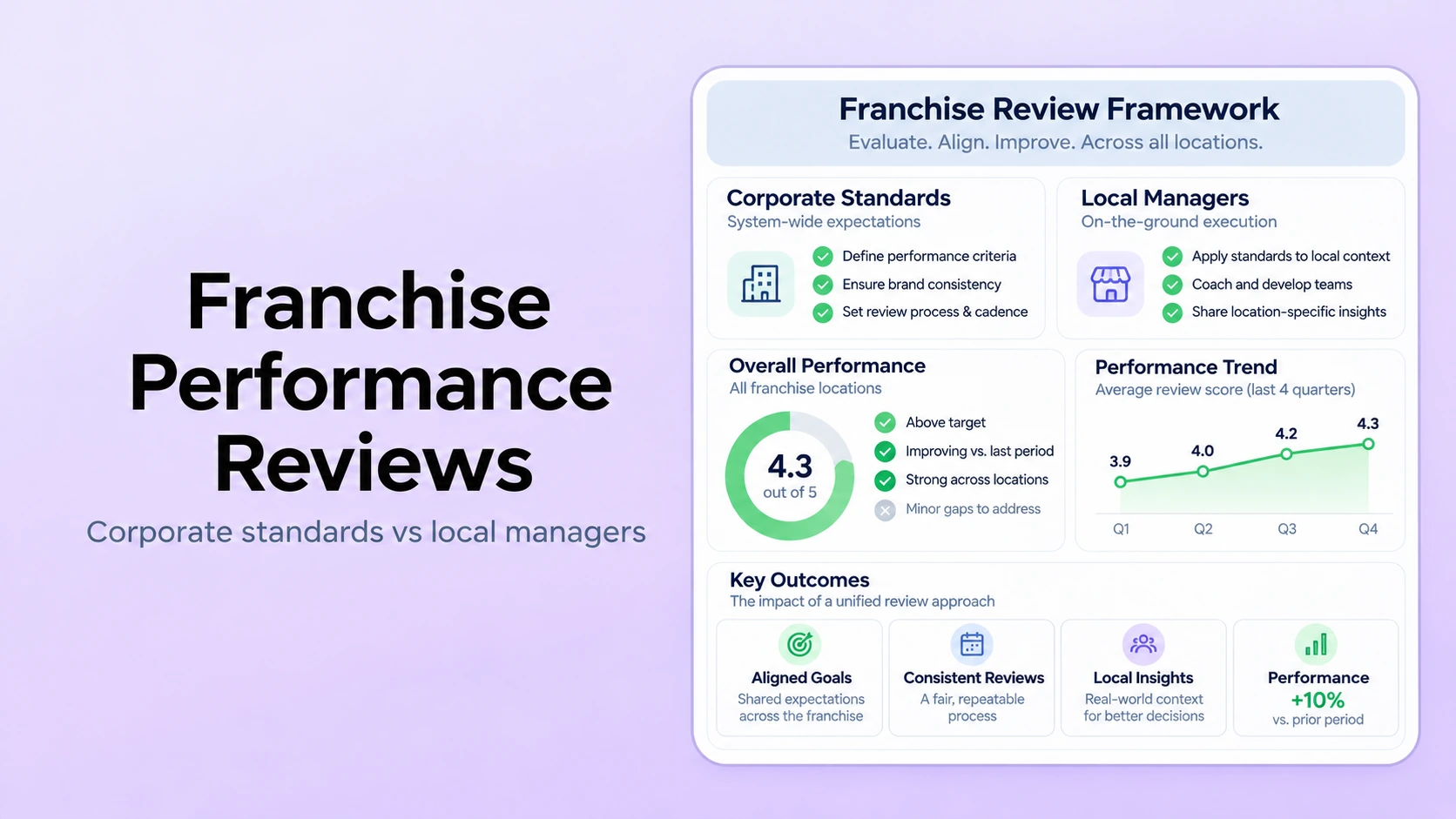
The detailed requirements in this article are about cross-store comparison. If your immediate problem is collecting store manager reviews, district ownership and workflows in the first place, begin with our store manager review vendor checklist. If the stores have different employers or franchises, first confirm the legal and contractual access limits described in franchise performance review governance before creating a shared calibration panel.
Where PerformSpark fits in a retail district calibration evaluation
PerformSpark provides product information about calibration, performance reviews, goal management, check-ins and 1-on-1s, individual development plans and reporting and analytics. Those are relevant capabilities to investigate. Their product pages do not, on their own, establish support for every district-specific report, automated comparator rule, approval exception or detailed rating-history export described in these buyer scenarios.
Bring the four-store Ridgeway scenario, proposed rating evidence and the twelve acceptance tests to a demonstration. Ask which steps can be completed in today's product, which need configuration, which depend on external systems and which are unsupported. An accurate answer is more useful than a promise that software can make every rating objectively fair.
Final recommendation: make the reason behind each rating visible
For retail district manager calibration, consistent criteria and accountable decisions matter more than uniform score distributions. HR should be able to explain why a manager received a rating, what evidence supported it, how different store conditions were considered and who approved a change. Employees should have a meaningful way to understand and, under policy, respond to the result.
Use the twelve vendor tests to verify cross-store comparison, source integrity, access control, approvals and reconcilable reporting. Then apply the chosen process consistently, review it after each cycle and coach district leaders on evidence quality rather than rewarding only neatly aligned charts.
Retail District and Regional HR Teams
Evaluate fair calibration across your stores
Explore calibration, performance reviews and reporting with PerformSpark. Bring the twelve retail district demo tests to verify evidence, permissions, adjustments and reports.
Book a PerformSpark Demo →Bring your four-store calibration demo scenario