

.svg)





.webp)
Table of Contents

Quick Takeaways: Performance Calibration Best Practices
- Define rating standards and evidence expectations before managers draft reviews.
- Use distributions and outlier flags to identify questions, not to change ratings automatically.
- Prioritize cases requiring judgment and ask role-related evidence questions.
- Document approved decisions during the session and review the reasons behind process metrics after the cycle.
Performance calibration works best when the organization defines the standards, prepares the evidence, and clarifies decision rights before managers enter the meeting. The session should test whether comparable performance is being assessed under comparable expectations, without forcing a distribution.
This guide focuses on the operating practices for preparing, facilitating, documenting, and reviewing calibration sessions. For broader governance, compensation boundaries, and strategy, use the performance calibration strategy guide.
What Is Performance Calibration?
Performance calibration software can support structured discussions in which managers and HR compare proposed ratings, evidence, role context, and rating standards across a defined employee group before results are finalized.
The purpose is to:
- Clarify how rating definitions are being applied
- Identify unsupported or inconsistent assessments
- Review uncertain and high-impact cases
- Document approved changes
- Prepare managers to communicate final reviews
Calibration is not forced ranking. Managers should not move employees merely to produce a preferred curve or equal distribution.
10 Performance Calibration Best Practices
1. Define the rating standard before the review cycle
Managers need clear rating definitions and examples before they draft reviews. Each level should describe the expected results and behaviors, including what distinguishes adjacent ratings.
Use the performance review rating scale guide to define labels, behavioral anchors, evidence expectations, and how the scale connects to the overall assessment.
Do not use calibration to introduce a standard that managers and employees did not know during the performance period.
2. Complete manager drafts before calibration
Managers should enter calibration with proposed ratings, narratives, and supporting evidence. Incomplete reviews turn the meeting into a writing session and make it difficult to compare assessments.
Before the meeting, check:
- Required reviews are complete
- Ratings and narratives align
- Important claims have evidence
- Goal changes and role context are documented
- Employee self-assessments have been considered
- Required feedback is available
3. Prepare a focused pre-session view
A useful pre-session view may include:
- Employee, role, level, manager, and team
- Proposed overall and category ratings
- Goal outcomes
- Manager narrative
- Relevant feedback
- Rating distribution by manager or group
- Cases with missing or conflicting information
- Prior-cycle information where it is relevant and appropriate
Reporting and analytics can organize these data, but a distribution or outlier flag is a question for review, not proof that a rating is wrong.
4. Select the right participants
Include people who understand the work or have a legitimate decision role. A typical session may involve:
- Managers whose ratings are being reviewed
- An HR facilitator or process owner
- A business leader with defined decision authority
- A note-taker or system administrator where required
Limit access to people who need the information. Do not invite observers merely for development when the session includes sensitive employee records.
5. Clarify decision rights
Before the meeting, document:
- Who facilitates
- Who presents each case
- Who can approve a rating change
- How unresolved cases are handled
- Who records the decision
- When the final review is updated
A senior title should not replace the rating standard or evidence. When participants disagree, the decision owner should explain which information and standard support the final outcome.
6. Prioritize cases that require judgment
Do not spend equal time on every employee. Focus discussion on cases such as:
- Ratings near the boundary between two levels
- A rating that does not align with the written narrative
- Incomplete or contradictory evidence
- Unusual distributions requiring context
- Large proposed changes from prior evidence
- High-impact decisions requiring additional review
A case can be statistically unusual and still correct. Review the role, goals, team context, and evidence before concluding that a change is needed.
7. Ask evidence questions instead of challenging the manager personally
Facilitators should move discussion from confidence or hierarchy to the work record.
Useful questions include:
- Which role expectation does this rating reflect?
- What evidence from the review period supports the assessment?
- Is this a repeated pattern or one event?
- How were changes to goals or scope considered?
- What distinguishes this case from the adjacent rating level?
- Would the same evidence receive the same rating in a comparable role?
Avoid opening with “Are you sure?” or assuming a manager's distribution proves leniency or severity. The goal is to examine the reasoning.
8. Separate performance from potential and compensation
Current performance, future potential, and compensation are related but different judgments. Calibration should establish the performance assessment before the organization uses it in broader talent or pay processes.
Do not change an employee's performance rating solely to reach a compensation budget. Do not use a development need as proof that current performance is below expectations.
If the organization uses a 9-box or succession process, define potential separately and review the evidence and opportunity context supporting it.
9. Document decisions during the session
For an approved rating change, record:
- The original rating
- The final rating
- The rating definition applied
- The evidence considered
- The reason for the change
- The decision owner
- Required changes to the narrative or follow-up
Update the employee's performance review record through the approved workflow. Do not rely on a separate email or spreadsheet that can conflict with the final assessment.
10. Review the process after the cycle
After reviews are delivered, evaluate:
- Whether prework was complete
- Which cases required the most discussion
- Why ratings changed
- Whether managers understood the standard
- Whether final narratives aligned with ratings
- Employee and manager questions
- Whether decisions were updated correctly
- Which training or process changes are needed
A high or low rating-change rate does not have one universal meaning. Review the reasons. Many changes may indicate useful challenge or unclear standards. Few changes may indicate strong preparation or a superficial session.
How to Build a Calibration Agenda
A practical agenda can include:
- Purpose, confidentiality, and decision rules
- Rating-scale reminder
- Overall distribution and data-quality questions
- Priority cases by team or category
- Unresolved decisions and owners
- Documentation and next steps
- Manager communication preparation
Sequence related cases together when it helps participants compare standards. Avoid switching repeatedly between unrelated role levels or rating definitions.
How to Facilitate Difficult Calibration Discussions
When a manager becomes defensive
Acknowledge the context and return to the evidence: “Let's review the examples and the rating definition so the group can understand the proposed assessment.”
When a leader gives a conclusion without evidence
Ask which role expectation, outcome, or behavior supports the conclusion. Apply the same evidence requirement regardless of seniority.
When the group cannot resolve the case
Identify the missing information, assign an owner, set a decision date, and remove the case from the main discussion. Do not fill the gap with assumptions.
When demographic or protected information enters the discussion
Pause and involve HR. Participants should focus on job-related evidence and follow applicable policy and review requirements. Calibration software does not determine whether treatment is lawful or appropriate.
How Analytics and AI Can Support Calibration
Analytics or AI may help organize ratings, identify missing information, summarize authorized evidence, and surface distribution patterns. Users should be able to inspect the underlying records and understand how a prompt or flag was produced.
These tools should not independently:
- Change a rating
- Determine that a manager is biased
- Force a distribution
- Decide compensation
- Assign an employee to a talent category
The AI performance review software guide provides a complete evaluation checklist for data, permissions, transparency, and human oversight.
Post-Calibration Manager Preparation
Before managers meet employees:
- Confirm the final rating and narrative
- Review the evidence and rating definition
- Prepare a clear explanation of the assessment
- Confirm development or follow-up actions
- Know how employee questions or comments will be recorded
- Escalate sensitive cases to HR
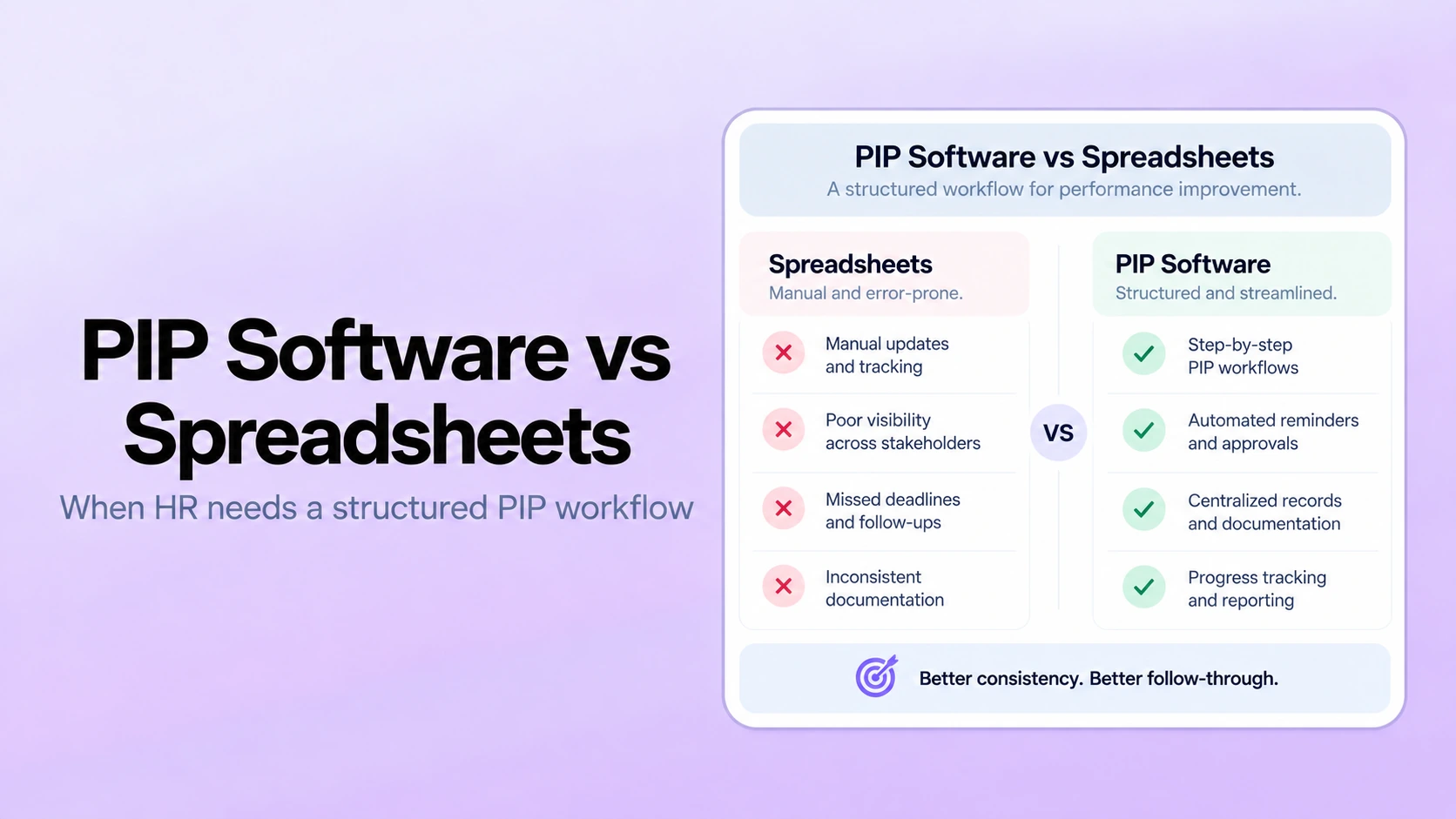
Managers should explain the final assessment without sharing another employee's rating or confidential discussion. If the review identifies a development priority, connect it to an individual development plan. If essential expectations are not being met and formal intervention is appropriate, use the approved PIP workflow.
Calibration Documentation Checklist
- The final rating is recorded in the approved system.
- The narrative supports the final rating.
- Approved changes include a reason.
- Missing evidence and follow-up owners are documented.
- Access to notes is appropriately limited.
- Employee review delivery occurs after calibration.
- Development and manager-support actions are assigned.
- Process lessons are captured for the next cycle.
Common Calibration Mistakes
- Introducing rating definitions during the meeting
- Allowing incomplete reviews into the session
- Treating an outlier as proof of a wrong rating
- Discussing every employee for the same amount of time
- Letting hierarchy outweigh evidence
- Combining performance, potential, and pay into one unclear decision
- Forcing a curve
- Changing ratings without updating narratives
- Communicating ratings before calibration is complete
- Treating AI output as the final decision
Run Calibration From a Connected Performance Record
PerformSpark connects reviews, goals, check-ins, feedback, calibration, development plans, approved changes, and reporting. Smart notifications can support preparation and follow-up without replacing manager accountability.
Explore PerformSpark pricing or book a personalized demo to see how HR can prepare evidence, manage decisions, and update final ratings in one workflow.




.svg)

.svg)
.svg)

