






Table of Contents

Key Takeaways:
- Use client feedback as relevant, firsthand evidence rather than an automatic final consultant performance rating.
- Separate client authorization, employee transparency and the applicable legal basis for processing feedback.
- Restrict external respondents to approved questions, records and access; do not invite unnecessary client-sensitive information.
- Test twelve vendor workflows for invitations, disclosures, correction, employee responses, approval and reporting.
- Require an authorized people manager to reconcile client input and document the final review decision.
Client feedback can inform a consultant's performance review when the client is authorized to provide it, the questions concern work the client actually observed, and the consultant's employer controls how that evidence is assessed. It should not automatically become the consultant's final rating. Before inviting a client to comment, HR needs to check the engagement agreement, the purpose and legal basis for processing personal information where applicable, confidentiality boundaries, and the employee's opportunity to respond.
A client sponsor may know whether a consultant communicated clearly during workshops but not why a delivery milestone moved, how the consultant collaborated with internal specialists, or which decisions the client organization controlled. That makes client feedback a useful but limited perspective. A vendor demonstration should prove that the client can submit the appropriate information without seeing HR files, and that an authorized people manager can reconcile it with other evidence.
This guide gives HR leaders in consulting, professional services, agencies and project-based businesses 12 software buying tests, a sample client-feedback request, an illustrative engagement scenario, and a decision framework for consent, evidence, and software fit. The focus here is external-client input. For internal reporting-line ownership, use our two-supervisor review workflow; for project timing and demobilization, see project-closeout employee reviews.
Should client feedback count toward a consultant's performance review?
Yes, as relevant supporting evidence, if the organization has an appropriate policy and data-handling process. A client can comment on directly experienced interactions such as preparedness, communication, follow-through and collaboration. The employer's designated reviewer still needs to consider assignment scope, documented objectives, limitations of the client's perspective, internal contributions, and the employee's response. Not every client will have sufficient exposure or permission to evaluate an individual consultant.
Use structured performance reviews for the final employee evaluation and feedback and surveys for appropriate collection of observations. Keep the two records distinct when needed: the source may describe a particular client interaction, while the manager evaluates the full role over an agreed period.
The EEOC's guidance on conducting performance evaluations recommends consistent standards and relevant facts. A negative client comment should therefore prompt review of the specific circumstances rather than an automatic rating reduction. The same principle applies to enthusiastic client praise: one successful presentation is useful evidence, not necessarily proof of superior performance for an entire cycle.
Permission, consent, and a lawful basis are three different questions
1. Is the client permitted to share the feedback?
Check the contract, engagement scope, applicable nondisclosure agreements, and the client's own authorization. A client sponsor might be approved to assess collaboration but prohibited from sharing confidential customer information, internal negotiations, personal details or proprietary workpapers. Do not assume that sending a survey link constitutes permission to extract material from a client's systems. Define an authorized contact and ask for observations about the consultant's work, not access to sensitive engagement files.
2. Has the employee been informed about how client input will be used?
Explain the purpose, typical recipients, confidentiality limits, retention approach, and whether the feedback contributes to development only or to a formal review. The UK Information Commissioner's Office guidance on employment records emphasizes lawful, fair, and transparent processing in the UK GDPR context. A U.S. employer must separately determine which state, federal, contractual, or other obligations apply. This is a policy and counsel question, not a universal requirement to collect a signature for every client comment.
3. Is consent actually the right legal basis?
Do not automatically equate permission to request feedback with employee consent to process it. Under UK GDPR, consent may be unsuitable when the employer-employee relationship creates a power imbalance. The ICO explains that organizations may need to consider another lawful basis, and that genuine consent must be freely given and withdrawable. The ICO's worker-data guidance discusses those limitations. The precise basis depends on jurisdiction, purpose and facts. Have privacy and legal teams approve the approach before deployment.
For a practical review design, distinguish client permission, employee transparency and applicable rights, and the employer's lawful processing and retention basis. A software vendor should demonstrate how the approved choices are recorded, not offer generic “GDPR compliant” assurances as proof.
What evidence can a client reasonably provide?
Ask about directly observed work and the circumstances of that work. Useful prompts include: “What did the consultant do during the agreed workshop?”, “How clearly were decisions and follow-up actions communicated?”, and “What is one specific collaboration behavior you would encourage them to continue or change?” A client may be able to assess the quality of a deliverable they reviewed, but might not know the original scope, staffing limits, or dependencies behind a delay.
A simple evidence record can contain engagement identifier, observation period, authorized respondent role, applicable question, specific observed behavior, date or context, and any clarification or correction. Keep a distinction between source statements and the internal manager's conclusion. If a comment includes confidential names or client data, follow the approved redaction and deletion process before it enters the personnel review.
Use the role-based appraisal criteria guide to connect work observations with communicated expectations. Goals can supply the consultant's assigned commitments, and manager check-ins can document how those commitments evolved. The client need not see the employee's full performance file for their feedback to be useful.
12 software demo tests for client feedback in consultant reviews
1. Restrict requests to an approved client respondent
Demo: create a fictitious client contact authorized to comment on consultant C-512's engagement, plus an unrelated client contact. Invite only the approved respondent, then try opening the request from the other account. Pass: the recipient and purpose are controlled, access can be revoked, and the unrelated contact cannot view or submit feedback. Buyer question: what safeguards prevent forwarding a generic survey link to someone without permission?
2. Record the purpose, notice and required approvals
Show how the employer documents the purpose of client feedback, internal approval to request it, and any notice or permitted processing choices required by policy. Test a request that must be canceled because permission was not confirmed. Pass: HR can identify the approved use and stop an unauthorized invitation before collection. Do not assume a checkbox alone establishes legal consent or fulfills an engagement agreement.
3. Limit the questions to firsthand, role-relevant observations
Ask the client to evaluate a documented stakeholder workshop and related deliverables, not the employee's salary, medical circumstances or unobserved internal conduct. Pass: the vendor can show a question set scoped to the client's actual interactions and, where relevant, a “not observed” option. Fail: the client must assign an overall employment rating despite lacking the necessary context. Compare question design with 360-degree feedback without treating one client's comments as a complete 360 assessment.
4. Preserve source identity and engagement dates appropriately
Enter an illustrative comment on a March engagement, then change the client's designated representative in April. Can the authorized internal reviewer tell when the original input was given and who was approved to provide it, subject to the agreed confidentiality model? Pass: engagement dates, source role and historical context remain traceable without exposing more identity details than permitted.
5. Prevent client access to confidential personnel records
Sign in or open the review as an external respondent. Attempt to see manager ratings, HR notes, other consultants' reviews, employee compensation information and internal development plans. Pass: the client can access only the approved questionnaire and any necessary neutral context. Test separate internal and external roles against confidential review permissions tests and security information.
6. Detect and remove unnecessary client-sensitive information
Insert a fictional comment containing a confidential client project code and an unrelated customer's name. Ask the system owner to follow the approved correction or redaction process and inspect any exports, email notices or retained history. Pass: unnecessary data is not widely redistributed, and the employer can explain retention and correction behavior. The FTC's business data-protection guidance recommends limiting sensitive data collection, retention and access to what is needed for legitimate purposes.
7. Keep client input separate from the final performance decision
Enter positive client feedback about a presentation and a separate internal observation about late documentation. Ask the designated people manager to review both and form a reasoned conclusion. Pass: an appropriate manager owns final signoff and the client comment does not silently change the overall rating. Use the controls described in review approval workflows.
8. Support conflicting feedback and an employee response
Have the client allege that an agreed report was late. Give C-512 a dated record that the client had approved a revised deadline. Ask HR to examine the source comment, approve any correction, and preserve the employee's response. Pass: original evidence, relevant correction and final reasoning are attributable. The EEOC's guidance on evaluation complaints supports prompt and impartial investigation when discrimination concerns arise.
9. Handle anonymous, named and limited-disclosure input honestly
Ask whether the program promises named attribution, confidential collection or anonymity, and what actually appears in the employee's and manager's reports. A single external client stakeholder may be identifiable even if their name is hidden. Pass: the company can accurately explain the disclosure model and demonstrate it with the intended accounts. Fail: the interface promises anonymity while giving enough detail to identify the only client reviewer.
10. Handle a client departure, refusal or withdrawn invitation
Before a project closes, the approved client respondent leaves their company or declines to participate. Test cancellation, expiry, permission changes and selection of a replacement with appropriate authority. Pass: unanswered invitations and withdrawn requests are clearly tracked; no one is pressured to manufacture a response and the consultant is not automatically penalized for a client's nonparticipation.
11. Route useful development actions into the next assignment
Close the engagement after feedback about clearer decision logs. Have the authorized manager agree on a practical improvement with the consultant, then transfer the consultant to another project. Pass: the next authorized manager can follow the approved development plan without gaining unnecessary access to the client's full response or contract documents. Check closeout review timing separately from ordinary yearly evaluation.
12. Reconcile feedback participation and official review completion
Create five consultants, two client feedback requests for one employee, one canceled client invitation and one incomplete annual review. Ask the vendor to export invited, authorized, responded, canceled and incorporated records separately from completed employee evaluations. Pass: the report does not double-count a consultant or treat a missing client response as a completed review. Validate using reporting and analytics and our reporting demo tests.
Illustrative client-feedback example: a consultant and a disputed deadline
Hypothetical case: C-512 is a consultant supporting the Eastbridge operations transformation. A client sponsor attended six workshops and reviewed the final handoff. The sponsor praises C-512's facilitation but says the draft implementation report arrived two days late. The internal engagement lead says the client had requested additional validation and approved a new due date.
HR first confirms whether the sponsor is an authorized respondent and which information the client may share. The client is asked for specific observations, without access to the consultant's personnel notes. The engagement lead supplies the scope-change record, while C-512 can provide a factual response under policy. The primary people manager evaluates workshop facilitation and deadline management against the expectations that were communicated at the time.
The final review may reasonably recognize strong client facilitation and recommend clearer written communication about changed milestones. It should not automatically record a missed deadline simply because the initial contract schedule differed from the approved revised date. All names and details here are invented for buyer testing and do not describe a PerformSpark customer.
Client-feedback request template: what should the form ask?
A short form is usually more useful than a broad invitation to rate the consultant's entire career. Use wording such as: “Please comment only on work you personally observed during this engagement. Do not include confidential client data or private information about other individuals.” Identify the consultant, engagement period and purpose in an approved manner, and explain how responses will be handled.
- Work observed: Which meeting, deliverable or interaction are you commenting on?
- Communication: What did the consultant do that made collaboration easier or harder?
- Execution: Which agreed commitments did the consultant meet, and what evidence supports the observation?
- Development: What is one specific behavior to continue or improve?
- Not observed: Which subjects should you decline to assess because you lacked direct exposure?
Before deployment, the employer should approve the survey purpose, any client-facing notices, recipient authorization, accessibility needs, response disclosures and retention policy. Feedback and surveys is a relevant product area to explore, but the exact external-client form and permission settings must be shown in the proposed PerformSpark environment.
Client Feedback in Consultant Reviews
Test client feedback without compromising review integrity
Bring a synthetic client invitation, confidentiality restrictions and an employee response scenario. Ask PerformSpark to demonstrate the workflow and identify any gaps.
How to score vendors on consent, evidence and software fit
Start with hard gates: confirmed client authorization and appropriate legal review of processing, no unauthorized disclosure of employee or client information, source-attributed evidence, an employee response route, and a designated final employment reviewer. Do not compensate for a privacy or authority failure by adding points for attractive dashboards.
For the remaining tests, record Demonstrated, Conditional or Not demonstrated. Conditional means the vendor showed a documented manual step, supported integration or configuration dependency that needs further approval. Note the account used, the precise task, data exchanged, the export result and any contract or implementation dependency. This is a suggested buyer scoring method, not a formal legal compliance certification.
For companies with clients in more than one jurisdiction, ask counsel and privacy leaders to check applicable employee privacy, data transfer and contract requirements. A legal basis is not the same thing as a software checkbox. The vendor can show record handling and permissions, but the employer remains responsible for deciding whether and how to use the information.
Eight RFP questions to ask before inviting client feedback
- Can the employer control which external client contacts receive feedback invitations and revoke access?
- What client permission, contract restrictions, employee notices and internal approvals can be documented?
- How do external forms restrict questions to work the client actually observed?
- Can client respondents submit input without viewing internal HR or other employee records?
- Can sensitive content be corrected, redacted, deleted or restricted according to the employer's policy?
- How are named, confidential and potentially identifiable client responses presented to managers and employees?
- Does a designated manager retain final approval after client feedback and an employee response?
- Can reports reconcile invitations, responses, engagement periods and finalized employee reviews without duplicates?
Add these questions to your performance software RFP checklist and, when appropriate, a controlled pilot plan. Keep the RFP focused on observed capabilities and actual client agreements rather than relying on an advertised external feedback feature.
Where PerformSpark fits in the evaluation
PerformSpark presents performance reviews, feedback and surveys, 360-degree feedback, check-ins, development planning, and calibration as relevant parts of performance management. These product areas make the platform worth evaluating for a consulting workforce. They do not establish that external clients can sign in, consent records are automatically maintained, redaction is supported, or particular contract or data-protection obligations are satisfied without configuration.
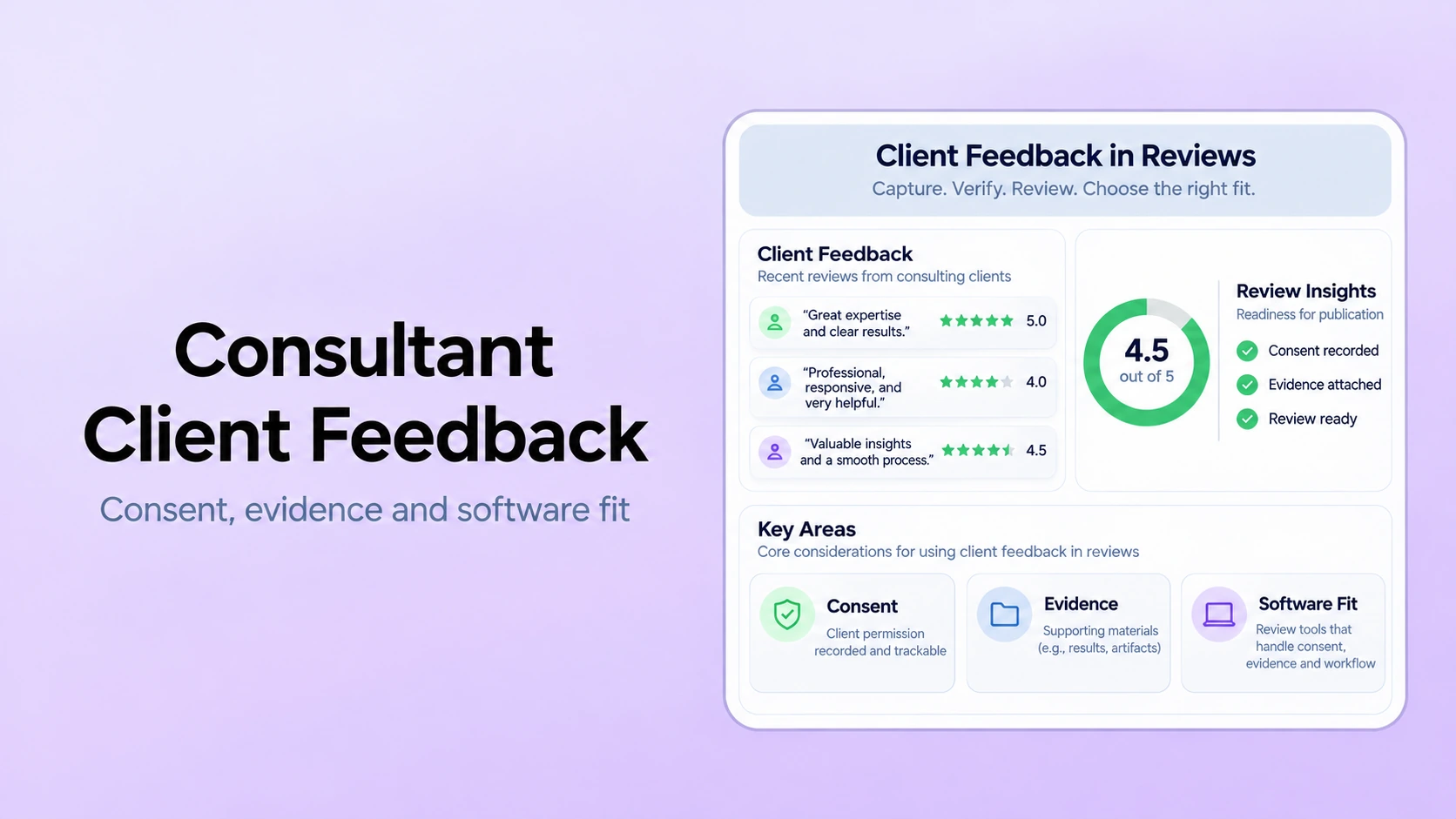
Bring the C-512 scenario to a demonstration and ask which features can be shown today using limited external access, an authorized people manager and an HR administrator. Distinguish demonstrated workflow, approved manual procedure, integration dependency and unsupported feature. The illustrations in the thumbnail are mock data, not client results or a verified rating calculation.
Final recommendation: capture useful client observations without giving them the final say
Strong client feedback is specific about what the respondent saw, collected and processed under an approved purpose, limited to authorized recipients, and interpreted alongside the consultant's other evidence. A reliable review process lets the employee address factual disputes and keeps final employment decisions with the employer's designated manager.
Use the twelve demonstrations to evaluate privacy, authorization, relevance, correction and reporting before introducing client feedback into employee reviews. Consult HR leadership and qualified legal or privacy advisers for consequential employment and cross-border data decisions. This article is educational, not legal advice.
Consulting and Project-Based HR Teams
Evaluate external client feedback in performance reviews
Explore feedback collection, manager reviews and reporting with PerformSpark. Bring your twelve client-feedback software tests and ask what the current product can actually demonstrate.
Book a PerformSpark Demo →Bring your client permission and evidence test case