






Table of Contents

Key Takeaways:
- Define a single authorized final reviewer while gathering relevant firsthand input from dotted-line and project managers.
- Use separate roles, dates and evaluation criteria so contributors cannot silently edit one another's observations.
- Resolve conflicting manager input using evidence and employee context rather than an unexplained numerical average.
- Test twelve software scenarios covering reassignment, confidentiality, employee responses, approvals and completion reporting.
- Keep development ownership clear when projects end, and verify current vendor functionality instead of accepting feature claims.
In a dotted-line performance review, the primary or solid-line manager should ordinarily own the final employee evaluation under company policy, while the dotted-line or project manager contributes specific, firsthand evidence from the work they supervised. The arrangement is not a universal hierarchy rule. It is a practical starting point for matrix organizations in which an employee supports a project, client, function, or department without changing their formal reporting relationship.
The most important buying question is not whether software can display two manager names. It is whether each person can contribute within their authority, the employee understands who evaluates them, differences in feedback are resolved fairly, and HR can reconstruct one authorized decision. When the two supervisors use different goals or rating scales, averaging their scores may create false precision rather than fairness.
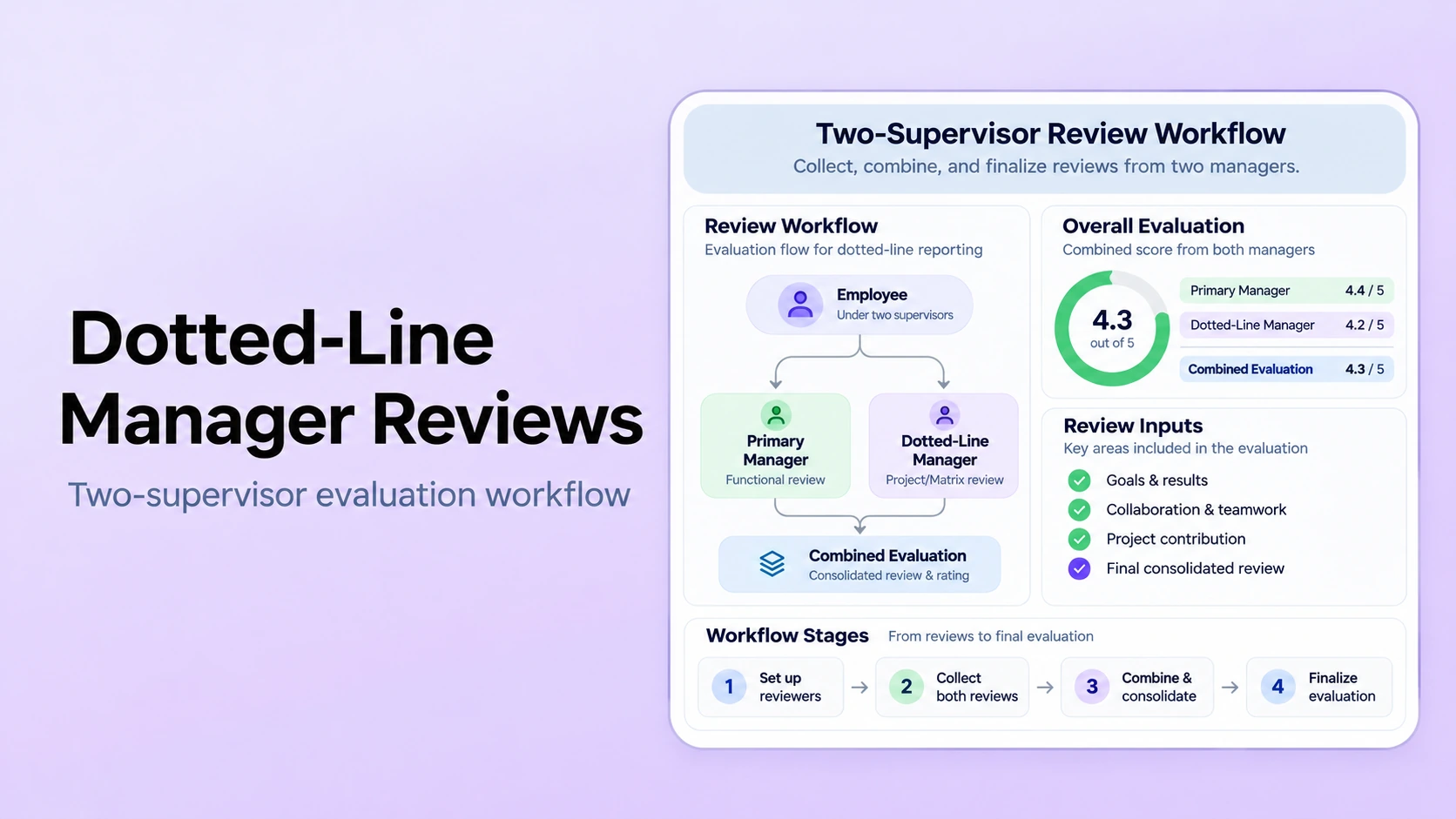
This article gives HR teams an illustrated two-supervisor responsibility framework, a six-step workflow, an original synthetic consulting-project example, and 12 vendor demonstration tests. It focuses on matrix reporting and review ownership. For construction-specific job titles, use project manager versus site supervisor review responsibilities; for review timing after a project ends, see the project-closeout employee review guide.
What is a dotted-line manager review?
A dotted-line manager review gathers performance input from someone who directs or observes part of an employee's work but is not necessarily the employee's formal people manager. The solid-line manager often remains accountable for the overall performance review, career conversations and formal approval. The dotted-line manager may observe project delivery, collaboration, technical execution or client handoffs that the primary manager does not see firsthand.
That division should be defined by the employer, not inferred from an organizational chart. The Project Management Institute's matrix-organization analysis describes the potential tension between functional authority and project responsibility and the value of explicitly allocating responsibilities. PMI's discussion of project HR responsibilities also notes that project managers sometimes provide evaluation input to the functional manager, while in other structures they conduct the appraisal themselves.
For a vendor comparison, use the performance review workflow to test whether the reporting model is represented accurately. A system that treats both supervisors as full owners may generate duplicate reviews, conflicting reminders or inappropriate personnel access. A system that allows only one contributor may discard the most relevant project evidence.
Define the primary manager, dotted-line contributor, HR approver, and employee
Primary or solid-line manager: owns the final review when designated by company policy, confirms role expectations, reconciles evidence and conducts the formal conversation. This person should not claim to have observed work they did not see. The company's manager workflow should reflect the exact authority and next action.
Dotted-line or project manager: contributes dated observations about assigned deliverables, coordination, feedback and responsibilities they supervised. Their input can be substantive without granting them the right to finalize an employment evaluation or access all private HR notes.
HR or a second-level approver: monitors process consistency, missing input, exceptions, reporting and any required approval. HR may investigate disputes under policy, but should not replace the actual observer's account with a fabricated narrative.
Employee: knows which goals matter, who is providing input, how the overall rating will be decided and how they may respond to material feedback. The employee-facing review experience needs an appropriate visibility and acknowledgement route. The exact permissions, routing and dispute options are vendor demonstration requirements, not confirmed PerformSpark configurations.
Four matrix-reporting cases that need different review rules
- Consultant with a home department and client project: a functional manager sets career and professional standards, while a project lead supplies evidence about the engagement's assigned work. Client comments should be assessed for relevance and permission before inclusion.
- Engineer supporting two product teams: one people manager owns the annual evaluation; two delivery leads can submit role-relevant evidence for their respective assignment periods. A team lead with only a short assignment should not evaluate the entire year.
- Marketing specialist on a cross-functional launch: the marketing manager reviews professional development and role expectations, while the launch owner contributes dated collaboration examples. A missed launch deadline is not automatically attributable to one person.
- Temporary acting manager during leave: HR should define whether the acting manager provides evidence, temporarily owns review tasks or has formal approval authority. Permission changes must have effective dates and preserve previous authorship.
These are illustrative policy-design cases, not legal classifications or descriptions of software defaults. Where an employee changes projects mid-cycle, the employer may need a separate multi-location or multi-assignment record strategy in addition to the two-manager workflow.
Six steps for one accountable two-supervisor evaluation
Step 1. Assign the final owner before requesting ratings
Define the accountable reviewer, other contributors, cycle dates, approval route and the employee's current reporting relationships. The company may permit the project manager to finalize some reviews in a strong-matrix arrangement, but that must be an intentional policy decision. In the software, demonstrate the configured review ownership and approval path rather than assuming the most recent manager is automatically correct.
Step 2. Match each contributor to observable criteria
Identify which manager can evaluate technical judgment, project coordination, communication, coaching or professional development. Use agreed role-specific performance criteria so a project deadline is not confused with a competency rating. The formal manager should have access to relevant source evidence but not to every unrelated project file.
Step 3. Request separately attributable observations
Ask each manager to record the dates and situations they directly observed, the employee's responsibility and what resulted. Ongoing check-ins and 1-on-1s can reduce end-of-cycle memory gaps, while structured feedback collection may capture additional perspectives. Preserve author, date and context instead of merging two narratives into a single unattributed paragraph.
Step 4. Reconcile conflicting evidence before selecting a rating
Check the relevant assignments, constraints, different goals and length of each manager's exposure. If one contributor reports strong collaboration and another reports a missed handoff, both may be correct. The final reviewer should examine the facts and write a conclusion that explains the differences. The process should not force a simplistic 50/50 average unless a documented, job-relevant methodology genuinely supports that calculation.
Step 5. Invite an employee response and obtain approval
Explain the proposed evaluation, give the employee the response route defined by company policy and secure any required second-level approval. EEOC evaluation guidance emphasizes communicating standards, applying them consistently and supporting conclusions with relevant facts. Sensitive concerns need the employer's separate HR process, not a hidden manager-to-manager chat that the employee cannot challenge.
Step 6. Finalize once and assign the right next steps
Complete one official review and distinguish it from the contributing project feedback records. Give the authorized manager ownership of an appropriate individual development plan or goal follow-up. When the project ends, keep the historical input but update responsibility for future coaching. Reports should count one employee and one completed official evaluation, not two simply because two supervisors contributed.
Example: two supervisors see different sides of a consultant's work
Illustrative scenario, not a customer case: employee C-410 is a business analyst in the Operations Practice at a consulting firm. Priya is C-410's formal people manager. Daniel manages the client implementation project for four months. The analyst delivered clear process maps and strong stakeholder workshops but submitted one requested status update after the project's agreed deadline. Priya saw evidence of professional growth over the year; Daniel saw the missed project handoff.
Daniel's project input states the specific deliverable, agreed deadline and observable impact, including whether the analyst had the information necessary to submit it. Priya assesses that input alongside C-410's other work, the professional expectations in effect and the analyst's response. The final review might recognize strong workshop facilitation while identifying earlier escalation of blocked status reports as a development objective. It should not turn a whole project's success or delay into the analyst's personal score.
Now change the scenario: Daniel leaves the firm two days before the evaluation closes. A suitable review workflow retains his dated contribution and routes any outstanding task according to policy without making his successor the author of the original comments. The approved next action belongs to Priya or a formally designated alternate, not whichever manager is listed last on the project roster.
12 software demo tests for dotted-line manager reviews
1. Set up one employee with two supervisor relationships
Ask the vendor: create C-410 with Priya as the formal manager and Daniel as the project contributor. Show the role and effective date of each relationship. Pass: the system represents both accurately without creating duplicate employee profiles or granting both full personnel authority.
2. Separate contributor comments from final reviewer permissions
Have Daniel submit a dated project observation while Priya owns the official evaluation. Attempt final signoff from Daniel's account. Pass: the assigned owner can finalize while a contribution-only manager cannot bypass approval. Test the exact confidential review permissions in the proposed configuration.
3. Ask different questions of the two managers
Give the project manager questions about delivery handoffs and stakeholder communication, while the formal manager assesses broader role expectations and professional development. Pass: the application can show the right criteria to the right contributor without misleading them that they observed every dimension. Request a “not observed” option where appropriate.
4. Maintain original evidence and author attribution
Enter two conflicting observations and ask Priya to document an evidence-based resolution. Attempt to overwrite Daniel's submitted note from another account. Pass: original sources remain attributable and the reason for any correction or final decision can be reconstructed. A merged narrative with no author trail fails.
5. Resolve contradictory manager ratings without averaging blindly
Give Daniel a strong collaboration rating and Priya a more cautious score for consistent task completion. Ask the software to show what formula, decision authority or manual reasoning determines the final assessment. Pass: HR understands the method and the authorized reviewer can document the rationale. Fail: the product silently applies an unexplained average.
6. Preserve the review when a project manager changes
Replace Daniel with an acting project lead after his evidence is submitted. Check pending approvals, source dates, reminders and the new account's visibility. Pass: historic comments retain the original author, unauthorized access is removed when appropriate and outstanding work routes to an authorized person.
7. Test overlapping projects with one formal manager
Assign C-410 to a second project for part of the same cycle, with another delivery leader supplying separate input. Pass: each project's contribution retains its assignment dates and the official review owner remains unambiguous. Check whether overlapping review cycles create redundant tasks or conflicting end states.
8. Give the employee an appropriate response path
Have C-410 dispute a factual statement about the late status report and attach a timeline or written explanation. Pass: the employee can use the defined response process, appropriate managers see the information and the original record is not quietly erased. Ask how the process deals with serious complaints separately from routine calibration.
9. Check privacy for project managers, clients and HR
Attempt to read an unrelated salary discussion, confidential HR note or other project employee's appraisal from the contributor account. Pass: restricted information stays restricted while the user can access approved work-related feedback. Test the documented controls alongside the security overview and your company's privacy rules.
10. Route reminders to the person who actually owes the next action
Leave one project contribution unfinished while Priya is ready to approve. Simulate Daniel becoming inactive or changing assignments. Pass: notifications do not repeatedly prompt the wrong owner, and HR can see precisely why a review is waiting.
11. Carry coaching actions forward without confusing ownership
Finalize C-410's review, document a communication goal and end the client project. Pass: Priya or an approved manager owns the ongoing development action, while the historical project input stays available under appropriate permissions. No finished project deliverable should automatically remain an overdue employee goal.
12. Reconcile reviewer input and official completion reporting
Give five synthetic employees varying numbers of project contributors and one incomplete official review. Export employee IDs, contributor statuses, final owner, approval date and completed review counts. Pass: reporting reconciliation checks show five people, multiple legitimate input records and only the correct number of completed official evaluations.
Score these as demonstrated, conditional or not demonstrated. Record the user roles, test data, version or package, configuration dependencies and unresolved exceptions. The twelve items are proposed buyer acceptance tests, not published evidence that PerformSpark has passed every one.
Dotted-Line Performance Reviews
See how two managers contribute to one review
Bring your solid-line and project-manager roles, two conflicting observations and an approval scenario. Ask which workflow steps the current PerformSpark product can demonstrate.
Where two-supervisor reviews commonly go wrong
Both managers think they own the final rating
Separate the authority to contribute evidence from the authority to approve an employment evaluation. Document who owns the result before collecting inputs. Relying on job title, project seniority or the most recently edited manager field may create duplicate evaluations.
A percentage weight replaces human judgment
A preset formula such as 60% formal manager and 40% project manager may appear objective, but it can exaggerate the reliability of thin or incomparable evidence. If an employer uses weighting, make the basis explicit, test it on real role expectations and allow appropriate investigation of exceptions. Not every dotted-line arrangement needs numerical weighting.
The project lead knows results but not the employee's role conditions
Delayed deliverables or budget changes might reflect client scope, shared dependencies or priorities set by another manager. Ask what the employee was assigned, how problems were escalated and what support or information they had. Avoid converting project success directly into a personnel judgment.
Confidential comments reach the wrong audience
Companywide project visibility is not permission to inspect an employee's HR record. Test record-level access as each participant, not only dashboards shown to administrators. If the review gathers other perspectives, compare with 360-degree feedback without assuming a 360 program is the same as a two-manager formal evaluation.
How to compare vendors without rewarding feature claims
Start with hard gates: one accountable final owner, preserved source authorship, protected personnel data, an employee response route and reporting that counts completed evaluations correctly. A failure in a critical gate should not be offset by attractive forms or dashboards. For other tests, record whether the full case passed, a documented workaround was observed, or the feature was merely described.
Require the vendor to demonstrate one project transfer, two conflicting manager observations, an inactive contributor, a corrected fact and a completed final report. Use a controlled performance software pilot to see whether the configuration remains practical after real assignment changes. Ask whether integration with an HRIS, staffing system or project tool is supported today through available integration options and how errors are handled.
For overall procurement, add these cases to the performance management software RFP checklist. They are not a substitute for vendor security review, implementation planning, contract and data-export requirements, or any relevant employment-law advice.
Eight RFP questions for matrix-organization HR teams
- Can we maintain one formal review owner while collecting multiple role-limited project contributions?
- How are solid-line and dotted-line relationships, dates and approval authority represented?
- Can each manager receive different, relevant questions without scoring dimensions they did not observe?
- What happens when the managers disagree, a project ends or a contributor leaves?
- Can the authorized reviewer document why a final rating differs from one input?
- What information may a project lead, HR approver, employee or unrelated manager view or export?
- Can development goals remain with the right people manager when projects change?
- Can reports distinguish contributor feedback from one completed official performance evaluation?
Use the buyer questions to identify which product capabilities are proven, which need configuration and which remain unsupported. That distinction matters more than a yes/no RFP checkbox.
Where PerformSpark fits in a two-supervisor evaluation
PerformSpark presents performance reviews, goals, check-ins, feedback and surveys, calibration, and reporting as related product areas. These are sensible starting points for a matrix-team demonstration. They do not establish that each dotted-line permission, contributor-specific questionnaire, source history or automated routing requirement described here is supported by default.
Ask the team to demonstrate C-410's two-manager scenario using actual product roles. Record what works now, what needs configuration or external systems, and which requirements need product-owner confirmation. Do not rely on the illustrative thumbnail scores as verified results or a recommended weighting formula.
Final recommendation: one accountable decision, multiple credible perspectives
A fair dotted-line review preserves the value of direct project feedback while keeping formal evaluation authority clear. The right workflow explains who observed what, which standards applied, why the final reviewer reached a conclusion and how the employee can respond. Multiple contributors should improve the evidence, not create duplicate ratings or uncontrolled access.
Before selecting performance software, run the twelve buyer tests with your real policy roles and fictitious records. Require a traceable result, an understandable employee experience and a report that reconciles one official review to its supporting project inputs.
Matrix Organization HR Teams
Evaluate two-supervisor performance reviews
Discuss reviewer ownership, project input, approvals, confidential permissions and reporting with PerformSpark. Bring the twelve two-supervisor vendor tests and verify live behavior.
Book a PerformSpark Demo →Bring your two-manager employee review scenario