






Table of Contents

Key Takeaways:
- Manufacturing reviews need traceable evidence and clear ownership when employees and managers change shifts.
- Test five handoffs: incoming shift, lead-to-supervisor, quality or maintenance input, temporary cover, and review-to-coaching follow-up.
- Keep operational safety logs, employee performance evidence, and confidential personnel records appropriately separate.
- Make vendors demonstrate author attribution, role permissions, open-review reassignment, and report reconciliation using the same synthetic scenario.
- A passing demo proves the approved workflow works today, not just that the vendor can describe a feature.
Manufacturing shift supervisor reviews should preserve who observed an employee, what occurred on each shift, who owns the final evaluation, and what action remains open. A supervisor on the morning shift should not rate an operator's entire quarter from a few recent incidents. Likewise, a night-shift lead should not lose the evidence they recorded when an employee rotates to another team. Buyers should make vendors demonstrate these handoffs with test employees, roles, dates, and permission changes.
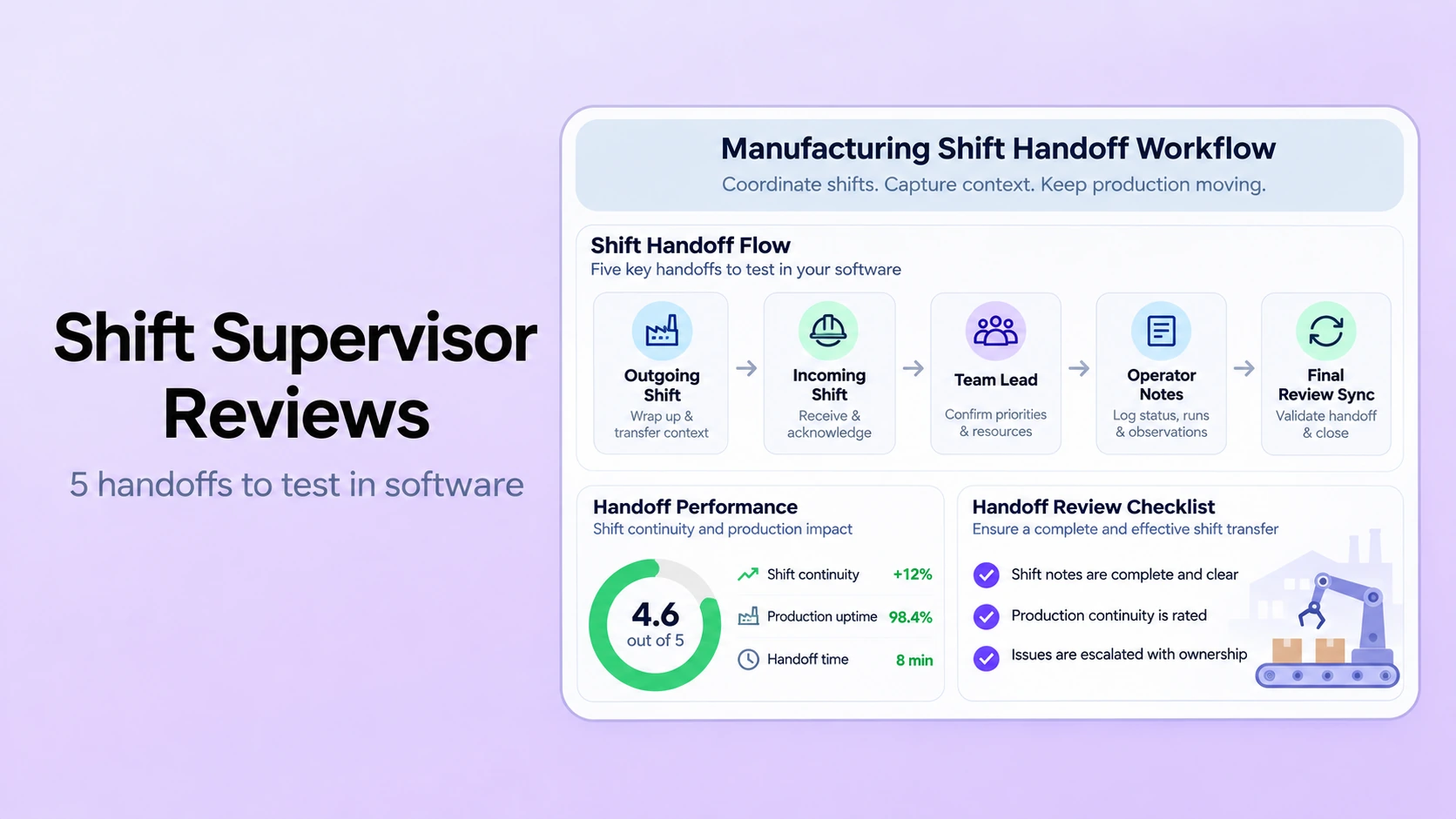
This guide covers five handoffs to test in performance review software: outgoing to incoming shift, team lead to accountable supervisor, quality or maintenance to performance reviewer, temporary supervisor coverage, and completed review to the next shift's coaching owner. Each includes a sample scenario, what the vendor must show, a failure condition, and questions for HR to ask.
These are performance-management tests, not instructions for operating a production line. Manufacturing employers still need their own operational shift handover procedures. The UK Health and Safety Executive describes effective operational handover as preparation, communication, and incoming-team cross-checking. That operational principle helps explain why shift handover needs reliable context, but it does not mean the performance review system replaces a safety log, maintenance system, or production-control process.
Why manufacturing employee reviews break between shifts
In a three-shift plant, the employee's formal manager may have limited firsthand visibility into the night or weekend crew. Different supervisors can interpret the same output, quality, training, or teamwork metric differently. Some employees rotate across production cells; others cover overtime during a supervisor's absence. A manufacturing performance software buyer guide can help teams choose broad capabilities, but the most revealing test is whether review evidence remains accurate while that day-to-day ownership changes.
Illustrative example: operator M-208 works the evening shift on Line 4, covers a night shift on Line 2, and returns to Line 4 after a maintenance shutdown. During the same review period, a team lead reports a defect-prevention improvement, a quality lead raises a recurring inspection issue, and the regular supervisor is on leave. HR needs a traceable record, not a merged paragraph that loses which person saw which event.
Keep three kinds of information separate: the operational shift handover record for work continuity, employee-level performance evidence that the company is authorized to use in evaluations, and confidential HR records. The right performance review process can refer to relevant evidence without granting every shift lead access to private personnel data.
Set four rules before running the five handoff tests
Identity: use one stable employee ID even when the person changes shifts, cells, or supervisors. Attribution: date every observation and retain the contributor and work context. Ownership: assign one accountable final reviewer and a separate approver where policy requires it. Access: give leads, supervisors, HR, and the employee only the actions and information appropriate to their role.
Use an artificial dataset, never personal employee records, in vendor demonstrations. Assign test operator M-208 a formal manager, one morning supervisor, an evening lead, a night-shift substitute, and an HR approver. Define consistent job-relevant evaluation criteria before asking reviewers for scores. The EEOC's guidance on performance evaluations emphasizes communicating standards and applying them consistently, supported by relevant facts. The framework here is for buyer evaluation and internal HR policy design, not legal advice.
Handoff 1: Outgoing shift to incoming shift
Test whether observations transfer with time and context
On Tuesday evening, a supervisor records that M-208 identified a setup inconsistency before first-piece approval. The operator then works the overnight shift under a different supervisor. That incoming leader should receive authorized context needed for coaching, without editing the earlier note or inheriting HR-only information. Importantly, the production handover remains in the plant's operational system; the performance tool should hold a distinct, relevant employee observation.
Demo script: sign in as the outgoing supervisor and add a dated, task-specific performance observation. Switch to the incoming supervisor's account, open the employee record, and review what appears. Attempt to change the original author's entry. Switch back to HR and inspect the history. Also ask whether the employee can respond in an approved feedback workflow.
Pass: the note retains its author, shift, date, context, and permitted visibility. The incoming supervisor sees only approved material; any correction has an accountable trail. Fail: a copied note appears as if the new supervisor wrote it, or an unrelated confidential note is exposed.
Vendor question: Does our company configure who may read an earlier shift's notes, and is that rule applied at the record level rather than only through a dashboard filter?
Handoff 2: Team lead to accountable shift supervisor
Check contributor roles without creating two final reviews
A team lead may closely observe changeovers, coaching, or work quality but not have authority to make a formal employment evaluation. A shift supervisor may own the manager review even when the lead supplies most daily input. Software should respect that difference. An employee should not receive two competing final ratings simply because both people have contributed information.
Demo script: have the lead enter two observations about M-208's response to setup coaching. Route the comments to the assigned supervisor, who adds their own dated assessment and completes the review. Give the lead permission to comment but not finalize, alter the supervisor's approval, or access another worker's confidential record. Use an exception: the lead disagrees with the supervisor's conclusion.
Pass: the lead's original input remains attributable, the supervisor can explain how it influenced the review, HR can inspect approval status, and only an authorized owner can finalize it. Fail: the system silently merges the author fields, produces duplicate completed reviews, or permits unauthorized edits.
The manager workflow and review approval tests are useful starting points for this buying question, but the exact roles must be demonstrated in the proposed configuration. Where the lead is actually the formal manager, the organization should update its responsibility matrix instead of forcing an arbitrary split.
Handoff 3: Quality or maintenance observation to a performance review
Preserve relevant evidence without blaming the wrong employee
Production output and defect rates need interpretation. A quality technician may document an out-of-spec inspection result, while maintenance may document that a sensor issue contributed to downtime. A supervisor should not automatically convert either event into a negative employee rating. The evaluator must establish what M-208 was assigned to do, what information they had, and what was in their control.
Demo script: create a synthetic quality observation, a maintenance note, and a supervisor's coaching entry. Ask which fields can be referenced in the employee review, whether the source can be identified, and what consent or access restrictions apply. Then change the source note to correct a factual error and see whether the review owner is notified rather than silently receiving altered evidence.
Pass: the reviewer can distinguish verified facts from judgments, preserve context, correct errors visibly, and exclude unrelated records. Fail: defects, machine failures, or injury reports automatically determine an individual rating regardless of cause.
This is also where individual goals and role-specific criteria matter. For example, completing a required first-piece check may be a relevant operator behavior; overall line yield may depend on materials, staffing, and process conditions outside the operator's influence.
Handoff 4: Temporary coverage, shift rotation, or supervisor absence
Test reassignment while a review is in progress
Two days before the review deadline, the night supervisor is absent. The acting supervisor has observed M-208 for only one shift. HR needs the review to continue, but the substitute should not be pressured to write an entire cycle's evaluation based on limited exposure. Some plants also rotate employees between shifts under the same formal manager, creating similar coverage and visibility questions.
Demo script: open a review with one submitted observation and one incomplete task. Mark the assigned reviewer unavailable, assign a substitute according to the employer's policy, and then return the original supervisor. Check what happens to pending tasks, deadlines, comments, and approvals. Compare expected behavior with multi-cycle review software requirements if the worker has probationary or role-change reviews in the same period.
Pass: the record retains its prior contributors and timestamps, the new owner receives the correct next action, and HR can reconstruct who held authority at each point. Fail: the workflow restarts, old notes disappear, or the substitute gains unnecessary access. Ask how review reminders handle reassigned owners without messaging the wrong person.
In a multi-location operation, repeat this test across two plants as well as two shifts. An acting supervisor at Plant B should not automatically see unrelated Plant A records.
Handoff 5: Completed review to the next shift's coaching owner
Prove that a development action survives the next rotation
An evaluation is only useful if the employee and appropriate manager understand the follow-up. Suppose M-208 needs additional support with a setup checklist, but the next cycle begins under a different supervisor. The agreed coaching action should keep its owner, due date, current status, and privacy rules instead of disappearing once the final score is approved.
Demo script: finish an evaluation, document the employee's response, assign one realistic development task, and change the regular shift supervisor. Ask the next authorized manager to find the action and conduct a follow-up check-in. Record completion evidence and confirm that the employee can see the commitments intended for them.
Pass: a valid manager can locate the action, the previous review remains intact, and the employee can track the agreed next step. Fail: the coaching item is locked inside the former supervisor's notes or disappears when shifts change.
Use individual development plans for ordinary growth needs and reserve formal performance improvement plans for situations that meet the company's separate policy. Do not automatically create a disciplinary process from a missed production target.
Run one five-handoff vendor demo from start to finish
Give each shortlisted vendor the same synthetic factory setup: two production lines, a morning and night shift, three supervisors, one acting manager, a quality contributor, and HR. M-208 has a quarterly review open, a dated setup-coaching observation, a corrected quality note, and one development action due after a shift rotation.
- Record the outgoing shift's observation. Open it as the incoming manager and inspect authorship and permissions.
- Add a lead's contribution. Confirm that the accountable shift supervisor, not the lead, can finalize the review.
- Attach relevant quality context. Demonstrate a factual correction without creating an automatic performance penalty.
- Reassign the supervisor mid-cycle. Preserve work in progress, access boundaries, reminders, and the ownership audit trail.
- Close the review and transfer the coaching action. Test the new supervisor's follow-up and the employee's view.
Ask the vendor to use actual product roles, not a screen-share as a super-administrator. Run separate sessions as the employee, lead, supervisor, and HR user. A small software pilot can reveal whether these workflows remain manageable during normal plant operations. Keep test scores and any product claims in the vendor log until verified.
Manufacturing Shift Reviews
See shift-supervisor review handoffs in action
Bring the five supervisor-handoff test cases to a demo. Check evidence authorship, reviewer ownership, permissions, and coaching follow-through in the current product.
How to score the five handoffs and compare vendors
Use three outcomes for each test: Pass means the full workflow was observed with the required permissions and source history; Conditional means the vendor demonstrated a workaround, configuration dependency, or supported integration that needs verification; Not demonstrated means the test was not completed or relied only on a promise. Record whether the demo environment matched the proposed product package.
Prioritize hard gates before calculating any score. For instance, exposing confidential personnel records, erasing original evidence, or assigning review approval to an unauthorized account may disqualify a product even if other workflows look good. A practical review permissions test should check the actual data accessible after a shift change, not merely read an access-control feature list.
For reporting, ask whether review completion reports distinguish one completed employee review from several source observations. See the dashboard test guide for reconciliation questions. Do not average plant-level completion percentages with different employee populations without checking the denominators.
Keep fatigue, safety reporting, and performance evidence distinct
Shift schedules can influence attention, reaction time, and judgment. NIOSH's fatigue guidance identifies night shifts and extended work hours as factors associated with workplace fatigue. This does not justify assumptions that an individual night worker performs worse. Compare employees to the same communicated, job-relevant standards while evaluating staffing, shift length, equipment, and work conditions.
Manufacturers should also avoid penalizing workers for reporting an injury or illness. OSHA regulation 29 CFR 1904.35 prohibits retaliation for reporting work-related injuries or illnesses. A review may discuss separately documented safe-work practices under applicable policy, but a reported injury itself should not automatically reduce a rating.
If a worker identifies a hazard and the incoming shift receives that information, keep the safety communication in the approved operational channel. The performance record should only include relevant, authorized evidence of employee behavior. For staffing-agency workers or contractors, define which employer owns the performance process and distinguish that from OSHA's host-employer and contractor safety communication guidance. Consult HR, safety leadership, and qualified counsel for high-risk employment decisions. This article is educational, not legal advice.
Questions manufacturing HR should ask in the software RFP
- Can a contributor add evidence for one shift without becoming the employee's final reviewer?
- Which fields retain the original supervisor, date, shift, work area, and any subsequent correction?
- What happens to a partially completed review when a supervisor changes or takes leave?
- Can a quality or maintenance observation be reviewed in context without automatic rating penalties?
- How are employee responses and confidential notes restricted from unauthorized shift leaders?
- Can a coaching action follow an employee to the next shift supervisor after the review closes?
- Can an employee participate using the approved device and authentication method for their role?
- Do reports reconcile employee counts, submitted contributions, and overdue approval tasks?
Use these questions alongside the general performance management RFP checklist; they do not replace contract, security, implementation, or workforce-policy questions. For technology fit, verify integration options rather than assuming a production scheduling, manufacturing execution, maintenance, or quality system automatically connects.
Where PerformSpark fits in the buyer evaluation
PerformSpark publishes information about performance reviews, manager check-ins, feedback, calibration, development planning, smart notifications, and reporting. These product areas make a structured manufacturing review demonstration relevant. They do not independently confirm that the platform provides every shift-specific role, offline action, manufacturing-system integration, or correction log described here without configuration.
Request a demonstration using M-208 and the five handoff steps. Ask the PerformSpark team to identify observed capabilities, configuration requirements, limitations, and any additional systems. An RFP answer should distinguish a feature that works today from a future request or a manual workaround.
Final recommendation: evaluate continuity, not just completion
The right manufacturing shift supervisor review process maintains context from the person who observed the work to the person responsible for final approval and coaching follow-up. The software should support that continuity while keeping operational safety handovers, performance evidence, and restricted HR records appropriately separate.
Shortlist vendors on five observed handoffs, audit the important exceptions, and compare the employee and supervisor experience under real shift conditions. A complete review form is only one part of a trustworthy process.
Manufacturing HR Teams
Evaluate reviews across manufacturing shifts
Explore performance reviews, supervisor input, coaching actions, and HR reporting with PerformSpark. Bring the five handoff scenarios and confirm which workflows can be demonstrated today.
Book a PerformSpark Demo →Bring your five-handoff demo checklist