






Table of Contents

Key Takeaways:
- Select frontline 360 reviewers for firsthand exposure and relevant behaviors, not current shift-roster membership alone.
- Preserve original reviewer roles and work periods when employees, supervisors, or peers change shifts.
- Protect confidentiality in small reviewer groups and clearly disclose when anonymity cannot be guaranteed.
- Test ten vendor workflows spanning reviewer approval, selection, access, replacement, conflicts, and response reporting.
- Separate development feedback from formal evaluation and document all important reviewer-selection decisions.
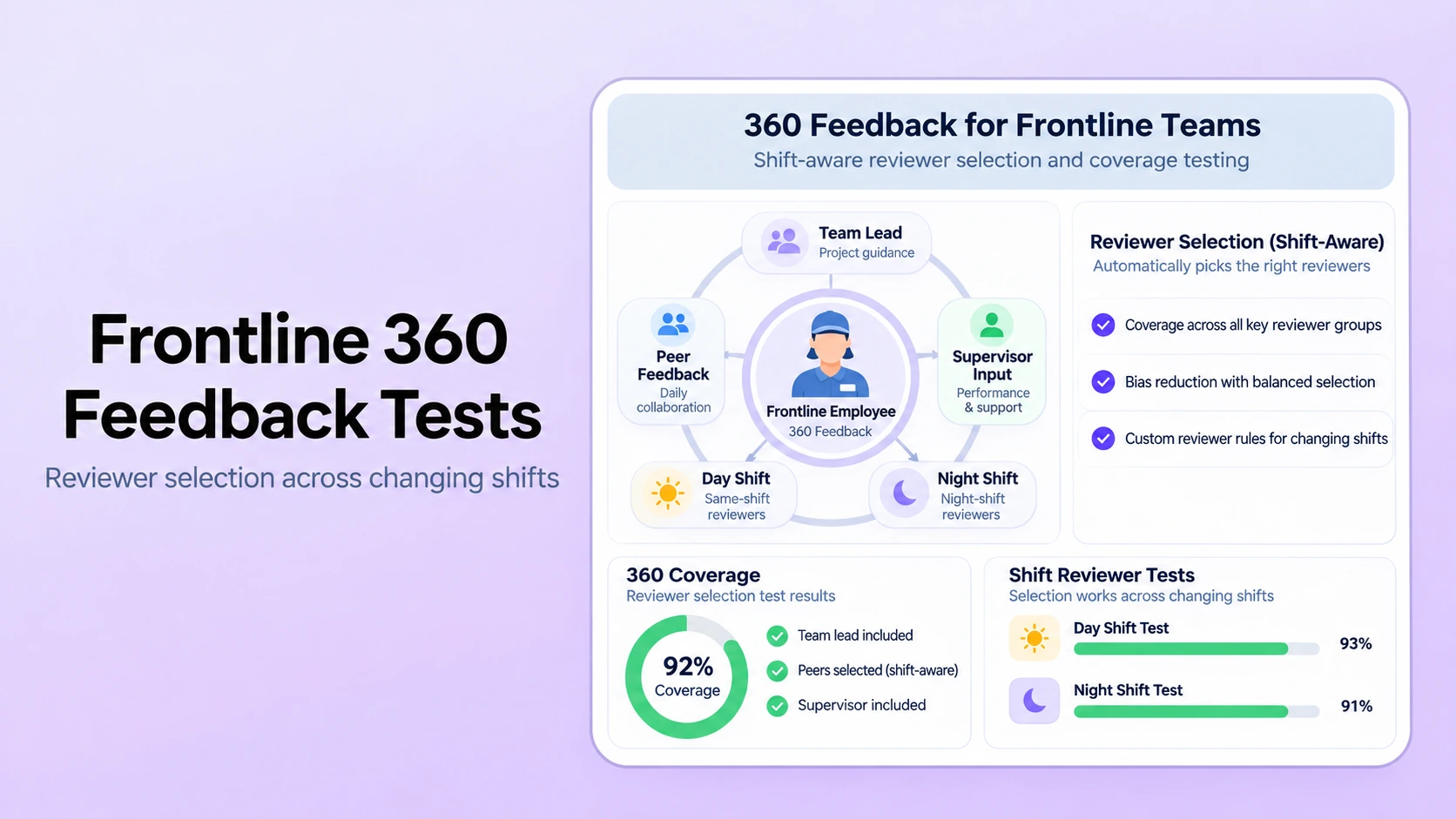
For frontline 360 feedback across changing shifts, select reviewers who directly observed relevant work, not everyone who happened to share an employee's roster. A useful reviewer list may include a current supervisor, a former shift lead, and peers who worked alongside the employee during the review period. The correct mix depends on the behaviors being assessed, the length and quality of interaction, and whether the group can provide feedback without exposing individuals or discouraging candid participation.
Consider a warehouse team lead who spent six weeks on the day shift, covered three nights during a peak period, and then moved to weekends. A system that automatically nominates the current shift roster could overlook the people who observed most of the employee's teamwork. Conversely, inviting every coworker across three rosters creates irrelevant responses and confidentiality risks. HR needs to test how reviewers are proposed, screened, approved, invited, replaced and reported.
This guide provides 10 software reviewer-selection tests, a synthetic shift-rotation scenario, privacy and evidence requirements, and buyer questions for a vendor demonstration. It complements our broader frontline performance review buyer checklist without duplicating the authentication-focused review access without work email guide.
How should frontline 360 reviewers be selected?
Start from a defined behavior and then choose people who can describe it from direct experience. A shift peer may know whether the employee communicated a handoff clearly; a supervisor may have the authority and context to discuss work priorities; a cross-functional teammate may have observed coordination during a specific issue. Someone who shares a department but never worked alongside the employee is a weak source for those questions.
Use the 360-degree reviews process for relevant multi-perspective behavior and development feedback, not as a substitute for a manager-owned appraisal or a safety investigation. The National Fire Chiefs Council's 360-feedback guidance emphasizes meaningful interaction with the employee, clearly communicated confidentiality expectations, and a range of working relationships. The guidance comes from its own sector; its reviewer counts should not be imposed as universal requirements for manufacturing, retail or warehousing.
Decide the use of the information before inviting anyone. A development-only 360, a formal performance evaluation, and a fact-finding process for a disputed event have different risks and decision owners. In general, do not make anonymous peer comments automatically determine pay, discipline or promotion decisions. Communicate who will see results and how they will be used under company policy.
Five reviewer-eligibility rules for rotating frontline teams
1. Confirm firsthand observation during the relevant period
Ask whether the person observed the behavior being rated, what shifts they shared, and for how long. A peer who worked one short overtime shift may be able to describe that shift but not the employee's whole quarter. A former team lead who observed six weeks of daily work can be relevant even after being reassigned. Keep exposure periods as context, not an untested algorithmic eligibility score.
2. Match reviewer role to the question
Supervisors, peers, direct reports and other collaborators may have different knowledge. Do not ask a temporary coworker to assess strategic leadership or a distant manager to rate detailed handoffs they did not witness. Use feedback survey design and role-specific criteria to keep questions observable and grounded.
3. Balance perspectives without enforcing equal response counts
Day-shift peers and night-shift peers might have different exposure to the employee. Seek relevant perspectives across assignments without assuming that equal numbers make the sample representative. A team with only two qualified overnight colleagues may need a different process from a 30-person day crew. Explain missing coverage rather than inventing or automatically weighting responses.
4. Protect confidentiality before selecting small groups
A category labeled “night shift” containing only one response would make the contributor readily identifiable even if names are hidden. Set a disclosure threshold and a safe fallback, such as withholding or appropriately combining eligible categories, under the organization's survey policy. The Canadian Public Service Commission's 360-feedback guidance identifies confidentiality and rater anonymity as important for participation; its own access approach is a useful example, not a statement of PerformSpark settings.
5. Give HR a controlled exception and dispute path
Employees should understand the selection rules and have a way to flag reviewers with inadequate exposure or potential conflicts. The accountable program owner should approve replacements and document why a nomination was accepted or rejected. Do not promise that a peer can be removed merely because their potential comments are unfavorable. Protect the process from retaliation or inappropriate manager influence, with HR oversight through HR leadership workflows.
Use one realistic dataset for all 10 vendor tests
Illustrative test employee: F-208 is a frontline team lead at a distribution center. From January 6 through February 16, F-208 worked days with supervisor S-1 and three regular peers. During February 17 through March 9, F-208 covered evenings with supervisor S-2 and two peers. During March 10 through March 31, the worker moved to a weekend shift, where S-3 observed only three shifts before a review launched. HR owns the 360 program and a designated line manager owns the formal review.
Create synthetic reviewer records with roles, shift periods, documented work overlap, invitation status and response status. Include one peer with no actual overlap, a former supervisor with substantial exposure, an employee with no company mailbox, an employee who changes assignments mid-survey, and one reviewer reporting a conflict of interest. Keep the feedback examples limited to work-related behaviors such as handoff clarity, coaching and collaboration. Do not upload actual personnel data to a sales demo.
10 reviewer-selection tests for frontline 360 software
Test 1. Select people who observed the employee, not the current roster
Demo: create a reviewer list using F-208's weekend roster, then compare it with people who actually overlapped during the full period. Ask whether HR or the assigned manager can propose the former day-shift peers and remove the unrelated current coworker. Pass: the user can review and correct eligibility using actual exposure and role context. Fail: the application silently treats current roster membership as proof of observation.
Test 2. Preserve historical shift and reporting relationships
Demo: move F-208 to a new shift while 360 invitations are pending. Check whether the previously approved reviewer list persists, whether a new supervisor is automatically added, and whether HR can see the justification. Pass: original relationships remain attributable, changes are controlled, and invitations do not silently jump to unrelated managers. Compare this with shift supervisor handoff tests for the separate manager-ownership workflow.
Test 3. Match each reviewer group to observable behavior
Demo: assign peers questions about shift communication and team leads questions about coaching behavior. Include one question about work the reviewer never observed. Can the survey allow a meaningful “not observed” response or route a question only to qualified groups? Pass: responses distinguish firsthand behavior from speculation. Fail: users must guess a numerical rating about work they did not see. Ask to inspect the actual configuration of feedback question workflows.
Test 4. Handle uneven overlap between day and night shifts
Demo: put three frequent day-shift collaborators and two occasional night-shift collaborators into separate groups. Ask how the report describes their exposure and whether numbers are averaged, weighted or merely shown separately. Pass: the vendor explains every calculation and any grouping decisions without promising that equal votes equal fair representation. Fail: one brief reviewer dominates a score without a visible rule, or an unsupported “fairness” percentage is presented as fact.
Test 5. Protect one-person or two-person reviewer groups
Demo: invite a night-shift category with two people but receive only one response. Then generate an employee report and manager report. Require the vendor to demonstrate the organization's confidentiality threshold, what is suppressed or combined, and how written comments are handled. Pass: small-group feedback is not identifiable through category labels, direct text or drilldowns. Fail: a hidden name still leaves only one obvious rater. A threshold such as three responses per category is a possible policy example, not a universal requirement or a confirmed product default.
Test 6. Check reviewer nomination and approval boundaries
Demo: allow F-208 to suggest peers, let the manager nominate a prior supervisor and ask HR to approve or reject questionable nominations. Attempt to have a line manager replace all peers with preferred reviewers after invitations are sent. Pass: authorized approval decisions and changes are recorded; no unapproved substitution can bias the survey. Fail: nominations can be manipulated without review or traceable ownership. Evaluate alongside review approval controls.
Test 7. Invite frontline raters who do not use work email
Demo: include a valid peer with no corporate inbox. Have the vendor show the actual approved invitation, identity verification and submission route, including a safe alternative if the person has no personal phone. Test whether a shared device leaves another person's answers accessible. Pass: the reviewer can participate securely using a demonstrated method. Fail: an email-only form excludes the qualified peer and the report still claims full coverage. See frontline authentication demo questions for the deeper access script.
Test 8. Replace an unavailable reviewer without exposing responses
Demo: invite a relevant supervisor, then mark them unavailable due to leave or reassignment before their response. Replace them with an eligible observer, reopen the participant list and inspect invitation status and any drafted feedback. Pass: the process preserves an audit trail and applies the approved replacement rule while respecting respondent confidentiality. Fail: the new person can read another rater's confidential draft or an invitation is silently reissued to the wrong account. Check relevant notification routing behavior.
Test 9. Address retaliation, conflicts and employee objections
Demo: add a peer with a documented interpersonal conflict and a worker who recently raised a workplace concern. Ask how HR receives a challenge to the reviewer list and how the company prevents managers from pressuring respondents. Pass: HR can document the concern, restrict unauthorized access and act under policy without disclosing confidential responses. Fail: the tool exposes a named rater to the person being assessed or automatically converts an unverified allegation into a disciplinary finding. The EEOC's retaliation guidance supports careful, documented review of consequential employment decisions.
Test 10. Reconcile coverage and produce a defensible report
Demo: invite ten candidate reviewers across three shifts; mark two ineligible, one nonresponding and one replaced after approval. Export the invitation list, eligible reviewer count, received responses and final group disclosures. Ask HR to reconcile these against the synthetic source roster without revealing anonymous comments. Pass: the coverage metrics are defined, the denominator excludes ineligible people according to policy, the respondent groups protect privacy and an export can explain decisions. Use reporting reconciliation tests for additional audit questions.
How many 360 reviewers does a frontline worker need?
There is no single number suitable for every shift pattern, team size or purpose. The right question is whether enough credible observers cover the behaviors being assessed and whether the reporting approach can protect confidentiality. NFCC's 360-feedback guidance recommends a cross-section of working relationships and describes a program in which groups with fewer than three raters are combined to reduce identification risk. That is an example of one program's rules, not a universal minimum that applies to every organization or vendor.
In a five-person overnight crew, it may be impossible to collect anonymous shift-specific peer feedback from a sufficiently large group. HR could consider an appropriately combined peer category, a smaller non-anonymous feedback process with clear consent and disclosure, or a manager check-in instead of a full 360 cycle. What matters is truthful communication about anonymity and use. Do not promise anonymity where a unique work incident, tiny group or identifiable comment makes it impossible.
The Canadian public-service 360 guidance illustrates how confidentiality can affect participation and use of the final report. Before procurement, ask the vendor to demonstrate report access as the employee, manager, HR administrator and unrelated supervisor. Pair this with review confidentiality test cases.
Shift-Aware 360 Feedback
See reviewer selection across changing shifts
Bring a synthetic multi-shift reviewer list and confidentiality requirements. Ask PerformSpark to demonstrate supported reviewer approval, responses, and reporting.
Score reviewer-selection software using evidence, not automation claims
Use three outcomes for each of the ten tests: pass when the actual configured workflow meets the agreed acceptance criterion, conditional when an observed manual process, integration or supported configuration is necessary, and not demonstrated when the vendor only describes or promises the result. Keep the exact user role, device, scenario, observed behavior, unresolved risks and responsible owner in the test log.
Set hard gates before scoring: no unauthorized disclosure of anonymous feedback, clear reviewer eligibility and approval responsibilities, safe frontline participation, and no unexplained alteration of reviewer or response history. A high average test score cannot compensate for a privacy failure. Where the tool claims automatic reviewer selection from shift schedules, require proof of the data mapping and the exception process. Check integration documentation instead of assuming a payroll, scheduling or timekeeping system is already connected.
Useful acceptance questions include whether an authorized manager can correct a roster-based proposal, whether HR can withhold an under-threshold category, and whether the final report distinguishes invited, eligible, responded and disclosed groups. A controlled performance software pilot can reveal how these policies work when shift coverage changes during a real cycle.
Keep development feedback separate from final employment decisions
360 feedback can help employees understand communication, collaboration and leadership behaviors from different viewpoints. It does not automatically provide an objective overall performance score. The EEOC's employer evaluation guidance recommends communicating standards and supporting performance evaluations with relevant facts. HR should define whether anonymous 360 responses are used for development, as one input to formal evaluation or for another permitted purpose, and communicate those rules before asking people to respond.
After an appropriate confidential feedback discussion, a manager and employee might agree to a practical development plan or coaching check-ins. If allegations involve misconduct, discrimination or retaliation, follow the company's separate investigation and employment-decision procedures rather than treating anonymous survey comments as established findings. Use performance calibration only where the organization has clear criteria and authorized access to relevant evidence.
Eight questions to send vendors before a frontline 360 demo
- Can we nominate and approve reviewers based on actual shared-work periods rather than current shift membership?
- How are self, manager, peer and direct-report roles defined when employees rotate between teams?
- Can respondents select “not observed,” and can HR restrict questions to relevant reviewer groups?
- What minimum response thresholds and reporting suppression rules can be configured, and do they apply to written comments?
- What happens when reviewers change shifts, leave the organization or decline an invitation?
- Can qualified workers participate securely without an organizational email address?
- Which roles can view nomination history, individual responses, group results, and final reports?
- Can reports reconcile candidate, eligible, invited, completed and disclosed reviewer counts without revealing identities?
These checks supplement the broader performance management software RFP. If the intended purpose is manager evaluation rather than multi-source development, also compare manager workflows and the formal review process before expanding the survey to frontline peers.
Where PerformSpark fits in the evaluation
PerformSpark presents product information about 360-degree feedback, reviews, feedback and surveys, development plans, notifications and reporting. These are relevant areas for the buyer to investigate. Their presence does not establish that every shift-roster integration, automatic reviewer suggestion, minimum-response threshold, anonymity control or frontline sign-in method described here is available by default.
Bring F-208's three-shift scenario to a PerformSpark demonstration. Ask the team to identify which reviewer selection, permissions, reporting and exception workflows can be shown now, what requires configuration, and what is not supported. If the vendor uses a manual workaround, record the cost and ongoing administrative burden before choosing it.
Final recommendation: choose observable reviewers, then protect their feedback
Shift coverage changes who sees an employee's work, so a useful 360 program must look beyond a current org chart. Select raters for relevant firsthand experience, document controlled exceptions, avoid forcing opinions from people without exposure and protect small-group responses. The goal is credible feedback that helps employees improve, not a complete-looking dashboard built on weak observations.
For a shortlist decision, require the vendor to pass the ten reviewer-selection and confidentiality tests with synthetic shift data. Explain the program's purpose and privacy promises before inviting actual employees to participate.
Frontline Performance Reviews
Evaluate 360 feedback across changing shifts
Discuss who should provide feedback, how small rater groups are protected, and how manager approval and reporting work in the current platform. Bring the ten buyer demo tests.
Book a PerformSpark Demo →Bring your shift-aware reviewer-selection checklist