






Table of Contents

Key Takeaways:
- The strongest performance evidence comes from managers who directly observed the employee's assigned work.
- Site supervisors typically contribute daily work observations, while project managers contribute role-relevant project coordination evidence.
- Name a single final review owner and a separate HR or second-level approval route before collecting ratings.
- Resolve conflicting comments using dated examples, employee responsibilities, and an opportunity to respond rather than averaging unsupported ratings.
- Validate reviewer permissions, evidence authorship, approvals, and reports with eight live vendor demo tests.
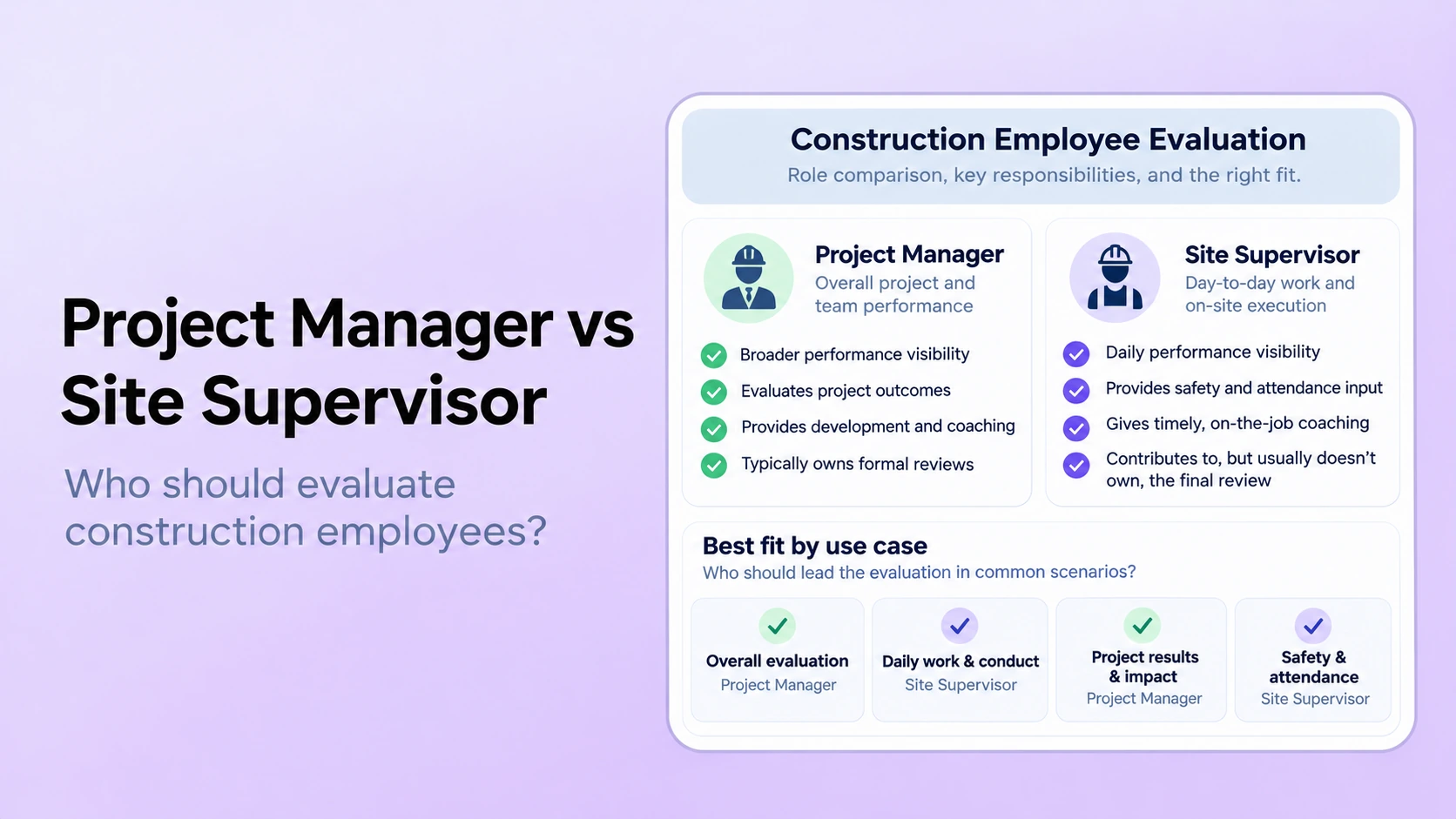
For most construction employee reviews, the supervisor who directly observed the work should supply the primary performance evidence, while the employer's designated line manager owns the final evaluation. A project manager may contribute evidence about coordination, schedule commitments, client communication and cross-team outcomes. A site supervisor or superintendent is generally better positioned to describe daily execution, workmanship, collaboration and coaching. HR should confirm the accountable reviewer in advance, rather than allow whichever manager has the most senior title to decide.
There is no universal job-title rule. A small contractor may combine project manager and superintendent responsibilities, while a larger contractor may employ a general superintendent, several foremen, separate project managers and a regional people leader. The Associated General Contractors of Massachusetts lists foremen, superintendents, project managers, and project engineers among construction management roles. Mortenson explains that a smaller firm may combine project manager and superintendent responsibilities, while larger organizations may assign the roles to different people. An employee's actual reporting relationship, job duties and firsthand exposure matter more than the label.
This guide answers the owner-versus-contributor question, supplies a practical responsibility matrix, shows how to handle conflicting judgments and gives HR buyers software demonstration tests. It is distinct from our jobsite-transfer review test cases, which focus on preserving a worker's record when assignments change.
What is the difference between a project manager and a site supervisor in a performance review?
A construction project manager typically oversees project delivery decisions such as budgets, contracts, resources, schedule coordination and stakeholder communication. The site supervisor, foreman or superintendent is more likely to observe what an employee did on a particular shift, the conditions under which they worked and how they responded to immediate field problems. Mortenson's comparison of these construction roles supports this broad division, while acknowledging that responsibilities vary by company.
Neither role automatically qualifies to judge every dimension. A PM might know that a milestone was missed but not whether a craft employee lacked materials, was reassigned or had to stop work because of a hazard. A superintendent may know the crew's daily performance well but have limited visibility into the employee's organization-wide development objectives. The process should distinguish the person who observed, the person accountable for the final review and the person authorized to approve a consequential decision.
For most HR teams, the critical requirement in performance review workflows is reliable evidence attribution. Standardized forms help, but they do not substitute for a documented ownership policy.
Assign four separate responsibilities before the review opens
1. Observation owner: the person who actually watched the work
For a craft employee, the foreman or site supervisor may supply dated examples of installation quality, teamwork, problem solving, coaching response and adherence to the assigned work process. The comment should name the observed task and its context rather than claim to know the employee's general attitude. Regular check-ins and 1-on-1s can capture observations while memories remain fresh. When the observer leaves the project, preserve authorship and dates instead of copying their words into the new manager's name.
2. Project contributor: the manager who can explain project outcomes
The PM can contribute useful information about planning commitments, handoffs, coordination with other teams and customer-facing deliverables when those behaviors are part of the employee's role. Avoid using a project's gross profit or delay as a direct individual score. Those results can reflect weather, design revisions, supply constraints, contract scope and decisions outside the employee's control. Connect relevant individual commitments to role-specific goals instead of rewarding or penalizing workers for the entire project's numbers.
3. Final reviewer: the designated accountable manager
The final reviewer should be identified at cycle setup and should reconcile contributions, clarify contradictions, meet with the employee and sign the evaluation. Often this is the employee's formal line manager; on other crews it may be a general superintendent or field operations manager. Check who has authority under the company's organization chart, employment policies and any applicable collective bargaining arrangements. Manager permissions and responsibilities should make this role visible to everyone involved.
4. HR or second-level approver: consistency and process oversight
HR or an authorized second-level manager should review missing evidence, rating anomalies, employee responses and policy compliance without pretending to have observed the work directly. This is where performance calibration can resolve inconsistent rating standards. HR's approval role is not an invitation to manufacture a justification for a predetermined employment action. The record should show what information each contributor provided and who made the final decision.
Reviewer ownership matrix: six construction situations
The following is a proposed decision framework for HR policy design, not a legal rule or a claim about PerformSpark's built-in logic. For each scenario, name a final owner, evidence contributors and an escalation route before the cycle begins.
- Craft worker with one stable site supervisor: the direct supervisor contributes most behavior and task evidence; the formal line manager owns the rating unless they are the same person. PM input is limited to directly observed role-relevant work.
- Worker assigned to several foremen: each foreman supplies evidence for the work they observed; the line manager or general superintendent consolidates it. The newest foreman should not be required to invent an account of earlier assignments.
- Assistant superintendent evaluated for field leadership: a general superintendent or the designated field operations leader may be the primary reviewer; the PM can contribute specific coordination, schedule and subcontractor interface examples.
- Project engineer or project coordinator: the PM who directs daily deliverables may be the most informed reviewer; a superintendent can contribute evidence on field communication and constructability support, not substitute for the formal manager without approval.
- Employee with a dotted-line project assignment: the home manager retains final review ownership while the PM or site supervisor supplies assignment-specific evidence. Confirm who can edit, approve and see the record.
- Small contractor where the PM and supervisor are one person: one manager may observe and own the review, but a second-level HR or leadership check is useful for consistency and conflicts of interest.
For employees whose assignment changes mid-cycle, use the separate cross-jobsite review transfer workflow rather than trying to extend this responsibility chart into a full transfer policy. If multiple reporting lines are common, verify manager approval and reviewer reassignment controls in the software.
What evidence should each reviewer submit?
Start by matching each performance dimension to a role that can reasonably observe it. HR should request specific facts and give reviewers space to explain constraints. A short, reliable observation is more useful than an unsupported rating.
Site supervisor evidence: work that was directly observed
- Quality of assigned work, with task, date and relevant specification.
- Collaboration and communication in a specific handoff or shift.
- Preparation, problem solving and response to timely coaching.
- Participation in appropriate safe-work practices without using injury reporting as a penalty.
- Progress on agreed skill or process improvements.
Ask supervisors to separate employee actions from equipment shortages, weather stoppages and crew-level coordination decisions. To capture the context, use structured feedback or documented field check-ins rather than short generic statements. Where a broader assessment is warranted, 360-degree feedback may add perspectives, but not every short-term assignment merits a full 360 review.
Project manager evidence: responsibilities within the employee's control
- Delivery of specifically assigned coordination or documentation tasks.
- Timely escalation of changes and dependencies.
- Communication during a subcontractor or client handoff.
- Planning contributions supported by meeting records or deliverables.
- Cross-project collaboration when the PM personally observed it.
Do not infer personal performance from total margin, overall schedule variance or customer satisfaction alone. A project-level result can identify an issue worth investigating, but the reviewer must trace it to the employee's agreed responsibilities and the circumstances. Use performance appraisal criteria by role to avoid scoring a journeyman, field supervisor and project engineer against one generic rubric.
Example: two managers disagree about the same employee
Illustrative case: A project engineer delivers revised shop drawings late. The PM writes, “Repeated delays caused a missed coordination milestone.” The site supervisor writes, “Provided accurate revisions during the next morning's coordination meeting and helped avoid rework.” Both observations may be true. They describe different stages of one assignment and use different definitions of success.
Before scoring, the review owner asks: When were the drawings requested? Who controlled the design response? Which milestone was assigned to the engineer? Was the early warning communicated? What outcome could the employee reasonably influence? The final comment might say: “Escalated the drawing conflict promptly and corrected the field issue, but the revised submittal was not ready by the agreed coordination deadline. Next cycle, provide a status update two working days before that deadline when a dependency remains unresolved.”
The example demonstrates evidence reconciliation, not a fixed weighting formula. A software tool should preserve each contributor's original input and the final reviewer's reasoning. Ask whether the reviewer can reference dated evidence, request clarification and record the employee's response. Reviewers using individual development plans can turn an evidenced gap into a practical follow-up rather than a vague label.
Seven steps for a two-supervisor evaluation workflow
- Confirm employment authority. Identify the person's official line manager and which project roles can give input. Do not treat a host-site supervisor as the worker's employer when they are employed by a subcontractor.
- Assign evaluation dimensions. Define which contributor can assess workmanship, project coordination, leadership, documentation and agreed goals. Use observable descriptions.
- Gather firsthand examples. Request dated comments from the site supervisor and PM, with task context and any recorded constraints.
- Resolve contradictory evidence. Ask the contributors to clarify facts, exposure period and responsibilities before calculating or selecting a rating.
- Give the employee a voice. Invite a self-assessment or response to material claims and preserve the response with the final review.
- Secure approval and visibility. Route the completed evaluation to the authorized manager and HR reviewer, keeping confidential notes outside inappropriate project access.
- Assign a follow-up. Agree on one or two role-specific actions and identify the owner for coaching, a check-in or a development plan.
For multiple overlapping cycles, compare the process with multi-cycle review software requirements. A system should not create conflicting final reviewers merely because a project closeout and annual review occur in the same month. Reminders through review notification workflows should go to the people who actually own the next action.
Eight vendor demo tests for project manager and supervisor reviews
Use fictitious employees and a realistic project organization. The buyer should operate the product with separate HR, PM, superintendent and employee accounts. Record demonstrated, requires configuration or not demonstrated for each test, and document the evidence rather than accepting verbal claims.
- Different contributor permissions: the PM can submit project coordination evidence but cannot edit the superintendent's dated observation or HR-only material.
- One final review owner: assign the authorized line manager as the final reviewer while two other managers contribute comments. The workflow should not silently create two final ratings.
- Different scoring criteria: configure a field execution competency and a project coordination competency. Check whether each evaluator understands which dimension they may comment on.
- Conflicting input: give the PM and supervisor contradictory but plausible observations. Ask the final owner to review source notes and document a reasoned outcome.
- Reviewer absence: remove one contributor during a draft review and check reassignment, deadline, reminders and preservation of completed work.
- Employee response: add a factual dispute and test the employee's opportunity to comment while preserving original authorship.
- Confidentiality: attempt to open a personnel note from a project-only account, then verify the access restriction and export behavior.
- Final report: produce one completed review count per employee while still showing how many contributions were received, who approved the decision and whether any tasks remain overdue.
For deeper technical questions, use review permission tests and reporting reconciliation scenarios. Ask the vendor for a system demonstration rather than extrapolating from an interface screenshot.
Construction Reviewer Ownership
See how two managers contribute to one review
Bring your project manager, site supervisor, and line-manager responsibilities to a demo. Test evidence contributions, approval ownership, and role-level permissions with synthetic employee records.
Avoid four common reviewer mistakes
Promoting seniority into evidence
A PM's title does not automatically make their judgment more reliable for daily workmanship. Likewise, a site supervisor should not be asked to rate contractual outcomes they never managed. Give weight to firsthand observation, relevance and documented responsibility.
Confusing project outcomes with employee behavior
A project could miss a deadline because of a design change while the employee executed their task well. A favorable project margin could coexist with poor teamwork. Examine what was within the employee's control before turning a project metric into a performance rating. The reporting and analytics discussion should begin with definitions and evidence, not a single composite score.
Letting one manager overwrite another's notes
The final reviewer may summarize and resolve conflicting input but should not quietly erase an original contributor's statement. Keep a documented correction path. Buyers should ask for precise audit and permission behavior in the demo rather than assume a particular configuration is available.
Using injury reports or hazard disclosures as negative ratings
Managers can assess specific, role-related safe-work behaviors supported by evidence, but should not penalize an employee for reporting an injury, illness or hazard. OSHA's worker participation guidance stresses reporting without retaliation and employee involvement in preventing hazards. The design of any safety-related review criterion should be reviewed by safety, HR and qualified counsel; this article is educational and is not legal advice.
What should HR check before choosing performance review software?
Before procurement, document how the company defines a line manager, project contributor, site observer and final approver. Then require the vendor to demonstrate the eight scenarios with those roles, including a documented exception for absence or reassignment. Reconcile the reporting to individual records and ask which requirements involve configuration, a third-party system or manual steps.
PerformSpark publicly describes performance reviews, goal management, manager check-ins, feedback, calibration and reporting. Those capabilities make it relevant for a structured evaluation, but do not prove that the exact field-role matrix or every permission rule in this guide is available without configuration. Ask the team to demonstrate the specific workflow, explain any limitations and confirm integration or data handling requirements using official integration information.
When selecting vendors, combine this role-based assessment with the broader performance management RFP checklist or a controlled software pilot. The right choice is the one that can show how evidence, ownership and employee response remain clear in a real review process.
Final recommendation: separate the evidence contributor from the decision owner
For most construction teams, the site supervisor should contribute direct observations of day-to-day work, the PM should contribute only the project outcomes and collaboration they can substantiate, and one designated line manager should own the final evaluation. HR should establish that policy before ratings are submitted and resolve exceptions according to documented roles rather than seniority alone.
The test of a fair workflow is whether a reviewer can explain the evaluation using the right evidence, from the right observer, for the right period, while giving the employee an appropriate opportunity to respond. A performance review system should make that chain clear without confusing who contributed and who approved.
Construction Performance Management
Make project manager and supervisor reviews more accountable
Explore how PerformSpark's review, feedback, and manager workflows may fit your team. Bring the eight two-supervisor demo tests and confirm what the product can demonstrate today.
Book a PerformSpark Demo →Bring your reviewer responsibility matrix to the demo