






Table of Contents

Key Takeaways:
- Require vendors to demonstrate twelve field-team workflows, not merely confirm that review features exist.
- Make employee identity, reviewer ownership, field access, confidential permissions, and auditable evidence explicit RFP requirements.
- Test project closeout, supervisor changes, interrupted mobile sessions, employee responses, and report reconciliation using one synthetic scenario.
- Keep injury and hazard reporting free from automatic negative scoring, consistent with OSHA anti-retaliation principles.
- Use mandatory acceptance gates and document unverified capabilities, configuration dependencies, and procurement follow-ups.
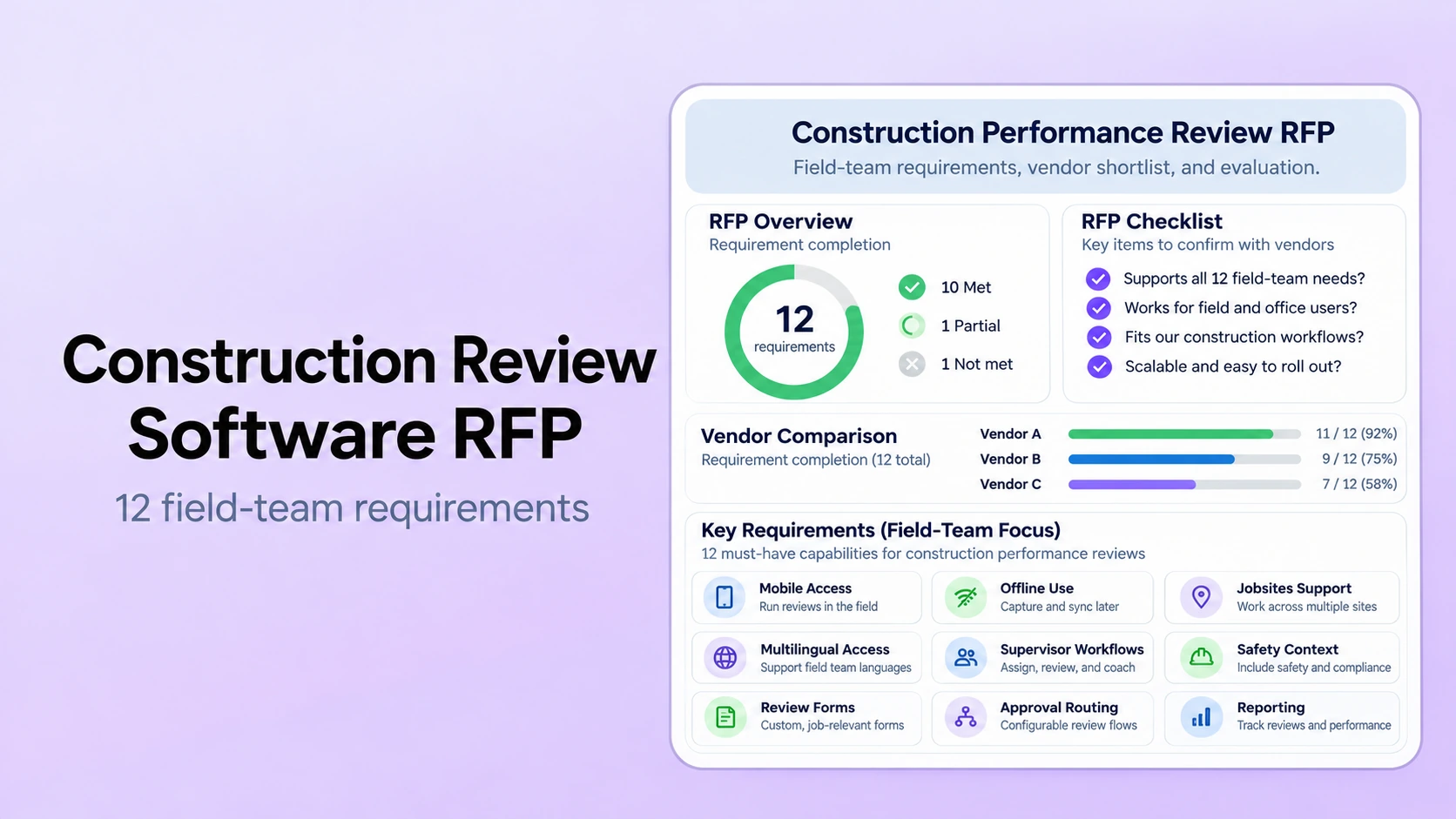
A construction performance review software RFP should test the work that happens between jobsites, supervisors, field employees, and HR, rather than ask vendors only whether they offer review forms. Start with twelve requirements: stable employee identity, reviewer ownership, accessible field participation, connectivity exceptions, evidence collection, job-specific criteria, multi-rater input, project-closeout schedules, fair rating review, protected safety reporting, restricted access, and reconciled reporting.
Construction HR teams often evaluate software using office-worker assumptions: everyone has a corporate email address, one manager observes the entire cycle, and reviews are completed at a desk. Those assumptions can fail for craft workers, shift supervisors, traveling employees, and project engineers. A useful RFP turns each operational constraint into a demonstration request, a measurable acceptance criterion, and a clear statement of what needs configuration.
This article is an industry-specific procurement checklist. It complements the general 25-question performance management software RFP and does not duplicate our guides to reviews across jobsites or project manager versus site supervisor reviewer ownership. All sample employee and company details below are fictional.
What belongs in a construction employee review software RFP?
For each requirement, ask the vendor to state whether it is available in the standard product, configurable, dependent on an integration, requires a custom change, or is not supported. Request a demonstration using the same test data for every shortlisted vendor. A checked feature box is not equivalent to an observed workflow. Buyers should also distinguish an employer's performance review records from safety management, timekeeping, job costing, and subcontractor workforce systems.
Most of these requirements connect to performance review workflows; several need separate validation of manager responsibilities, employee participation, and privacy and security controls. Before drafting vendor questions, the HR and field operations team should agree on what constitutes a passing response.
12 field-team requirements and the exact software tests
1. One employee record across changing projects and jobsites
RFP requirement: Support a stable employee identity while recording changes in location, assignment, department, job role, and reviewing supervisor. Preserve the original dates and contributors for historical feedback. Avoid duplicating the employee just because the next project has a different manager or code.
Vendor demonstration: Create employee C-204 at Site A, record a February observation, then transfer the employee to Site B while a quarterly review is open. Show where the observation, previous assignment, and review task remain. Acceptance: one employee profile, no lost review data, clear assignment history, and documented controls for reassignment. Our jobsite-transfer test guide covers this scenario in greater depth.
2. Separate observation, review ownership, and approval rights
RFP requirement: Give field supervisors, project managers, formal line managers, and HR distinct permissions to supply evidence, finalize a rating, and approve a review. A project manager who knows delivery results should not automatically gain authority over an employee's entire personnel evaluation.
Vendor demonstration: Have the superintendent submit direct work observations and the project manager submit coordination feedback. Route the combined review to an accountable final reviewer and an HR approver. Reassign one absent contributor mid-cycle. Acceptance: the application preserves the original author, retains finished work, and produces only one final evaluation. Use the detailed approval-workflow evaluation when comparing exception handling.
3. Field-employee access without assuming work email
RFP requirement: Clearly explain how employees without corporate email addresses authenticate, receive appropriate notices, review feedback, and provide responses. Include accessibility, supported languages, shared-device policies, and account recovery. Do not assume personal-device or personal-email enrollment is permitted by your workforce policy.
Vendor demonstration: Create a sample field employee without a work inbox. Ask that person to open a review on a phone and on an approved shared device; then sign out and confirm that the next user cannot see their records. Acceptance: an approved login path and safe session behavior are observed, not inferred from screenshots. Compare the required communications with review notifications and employee-facing workflow guidance.
4. Weak connectivity, interrupted drafts, and device continuity
RFP requirement: Document exactly what happens when a field worker loses mobile service or closes a browser during a review. Specify whether drafts auto-save, what works offline, how a reconnect occurs, and whether time-stamped evidence is preserved. Offline capability is a question to verify, not a feature to presume.
Vendor demonstration: Enter a partially completed self-review on a supported phone, interrupt network access, and retry from the same or another authorized device. Acceptance: the vendor can demonstrate whether entries survive and what the employee is told if a submission fails. Record any manual fallback and whether it meets your operations and privacy policies. Evaluate this along with manager check-in workflows for brief assignments.
5. Source-attributed field observations and supporting evidence
RFP requirement: Allow reviewers to identify what was observed, when, by whom, on which assignment, and against which role expectation. Clarify whether attachments, notes, or evidence links are supported, along with permitted file types and retention. Workmanship, coordination, response to coaching, and skill use are distinct dimensions.
Vendor demonstration: Add two conflicting observations about C-204 from different supervisors. Ask the final reviewer to inspect the source and add a reasoned resolution without overwriting either original. Acceptance: evidence history is attributable and permissions are enforced. A generic employee feedback tool description is not enough; the specific evidence workflow must be shown in the vendor's current product.
6. Job-specific criteria with consistent rating definitions
RFP requirement: Support distinct criteria for craft employees, foremen, superintendents, project engineers, and office roles without changing the meaning of core rating levels between locations. Tell vendors which standards should remain centrally controlled and which can vary by job.
Vendor demonstration: Assign one role-based form to a crew lead and another to a project engineer. Ask HR to update a future cycle's definition and check that completed historical ratings retain their original criteria. Acceptance: the reviewer sees the correct job expectations and can trace any policy change. The EEOC's performance evaluation guidance emphasizes communicating standards and applying them consistently. Use our role-specific appraisal criteria guide for content design.
7. Relevant input from more than one supervisor
RFP requirement: Collect role-relevant input from site supervisors, project managers, or other designated observers while keeping one accountable final reviewer. Explain how observation periods, permissions, duplicate comments, missing reviewers, and conflicting evidence are handled. Do not assume a numeric average is fair across different assignments.
Vendor demonstration: Give C-204 two project contributors, one with six weeks of observation and another with three days. Have them submit different assessments and then ask the reviewer to document a conclusion. Acceptance: sources remain visible and the reviewer is not forced into an unsupported arithmetic average. If the organization wants a broader program, examine 360-degree review capabilities separately from limited field-input collection.
8. Project closeout, annual cycles, and reviewer deadlines
RFP requirement: Explain whether a company can handle project-completion feedback alongside annual reviews without redundant tasks or contradictory final ratings. Define reminder owners, supervisor departure procedures, cycle locking, and what changes once a project closes.
Vendor demonstration: Start a project-closeout input request while C-204 has an annual review in progress. Remove the assigned site supervisor before submission, route the outstanding feedback to an authorized replacement, and verify that historic notes remain intact. Acceptance: no lost work and a traceable due-date or reviewer change. Benchmark vendors against multiple review-cycle buying criteria and the company's notification setup.
9. Fair comparisons, calibration, and employee responses
RFP requirement: Permit HR to review rating differences against agreed standards and the evidence available for each worker. Employees should have an appropriate response or dispute route under company policy. HR must be able to investigate concerns without changing original evidence silently.
Vendor demonstration: Show two employees with the same classification but different assignment conditions, then ask reviewers to compare their ratings and record whether a change is justified. Enter an employee objection and document a resolution. Acceptance: reasoning and authorizations are clear. The EEOC recommends consistent performance standards and relevant supporting facts; see EEOC guidance on evaluation complaints and our calibration overview.
10. Safe-work expectations without retaliation for reporting hazards
RFP requirement: Separate legitimate, evidence-based safe-work behavior criteria from incident, injury, near-miss, and hazard reporting. Do not design an automatic negative rating for reporting an injury or concern. Give safety and HR leaders a review step for sensitive criteria.
Vendor demonstration: Enter a fictitious near-miss report and confirm it does not automatically lower the worker's rating. Add a separate, fact-supported coaching observation about a work procedure, and inspect who may see it. Acceptance: no punitive auto-score tied to protected reporting and a documented access boundary. OSHA's worker participation guidance stresses reporting without retaliation, including contractor and subcontractor contexts. This material is educational, not legal advice.
11. Restricted access, audit history, and sensitive information handling
RFP requirement: Specify distinct permissions for employees, local site managers, regional HR, project leaders, and administrators. Require documented retention and export capabilities, audit history, account revocation, and controls on confidential notes. Ask about security and privacy documentation without assuming the vendor holds any particular certification.
Vendor demonstration: Log in as a site supervisor and attempt to read another location's employee record and an HR-only note. Change a review owner, then inspect what can be viewed and exported. Acceptance: unauthorized requests are denied in the actual configured system and critical changes can be reviewed. The NIST least-privilege guidance is a useful design reference, not a claim that any named standard applies to every contractor. Use confidential review permission tests for the test script.
12. HRIS mappings, reports, and defensible data exports
RFP requirement: Document which employee IDs, job roles, managers, project identifiers, and status fields can be imported or synchronized. Clarify integration availability, update frequency, ownership of source data, error handling, retention and export format. Distinguish employees from assignments when calculating review completion.
Vendor demonstration: Provide synthetic source records with a transferred worker, an inactive manager and two sites. Produce a report by current jobsite and by location during the review, then export the underlying rows. Acceptance: one companywide employee count, clear attribution rules, and a reproducible report. Use PerformSpark's integrations overview and performance reporting validation tests to prepare questions; ask the vendor to verify each proposed connection.
A single demonstration scenario that exposes the biggest RFP gaps
Illustrative buyer scenario: Ironworker C-204 works at a warehouse project for six weeks and then moves to a hospital jobsite. A foreman enters a dated workmanship observation before the transfer. The project manager supplies coordination input. The employee has no company email address and uses an approved shared device for the self-review. The former foreman is unavailable when the review reaches approval.
Ask each vendor to run that sequence, using separate HR, site supervisor, project manager, and employee accounts. Have the employee sign in and out, change the supervisor assignment, add a disputed comment, invite an employee response, and approve the record. Request both a location-specific report and a companywide summary. This scenario tests more than a checklist does because it combines identity, authorization, handoff, evidence, access, and reporting. Use a structured software pilot when more implementation time is needed.
Construction Software Evaluation
Test field-team review workflows before you shortlist
Bring your twelve RFP acceptance tests to a PerformSpark demonstration. Ask what the current product can show, what needs configuration, and where additional systems are required.
How to score the RFP responses without rewarding feature claims
First mark the organization's non-negotiable items. For example, historical evidence integrity, appropriate access controls, the approved employee sign-in path, and unambiguous final reviewer ownership may be mandatory. An RFP bidder that cannot meet a mandatory requirement should not pass solely because it scores well on lower-priority features.
For requirements that can be scored, use an explicitly defined demonstration scale: 0 for not demonstrated, 1 for demonstrated only with a documented workaround or unconfirmed dependency, and 2 for a complete observed result that meets the acceptance test. Record whether the test ran in a live trial, sales sandbox or sample environment, and whether the feature is part of the proposed commercial package. These are suggested procurement scores, not independently researched benchmarks.
For every answer, preserve the requirement ID, vendor response, configuration or integration dependency, observed evidence, owner, unresolved risk, and contractual clarification. Buyers should compare the cost and operating impact of exceptions, not just a total score. An enterprise RFP checklist can capture broader procurement, support and contract questions without crowding this construction-specific evaluation.
Contract and rollout questions that should follow the feature demo
A demonstration cannot settle all implementation questions. Ask which employees are licensed and billed, what happens when a seasonal workforce expands, whether mobile access adds cost, who configures roles, and how employee records are migrated at contract end. Clarify any required identity provider, integration, notification channel and data-retention terms. Do not treat marketing claims as a signed service commitment.
Run a small pilot with a field supervisor, a project manager, one worker without a work email address, and an HR administrator. Check whether the manager experience feels practical in brief jobsite check-ins and whether employee access respects the organization's authentication and device policies. Confirm the relevant security documentation and any applicable workforce or collective bargaining obligations with qualified advisers.
Where PerformSpark fits in the construction software shortlist
PerformSpark presents a performance management product family covering performance reviews, goals, manager check-ins, feedback, calibration, and reporting and analytics. These are relevant starting points for construction HR buyers. They are not proof that the product automatically supports every industry-specific requirement, offline behavior, supervisor permission rule, or contractor integration in this RFP.
Request a live demonstration with the twelve acceptance tests and ask for any gaps to be documented in writing. If a feature requires custom configuration or another system, identify the responsible party, price and implementation dependency before a shortlist decision. A useful vendor answer should say what is available today, not promise an unspecified future capability.
Eight final vendor questions to send with the RFP
- Can the same employee retain historical reviewer input after transferring projects or changing direct supervisors?
- What exact permissions separate project managers, site supervisors, final reviewers, HR and employees?
- How can employees without work email access reviews without exposing another worker's data on shared devices?
- What happens to a partially completed review when mobile connectivity fails?
- Can your demo preserve dated source evidence when two supervisors disagree?
- How are a project-closeout review and an annual cycle reconciled without duplicate final ratings?
- Can you demonstrate that a hazard report does not automatically trigger negative performance scoring?
- Which exports reconcile companywide completion rates to employee-level records and assignment dates?
Keep the questions in this RFP centered on field-team constraints. Use the other two construction articles for the detailed employee transfer scenarios and reviewer responsibility decisions so the three pieces support distinct buyer needs.
Final recommendation: request workflow evidence, not a feature-count promise
A strong construction performance review software RFP is precise about who uses the system, what information is collected, who may approve a rating, and how a worker's history survives changes in project and supervisor. Vendors should demonstrate what the product actually does in those circumstances. Record what passed, what needed configuration and what remained unverified before procurement.
Use the twelve requirements to shortlist vendors on realistic field conditions, then validate the best candidates with supervised pilot data. Review employment practices with HR and legal advisers where necessary. The purpose of the RFP is an explainable, fair review process, not an automatic claim that software alone guarantees better evaluations.
Construction HR Software Buyers
Evaluate your construction review requirements with PerformSpark
Walk through employee access, reviewer assignments, project handoffs, field evidence and reporting. Confirm which RFP requirements can be demonstrated and documented in the current platform.
Book a PerformSpark Demo →Bring your field-team RFP checklist to the demo