






Table of Contents

Key Takeaways:
- Carry one evidence history across jobsite changes, with dates, authorship and reviewer ownership preserved.
- Test an open review during a supervisor transfer rather than relying on a feature checklist.
- Use twelve observable demo cases to evaluate permissions, feedback, goals and reporting.
- Keep occupational injury reporting separate from performance scoring and respect anti-retaliation requirements.
- Reconcile review counts and employee development actions before committing to a platform.
Employee performance reviews become unreliable when construction workers move to a new jobsite but their evidence stays with the previous supervisor. A useful review process must carry forward the right facts, identify who observed the work, preserve historical manager decisions and keep the next review owner accountable. A software buyer should test those transfers directly, not stop at seeing an attractive review form.
Picture a crew lead assigned to three projects in one quarter. The first supervisor saw concrete placement and coordination, the second observed installation quality, and the third has only a few days of exposure. If the latest supervisor completes the entire review from recent memory, the assessment can miss important work. Unlike general multi-location performance management, construction transfers can change an employee's reviewer, project objectives and evidence sources before a single review cycle ends.
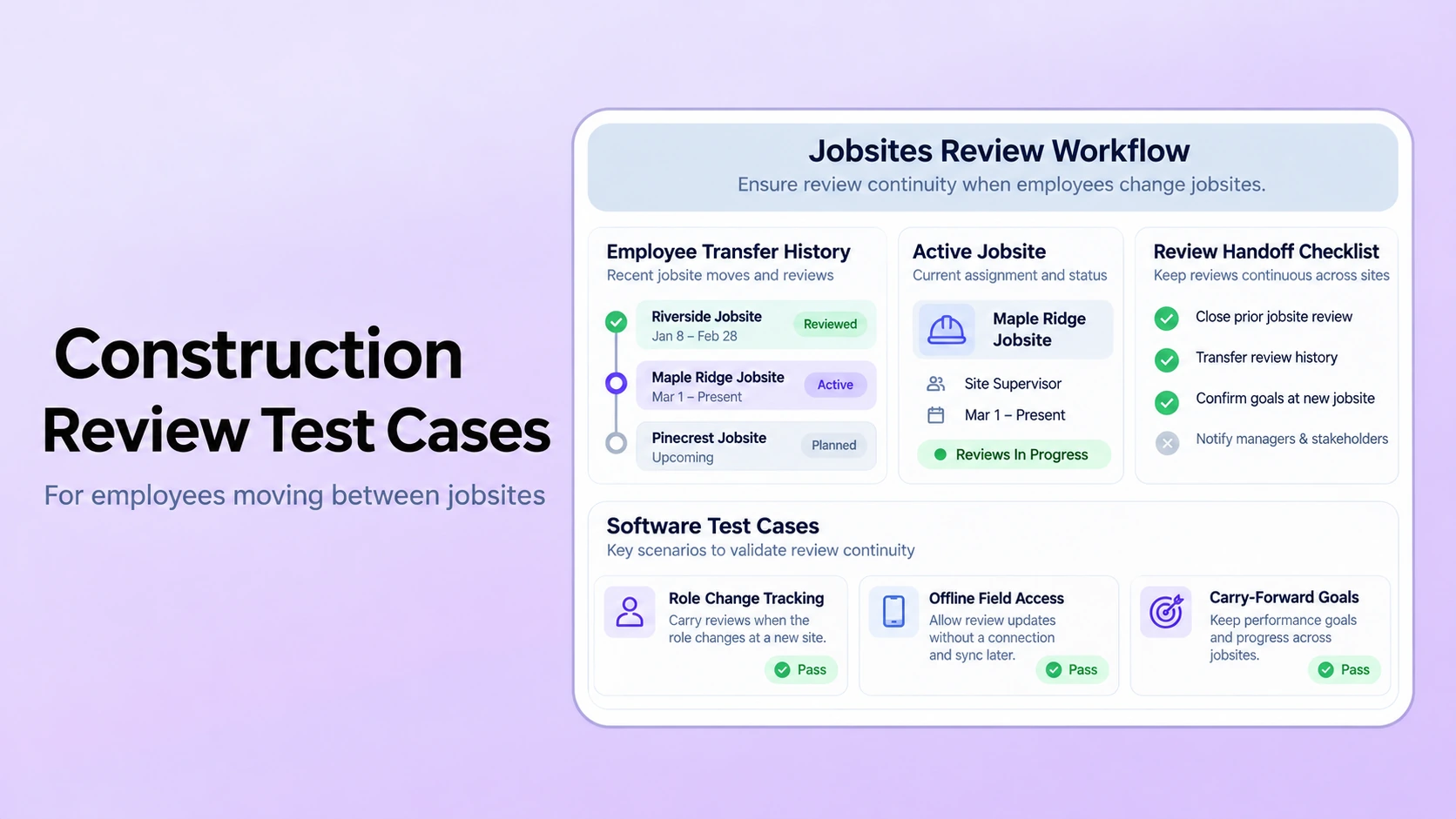
This buyer guide provides twelve construction-specific software test cases, a synthetic three-site dataset, pass/fail criteria and vendor questions. The scenarios are illustrative evaluation exercises, not claims that any named product has passed a hands-on test.
What must travel with a worker's performance record?
At minimum, a portable review record should preserve a stable employee ID, dated project assignments, the supervisor who submitted each observation, the form and rating criteria used at that time, the review's approval owner, and any employee response or correction. The transfer should change future access and task ownership without rewriting history. This is different from copying a completed form into a new department.
Buyers evaluating performance review software should examine how goals and feedback records connect to the review. Keep assignment facts separate from evaluative statements. “Transferred to North Terminal on March 21” is a factual record; “unreliable teammate” requires observable evidence, context and an opportunity to respond.
A reusable three-jobsite test dataset
Create synthetic employee C-1042, a crew lead assigned to East Yard (January 8 to February 12), River Bridge (February 13 to March 20) and North Terminal (March 21 to April 30). Start a quarterly review on March 10; finish on May 7. Give each project a different supervisor. Include two quality observations, one disputed comment, a revised project goal, a completed coaching action and a confidential HR-only note.
Designate a home manager, an assignment supervisor and the final review owner. Those positions may be held by different people. Make the vendor identify which manager workflow controls each task, who can read each piece of evidence and what happens when the worker transfers during an open review. Use fictional names and records, not real employee information.
Twelve construction jobsite transfer test cases
Test 1: One employee identity across sites
Record a check-in at East Yard, transfer C-1042 to River Bridge and confirm that the previous evidence remains attached to the same employee. The old supervisor's name, timestamp and project must still appear. An unexplained duplicate employee profile fails the test. If the history originates in a prior HR system, compare the export to the data migration checklist.
Test 2: Outgoing supervisor evidence handoff
Before the first assignment ends, ask the original supervisor to submit three dated observations and an unresolved coaching issue. Mark the record as source evidence rather than the final performance judgment. Remove their active assignment and try editing the submitted input. Can HR distinguish a missed handoff from an intentionally omitted review? Assess whether manager check-ins help capture evidence while the work is still recent.
Test 3: Reviewer reassignment without lost work
Change the assignment supervisor on February 13, then switch the final review owner on March 21. Show the effective date, old and new owner, approval authority and history of any reassignment. Submitted observations should not silently change authors. Use the same exception cases described in review approval workflow tests, including a review awaiting signoff.
Test 4: In-progress review survives the transfer
Open the quarterly review before the move to North Terminal and leave the first manager's section partially complete. Transfer the employee. Check whether pending tasks remain assigned correctly, whether the new supervisor sees the proper work, and whether finished comments remain unchanged. Compare this to overlapping review-cycle management when project closeout and quarterly schedules intersect.
Test 5: Project goals change without rewriting history
Create one role-level skill goal and one River Bridge deliverable that becomes irrelevant after the transfer. Ask the vendor to close, retain or revise the project goal with dates and rationale. Does the system preserve the old expectation rather than scoring the employee against work they never performed? Use role-specific appraisal criteria to distinguish portable skills from assignment outcomes.
Test 6: Two supervisors give conflicting input
Enter a positive collaboration observation from East Yard and a critical, specific comment from River Bridge. The final reviewer must see the author, period, basis and employee context for both. Ask whether any weighted calculation can be shown and explained rather than assumed. 360-degree feedback may be helpful for selected roles, but do not turn every short assignment into a broad anonymous survey.
Test 7: Permission boundaries after the move
Give the North Terminal supervisor access to current work and approved historic context, but not to a separate HR-only note or another employee's review. Test as a manager, employee and HR administrator, not only as a superuser. Verify what each account can export. Include the controls described in confidential review software permissions and request the vendor's security documentation.
Test 8: No-work-email and shared-device access
Create a field employee without a corporate inbox and another who uses an approved shared device. Demonstrate authentication, identity verification, session logout and access recovery. Disconnect the device during a submission and observe what happens, but do not assume offline processing exists. Ask how review notifications reach employees securely without revealing private review content in a message preview.
Test 9: Short assignments and recency bias
Set the new supervisor's exposure period to ten workdays. Include one recent disagreement and months of earlier documented work. Can the reviewer see how much evidence came from each assignment? Require a rationale for a rating that contradicts the broader record. Use calibration discussions to examine differences, while preserving legitimate changes in tasks, materials and responsibilities across jobsites.
Test 10: Employee response and correction trail
Enter a comment the employee disputes, then collect a dated response and HR follow-up. The original comment should remain attributable, with correction history clearly documented. Ask how the resolution can inform an individual development plan if it identifies a training need. A software record should support fair decisions; it should not automatically determine disciplinary action or dismiss the employee's account.
Test 11: Reporting reflects assignment dates
Give HR a list of five workers, including two who transferred during the cycle. Produce counts by current jobsite, jobsite during evaluation, responsible reviewer and cycle status. Reconcile each count to the underlying assignments, avoiding double-counting in companywide completion rates. Apply the check from reporting dashboard demo tests and ask what historical filters and export fields are actually available.
Test 12: Archived review and future follow-up
Close the review, move C-1042 to a fourth site and ask the vendor to retrieve the original evidence, response, approval and final outcome. Show who can reopen or correct a record under policy. Confirm how any agreed action is tracked through development planning or a separately authorized performance improvement workflow. An incomplete export or untraceable change is a failed acceptance criterion.
Use a practical pass, conditional or fail scorecard
Evaluate each test as Pass when the required action and controls were demonstrated, Conditional when it needs an identified configuration or manual step, and Not demonstrated when the vendor provided only a promise or screenshot. Keep a short log of expected behavior, observed outcome, role used, available evidence, owner and follow-up. Do not label an untested capability a pass.
Prioritize four hard gates: historical authorship remains intact; permissions prevent unauthorized access; open reviews survive reassignment; and reports reconcile to the source data. A high overall score cannot outweigh a critical privacy or records-integrity failure. For a controlled comparison, use the 30-day performance software pilot approach with an HR owner and one field supervisor.
Construction Field Teams
See how jobsite review handoffs work
Bring a three-jobsite employee scenario, supervisor changes, and your review evidence checklist. Ask the PerformSpark team to demonstrate the supported workflow and identify any configuration gaps.
Keep workplace safety reporting distinct from review scores
Construction reviews can consider role-relevant safe work practices, quality checks, teamwork, hazard identification and participation in corrective actions. They must not turn injury reporting into a negative automatic rating. The U.S. Occupational Safety and Health Administration explains that employees must be able to report occupational injuries and illnesses without retaliation and that incentive arrangements must not deter reporting (OSHA recordkeeping and anti-retaliation guidance).
OSHA also distinguishes proactive safety leading indicators from lagging outcomes such as injury rates. An employee who identifies and reports a hazard should not be disadvantaged simply for reporting it. Keep safety records, protected medical information and HR performance notes subject to their appropriate access rules. Review high-risk employment criteria with the safety team, HR leadership and qualified counsel.
When sensitive notes follow an employee, ask exactly who needs access and for what purpose. HR leaders should govern retention, access, corrections and escalation instead of allowing every site supervisor to see unrelated private details.
Six steps for the outgoing and incoming supervisors
- Confirm the transfer: employee identifier, old and new site, dates and reporting line.
- Close the evidence window: capture dated quality, collaboration and coaching observations before the outgoing supervisor leaves.
- Assign the review owner: separate contribution of evidence from authority to approve the final review.
- Adjust permissions: give the incoming supervisor only the historic context required for the next assignment.
- Invite the employee response: explain material observations and document any disputed facts.
- Carry forward actions: move appropriate learning or coaching commitments into the next review period with an owner and due date.
If a construction payroll, project-management or scheduling system supplies assignment data, verify how IDs and manager relationships are synchronized. Review performance management integration options and the published integrations overview. Do not assume a particular project platform connects to PerformSpark unless the current integration is verified in writing.
Eight vendor questions for a construction HR shortlist
- Can one worker retain the same employee ID across simultaneous or consecutive jobsites?
- What happens to partially completed review tasks when a supervisor changes?
- Who may read outgoing-site feedback after the employee moves?
- Can the incoming supervisor distinguish firsthand evidence from opinion?
- Can project-specific goals be changed without altering the historical target?
- What options exist for workers without corporate email or dedicated devices?
- Can the employee respond to a disputed observation before the review is closed?
- How do reporting exports distinguish employee counts from assignment counts?
These tests complement a general performance management RFP checklist; they do not replace security, contract, implementation or accessibility requirements. A contractor should also determine whether a particular procedure fits its workforce policies and relevant law.
What PerformSpark should show in the demonstration
PerformSpark publicly describes configurable reviews, goals, check-ins, feedback, calibration, development plans and reporting. These capabilities make it relevant to examine, but they do not prove out-of-the-box support for every construction assignment history, mobile authentication option, approval rule or jobsite integration in this guide. Ask the team to run the same synthetic test data and distinguish demonstrated functionality from proposed configuration.
The goal is a review history a decision-maker can explain: which assignments the employee completed, which managers observed the work, why ratings differ and what comes next. Purchase decisions should rely on demonstrated controls, not assumed feature coverage.
Construction Performance Reviews
Evaluate reviews when construction employees move jobsites
Review supervisor handoffs, access permissions, evidence continuity, and reporting with the PerformSpark team. Confirm which of the twelve test cases the current platform can demonstrate.
Book a PerformSpark Demo →Bring your three-jobsite test scenario to the demo