
.svg)





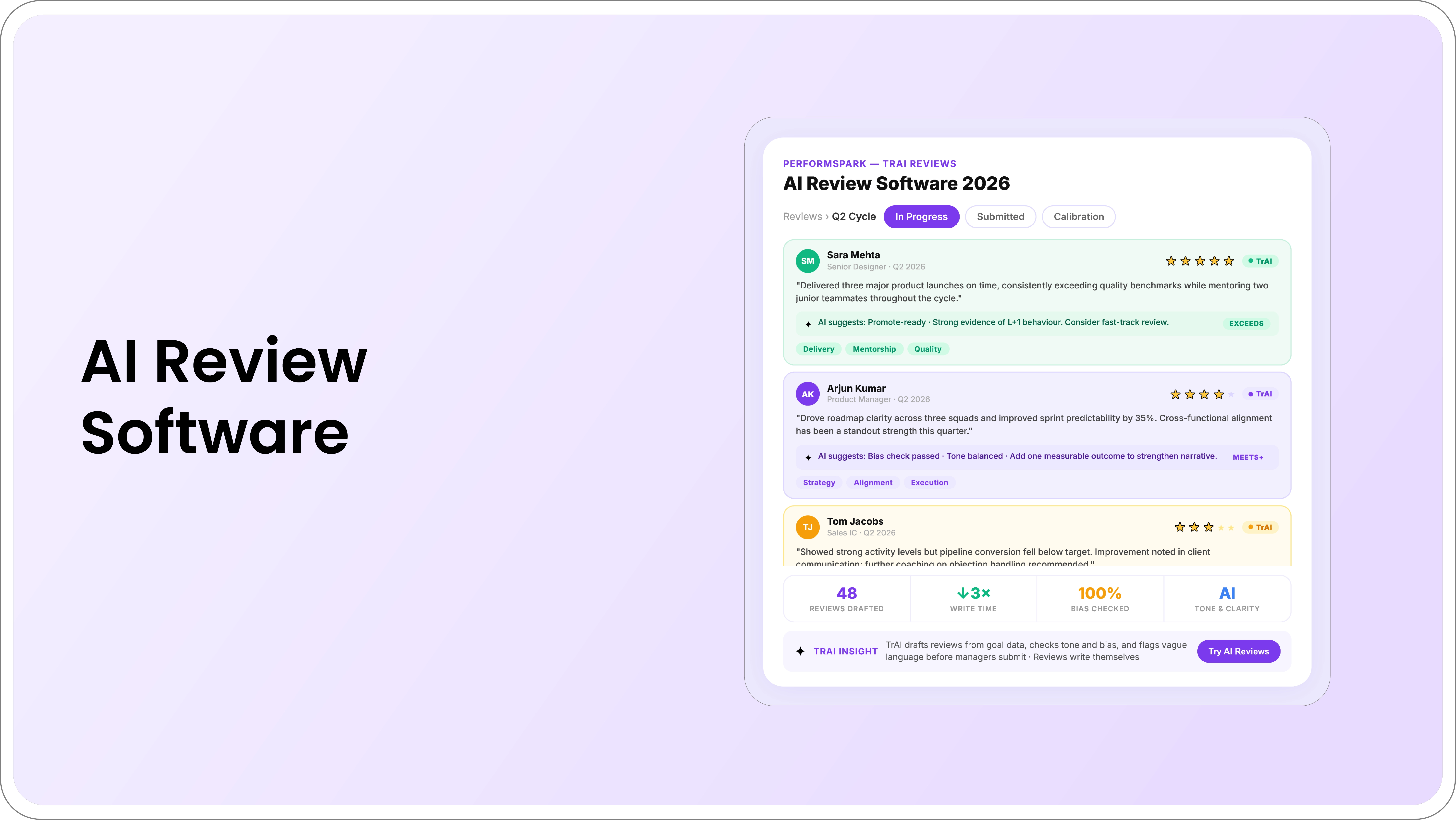
Table of Contents

Quick Takeaways: AI Performance Review Software
- Evaluate AI writing, evidence summarization, tone prompts, rating analysis, and calibration preparation as separate capabilities.
- AI outputs should be traceable to authorized evidence and reviewable by managers and HR.
- An outlier or generated suggestion is a prompt for human review, not an employment decision.
- Start with one defined use case, pilot it, train users, and measure whether it improves review quality or workflow efficiency.
AI performance review software can reduce administrative work, improve access to evidence, and help HR identify patterns across a review cycle. The value depends on what the AI actually does, which data it uses, how transparent its output is, and where human review remains required.
A vendor may describe review-writing suggestions, tone checks, summaries, rating analysis, or calibration preparation as “AI.” These capabilities solve different problems and should not be evaluated as one feature. HR teams need to see the exact input, output, permissions, and decision workflow for each capability.
This guide explains the main AI capabilities available in performance review software, the risks buyers should assess, the questions to ask during a demo, and how to introduce AI without handing employment decisions to an automated system.
What Is AI Performance Review Software?
AI performance review software is a performance management platform that uses machine learning or generative AI to assist with one or more parts of the review process. Depending on the product, the system may summarize existing performance records, suggest review language, identify missing evidence, analyze rating distributions, prepare calibration views, or surface workflow risks.
The software should support human judgment rather than replace it. Managers remain responsible for the accuracy and context of written feedback. HR remains responsible for process design, consistency, and appropriate use of the information. Leaders remain responsible for compensation, promotion, development, and employment decisions.
AI becomes more useful when it can work with connected goal data, documented 1-on-1 check-ins, feedback, prior reviews, and development records instead of generating text from a blank prompt.
Six Common AI Capabilities in Performance Reviews
1. Review writing assistance
Writing assistance helps a manager turn notes or structured evidence into a clearer draft. Useful systems preserve the manager's meaning, distinguish facts from suggestions, and allow the manager to edit or reject every recommendation.
Buyers should ask whether the tool:
- Uses only authorized employee records
- Shows which information informed the suggestion
- Avoids inventing achievements, dates, or metrics
- Keeps the manager responsible for the final wording
- Supports different rating levels and competency frameworks
Managers who need examples before using an AI assistant can reference these performance review phrases and strengths and weaknesses examples.
2. Evidence summarization
Evidence summarization brings together relevant information from the review period, such as goal updates, completed projects, check-in notes, recognition, and feedback. The goal is to help the manager review a fuller record rather than relying on recent memory.
A useful summary should separate source material from interpretation. Managers should be able to open the underlying record and confirm the context before using it in a formal review.
3. Feedback quality and tone prompts
Some systems review draft comments for vague, personal, or unsupported language. For example, the tool may prompt a manager to replace a broad statement such as “needs a better attitude” with an observable behavior, impact, and next step.
These prompts can improve writing quality, but they do not prove that a comment is unbiased, fair, or appropriate. HR and managers still need to review the evidence and circumstances. The areas of improvement guide provides a practical behavior-evidence-impact-next-step framework.
4. Rating distribution analysis
AI or statistical analysis can compare proposed ratings across managers, departments, levels, or review cycles. It may surface unusually high or low distributions, extensive midpoint clustering, or rating patterns that deserve discussion.
An outlier is a question, not a conclusion. A manager's distribution may differ because of team performance, role mix, new hires, restructuring, incomplete goals, or inconsistent standards. The system should help HR investigate the pattern without automatically changing ratings.
5. Calibration preparation
Calibration preparation organizes ratings, evidence, goal attainment, and manager distributions before the meeting. It can help HR identify cases requiring discussion and reduce the amount of manual spreadsheet work needed to prepare the session.
The actual performance calibration conversation still requires managers and HR to compare evidence, apply common standards, and document the reason for any approved change. AI should not force a distribution or determine who must move to a different rating.
6. Workflow and completion insights
AI can also assist with operational tasks such as identifying incomplete reviews, missing comments, overdue approvals, or teams that may need support. Combined with automated reminders, this can help HR focus attention where intervention is actually needed.
AI Writing Assistance vs. AI Calibration Analysis
These capabilities are often grouped together, but they serve different users and decisions.
- Writing assistance supports an individual manager while drafting a review.
- Evidence summarization supports the manager's preparation.
- Tone prompts support clearer, more behavior-focused language.
- Rating analysis supports HR oversight across a group.
- Calibration preparation supports a multi-manager decision process.
A buyer should evaluate each capability separately. A platform with strong writing assistance may have limited calibration functionality. A platform with strong distribution analysis may not provide useful drafting support.
How TrAI Supports the PerformSpark Review Workflow
Within PerformSpark, TrAI supports performance workflows by helping users work with connected goals, check-ins, feedback, review information, and calibration data. The purpose is to improve preparation and visibility while keeping final decisions with managers, HR, and leadership.
Relevant information can move through the broader performance management platform instead of being copied between separate documents. HR can use reporting and analytics to review completion, ratings, and patterns, while managers use the employee's documented record to prepare more specific feedback.
When a review identifies a development priority, the next action can flow into an individual development plan. When essential expectations are not being met and HR determines that a formal process is appropriate, the organization can use a structured performance improvement plan.
What AI Should Not Decide
AI should not independently decide:
- An employee's final rating
- Whether a person should receive a raise or promotion
- Whether an employee should be placed on a PIP
- Whether employment should continue
- Whether a manager's explanation is truthful
- Whether different treatment is justified
The tool may surface information or patterns that support review, but a qualified human should examine the evidence, employee context, policy, and applicable requirements.
AI Performance Review Software Evaluation Checklist
Data and permissions
- Which employee records can the AI access?
- Can access be restricted by role, team, workflow stage, and data type?
- Does the system use customer data to train shared models?
- How are prompts, outputs, and user edits retained?
- Can administrators disable individual AI capabilities?
Review the vendor's security controls, data-handling documentation, retention options, and access model rather than relying on a general statement that the product is secure.
Transparency and evidence
- Can users see the source information behind a summary or suggestion?
- Does the tool identify uncertainty or missing evidence?
- Can users distinguish generated text from employee records?
- Can HR review edits and final decisions where appropriate?
Human oversight
- Can a human reject or edit every recommendation?
- Does the workflow require manager confirmation before submission?
- Can HR review sensitive outputs before they affect an employee?
- Does the vendor clearly state which decisions remain human?
Review and calibration workflow
- Does the system connect AI output to review templates and rating scales?
- Can HR compare distributions without forcing a curve?
- Can calibration participants open supporting evidence?
- Are approved rating changes documented with a reason?
- Can final decisions flow back into the employee's review record?
Implementation and adoption
- What manager training is required?
- Can AI be introduced to a pilot group first?
- How will employees be informed about AI-assisted processes?
- What quality checks will HR run during the first cycle?
- How will the organization measure whether the capability improves the process?
Questions to Ask During an AI Software Demo
- Show the exact input used to create this output.
- Show what happens when the source record is incomplete or contradictory.
- Show how a manager rejects, edits, or reports an incorrect suggestion.
- Show how permissions prevent unauthorized employee data from appearing.
- Show how calibration outliers are calculated and explained.
- Show how the platform avoids turning an outlier into an automatic decision.
- Show what HR can audit after the cycle.
- Show which AI features can be disabled.
- Explain whether customer data is used to improve a shared model.
- Explain how generated content is stored, retained, and deleted.
The performance management software buyer guide provides a broader evaluation framework for workflows, integration, implementation, and total cost.
How to Introduce AI Into Performance Reviews
- Start with a defined problem. Select one use case, such as evidence summarization or calibration preparation, instead of enabling every AI feature at once.
- Review the data foundation. Confirm that goals, check-ins, reporting lines, and review templates are accurate before asking AI to analyze them.
- Set human-review rules. Document who can use the output, who approves it, and which decisions cannot be automated.
- Pilot with a limited group. Test accuracy, usefulness, permissions, and manager behavior before expanding.
- Train managers. Explain that generated content is a draft requiring verification, not an approved assessment.
- Review outcomes. Compare completion, comment quality, manager effort, employee questions, and calibration effectiveness.
The performance review automation guide explains how to connect review templates, scheduling, reminders, completion tracking, calibration, and development actions.
Use AI to Support Better Review Decisions
The strongest AI capability is not the one that produces the most text. It is the one that solves a defined workflow problem, uses appropriate evidence, explains its output, respects permissions, and keeps accountable people in control.
PerformSpark connects AI-assisted preparation with reviews, goals, check-ins, feedback, calibration, development, and reporting. Explore PerformSpark pricing or book a personalized demo to evaluate the workflow using your review process and decision requirements.



.svg)

.svg)
.svg)

