
.svg)





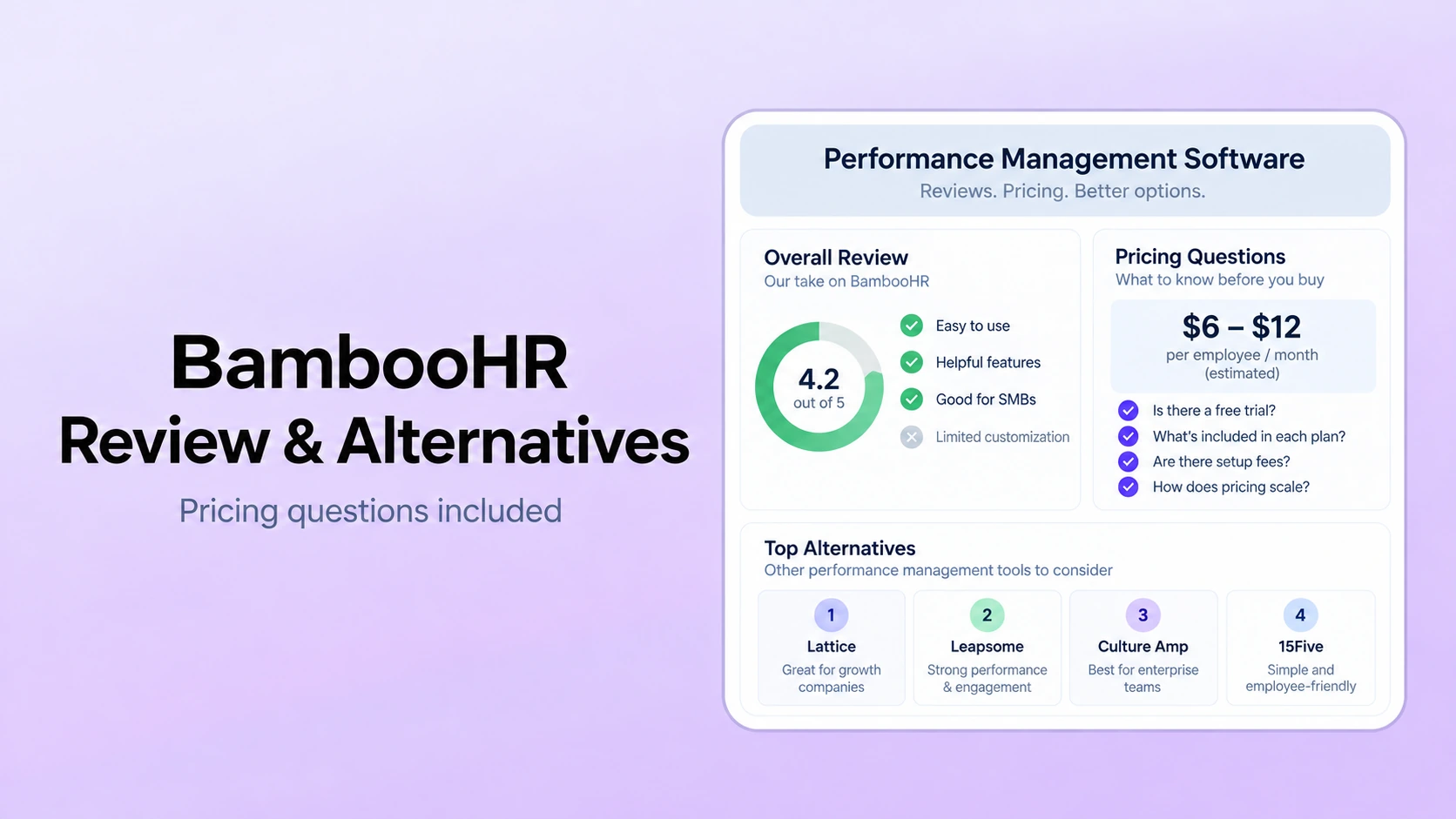
Table of Contents

Key Takeaways:
- BambooHR Performance Management is currently included in BambooHR Pro, not positioned as a separate performance add-on.
- BambooHR Pro currently lists 360° review cycles, 1:1s, goal tracking, flexible reviews, reminders, and performance reporting.
- For organizations with more than 25 employees, BambooHR currently lists Core at $10, Pro at $17, and Elite at $25 per employee per month.
- The main buyer question is workflow depth: calibration, governance, reporting, coaching continuity, development follow-through, and integration fit.
- Use one controlled demo scenario across BambooHR and every alternative instead of comparing feature-name checklists.
BambooHR Performance Management is now part of BambooHR Pro, not a separately priced performance add-on. BambooHR currently lists Pro at $17 per employee per month for organizations with more than 25 employees, with Performance Management included alongside 360° review cycles, 1:1s, and instant reporting. For smaller organizations with 25 employees or fewer, BambooHR says plans start at a $250 monthly flat rate.
That changes how HR teams should evaluate BambooHR in 2026. The question is no longer whether BambooHR has performance management basics. It clearly does. The better question is whether BambooHR Pro provides enough depth for your review, calibration, reporting, manager, goal, and development workflows, or whether a dedicated performance management software platform is the better fit.
This review uses BambooHR's current public pricing and product documentation as of September 23, 2026. Product scope and pricing can change, so reconfirm current terms before buying.
What BambooHR Performance Management Includes in 2026
BambooHR's current Performance Management product is materially broader than older descriptions of the module. BambooHR documents self, manager-to-employee, peer, and skip-level reviews; individual and team goals; one-on-ones; flexible review cycles; email reminders; review and goal reports; performance reporting; and mobile access.
BambooHR's current Performance Management page is the right first-party source for the feature baseline. HR buyers should compare that current product, not an older version of BambooHR's performance module.
| Area | BambooHR currently documents | What HR should verify |
|---|---|---|
| Review cycles | Flexible custom review cycles plus pre-built options | Different populations, cadences, reviewer roles, approval steps, and exceptions |
| 360° feedback | Self, manager-to-employee, peer, and skip-level reviews | Reviewer selection, visibility rules, anonymity, reminders, and follow-up |
| 1:1s | Scheduling, notes, and agenda tracking | How prior commitments, goals, and review context carry into future meetings |
| Goals | Individual and team goals on desktop and mobile | Goal hierarchy, alignment, updates, evidence, and review connection |
| Reporting | Instant reporting, review reports, goal reports, and performance reporting | Which dashboards, filters, exports, trends, and executive views are available in your plan |
| Reminders and administration | Completion notifications and email reminders | Reassignment, manager changes, deadline exceptions, and cycle administration at scale |
How BambooHR Performance Management Is Priced
BambooHR now publishes plan pricing on its website. For organizations with more than 25 employees, BambooHR currently lists Core at $10 per employee per month, Pro at $17 per employee per month, and Elite at $25 per employee per month. BambooHR states that Performance Management is included in Pro, not sold as a separate performance add-on in the current plan structure.
For companies with 25 employees or fewer, BambooHR says its software is charged at a monthly flat rate starting at $250 per month. The pricing page also states that volume discounts are automatically applied and that registered nonprofit organizations can receive an additional discount.
Review BambooHR's current pricing page before comparing a quote. Then compare the full operating scope against PerformSpark pricing and the broader cost categories in this performance management software pricing guide.
What BambooHR Does Well for Performance Management
BambooHR's strongest buying case is integration with the broader HR platform. If employee records, organizational structure, hiring, time off, benefits, and other HR workflows already live in BambooHR, adding Performance Management inside Pro can reduce the number of systems HR needs to administer.
The current performance product also covers several workflows buyers sometimes assume require separate software: 360° feedback, 1:1s, individual and team goals, customizable review cycles, reminders, reporting, and mobile access. For organizations that want a broad HR system with integrated performance capabilities, that is a meaningful advantage.
HR teams should also test the day-to-day experience for both managers and HR leaders. Product breadth only creates value if managers complete recurring work and HR can administer the process without rebuilding key steps outside the system.
Where HR Teams Should Test BambooHR More Carefully
The right way to evaluate BambooHR is not to assume missing capabilities. Instead, identify the workflows where your organization needs more depth than the public product page can prove, then reproduce those workflows in a controlled demo.
Calibration depth and rating governance
BambooHR publishes detailed guidance on performance calibration, but its public Performance Management feature page does not present a dedicated calibration workflow in the same way it presents review cycles, 360° feedback, 1:1s, goals, and reporting. If structured cross-manager calibration matters, ask BambooHR to demonstrate the complete process rather than inferring capability from thought-leadership content.
Test how HR prepares rating distributions, reviews evidence, records approved changes, preserves rationale, and controls finalization. Compare that workflow with a dedicated performance calibration product and these performance calibration best practices.
Reporting depth beyond standard performance reports
BambooHR clearly documents performance reporting and instant reporting. The buyer question is depth. Ask which filters, trends, cross-team comparisons, custom views, exports, and executive reporting are available for your plan and use case.
Bring three real questions to the demo rather than asking whether reporting exists. For example: Which teams have incomplete reviews? Where do rating distributions differ materially? Which goals or development actions remain open after the cycle? Compare the answers with your requirements for performance reporting and analytics and the metrics in this performance management metrics guide.
How connected the ongoing performance workflow needs to be
BambooHR supports goals and one-on-ones, so the relevant question is not whether those features exist. Test how much context carries from one workflow to another. Can a manager open a 1-on-1, review a current goal, reference authorized employee feedback, and carry the right evidence into a formal performance review without manual copying?
If 360 input is important, also test the complete 360 review workflow, including reviewer selection, permissions, reminders, aggregation, and follow-up.
Development and skills follow-through
Performance reviews often create development actions that need to survive beyond the review cycle. If the organization expects reviews to feed structured development plans, skill evidence, or manager coaching, demonstrate that handoff before signing.
For a dedicated development workflow comparison, review PerformSpark's guide to individual development plan software and its skills management software.
BambooHR Evaluation
Test the workflow, not the feature list
Bring one real review cycle, one calibration case, one manager workflow, and three reporting questions to a PerformSpark walkthrough.
BambooHR vs. a Dedicated Performance Platform
BambooHR and a dedicated platform solve overlapping but not identical buying problems. BambooHR Pro bundles performance capabilities into a broader HR platform. A dedicated platform may be more attractive when performance management itself needs deeper configuration, governance, coaching continuity, or specialized reporting.
| Decision area | BambooHR Pro | Dedicated performance platform | Demo test |
|---|---|---|---|
| Primary buying objective | Broader HR platform with performance included | Performance management as the central operating workflow | Decide whether HR-suite consolidation or performance depth is the priority |
| Reviews and feedback | Custom reviews, 360° feedback, reminders, mobile access | Often differentiated by workflow depth, calibration, coaching, or governance | Build your hardest review cycle in both systems |
| 1:1s and goals | Included in BambooHR Pro | May be more tightly connected to continuous performance workflows | Trace one goal through 1:1s, feedback, review, and follow-up |
| Calibration | Verify exact product workflow in a live demo | Some specialist products expose dedicated calibration workflows | Prepare distributions, change one rating, document rationale, and finalize |
| Reporting | Instant reporting plus review, goal, and performance reports | Depth varies by vendor and may focus more heavily on performance analytics | Answer the same three leadership questions in both products |
| Commercial model | Performance is included in BambooHR Pro at the current public plan price | Pricing may be performance-specific or suite-based | Compare total contract, implementation, support, integration, and admin cost |
BambooHR Performance Management Alternatives to Consider
If BambooHR Pro fits the broader HRIS strategy, there may be no reason to replace it. Alternatives become relevant when a different workflow, commercial model, or product focus better matches the operating problem.
- PerformSpark: evaluate when reviews, calibration, goals, 1:1s, feedback, development, and reporting need to remain connected inside a performance-first workflow. Review PerformSpark performance management software.
- PerformYard: evaluate for flexible review-centric workflows. Use this PerformYard alternatives comparison to frame the shortlist.
- Lattice: evaluate when performance, goals, and broader people workflows are central. See the Lattice alternatives comparison.
- Culture Amp: evaluate when engagement and people-science positioning matter alongside performance. See Culture Amp alternatives.
- 15Five: evaluate when recurring manager check-ins and performance workflows are a priority. See 15Five alternatives.
- Leapsome: evaluate when goals, performance, and development are being considered together. See Leapsome alternatives.
If you are still defining the shortlist, start with this guide to the best performance review software for small companies and then narrow the evaluation using your actual review and manager workflows.
A Controlled Buyer Test for BambooHR and Its Alternatives
Run the same scenario in every finalist. This is more reliable than comparing feature names across marketing pages.
- Create two review cycles with different employee populations and timelines.
- Add self, manager, peer, and skip-level input where relevant.
- Change one employee's manager after the cycle starts.
- Show reminders, overdue tasks, reassignment, and completion tracking.
- Open a goal and a 1:1, then show what context carries into the review.
- If calibration matters, prepare a distribution, discuss an outlier, change one rating, and document the rationale.
- Answer three leadership reporting questions without exporting to a spreadsheet first.
- Show role-based permissions for employee, manager, HR, and executive users.
- Demonstrate the required HR-system integrations and explain sync ownership and failure handling.
- Export the data you would need if the organization later changes platforms.
How to Decide Whether BambooHR Pro Is Enough
BambooHR Pro can be a practical choice when the organization already wants BambooHR as its HR platform and the current Performance Management capabilities match the review, feedback, goal, 1:1, and reporting workflows HR actually needs.
A dedicated performance platform becomes more relevant when performance management is itself a high-priority operating system and HR needs deeper calibration, more specialized governance, tighter coaching continuity, development follow-through, or performance-specific analytics.
Do not use employee count as the deciding threshold. Use workflow complexity. Document the review types, reviewer roles, calibration process, reporting requirements, integrations, manager routines, development follow-up, and total cost. Then test both products against the same process.
Migration Questions to Resolve Before Switching
If BambooHR is already the system of record, replacing only the performance layer creates integration and data-governance decisions. Before moving, confirm which review records, goals, 1:1 notes, feedback records, attachments, ratings, and historical fields can be exported, what format they use, and which records need to remain in BambooHR.
Also decide where employee and manager changes will originate after migration. If BambooHR remains the HRIS, the performance platform should receive clean employee, manager, department, status, and identity data through an agreed integration process rather than through recurring manual reconciliation.
Finally, define whether development actions stay in the performance platform. If they do, test the connection among reviews, goals, coaching, and development before migrating historical data.
Bottom Line
BambooHR Performance Management in 2026 is not the basic add-on that older comparisons often describe. BambooHR Pro currently includes customizable review cycles, 360° feedback, 1:1s, goal tracking, reminders, and performance reporting at a publicly listed plan price.
The buyer decision is therefore about fit, not feature existence. If BambooHR's integrated HR platform and current performance depth match the operating model, it can be a strong fit. If performance management requires deeper calibration, governance, coaching continuity, or specialized analytics, test a dedicated platform against the same workflow before deciding.
BambooHR vs. PerformSpark
Test both platforms against your real review workflow
Bring one review cycle, one calibration case, one manager workflow, and three reporting questions to a focused PerformSpark walkthrough.
Book a PerformSpark Demo →Personalized performance management walkthrough



.svg)

.svg)
.svg)