






Table of Contents

Key Takeaways:
- Review complexity, not a fixed employee count, should trigger a software evaluation.
- As teams expand, consistent reviews must still reflect different job responsibilities.
- Test manager promotions, transfers, permissions and reporting with realistic records.
- Compare manual processes, HRIS modules and dedicated platforms on actual fit and cost.
- Pilot one manageable review cycle before committing to an organization-wide rollout.
Performance management software for growing companies should make employee reviews, goals, feedback and manager responsibilities repeatable as teams expand. The trigger to buy is not an exact headcount. It is the point where managers, departments, review cycles or reporting lines become difficult to coordinate accurately with existing tools.
Imagine an illustrative company with 120 employees. HR uses a spreadsheet to assign annual reviews and sends individual emails when managers miss deadlines. After a new department launches, two employees report to newly promoted supervisors, a manager is on leave, and leadership wants to know how many reviews are actually complete. A process that once worked now has ownership and reporting gaps.
This buyer's guide explains what can change as organizations grow toward 500 employees, which capabilities are worth testing, and how to compare an existing HRIS module with dedicated performance management software. It focuses on scaling review operations, not repeating a general small-company review software roundup or performance management product overview.
When does a growing business outgrow manual performance reviews?
A spreadsheet is not inherently wrong for a small team. The warning signs are operational: reviewers do not know what they own, HR cannot identify late tasks without chasing managers, forms differ for no good reason, reporting changes when people move between teams, or sensitive feedback is shared more widely than intended. Those issues become more consequential when several managers rely on one administrator.
Evaluate the current process before buying. Write down who assigns a review, who completes it, how a manager receives evidence, who can approve it, and how the employee receives feedback. If everyone can explain those steps and the system protects the records adequately, immediate replacement may not be justified.
CIPD's January 2026 performance management factsheet describes effective performance management as connected goal setting, regular feedback, review and development, rather than just a periodic appraisal. That provides a useful product-evaluation test: the software should support the conversations and decisions, not merely generate completed forms.
What changes between roughly 100, 250 and 500 employees?
The following stages are illustrative planning scenarios, not research-derived workforce thresholds. A distributed business of 100 people might need more governance than an organization of 500 with stable roles. Use the examples to decide which complexity actually applies.
- Around 100 employees: the founder or a small HR team may still know most reviewers personally. Test whether standard templates, assigned managers and a visible completion report are enough to replace unreliable email reminders.
- Around 250 employees: additional managers and departments may create several role groups, different review schedules and employee transfers. Test reviewer reassignment, goal consistency, permissions and reporting by team.
- Around 500 employees: HR may need repeatable processes for new managers, more than one location and several active review cohorts. Test centralized configuration, delegation, export controls, reporting definitions and sustainable support responsibilities.
An employee count alone tells you nothing about the quality of performance discussions. The performance software pricing guide helps frame the cost question, but the decision should begin with required workflows and a documented owner.
Six capabilities that matter as management layers expand
1. Standard review processes with role-specific evaluation
An organization needs shared standards for rating definitions and evidence, but a customer support manager and engineering lead should not necessarily have identical job objectives. HR should be able to evaluate what is centralized and what authorized department managers may configure. Test a performance review template for two roles, then confirm that their expectations are aligned without forcing the same checklist.
Ask the vendor to demonstrate a template revision after the review period opens. What happens to already-submitted forms? Can the organization distinguish a new version from historical evaluations? A platform that permits frequent template edits without clear rules can create inconsistent evidence.
2. Correct manager assignments and changing reporting lines
New departments, promotions and employee transfers are ordinary growth events. During the demo, promote an employee into a manager role, assign direct reports and inspect whether their access changes appropriately. A former supervisor should not automatically retain access to everything after responsibility changes.
Check the connection between HR integrations, the integration directory, and actual reviewer assignments. A vendor may support a connector but not every employee field or reassignment scenario. Document which system owns identifiers, manager relationships, locations and employment status.
3. Regular check-ins and goals that managers can maintain
A growing organization can lose performance context when a manager has many direct reports or teams change quickly. Test whether managers can review relevant check-ins and 1-on-1s, agree on employee goals, and refer to authorized evidence during the formal assessment.
The goal is not to increase administration by adding more meetings or rating forms. Ask typical managers to demonstrate how a brief conversation becomes a useful next step and whether the employee can understand progress without relying on private spreadsheets.
4. Approvals and review cycles without unnecessary complexity
A company may run annual assessments alongside new-hire reviews or department-specific check-ins. Avoid adding a mandatory approval stage merely because the software supports it. Define when HR, a department head or an executive genuinely needs to sign off.
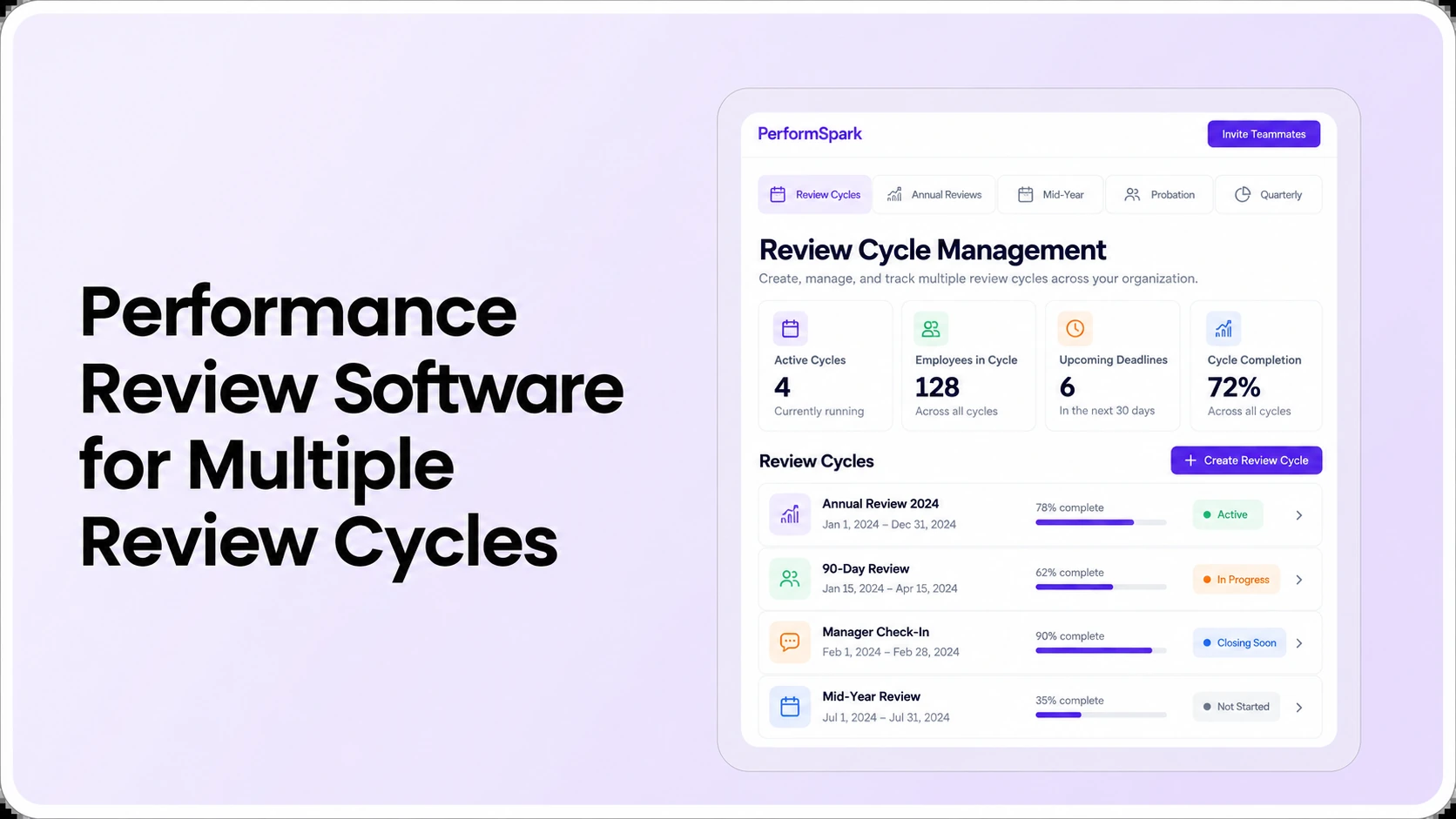
For a targeted test of overlapping assignments, use the multiple review cycles buying guide. For the approval handoff itself, the review approval workflow evaluation can clarify roles, visibility and exception handling. Make sure each participant knows which action is outstanding.
5. Reporting that survives organizational changes
HR should be able to explain how many reviews were assigned, completed, overdue or awaiting approval, including the time range and employee population. A report broken down by manager becomes difficult to interpret if transferred employees are counted twice or if an open review retains an old owner.
Use reporting and analytics to test a known dataset. If the system shows a 90% completion rate, ask how the denominator was calculated and what a report would show if a manager or employee changes teams. The six dashboard evaluation tests provide a separate detailed reporting checklist.
6. Access controls and development follow-through
New management layers must not mean every manager receives every employee's notes. Test security and access controls with HR, employee, manager and executive accounts. Include a supervisor promotion and one transfer as practical permission scenarios.
Review completion should also lead to useful action. Ask whether a manager can record an individual development plan and check progress later. Keep a normal learning objective distinct from a formal performance improvement plan, which may require separate HR guidance and procedural controls.
A growing-company software evaluation checklist: 10 buyer tests
Run the same scripted checks with shortlisted platforms using sample records. Give a passing mark only for behavior actually demonstrated; label anything promised but not shown as needing verification.
- Two departments: create a shared review cycle with appropriately different job competencies and common rating definitions.
- Manager promotion: change an individual contributor into a manager, assign reports and check what employee records become visible.
- Supervisor departure: reassign an unfinished review and show what happens to the evidence from the former reviewer.
- Employee self-review: ask someone unfamiliar with the product to find, complete and submit the assigned assessment.
- Manager workload: ask a manager with several sample direct reports to find upcoming and overdue work in one view.
- Different schedules: run an annual review while another sample employee follows a new-hire milestone process.
- Goal continuity: capture one performance objective and follow it through a check-in and formal review.
- Access boundary: attempt to view an employee record from outside the sample manager's authorized reporting line.
- HR status report: reconcile assigned, completed and outstanding reviews from a known set of test records.
- Contract terms: ask how licensing, onboarding, training, integrations, support and headcount changes affect the first-year and renewal cost.
A product demonstration is an opportunity to test concrete responsibilities, not proof that every optional workflow or integration is supported. Keep a written evidence log, including who performed each scenario, what worked, and any configuration or support needed.
Growth-Stage Software
See how performance reviews scale with your team
Bring a new department, a newly promoted manager and your review cycle to test how roles, tasks and reporting work as your organization grows.
Should growing companies use an HRIS module, a spreadsheet or dedicated software?
The best option depends on the complexity of employee records, review cycles and manager workflows. Comparing products by module count can obscure whether the organization can actually operate them. Evaluate these three operating models against the same buyer requirements.
- Spreadsheets and shared documents: may work with a stable team and straightforward review schedule. Test confidentiality, owner changes and the time required to consolidate results.
- HRIS performance module: may reduce the need to synchronize basic employee information. Test review usability, changing manager permissions, goal integration, exception handling and reporting depth.
- Dedicated performance management platform: may provide more specialized reviews and development workflows. Test integrations, required administration, staff training and commercial terms rather than assuming additional features are always worth buying.
Build a simple weighted scorecard as an illustrative purchasing tool: workflow fit (30%), manager usability (20%), permissions and reporting (20%), implementation ownership (15%), and first-year plus renewal cost (15%). Adjust those weights to your needs. An unacceptable data-access issue should remain a failed requirement even if the rest of the platform scores highly.
How to calculate the operational cost of reviews as you grow
Subscription cost is only one input. Ask how much time HR spends assigning managers, reminding reviewers, checking completion, updating templates and resolving exceptions. Estimate those tasks from observed internal work, not an invented vendor productivity percentage.
For example, suppose an illustrative HR team must check 40 manager assignments each cycle and correct six incorrect owners. The right question is whether the platform identifies and resolves those six cases through a repeatable process. It would be misleading to claim a fixed percentage of hours saved without measuring the current workflow and the vendor's demonstrated task steps.
Use PerformSpark pricing information as an entry point, then request written contract assumptions for headcount changes, billing definitions, implementation services and any add-ons. More software is not automatically a better decision for a growing company.
Implementation plan: Start with one review cycle
- Identify the operational problem: document the current review cycle, overdue work, manager ownership gaps and reporting questions.
- Choose a representative pilot group: include HR, a newly promoted manager, experienced managers and employees from two departments.
- Configure only required templates: keep the first cycle manageable while retaining necessary role differences.
- Use safe test records: evaluate permissions and export behavior without uploading sensitive histories unnecessarily.
- Test interruptions: simulate a manager change, a deadline change, overdue work and an employee transfer.
- Compare evidence with expected results: reconcile the status report and record incomplete features or training needs.
- Assign ownership after launch: designate who administers users, review cycles, reminders, reporting and improvement requests.
The 30-day software pilot plan offers an example evaluation sequence. It is not a guarantee of the time required to configure or implement a particular platform. Use a scoped vendor plan for any live migration.
Common mistakes when purchasing performance software during growth
- Waiting for a magic employee-count threshold: management complexity and workflow breakdown are more useful indicators than headcount alone.
- Buying features no team owns: a powerful configuration tool creates little value if no one can maintain it.
- Judging adoption from a sales demo: have real supervisors perform common tasks without a presenter controlling the screen.
- Using identical goals for unrelated roles: maintain fair process standards while evaluating job-relevant work.
- Confusing rating trends with causation: changes in team composition, rubric or business conditions may explain the difference.
- Ignoring manager changes: misassigned tasks and permissions can leave confidential data visible to the wrong people.
The U.S. Equal Employment Opportunity Commission's performance evaluation guidance emphasizes communicating performance expectations, using relevant facts and applying standards consistently. For significant employment decisions, HR leadership and qualified counsel should review applicable policies and law. Software supports documentation and process but does not independently determine whether an action is fair or lawful.
How to evaluate PerformSpark for your next stage of growth
PerformSpark brings together performance reviews, goal management, feedback and surveys, calibration and workforce reporting. Those connected workflows can be useful to examine when a growing company needs clearer manager responsibilities and development follow-through.
Bring your current review template, one reporting-line change and the management questions from this guide to a live demonstration. Ask the team to show which capabilities are available in your proposed configuration, what must be customized, and what a realistic rollout entails. For a formal comparison, use the vendor RFP checklist alongside the observed demo results.
Growing Companies
Build a review process your managers can sustain
Review templates, goal visibility, manager access, reporting and rollout requirements for your team with PerformSpark.
Book a PerformSpark Demo →Bring your growth-stage evaluation checklist