






Table of Contents

Key Takeaways:
- Use dated project feedback from people who observed the work.
- Keep one accountable people manager responsible for the final assessment.
- Evaluate technical quality, client stewardship, collaboration and development.
- Test permissions for project leads, HR, employees and practice leaders.
- Compare vendors with eight realistic project-review demonstration tests.
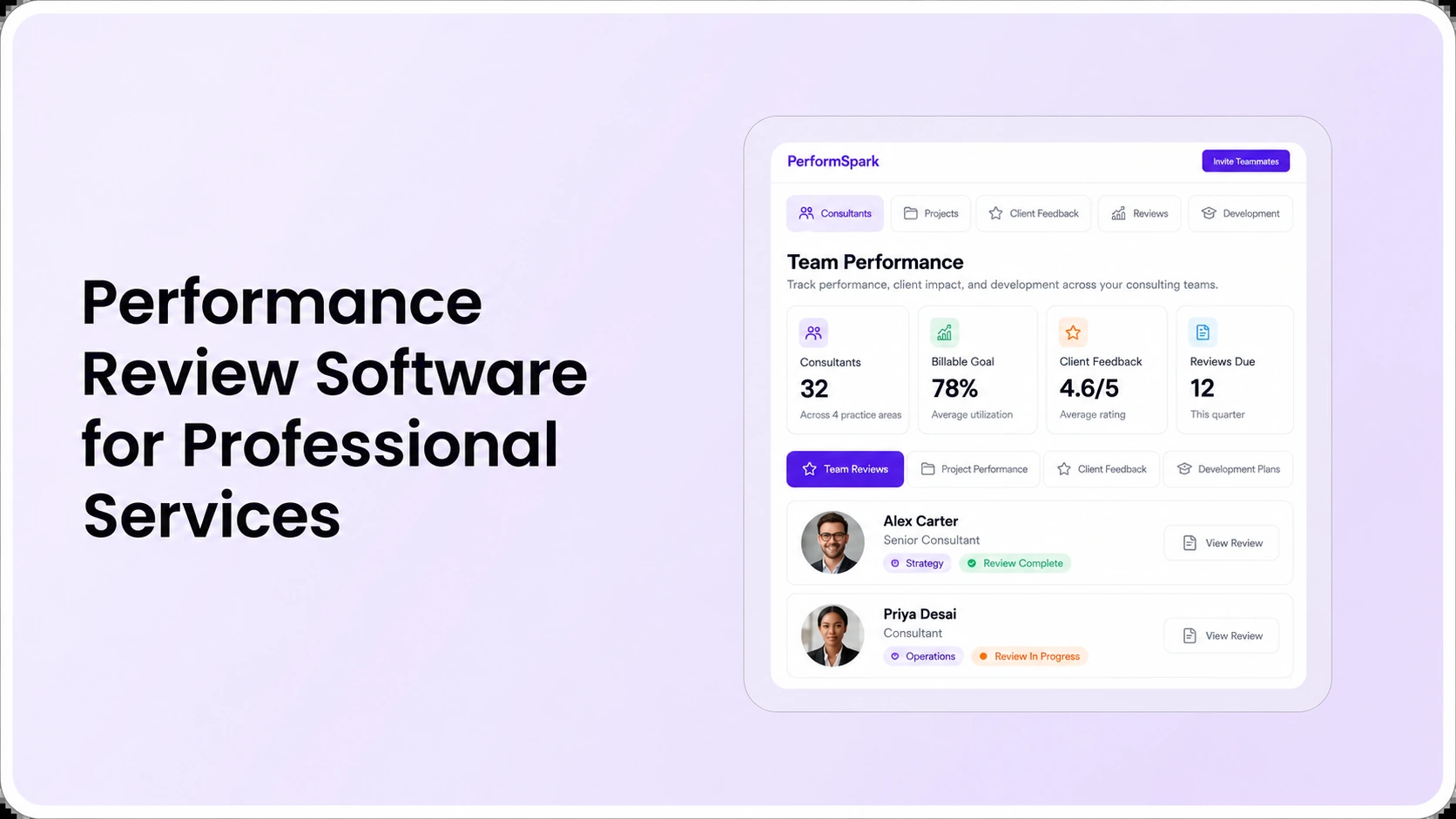
Performance review software for professional services firms should help people managers evaluate work performed across different client projects, gather relevant feedback from engagement leads, and build fair competency-based reviews. The critical test is whether several project contributors can supply useful evidence while one accountable manager retains responsibility for the final evaluation and employee development.
Consider a hypothetical advisory firm. A consultant worked on three engagements over six months: a short process-improvement project, a complex client assessment, and an internal mentoring assignment. Her line manager observed only the last one. A high-quality appraisal should draw on dated feedback from the people who actually saw the work, without turning billable utilization or a single client's reaction into the whole rating.
This buyer's guide covers professional services performance review software, project feedback, role-specific competencies, review-cycle ownership and HR reporting. For the industry overview, see PerformSpark's professional services and consulting solution. This page is about selecting and testing software, not promising outcomes from a particular configuration.
Why professional services reviews need project-level evidence
Consultants, accountants, advisory professionals and agency teams often serve several stakeholders at once. A delivery lead may observe analytical quality and client collaboration, a people manager may understand career progression, and HR may supervise the consistency of review standards. When feedback lives in separate email threads or project trackers, a formal annual review can overweight the most recent engagement.
The CIPD performance management guidance explains that job performance includes task outcomes, contextual contribution and adaptation. It also notes that professional and knowledge work can be difficult to capture through narrow indicators. That distinction is useful in consulting: on-time delivery matters, but so do professional judgment, knowledge sharing, quality and responsible collaboration.
Write down where each type of evidence originates before approaching vendors. A project lead may provide observations from one client engagement; the people manager should integrate those observations with agreed expectations and other relevant evidence. Software should support this handoff, not automatically equate the person who submitted the most feedback with the person who owns the employee's assessment.
Who should contribute to a consulting employee's performance review?
There is no universal reviewer structure. A professional services firm needs a practical responsibility model that matches its organization and access rules. Use the following illustrative review ownership matrix to document the difference between contributing feedback and approving an evaluation.
- Employee: provides a self-assessment, describes project contributions, identifies learning goals and responds to the completed review according to firm policy.
- Engagement or project lead: supplies dated observations about delivery, collaboration, judgment and client work actually witnessed. Access to a feedback request does not automatically require full visibility into private manager notes.
- People manager: owns the full-period evaluation, considers evidence from different engagements, explains the assessment and agrees on follow-through with the employee.
- HR or talent partner: defines the review process, manages exceptions, examines inconsistent criteria and supports the people manager on governance.
- Practice leader: may need approval responsibility or aggregated competency patterns, but individual narrative access should follow an explicit business need.
During a vendor demonstration, sign in with the account for each role and test what is visible. For example, a project lead contributing one review should not be assumed to see another project lead's feedback or the employee's entire history. Compare security and access controls with actual task permissions and consult the vendor about any role-specific configuration.
Which competencies should consulting firms evaluate?
Professional judgment and technical quality
Technical quality varies by discipline. For an accountant it may concern thorough working papers and appropriate escalation; for a consultant it may involve structured analysis, clear recommendations and careful handling of uncertainty. Define the expected behavior by role and seniority instead of using one generic numerical productivity target. Test whether performance review templates support those distinctions.
Client communication and stewardship
Ask for observations about meeting preparation, scope management, clear communication and professionalism. Client satisfaction can inform an assessment, but an unexpected project outcome or one difficult relationship does not, on its own, establish an individual's performance. Qualitative examples must be specific enough for the employee to learn from them.
Collaboration, learning and leadership
Consulting contributions also include helping colleagues, mentoring, improving methods and transferring knowledge between teams. Use individual goals and check-ins and 1-on-1s to examine progress between projects rather than waiting for the annual deadline.
Utilization and commercial contribution
Utilization may be relevant for roles with agreed billable expectations, but it should not substitute for professional quality, ethical conduct or development. An employee may have fewer billable hours because of approved internal assignments, leave or staffing decisions outside their control. The purchasing question is whether HR can record the appropriate context and avoid treating a single financial metric as an automatic rating.
The U.S. Equal Employment Opportunity Commission's performance evaluation guidance emphasizes communicating standards, applying them consistently and explaining assessments with relevant facts. Employment evaluations must be reviewed in light of applicable law and firm policy; software is not a substitute for sound HR judgment.
How should project feedback reach the annual employee review?
A useful design separates collection, assessment and development. First, authorized project leads contribute relevant examples. Next, the people manager examines the time period and role expectations. Finally, the employee receives a meaningful conversation and agreed actions.
- Request: identify the engagement, feedback provider, employee and competencies being assessed. Ask whether reminders are limited to actual outstanding requests.
- Capture: gather short, evidence-based observations while the project is recent, including the employee's strengths, collaboration and improvement opportunities.
- Review: allow the people manager to read only appropriately authorized contributions and identify missing engagement perspectives.
- Discuss: compare feedback against goals and other work evidence, distinguishing fact, opinion and circumstances beyond the employee's control.
- Follow through: agree on a specific coaching or development action and revisit it at the next relevant check-in.
The feedback and surveys workflow can illustrate collecting relevant input, while 360-degree feedback provides a more structured multi-source process when warranted. Those are distinct methods, and the organization should verify which one supports its specific project-feedback requirements.
A project can end months before an annual appraisal. If the platform is tested only with the most recent project, the vendor may never demonstrate how historical feedback remains available or how one people manager synthesizes contributions over the complete review period.
What about confidentiality and reviewer fairness?
A project lead may be asked to comment on one engagement without becoming a formal reviewer for every other project. Separate permission to submit feedback from permission to open ratings, private notes, draft reviews and HR reports. For multi-rater programs, determine whether the organization promises confidentiality or anonymity, then ask how small reviewer groups and open-text comments affect those promises.
Managers should discuss whether feedback is representative of the work performed. More comments do not mean better evidence, and a high-profile project should not automatically carry more weight than quiet, complex work. A calibration process can support consistency where appropriate, but should rely on documented standards rather than a forced rating distribution.
For unresolved performance concerns, distinguish ordinary coaching and development from the firm's performance improvement process. Formal decisions require qualified HR oversight and any needed legal review. Do not describe a software workflow as inherently legally compliant or unbiased.
Eight software demo tests for professional services buyers
Use a fictional employee, two project leads and one people manager. Ask each vendor to perform these steps with actual role accounts rather than describe them in a slide deck. Record demonstrated, requires configuration, not demonstrated or does not meet requirements.
- Two project leads: request relevant observations from two different engagement managers for the same consultant.
- Restricted contributor view: let one project lead submit feedback and attempt to open other project feedback and confidential people-manager notes.
- End-of-engagement feedback: close one project and confirm authorized feedback remains interpretable when the annual review starts.
- Role-specific competencies: compare templates for a junior analyst, experienced consultant and project manager.
- Utilization context: record an illustrative commercial target and see whether supporting narrative can explain approved internal work or staffing changes.
- Manager ownership: transfer the employee to a new people manager and inspect what happens to assigned tasks and historical input.
- Development follow-through: agree on a skill objective and show the next check-in or individual development plan task.
- Practice reporting: reconcile completion counts and employee-group filters through reporting and analytics, respecting access boundaries.
Ask who handles failed invitations, conflicting feedback, a manager who leaves, and external project contributors. The correct answer may involve HR policy or manual approval as well as product settings. The important outcome is a documented, workable process.
Project Feedback Review
Test project feedback across multiple managers
Bring an employee with two project leads and a people manager. Test reviewer permissions, evidence handoff, final assessment and development follow-through.
How to compare review software without rewarding unnecessary features
A focused evaluation scorecard can compare five buying criteria. As a planning example, weight feedback capture at 25%, final manager review ownership at 25%, role and data permissions at 20%, competency and development follow-through at 20%, and implementation and cost at 10%. These are adjustable priorities, not external benchmarks or verified software scores.
- Feedback fit: can project contributors provide useful evidence without extensive administration?
- Manager accountability: can one authorized manager create a complete assessment from multiple engagements?
- Privacy and employee visibility: can the organization test contributor, people manager, HR and employee access separately?
- Competency and development fit: can the assessment distinguish technical quality, client work and longer-term growth?
- Operating cost: are licensing, onboarding, training, integrations, support and exports clearly covered in a written proposal?
Apply non-negotiable access and legal requirements as separate gates. A platform with a strong overall score should still be rejected or reconfigured if a project reviewer can access employee records beyond the firm's policy. For broader procurement questions, use the performance management RFP checklist and performance management software buying guide.
What should HR report after project reviews?
A practical HR dashboard should separate process completion from performance conclusions. For an illustrative firm of 40 consultants, an assigned feedback population of 30 and 24 completed requests would yield an 80% submission rate. That is not the proportion of employees who completed annual reviews, nor evidence that the projects were successful. Label the reporting unit and date.
Practice leaders may need aggregate completion trends and competency themes. Managers may need only their authorized teams. The reporting tools should therefore be assessed alongside access settings. Filter by review cycle, practice and manager, then verify that an export does not disclose information unavailable in the permitted on-screen view.
Compare ratings only when assessment periods, scales and employee roles are reasonably aligned. For unrelated specialties, a single ranking table is often less useful than a role-based review of evidence and development needs. Consider the six dashboard tests for HR buyers for more rigorous reporting validation.
Rollout checklist for consulting and advisory firms
- Define reviewer roles: agree which engagement contributors can submit input and which people manager owns the final review.
- Map competencies: choose expectations that correspond to consulting role and seniority, not simply the same utilization target.
- Decide collection points: request relevant evidence at project completion or agreed checkpoints, without creating a heavy form for every meeting.
- Test privacy: sign in as project lead, people manager, employee and HR, then compare permissions.
- Trial a complete review: include two separate engagements and feedback that does not fully agree.
- Close the loop: make the employee's development action and next responsible person explicit.
- Validate technology: check integration requirements, exported records, HR administration and training responsibilities before rollout.
The implementation plan should explain who keeps reviewer assignments accurate when projects start, end or change personnel. Keep a controlled test log of what each vendor demonstrated; otherwise, buyers may confuse the requirements they asked about with features the platform actually supports.
Where PerformSpark fits into the decision
PerformSpark connects performance reviews, goals, 360-degree feedback, check-ins and development plans. These published workflows are relevant to professional services, but a buyer should confirm the exact project reviewer permissions, assignment logic, integration scope and manager handoffs during a product demonstration.
Bring one employee with two engagement leads, a people manager and a realistic completed project. Ask the team to demonstrate the complete evidence-to-review process, identify configuration needs and confirm expected costs through current pricing information. Where a requirement cannot be shown, leave it unverified rather than assuming it is supported.
Consulting Team Reviews
See how PerformSpark supports multi-project feedback
Walk through project feedback, consultant competencies, manager review ownership and confidential access with your actual buying checklist.
Book a PerformSpark Demo →Bring your consulting review requirements