

.svg)





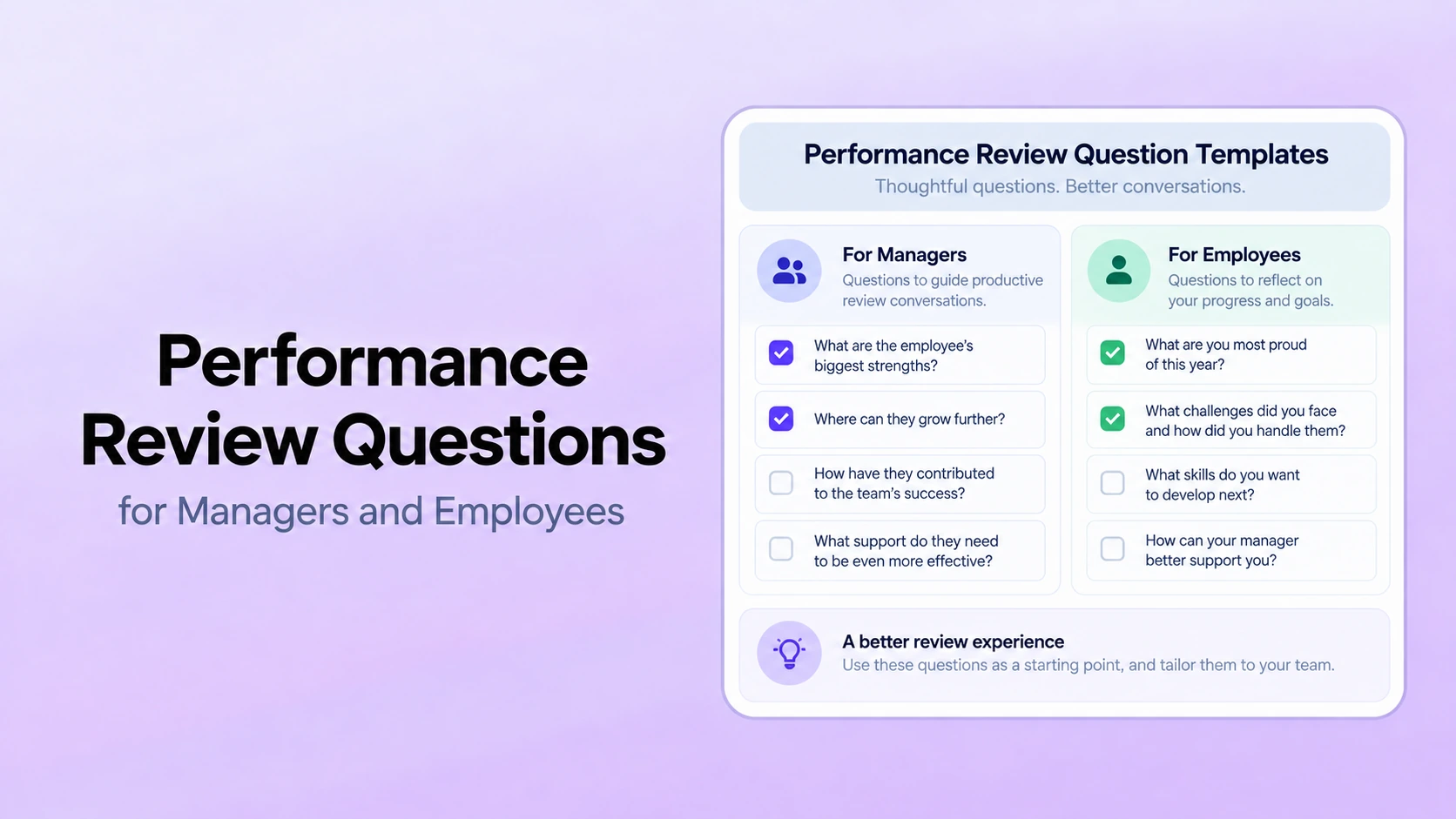
Table of Contents

Key Takeaways:
- Use a focused subset of the 38 questions based on the role, review purpose, available evidence, and decision required.
- Managers and employees should prepare examples from the full review period instead of relying on recent memory.
- Ask evidence-based questions about results, strengths, obstacles, manager support, development, and rating consistency.
- Avoid leading, personality-based, or vague questions that make it harder to separate evidence from opinion.
- End the review with documented goals, development actions, manager commitments, evidence expectations, owners, and follow-up dates.
Good performance review questions turn a review from a rating exercise into an evidence-based conversation about results, strengths, obstacles, support, development, and what should happen next. The best question set is not the longest one. It is the smallest set that fits the role, review purpose, available evidence, and decisions the conversation needs to support.
This guide includes 38 questions for managers and employees, plus a practical way to choose them, prepare for the discussion, avoid weak question patterns, and turn answers into goals, development actions, calibration evidence, or follow-up work.
If your team is designing the broader review workflow, use these questions alongside PerformSpark's performance review software and this guide to the employee performance review process.
Which Performance Review Questions Should You Use?
Do not ask all 38 questions in one meeting. A focused annual review may use several questions from each relevant category, while a lighter quarterly conversation may use only a few. For cadence decisions, see the guide to annual vs. quarterly performance reviews.
How Managers and Employees Should Prepare
Managers should review the full review period, not only the most recent project. Bring documented goals, previous check-ins and 1-on-1s, authorized feedback, examples of work, prior commitments, and the rating definitions used by the organization. If the review includes competency-based assessment, use role-appropriate criteria such as those in this performance appraisal criteria guide.
Employees should prepare examples, not only conclusions. Bring completed goals, outcomes, obstacles, feedback, changed priorities, work that may not have been visible to the manager, and one or two development priorities. This self-assessment performance review guide can help structure that reflection.
Both sides should distinguish performance evidence from assumptions about personality, intent, or potential. Questions should help clarify what happened, why it mattered, what support was available, and what should change next.
Performance Review Questions About Results
Compare answers with documented goals rather than relying on memory. A connected goal management process makes it easier to distinguish the original target, later changes, progress, and final outcome.
Questions About Strengths and Effective Behaviors
Keep this section evidence-based. If a manager needs examples of how to phrase strengths or improvement areas clearly, use these performance review strengths and weaknesses examples as a writing reference rather than as a substitute for role-specific evidence.
Questions About Challenges and Improvement
Separate a capability gap from unclear expectations, missing resources, or a process problem. If the issue requires structured follow-through beyond normal coaching, HR may need a documented performance improvement plan rather than a vague promise to “do better.”
Questions Managers Should Ask Employees
These questions make the review a two-way management conversation. Managers who want stronger follow-through between reviews can use structured manager coaching prompts and the recurring practices in this guide to high-leverage 1-on-1 meetings.
Questions Employees Can Ask Managers
The manager should answer with observable expectations and examples whenever possible. Employees can use those answers to clarify goals, role scope, skill priorities, and the evidence expected before the next review.
Questions About Development and Career Growth
When development requires multiple actions, convert the discussion into an individual development plan with clear owners, evidence, and follow-up. For broader capability planning, connect the review with skills management rather than treating development as an isolated note in the review form.
Questions Before Finalizing a Rating
Use the organization's actual rating definitions rather than relying on instinct. If the rating scale itself needs work, review these performance review rating scale options. When multiple managers apply the same scale, a structured performance calibration process can help compare standards across teams, supported by these calibration best practices.
Worked Example: Move From Opinion to Evidence
Weak answer: “I think I communicated well and supported the team.”
Stronger answer: “During the product launch, I created a weekly decision log, surfaced two cross-functional blockers before they affected the timeline, and changed the stakeholder update format after feedback from Sales and Support. The evidence is in the project notes, launch timeline, and stakeholder feedback.”
The stronger answer is useful because the manager can test the claim against actual work. The same principle applies when managers write the final review. Use specific examples, outcomes, context, and expectations rather than generic adjectives. See these performance review examples and phrases for managers for additional writing patterns.
Performance Review Questions to Avoid or Rewrite
How to Turn the Conversation Into Action
A review should end with a small number of documented next steps. Capture:
Use feedback workflows and 360-degree reviews when broader input is appropriate, then track the actions through goals, 1-on-1s, and development plans. HR can monitor completion and patterns through reporting and analytics and the measures in this performance management metrics guide.
Bottom Line
Performance review questions are useful when they produce evidence, clarity, and a decision about what happens next. Select the questions that fit the review purpose, prepare evidence before the meeting, avoid leading or personality-based wording, and document the actions that follow.
If you need a reusable starting point for the review form itself, PerformSpark also provides free performance review templates.




.svg)

.svg)
.svg)