

.svg)





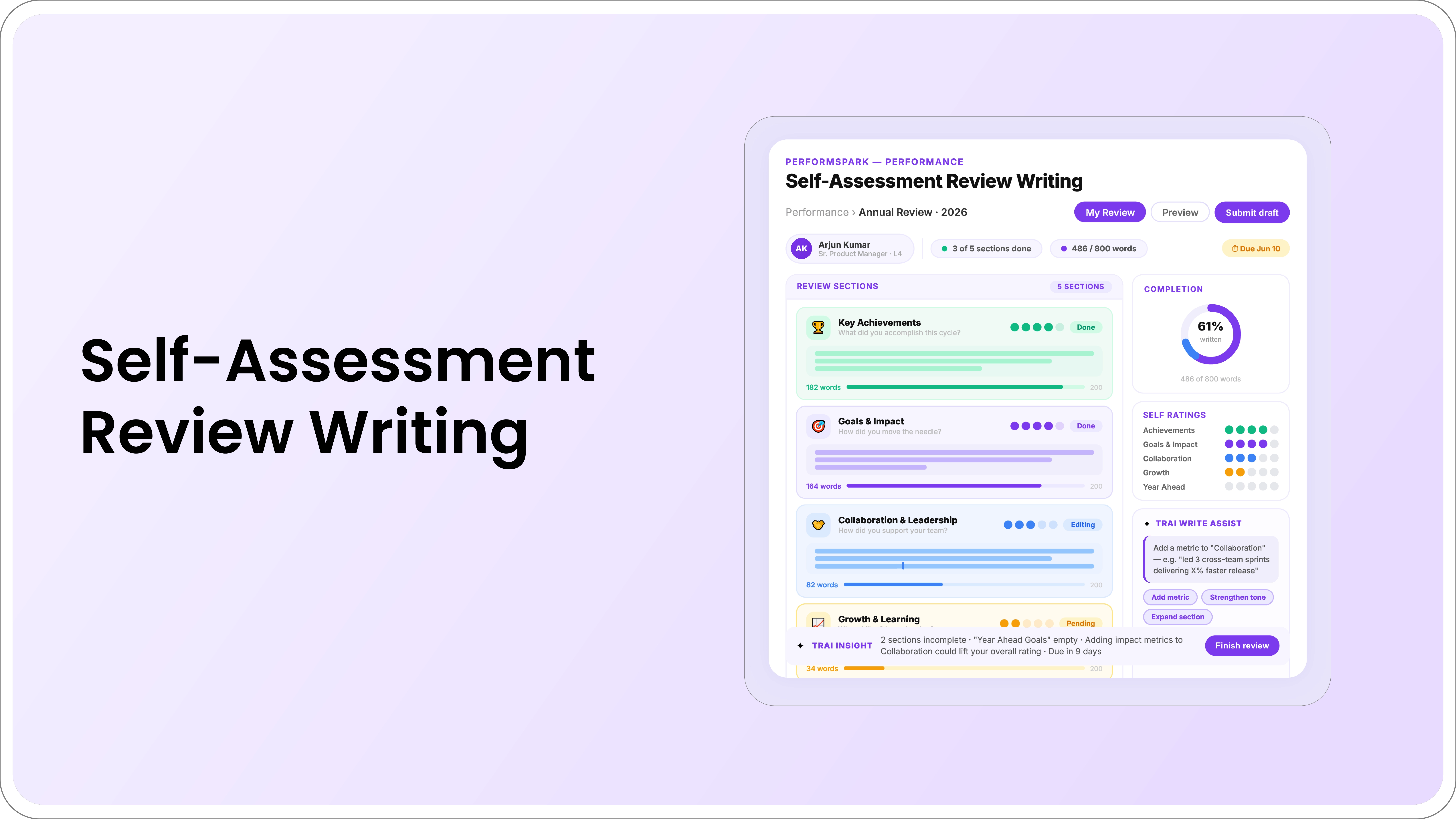
Table of Contents

Key Takeaways:
- Focus on representative contributions, reliable evidence, impact, and next steps rather than listing every task.
- Address completed and incomplete goals directly, including relevant context and the employee's own responsibility.
- Use observable behavior for strengths and development priorities instead of personality labels.
- Structure important points around contribution, evidence, impact, and the next step.
- A self-assessment informs the manager's review, but it does not determine the final rating by itself.
A self-assessment gives an employee a structured opportunity to explain their performance during the review period. It should help the manager understand important results, work that may not have been visible, changes to goals or responsibilities, feedback the employee applied, and development priorities for the next period.
A strong self-assessment is not a list of every task completed. It is a concise, evidence-based reflection on the work that mattered most. The employee should explain the expectation, their contribution, the result, and what they learned or plan to do next.
This guide focuses on the writing process. For short first-person wording, use the self-appraisal comments examples. For longer role-specific samples, use the self-evaluation examples and templates.
What Is a Self-Assessment in a Performance Review?
A self-assessment is the employee's written evaluation of their own work during a defined review period. It may be completed before the manager's assessment or as part of the same performance review workflow.
The format varies by organization, but a useful self-assessment usually covers:
- Major accomplishments
- Progress against agreed goals
- Role responsibilities and competencies
- Feedback received and applied
- Challenges, changes, or dependencies that affected the work
- Strengths to continue
- Development priorities
- Goals and support needed for the next period
The employee's perspective is one source of information. The manager should consider it alongside goals, work outcomes, documented 1-on-1 conversations, feedback, and other relevant evidence.
What a Self-Assessment Should Accomplish
A well-written self-assessment should make the review conversation more accurate and useful. It can:
- Surface work the manager did not directly observe
- Clarify the employee's contribution to shared outcomes
- Document changes to scope, resources, or priorities
- Show how the employee responded to feedback
- Identify a realistic development priority
- Prepare both parties to discuss next-period goals
It should not attempt to control the final rating, dismiss manager feedback in advance, or present unsupported conclusions. The goal is to provide clear context and evidence.
A Six-Section Self-Assessment Structure
The structure below mirrors PerformSpark's free, downloadable employee self-appraisal template, which provides fillable fields for each of these sections if you would rather start from a ready-made form than build one from scratch.
1. Role and review-period context
Begin with a short summary of the period. Mention important changes that affected the work, such as a new role, expanded responsibilities, a team transition, revised priorities, or a major dependency.
Example: “During this review period, I moved from supporting customer implementations to owning two projects independently. My responsibilities expanded to include project planning, weekly stakeholder updates, risk escalation, and final handoff.”
This context helps the reviewer understand the scope of the examples that follow. It should explain the work, not excuse every missed outcome.
2. Major accomplishments and impact
Select the achievements that best represent the employee's contribution. For each one, explain:
- The objective or problem
- The employee's specific role
- The action taken
- The result or impact
- Relevant evidence
Weak: “I helped with the onboarding project.”
Stronger: “I redesigned the customer onboarding checklist, coordinated review with support and implementation teams, and introduced an owner and due date for every handoff. The new process reduced missing setup information and gave project leads a consistent way to identify blockers before launch.”
Use exact figures only when the source is reliable and the employee can explain how the measure was calculated. A clear qualitative result is better than an invented number.
3. Progress against goals
Review each important goal through the connected goal management record. State the original target, current result, and relevant context.
For a completed goal, explain what enabled success and what should be repeated. For an incomplete goal, explain the gap directly, including changes to scope, dependencies, decisions, or employee actions.
Example: “The reporting automation goal was partially completed. The data-cleanup and validation stages were finished, but deployment moved to the next quarter after the source-system change. I documented the remaining dependencies and agreed on a revised milestone with the analytics lead.”
A missed goal should not be hidden. Balanced reflection demonstrates judgment and gives the manager a clearer basis for the conversation.
4. Feedback received and applied
Choose one or two meaningful examples of feedback. Explain the original observation, the action taken, and the change the employee or others observed afterward.
Example: “My manager asked me to make executive updates shorter and more decision-focused. I changed the format to include current status, business impact, recommendation, and owner. I used the format in the next three steering meetings and received fewer follow-up questions about the required decision.”
Feedback may come from a manager, peer, customer, project retrospective, feedback survey, or 360-degree review. Use feedback from people who had a relevant opportunity to observe the work.
5. Strengths and development priorities
Identify the strengths that contributed most to performance and one or two development priorities that would make the greatest difference.
Use behavior rather than personality:
- Strength: “I identify delivery risks early and bring stakeholders a proposed response.”
- Development priority: “I need to make ownership and deadlines clearer when decisions are made in cross-functional meetings.”
The strengths and weaknesses examples provide additional wording. For development-focused manager feedback, review the areas of improvement guide.
Do not create a false weakness to make the assessment appear balanced. A development priority can be preparation for broader responsibility rather than evidence of current underperformance.
6. Next-period goals and support
End with two or three priorities for the next period. Explain the result to achieve, why it matters, and what support or experience is needed.
Example: “During the next period, I want to lead one cross-functional implementation from planning through handoff. I will need agreement on the project scope, an experienced sponsor for the first planning review, and feedback after each major milestone.”
When the priority involves a capability that requires sustained development, it can move into an individual development plan with activities, milestones, manager support, and progress dates.
Use the Contribution-Evidence-Impact-Next Step Framework
For each important point, use four elements:
- Contribution: What the employee did
- Evidence: The project, record, feedback, or result that supports it
- Impact: Why the contribution mattered
- Next step: What to continue, improve, or build next
This structure prevents the self-assessment from becoming either a task list or a series of unsupported claims.
Example: “I created a weekly risk-review process for active customer projects. Project records show that risks were assigned an owner and next action before each steering meeting. This helped dependent teams respond earlier. Next quarter, I will extend the same process to internal platform projects.”
How to Discuss Shared Team Results
Employees should acknowledge team contributions while making their own role clear.
Too broad: “We launched the new process successfully.”
More useful: “The team launched the new process successfully. I owned the workflow mapping, coordinated feedback from three departments, and prepared the final implementation checklist.”
A self-assessment should not claim credit for other people's work. It should help the manager understand the employee's specific contribution within the shared outcome.
How to Address a Missed Goal or Performance Gap
Use a direct, accountable structure:
- State the expectation
- State the result
- Explain the relevant cause or context
- Identify the employee's responsibility
- Describe the corrective action
- Define how progress will be reviewed
Example: “I did not consistently send the required weekly project update during the first half of the period. Competing deadlines contributed, but I should have raised the conflict and confirmed priorities earlier. I now block time each Thursday, use the standard update template, and review overdue actions during my manager check-in.”
This approach demonstrates self-awareness without minimizing the issue or accepting responsibility for factors outside the employee's control.
How Long Should a Self-Assessment Be?
There is no universal word count. The appropriate length depends on the number of questions, review period, role complexity, and the organization's instructions.
Use enough detail to support the important points without documenting every task. A short form may require a few focused paragraphs. A free-form annual assessment may need separate sections. Managers should be able to identify the main achievements, evidence, development priority, and next steps without searching through unnecessary detail.
Common Self-Assessment Mistakes
Describing effort without the result
“I worked very hard” does not explain what the effort produced. Describe the completed work, problem solved, or lesson learned.
Listing every task
A long activity list hides the work that mattered most. Prioritize representative contributions.
Using unsupported numbers
Do not estimate percentages or financial impact merely to make the statement appear stronger. Use verified data or explain the result qualitatively.
Claiming no development needs
Most roles contain opportunities to build capability, improve consistency, or prepare for broader responsibility. Choose a genuine, useful priority.
Taking full credit for shared work
State the team outcome and then clarify the employee's contribution.
Using vague personality language
Replace “I am a natural leader” with observable examples of decision-making, communication, delegation, or coaching.
Writing only for the rating
The self-assessment should improve the quality of the review and development conversation. It is not a negotiation document that guarantees a particular score.
How the Self-Assessment Supports the Manager Review
The manager should review the self-assessment before completing the final narrative. It may add context, identify evidence that was not visible, or reveal a difference in how expectations were understood.
When the organization uses performance calibration, relevant self-assessment evidence may help the manager explain the proposed rating. Calibration participants should still review the complete performance record and rating standard. The employee's statement does not determine the final rating by itself.
The manager performance review phrases page helps managers turn the combined evidence into a clear assessment.
Self-Assessment Review Checklist
- The review period and role context are clear.
- Major achievements describe the employee's specific contribution.
- Important claims are supported by reliable evidence.
- Completed and incomplete goals are addressed directly.
- Feedback includes the action taken afterward.
- Strengths and development priorities describe observable behavior.
- Next-period goals include required support.
- The assessment avoids unsupported numbers and personality labels.
- Team contributions are acknowledged accurately.
- The final version is focused enough for the manager to use.
Connect Reflection to the Next Performance Cycle
PerformSpark connects employee self-assessments with manager reviews, goals, check-ins, feedback, calibration, development plans, and reporting and analytics. Employees and managers work from the same review-period record instead of separate documents.
Explore PerformSpark pricing or book a personalized demo to see how self-assessments can move directly into review conversations and development actions.




.svg)

.svg)
.svg)

