
.svg)





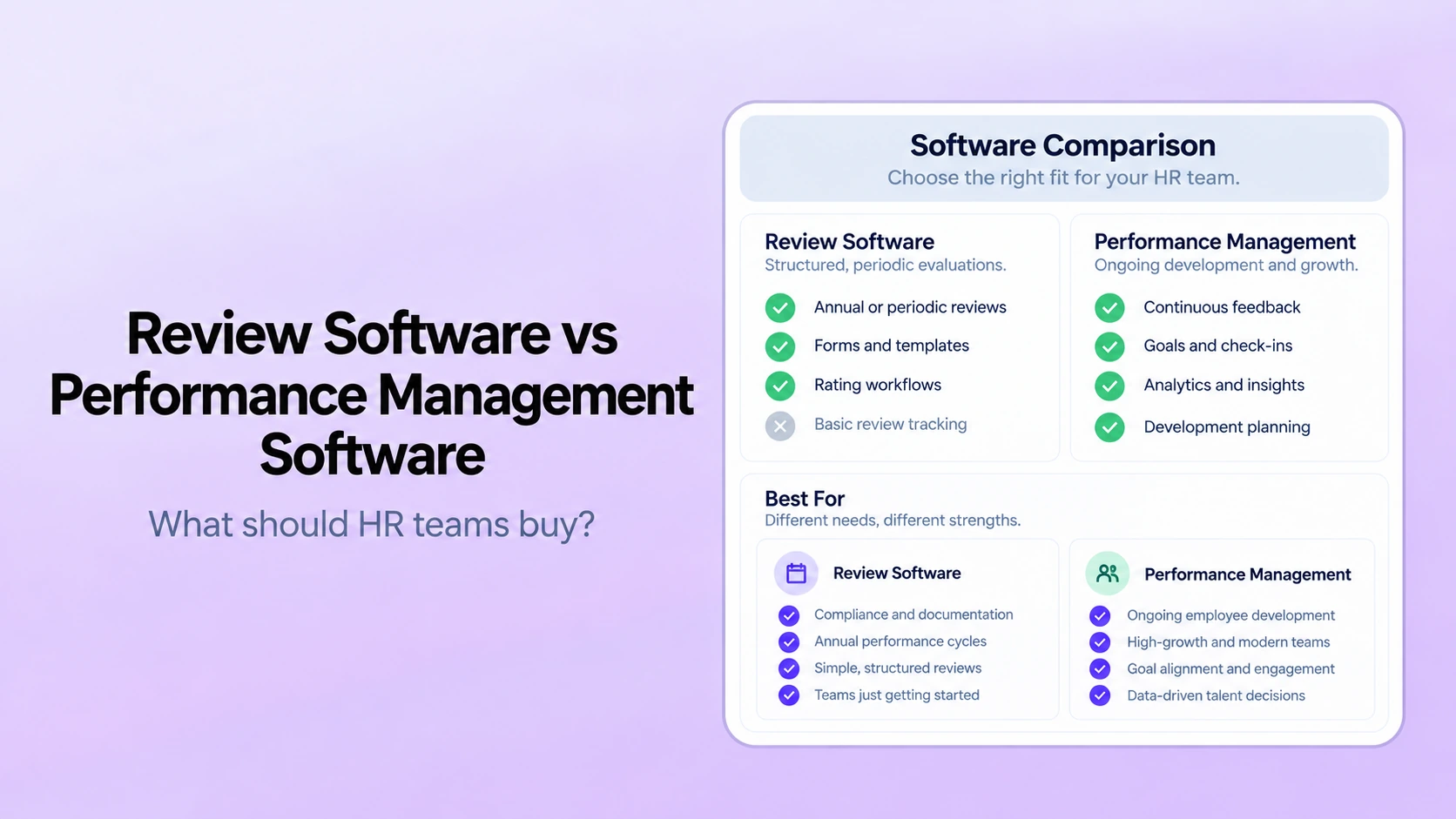
Table of Contents

Key Takeaways:
- Performance review software focuses on formal evaluation cycles, while performance management software supports the wider year-round process.
- A focused review tool can be enough when goals, coaching, feedback, and development already work elsewhere.
- Broader software becomes more useful when reviews need connected evidence from goals, check-ins, feedback, calibration, development, and reporting.
- PerformSpark connects reviews with goals, 1-on-1s, feedback, 360 reviews, calibration, IDPs, PIPs, recognition, analytics, notifications, integrations, skills, and assistive AI.
- Choose the smallest system that supports the full operating model your HR team actually plans to run.
Performance review software is built around formal evaluation cycles. Performance management software supports a broader year-round process that can connect reviews with goals, manager check-ins, feedback, calibration, development, performance improvement, recognition, and reporting.
The distinction matters because HR teams can make two expensive mistakes. One is buying a large platform when the only real problem is administering a review cycle. The other is choosing a review-only tool when managers are already struggling with disconnected goals, weak coaching history, inconsistent feedback, manual calibration, or development actions that disappear after the review is signed off.
The categories overlap, so the label on a vendor website is not enough. A better buying question is: what work should managers, employees, and HR be able to complete between one review cycle and the next?
What Review-Only Software Actually Covers
Review-only software is designed around the formal evaluation cycle itself. Typical workflows include review templates, self and manager assessments, rating scales, peer or multi-rater input, assignments, reminders, approvals, completion tracking, and final records.
That scope can be completely sufficient when HR already has working systems for goals, manager coaching, feedback, and development. In that situation, the software only needs to make the review cycle easier to launch, complete, govern, and document.
The limitation appears when managers need context from outside the review form. If they still have to search other systems for goals, check-in notes, feedback, or development history, the tool is solving the evaluation event rather than the wider performance process.
For an example of how the formal review workflow fits inside a broader system, see PerformSpark Performance Reviews.
Where Performance Review Software Stops — and Performance Management Begins
Performance review software is designed primarily around the evaluation event itself: forms, self-assessments, manager reviews, ratings, approvals, reminders, and final records.
Performance management extends beyond that event. The difference is what happens between review cycles. Goals stay active, managers hold recurring check-ins, feedback is collected when work happens, calibration adds governance to rating decisions, and review outcomes can lead into development or performance-support actions.
That distinction is the buying signal. If HR mainly needs to run a cleaner review cycle, a focused review tool may be enough. If managers need shared context from goals, check-ins, feedback, calibration, and development plans, the requirement is broader performance management.
For the broader category definition and product-level overview, use the main performance management software guide. This article stays focused on the purchase decision between review-only software and a connected year-round performance system.
Performance Review Software vs. Performance Management Software
| Buying Question | Review-Only Software | Broader Performance Management | PerformSpark Workflow |
|---|---|---|---|
| Formal reviews | Core use case | One part of the wider cycle | Performance reviews connected with year-round evidence |
| Goals | May capture goals for evaluation | Ongoing ownership, progress, and review context | Goal management |
| Manager coaching | Often outside the review workflow | Recurring check-ins between cycles | Check-ins and 1-on-1s |
| Feedback | Often cycle-specific | Continuous and multi-source feedback | Feedback and surveys plus 360 reviews |
| Rating governance | May stop at submitted ratings | Calibration and evidence review | Calibration |
| Development | May record a final development note | Owned actions and ongoing follow-through | Individual development plans |
| Performance support | Usually handled elsewhere | Structured follow-up for improvement | Performance improvement plans |
| Recognition | Usually separate | Can stay visible as part of the performance record | Employee recognition |
| Reporting | Cycle completion and ratings | Cross-workflow performance insights | Reporting and analytics |
| Adoption support | Review reminders | Prompts across recurring workflows | Smart notifications |
| HR stack connection | May use imports or basic integrations | Ongoing data exchange with other HR systems | Integration workflows and available integrations |
When Performance Review Software Is Enough
A focused review tool can be the right decision when the review cycle is the only process that needs improvement. That usually means goals already work somewhere else, managers have an established coaching rhythm, calibration is simple, development follow-up is managed effectively outside the review system, and HR mainly needs cleaner forms, reminders, approvals, and final records.
In that situation, buying more software does not automatically create better performance management. Unused modules add implementation work, administration, and cost without changing manager behavior.
When HR Needs Broader Performance Management Software
A broader platform becomes more useful when the problems happen between review cycles: goals are stale, check-ins are inconsistent, feedback is hard to retrieve, managers write reviews from memory, calibration requires manual spreadsheets, development actions are not revisited, or HR cannot see the performance process as one connected system.
If those are the problems, the buying requirement is no longer just a review form. It is a connected performance management platform.
How PerformSpark Supports the Full Performance Management Cycle
PerformSpark is designed for organizations that want a focused performance management layer while keeping their existing HRIS or core HR system. For a BOFU buyer, the important distinction is not that PerformSpark has more features than a review-only tool. It is how the individual workflows connect so managers and HR do not have to rebuild context at every stage.
Performance Reviews: the formal decision point
Performance reviews remain the formal evaluation layer, but they do not have to start with a blank page. Review cycles can draw context from goals, feedback, prior conversations, development activity, and other performance records already captured during the year. That gives managers a stronger evidence base and reduces the dependence on recent memory.
Goal Management: keep expectations current between reviews
Goal management gives managers and employees a place to maintain ownership, progress, and changing priorities during the cycle. The buying value is the connection back to reviews: goal evidence can remain part of the performance conversation rather than being copied manually into a separate review form at the end of the period.
Check-ins and 1-on-1s: turn recurring conversations into follow-through
Check-ins and 1-on-1s support the manager rhythm between formal evaluations. Instead of treating every review as a fresh reconstruction of the employee's year, recurring conversations can preserve context, actions, and follow-up that help both managers and employees prepare for the next performance decision.
Feedback and Surveys: collect evidence outside the review window
Feedback and surveys allow performance-related input and employee listening to happen outside the annual or semiannual review. This is useful when HR wants a broader view of the employee experience without forcing every observation into the review form itself.
360 Reviews: add multi-source perspective when the process requires it
360 reviews support situations where manager-only input is not enough. Peer, upward, or other multi-source perspectives can provide additional context for development and performance discussions when the organization's process calls for them.
Calibration: make rating discussions more structured
Calibration becomes important when ratings influence consequential talent decisions. The software should help reviewers compare ratings with supporting evidence and document the discussion, while accountable leaders retain responsibility for the decision. PerformSpark is designed to support that human review process rather than automate employment decisions.
Individual Development Plans: carry review outcomes into the next cycle
Individual development plans give review outcomes somewhere to go. Instead of ending the process with a development paragraph that is never revisited, HR and managers can connect performance discussions to owned development actions and follow-up.
Performance Improvement Plans: structure performance support
Performance improvement plans provide a separate workflow for situations that require clear expectations, actions, ownership, and follow-up. These workflows should support HR and manager judgment, not predetermine an employment outcome.
Skills Management: connect role evidence with development
Where skills and role readiness matter, skills management can add another layer of evidence to reviews and development conversations. The practical value is being able to discuss performance and capability development in the same broader system rather than treating them as unrelated records.
Employee Recognition: keep positive contribution evidence visible
Employee recognition adds positive contribution evidence between formal cycles. Recognition should not determine a rating on its own, but it can give managers additional context about work that may otherwise be forgotten by the time the next review is written.
Reporting and Analytics: see the process, not just the final rating
Reporting and analytics can help HR look across review progress, goals, rating patterns, calibration context, and other performance activity. The goal is not to reduce employee performance to a single score. It is to give HR a clearer view of where a process is working, where it is stalled, and where human investigation is needed.
Smart Notifications: support adoption without relying on HR follow-up
Smart notifications help reinforce the recurring work that makes performance management useful: updates, deadlines, manager actions, and follow-through. This matters because a broader platform only creates value when managers and employees actually use the workflows between review cycles.
Integrations: keep the performance layer connected to the HR stack
PerformSpark is not positioned as a replacement for every HR system. Integration workflows and the integrations directory are relevant for organizations that want employee and organizational data to stay connected while using a specialist performance platform.
TrAI: assistive AI, not an employment decision-maker
TrAI, PerformSpark's assistive AI layer, supports HR and manager workflows where AI can help with drafting, summarization, or pattern review. The important governance principle is that people remain accountable for performance judgments and employment decisions. For a deeper buyer checklist, see the AI performance review software guide.
From Review Cycles to Year-Round Performance
See How the PerformSpark Workflows Connect
Bring your current review process, goals, manager check-ins, feedback, calibration, development, and reporting requirements to one focused walkthrough.
Which Category Supports Manager Adoption?
Neither category automatically creates adoption. A clean review interface can still fail if managers have to reconstruct the year from several systems. A broad platform can also fail if recurring workflows are too complicated to use consistently.
Test the work a manager actually performs: find a goal, prepare for a 1-on-1, capture a follow-up action, request feedback, open a review, locate supporting evidence, and complete the next step. Repeated entry, unclear ownership, or difficult navigation is a stronger warning sign than a missing secondary feature.
How Calibration Changes the Buying Decision
When ratings influence compensation, promotion, succession, or other consequential decisions, a review-only process may not be enough. Evaluate evidence access, permissions, rating distributions, original and adjusted ratings, reason capture, and how the organization documents final decisions.
Software can organize the evidence and workflow, but accountable people should interpret that evidence and make the decision. Automated scores should not replace human review.
How Goals and Feedback Change the Decision
If goals are central to the performance model, test whether progress stays connected to the review instead of being copied into it manually. The same applies to feedback. Cycle-specific peer input is useful, but it solves a different problem from year-round feedback that managers can revisit later.
A broader platform is most valuable when these workflows share context without forcing managers to maintain duplicate records.
What About AI Features?
Evaluate the use case rather than the AI label. Ask what employee records the AI can access, whether source evidence is inspectable, how output is stored, whether the feature can be disabled, and which person verifies output before it affects an employee record or decision.
Use the AI performance review software guide for a deeper evaluation framework.
Implementation: Focused Tool vs. Broader Platform
A review-only implementation still requires process decisions, employee data, permissions, templates, testing, communication, and support. A broader platform adds goals, check-ins, feedback, development, integrations, analytics, and governance.
The safest implementation sequence is to launch the workflows that solve a documented problem, then expand. Buying a broad platform does not mean every module should go live on day one.
How to Compare Total Cost
Compare the full operating model: subscription fees, required modules, implementation, migration, integrations, training, support, internal administration, other tools that remain necessary, renewal terms, and exit requirements.
For the PerformSpark option, review the current pricing approach as part of the same comparison rather than evaluating license price in isolation.
Buyer Checklist: What Should HR Teams Buy?
A focused review tool is usually enough when the review cycle is the main problem, year-round manager workflows already work elsewhere, calibration is simple, and HR wants the smallest implementation possible.
Broader performance management software is more appropriate when goals, feedback, check-ins, reviews, calibration, development, performance support, recognition, and analytics need to share context or when multiple point tools create recurring manual work.
Use the performance management software RFP checklist to turn those requirements into vendor questions before demonstrations.
Choose the Smallest System That Supports the Full Process
The right answer is not automatically the product with the most modules. Choose the smallest system that can support the full performance process your organization actually intends to operate.
If formal evaluations are the only weak point, a review-focused tool may be enough. If the problems begin before the review and continue after it, a connected performance platform is usually the more appropriate category.
Compare PerformSpark Against the Process You Run Today
Use your real review cycle, goals, check-ins, feedback, calibration, development actions, reporting questions, and integration requirements as the demo script.
Book a PerformSpark demo



.svg)

.svg)
.svg)