
.svg)





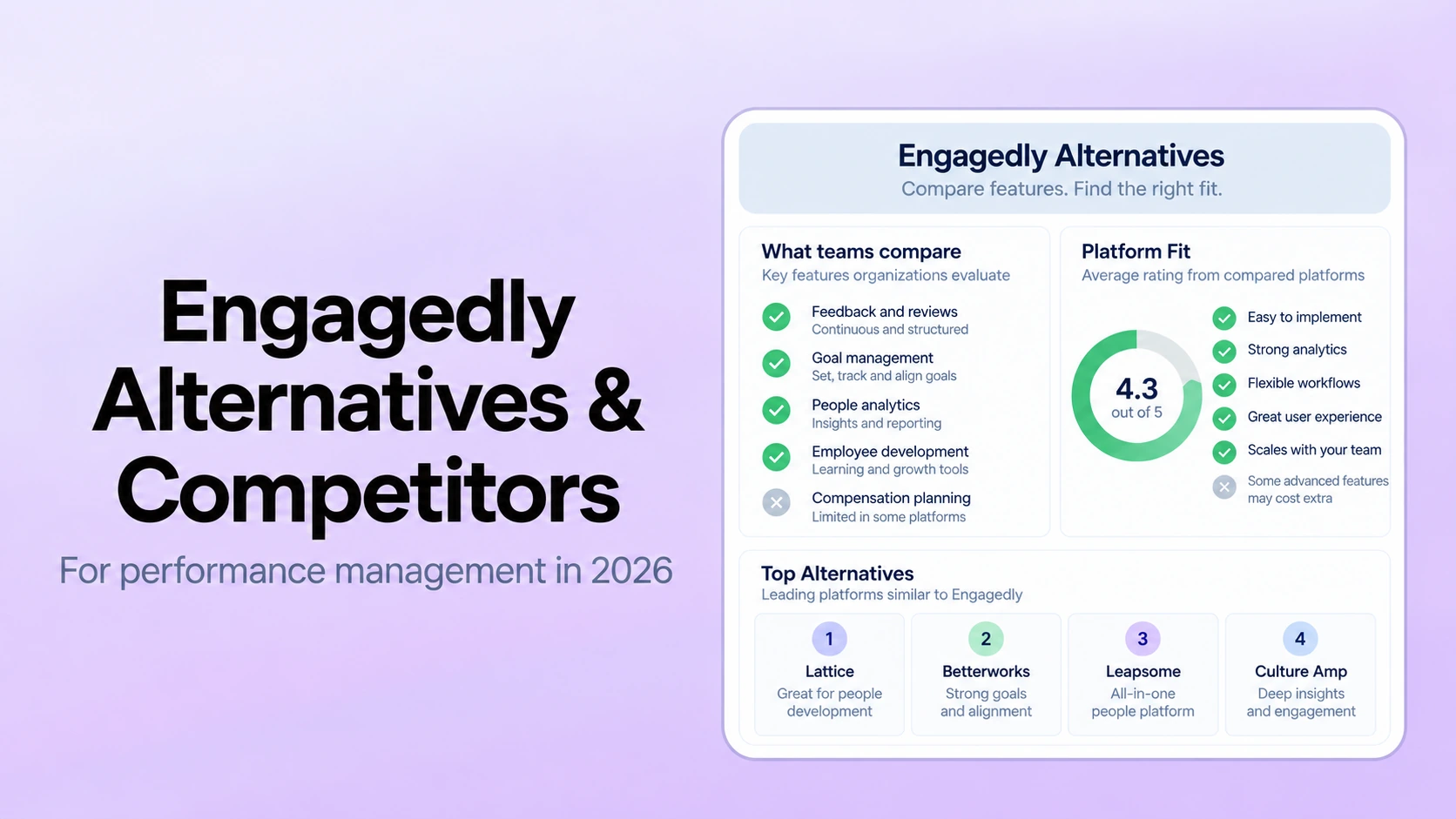
Table of Contents

Key Takeaways:
- Start with the Engagedly workflows your organization actually uses rather than trying to replace every module in the suite.
- Use the same review cycle, goal structure, check-in workflow, 360-feedback case, calibration scenario, reports, and integration constraints in every vendor demo.
- PerformSpark is a focused option for teams that want reviews, goals, check-ins, feedback, 360s, calibration, development, PIPs, recognition, skills, reporting, notifications, and integrations connected without replacing the HRIS.
- Broader people platforms and HCM suites can make sense when learning, engagement, talent development, or wider HR transformation are genuinely part of the project.
- Verify current capabilities, packaging, migration responsibilities, data ownership, implementation scope, and commercial terms directly with shortlisted vendors.
Engagedly is broader than a review-only system. Its current platform connects performance reviews, goals and OKRs, real-time feedback, 360 feedback, meetings, learning, recognition, engagement, skills, development, and talent-mobility workflows. That breadth is useful when HR wants several people programs in one environment, but it also changes how an alternative should be evaluated.
A useful replacement search does not begin with “Which vendor has all the same modules?” It begins with the problem behind the project. Some teams want a more focused performance layer while keeping their existing HRIS. Others want employee listening, learning, talent development, or a larger HCM suite in the same purchase.
This guide compares 10 alternatives using current official vendor information reviewed on October 1, 2026. It is not a universal ranking. PerformSpark appears first because this article is published by PerformSpark; the remaining platforms represent different product architectures and buying paths. Verify current packaging, pricing, implementation scope, and must-have workflows directly with each vendor.
What an Engagedly Replacement Needs to Account For
Engagedly's current performance product includes configurable performance reviews, 1-on-1s and check-ins, 360 feedback, analytics, and connections to learning, recognition, and development. Its wider platform extends into engagement, learning, skills, mentoring, career development, and talent mobility.
That means a replacement project can easily become larger than performance management. Before building the shortlist, identify which Engagedly workflows your organization actually uses today and which capabilities are simply available in the suite. Otherwise, the project can drift from “improve performance management” into an unplanned HR-platform replacement.
How We Evaluated Engagedly Alternatives
We compared review-cycle control, goals and OKRs, manager check-ins, continuous feedback, 360 feedback, calibration, development follow-through, reporting, integrations, permissions, administration, and the wider platform scope. The key distinction is whether the alternative is a focused performance system, a broader people platform, or a full HCM environment.
Use the performance management software RFP checklist to translate those requirements into the same demo scenarios for every vendor.
10 Engagedly Alternatives to Evaluate in 2026
| Platform | Evaluation Angle | Performance Scope | What HR Should Test |
|---|---|---|---|
| PerformSpark | Focused performance management alongside the existing HR stack | Reviews, goals, check-ins, feedback, 360s, calibration, IDPs, PIPs, skills, recognition, reporting, notifications | Whether the focused performance layer replaces the Engagedly workflows you actively use without forcing wider HR-system change |
| Lattice | Performance inside a broader people platform | Reviews, goals, feedback, 1-on-1s, talent and growth workflows | Module requirements, evidence flow, reporting, and administration |
| 15Five | Manager effectiveness and recurring coaching | Reviews, 360 feedback, goals, calibration, development and manager workflows | The weekly manager experience as well as formal reviews |
| Culture Amp | Performance connected to employee experience | Reviews, goals, feedback, calibration and engagement context | Governance between engagement and performance data |
| Leapsome | Connected talent and HR workflows | Reviews, goals, surveys, competencies, feedback, learning and wider talent modules | Which modules are actually required for the project |
| Betterworks | Real-time performance and goal alignment | Goals, feedback, 1-on-1s, coaching, reviews, skills and talent intelligence | How continuous performance signals become review evidence |
| Trakstar | Structured review-cycle administration | Reviews, goals, check-ins, self-reviews and 360 feedback | Review stages, approvals, 360-rater workflow, archive and reporting |
| PerformYard | Configurable performance administration | Reviews, goals, feedback, meetings, engagement, surveys and reporting | How easily HR can reproduce its actual cycles and manager workflows |
| Workday | Performance inside enterprise HCM | Performance enablement, goals, feedback, career development, skills and talent | Implementation scope and fit with the wider Workday architecture |
| BambooHR | Performance close to core HR records | Custom reviews, 360 feedback, goals, 1-on-1s and performance reporting | Whether performance depth is sufficient for your governance requirements |
1. PerformSpark
PerformSpark is the most relevant alternative to evaluate when the organization wants to keep its existing HRIS and simplify the project around performance management itself. Instead of replacing Engagedly's full learning, engagement, recognition, and talent-mobility footprint, the buying question becomes whether the performance workflows can be run more directly in a focused system.
Performance reviews
Performance Reviews are the formal evaluation layer. For an Engagedly replacement, test your actual cycle rather than a standard demo: templates, employee and manager input, rating models, review timing, approvals, visibility, exceptions, and how managers find supporting context while writing the review.
Goal management
Goal Management keeps goals active between review cycles. That matters when goals are not just fields inside an appraisal but part of the evidence managers use throughout the year. Recreate the hierarchy, ownership, progress updates, and alignment rules you use in Engagedly.
Check-ins and 1-on-1s
Check-ins and 1-on-1s provide the recurring manager layer between formal evaluations. The practical replacement test is whether managers can retain actions and context without maintaining another document or reconstructing the year when review season begins.
Feedback, surveys, and 360 reviews
Feedback and surveys support ongoing input outside the review cycle, while 360 Reviews add multi-source perspective where peer, upward, or other raters are part of the process. If Engagedly's 360 or real-time feedback workflows are heavily used, test reviewer selection, visibility, reminders, and how the evidence appears later.
Calibration
Calibration gives HR and leaders a governed way to review rating patterns and evidence. The purpose is to structure the discussion, not automate the employment decision. Test access, rating changes, supporting evidence, comments, and finalization using a realistic scenario.
Development plans and performance improvement
Individual Development Plans can carry review outcomes into owned development actions. Performance Improvement Plans provide a separate workflow for more formal performance support. Keeping those use cases distinct helps HR avoid turning every development need into a performance action.
Skills and recognition
Skills Management adds role and capability context to development conversations, while Employee Recognition can keep positive contribution evidence visible during the year. These signals should support human judgment rather than automatically determine a rating.
Reporting and analytics
Reporting & Analytics helps HR examine review progress, goals, rating patterns, calibration, manager activity, and related performance data. The right demo question is whether HR can answer the same operational questions it currently answers in Engagedly without exporting and rebuilding the analysis elsewhere.
Notifications and integrations
Smart Notifications support recurring follow-through across the performance process. The integration approach and integrations directory matter when PerformSpark is being added as a specialist performance layer rather than replacing the systems that own core employee data.
TrAI
TrAI, PerformSpark's assistive AI layer, should be evaluated for drafting, summarization, or pattern-review support while managers and HR remain accountable for performance judgments and employment decisions. Ask what source data an AI feature can access and how a person verifies the output before it is used.
2. Lattice
Lattice is relevant when performance management is part of a wider people-platform decision. Its current performance product connects reviews with goals, feedback, 1-on-1s, talent workflows, and newer evidence-based review drafting that can use existing performance data.
For teams moving from Engagedly, the main question is module scope. Separate the workflows you must replace from the broader Lattice capabilities you may or may not need, then verify how data moves between those modules.
3. 15Five
15Five is strongest to evaluate when manager behavior and recurring coaching are central to the project. Its current Perform product includes performance reviews, 360 feedback, goals and OKRs, calibration, reporting, and development-oriented workflows.
Do not limit the demo to the formal review. Have a manager complete a normal week, then use that history in a review. That exposes whether the platform fits the operating rhythm you want to preserve or improve.
4. Culture Amp
Culture Amp is a different alternative because performance can sit alongside a strong employee-experience program. Its current performance environment includes reviews, goals, feedback, and calibration, and Culture Amp's calibration guidance shows performance reviews, feedback, goals, and self-reflections being brought together for rating discussions.
If your Engagedly program combines listening and performance, test the data boundaries carefully. Ask which information stays confidential, which fields managers can see, and how employee-experience data is kept distinct from individual performance evidence.
5. Leapsome
Leapsome is worth evaluating when the project extends beyond performance into connected talent processes. Its current performance-review product connects reviews with goals, surveys, competencies, and instant feedback, while the wider platform can include learning and other talent workflows.
That breadth can be useful, but it can also recreate the same scope question you have with Engagedly. Define what belongs in phase one before comparing implementation effort and price.
6. Betterworks
Betterworks emphasizes real-time performance signals and goal alignment. Its current platform connects goals, feedback, 1-on-1s, performance signals, skills, reviews, and talent intelligence.
For an Engagedly replacement, test how those live signals become usable review evidence and whether the continuous model still supports the governance, approvals, and development processes your organization expects.
If Betterworks is already on the shortlist, the Betterworks alternatives guide provides another comparison path.
7. Trakstar
Trakstar is more review-cycle oriented. Its current documentation shows structured reviews, goals, self-reviews, manager reviews, check-ins, and 360-rater feedback as part of the broader performance process.
This can make sense when the replacement project is primarily about formal performance administration rather than recreating Engagedly's wider talent ecosystem. Test the entire configured cycle, not just the form builder.
See the Trakstar alternatives guide if review workflow depth is a major buying criterion.
8. PerformYard
PerformYard is a strong evaluation path when HR wants configurable performance administration. Current product information shows reviews, goals, feedback, meetings, surveys, engagement, reporting, and AI-supported workflows.
Give the administrator one of your actual Engagedly cycles and ask them to build it during the demo. That is more useful than comparing screenshots because it exposes configuration effort, manager experience, and reporting depth.
9. Workday
Workday belongs on the shortlist when performance management is one piece of an enterprise HCM architecture. Its current Talent Optimization product includes performance enablement, goals, feedback, career development, skills, recognition, and broader talent visibility.
If your organization already operates Workday, that common environment may simplify data ownership. If the only objective is replacing Engagedly's performance layer, compare the actual implementation scope rather than the theoretical breadth of the suite.
10. BambooHR
BambooHR is relevant when performance should remain close to core HR records. Its current performance product includes custom review cycles, self and manager feedback, peer and skip-level reviews, goals, 1-on-1s, and performance reporting.
The buying question is whether that level of performance depth matches your current Engagedly process. Recreate the complex parts first, especially review routing, 360 input, development follow-through, calibration expectations, and reporting.
Engagedly Replacement Evaluation
Test the Performance Workflows You Actually Use
Bring your current review cycle, goals, manager check-ins, feedback, 360 setup, calibration, development process, reports, and integration requirements to a focused PerformSpark walkthrough.
What to Test Before Switching From Engagedly
Separate active workflows from available modules
List what your organization actively uses today. If learning, recognition, engagement, or talent mobility are not part of the replacement problem, do not let them expand the shortlist criteria automatically.
Rebuild one full review cycle
Test templates, self and manager input, rating scales, review timing, approvals, reopening rules, exceptions, and completion reporting. Use Performance Reviews as one concrete PerformSpark comparison scenario.
Check how goals and manager conversations become evidence
Managers should not need to copy goals, check-in notes, or feedback manually into the review. Test goal management and check-ins as part of the same end-to-end workflow.
Recreate the 360 and feedback process
If multi-rater feedback is important, test reviewer selection, visibility, reminders, completion status, and how the results appear later. Compare that directly with PerformSpark 360 Reviews.
Run a real calibration scenario
Use the rating model and governance you operate today. Test evidence access, rating changes, comments, permissions, and finalization. Calibration should support accountable human review rather than replace it.
Make the vendor reproduce your reports
Ask for the reports HR actually uses: review completion, goal status, rating patterns, calibration context, feedback activity, and manager participation where relevant. A generic dashboard tour is not enough.
Map integrations before selecting the platform
Document the systems that own employee data, manager hierarchy, identity, productivity, and downstream reporting. Then compare the integration workflow and available integrations with the architecture you need.
How to Avoid Scope Creep in an Engagedly Replacement
Engagedly's breadth makes scope discipline especially important. Separate the project into three buckets: performance workflows that must be replaced, adjacent modules that are genuinely part of the approved project, and capabilities that are available today but are not operationally important.
This keeps a performance-management replacement from becoming a learning, engagement, recognition, skills, and HCM consolidation project by accident. If those areas really are part of the strategy, evaluate them deliberately and compare the implementation scope accordingly.
How to Build a Shortlist
Start with three to five platforms that match the architecture you want. Give each vendor the same scenarios: one review cycle, one goal hierarchy, one manager check-in workflow, one 360-feedback case, one calibration requirement, the same reports, and the same integration constraints.
Score what the vendor demonstrates, not what appears on a roadmap. For AI-assisted features, ask what data the model can access, whether evidence is visible, how outputs are retained, whether the feature can be disabled, and which person remains accountable before an output affects an employee record or decision.
If you need a broader framework, use the performance management software buyer guide without turning this page into another generic performance-management definition article.
Which Type of Engagedly Alternative Fits the Project?
A focused performance platform can make sense when you already have a core HRIS and want deeper performance workflows without buying another broad people suite. A broader people platform can make sense when engagement, learning, or development are also in scope. A full HCM suite can make sense when the project is part of an enterprise HR transformation.
Those are different buying projects. Compare workflow fit, administrator effort, implementation, integrations, support, and total cost within the category you actually need. For PerformSpark, include the current pricing approach in that comparison.
Use Your Current Engagedly Process as the Demo Script
The strongest demo is not the vendor's ideal workflow. It is your actual one. Bring the stages, roles, goals, feedback rules, 360 setup, calibration process, development actions, reports, and edge cases you already operate.
PerformSpark should be evaluated the same way. The goal is to determine whether a focused performance layer can replace the Engagedly workflows you genuinely need while reducing unnecessary scope and manual work.
Compare PerformSpark Against Your Real Engagedly Workflow
Use your current review cycle, goals, check-ins, feedback, 360 setup, calibration, development, reports, and integration requirements as the evaluation script.
Book a PerformSpark demo



.svg)

.svg)
.svg)