.svg)
Clearer Review Comments
Give managers concrete skill context instead of relying only on general feedback.
Capture the examples, validations, and context behind employee skills so managers can connect performance feedback with real capability evidence.

Skill evidence
Manager validation
Follow-through

Why Skill Evidence Matters
Managers often know that performance needs to improve, but they may not have clear evidence showing which skills are strong, developing, or missing. Without evidence, review comments can become subjective, development priorities can feel unclear, and follow-through can depend too much on manager interpretation.

Evidence Capture
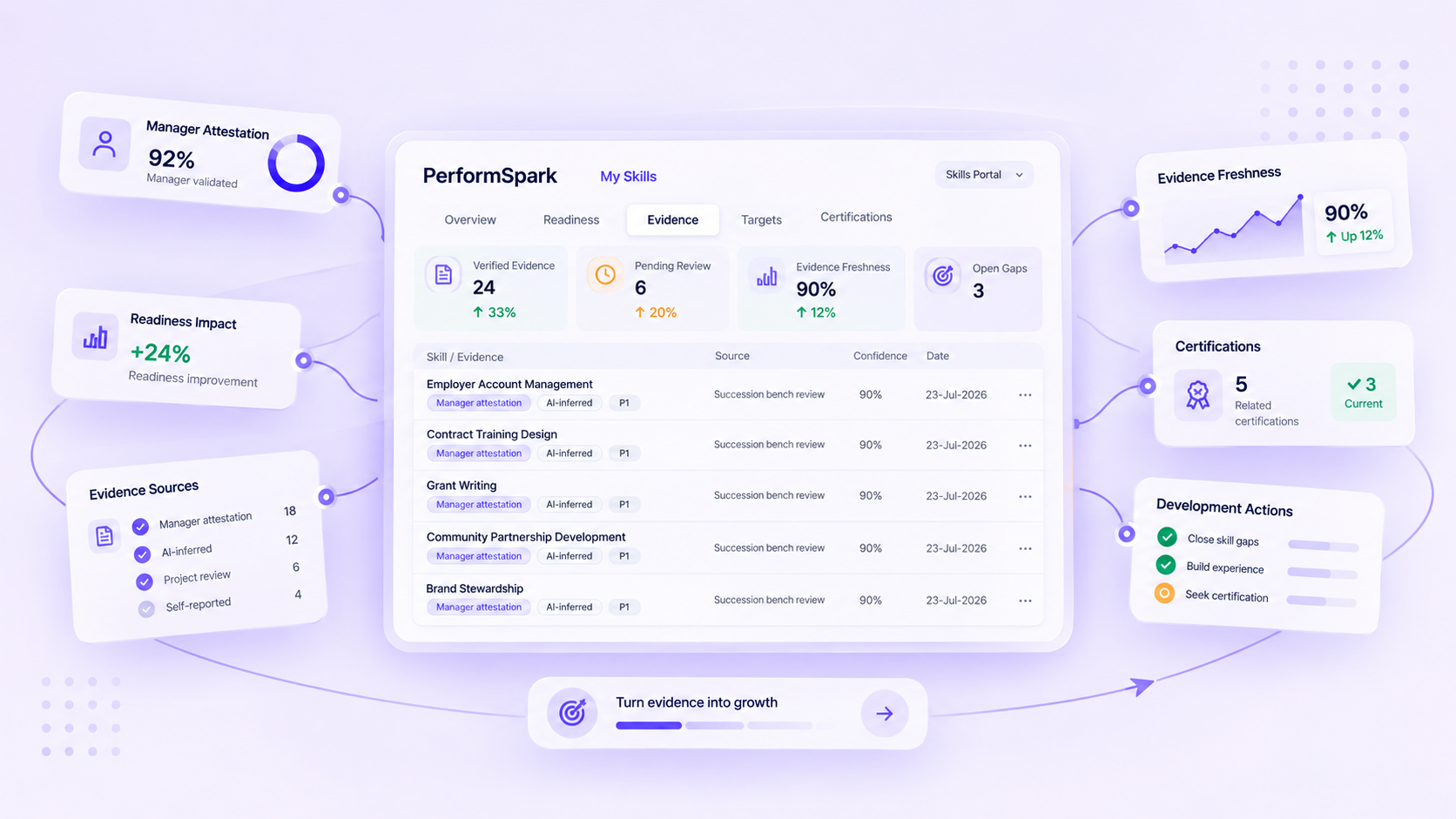
Skill Evidence helps teams capture examples of demonstrated capability, connect them to skills, and make that context available for readiness, development, and performance conversations. The goal is not just to store skill data. It is to make skill evidence useful when managers need to make better people decisions.
.svg)
Document examples that show how an employee demonstrates a skill.
.svg)
Use manager validation to confirm whether evidence supports the skill claim.

See whether skill evidence is current or needs review.

Use evidence to guide development plans, goals, PIPs, and learning next steps.
Use verified skill evidence to support clearer reviews, development plans, and readiness decisions.
How Skill Evidence Works
A five-step workflow keeps evidence connected from the first claim through development follow-through.
.svg)
Employees or managers begin with a skill that should be reviewed, developed, or validated.
.svg)
Evidence can come from work examples, reviews, projects, feedback, certifications, or manager input.
.svg)
The skill is connected with a level, status, freshness signal, and action path.

Managers confirm whether the evidence supports the skill claim before it informs decisions.
.svg)
Validated evidence can support readiness views, goals, IDPs, PIPs, learning plans, or performance conversations.
Explore Skills Features
Move from skill evidence and current proficiency to targets, manager validation, readiness, and development follow-through.
Explore Skills Management →Capture examples that show how an employee demonstrates a skill.
Document current capability before comparing it with expectations.
Define the proficiency employees are expected to work toward.
Add manager review to employee skill information.
Compare current capability with targets and role expectations.
Keep development actions connected to employee skill information.
Benefits
Give managers concrete skill context instead of relying only on general feedback.
.svg)
Use evidence to decide which skills need goals, IDPs, learning plans, or coaching.
.svg)
Help managers use shared skill evidence when discussing performance and readiness.
Show employees which skills are validated, which need evidence, and where action is needed.
Connect skill evidence with readiness gaps, role expectations, and career movement.
.svg)
Move from performance feedback to specific next steps with stronger context.
Connected Performance Workflow
Use skill evidence, targets, validation, and action tracking across reviews, goals, check-ins, IDPs, PIPs, calibration, 360-degree reviews, feedback, and recognition.
Connect feedback to strengths and development gaps.
Add skill context to feedback and make reviews more meaningful.
Turn priorities into measurable skill-based goals.
Clarify capability expectations during improvement.
.svg)
Discuss skill progress between reviews.
Turn skill gaps into structured development plans.
Add broader input to capability discussions.
.svg)
Provide context for recognizing demonstrated strengths and capability growth.
Support more consistent performance discussions.
FAQs
Have questions about PerformSpark? Here are some of the most common queries to help you get started.
See how PerformSpark helps managers connect skill evidence, readiness gaps, and development actions with performance conversations.

Make performance reviews your growth lever
No credit card required • Setup and training included • Annual contract minimums may apply


Map employee skills, uncover gaps, and connect development to reviews, goals, IDPs, and performance.
JUST LAUNCHED
Skills Management is now live
.svg)

.svg)
.svg)

