
.svg)





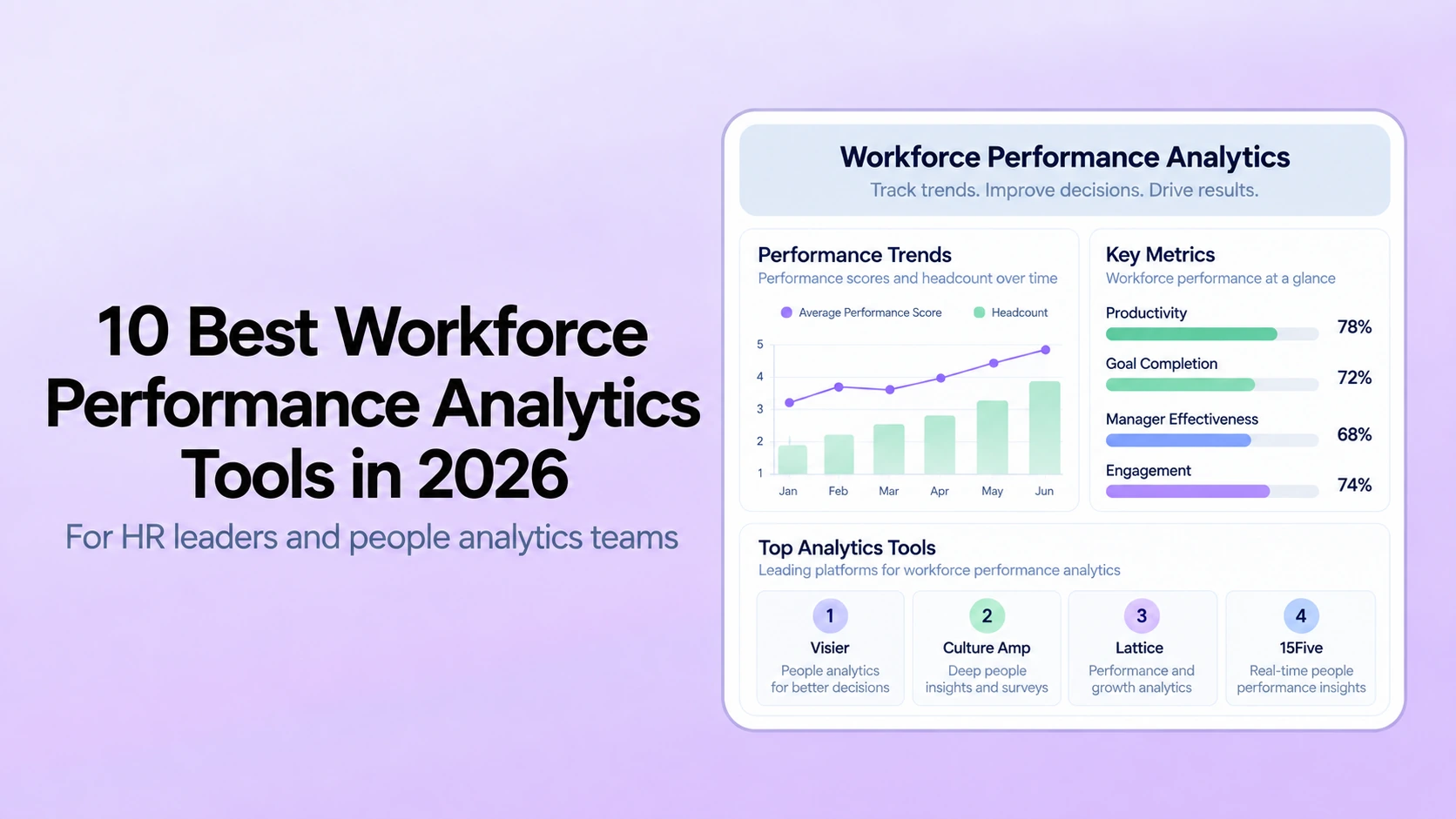
Table of Contents

Key Takeaways:
- Define the decisions and metrics HR needs to support before comparing analytics platforms.
- Performance platforms, dedicated people analytics tools, and broad HCM suites solve different reporting problems.
- Use a source-to-decision test that checks metric definitions, hierarchy changes, missing data, permissions, exports, and traceability.
- Manager activity and other operational signals require context and should not be treated as automatic measures of management quality.
- AI can support pattern detection and summarization, but accountable HR and business leaders remain responsible for interpretation and employment decisions.
Workforce performance analytics software helps HR leaders turn performance, goal, feedback, engagement, manager, and workforce data into defined measures that can support better questions and decisions. The useful distinction is not whether a platform has dashboards. It is whether HR can explain each metric, trace it to the underlying data, compare the right populations, and assign an accountable next action.
“Workforce analytics” is a broad label, and that is where many software comparisons become misleading. A performance platform, a dedicated people-analytics product, and an HCM suite may all show workforce dashboards, but they solve different problems. One is closest to the review and goal data. Another is built to model data across systems. A third keeps analytics inside the enterprise HR stack.
The 10 tools below are therefore compared by the kind of analytics problem they are designed to solve, not by a single feature score. PerformSpark appears first because this article is published by PerformSpark. Vendor capabilities were checked against official product information on September 30, 2026; use those links to confirm current functionality, then test each platform with the same metric, population, permission rule, and source record.
This article is separate from PerformSpark's employee performance tracking software guide. That guide focuses on employee-level evidence and workflow. This page focuses on analytics for HR and leadership across teams and workforce populations.
What Is Workforce Performance Analytics Software?
Workforce performance analytics software organizes workforce data into metrics, trends, segments, and reports that help HR investigate questions about employee performance and the systems around it. Depending on the platform, inputs may include goals, performance reviews, feedback and surveys, ratings, calibration, development activity, manager workflows, HRIS attributes, and other authorized workforce data.
Analytics should support judgment rather than replace it. A dashboard can surface a pattern that deserves investigation, but it does not prove why the pattern exists or what employment decision should follow. HR should define metric ownership, data quality, privacy, access, and human review before operationalizing analytics.
How We Evaluated Workforce Performance Analytics Tools
- Performance data: Goals, reviews, feedback, ratings, calibration, and development signals.
- Workforce context: Department, role, manager, tenure, location, and other authorized HRIS dimensions.
- Manager analytics: Appropriate visibility into recurring check-ins and 1-on-1s without equating activity with quality.
- Cross-program analysis: Ability to examine performance alongside engagement, turnover, talent, or skills data where appropriate.
- Traceability: Definitions, filters, source records, and exportability.
- Governance: Permissions, privacy controls, integrations, and accountable human interpretation.
- Operational fit: Whether insights connect back to actions such as coaching, development plans, or performance improvement plans.
10 Workforce Performance Analytics Software Tools to Compare in 2026
| Platform | Best Fit | Analytics Approach | Core Data Scope | What HR Should Verify |
|---|---|---|---|---|
| PerformSpark | Performance analytics tied to operating workflows | Embedded performance reporting | Goals, reviews, feedback, check-ins, calibration, development | Dimensions, exports, permissions, manager changes, report logic |
| Lattice | People teams using connected talent programs | Unified people analytics | Performance, engagement, talent, adoption | Metric definitions, segmentation, source modules, permissions |
| 15Five | Outcome and manager-effectiveness analysis | HR outcomes dashboard | Engagement, performance, turnover, manager effectiveness | Source inputs, weighting, filters, package requirements |
| Visier | Deep cross-system people analytics | Dedicated people analytics platform | Multi-source workforce data and planning | Connectors, semantic model, latency, governance, benchmarks |
| Workday | Organizations operating Workday HCM | Embedded HCM and people analytics | Talent, performance, retention, hiring, skills, organization | Subscription scope, configuration, report ownership, security |
| SAP SuccessFactors | Enterprise SAP HR environments | Workforce analytics and planning | Standardized HR metrics, trends, workforce data | Packaging, metric definitions, integration, implementation |
| Culture Amp | Performance plus employee experience analysis | Performance and experience insights | Ratings, demographics, performance and survey data | Confidentiality, demographic scoping, exports, governance |
| Leapsome | Cross-module HR and talent analytics | People analytics across platform modules | HRIS, performance, engagement, goals, learning, compensation | Customization, module scope, permissions, AI controls |
| BambooHR | Growing teams wanting accessible HR reporting | HR reporting and dashboards | Core HR data and related workforce trends | Performance depth, custom reports, package scope, exports |
| ChartHop | People analytics plus workforce planning | Connected people data model | Org data, planning, compensation, performance, engagement, goals | Data sources, refresh, metric modeling, permissions, planning workflows |
1. PerformSpark
PerformSpark is the most relevant option when the analytics question begins inside the performance process itself. Reporting & Analytics uses the same operating data created by goals, reviews, check-ins, feedback, 360 reviews, development, and calibration.
That matters when HR wants to move from a number back to the workflow that produced it. A review-completion problem can be investigated alongside the cycle stages. A rating pattern can be reviewed with calibration context. A development metric can be traced back to the underlying plan rather than living in a separate BI layer.
The right demo is a traceability test. Pick one metric your leadership team already uses, change a manager or department assignment, restrict access for one role, and then export the source records. If skills or role evidence is part of the analysis, include skills management in the scenario.
2. Lattice
Lattice is useful when the analytics need to sit across several people programs rather than only the review cycle. Its Analytics product brings performance, engagement, talent, and adoption data into a shared analytics experience.
For a team already using those Lattice modules, that shared context can reduce the need to reconcile separate exports. For a new buyer, the important question is where each metric actually comes from. Ask which module owns the source data, how definitions change when filters are applied, and whether a leader can trace a chart back to the records underneath it.
3. 15Five
15Five takes a more outcome-oriented approach. Its HR Outcomes Dashboard is organized around engagement, performance, turnover, and manager effectiveness rather than only operational reporting.
That framing can be helpful for HR leaders who want a smaller set of signals tied to action. It also raises a governance question: how are those outcomes defined? Ask the vendor to walk through the source inputs and weighting behind manager-effectiveness or performance designations, then show how a user can challenge or explain a result before it influences a people decision.
4. Visier
Visier is different from most tools in this list because analytics is the core product, not a reporting layer attached to a performance application. Its People Analytics platform is designed to unify workforce data across systems and support broader analysis, planning, and benchmarking.
That makes it a stronger fit when HR is asking questions that cross performance, headcount, mobility, retention, and other datasets. The tradeoff is that the implementation has to solve data modeling and governance deliberately. Evaluate connector coverage, refresh timing, semantic definitions, and how the experience differs for analysts, HR business partners, and managers.
5. Workday
Workday's analytics value is closely tied to the fact that so much workforce data can already live in the same HCM environment. Its People Analytics offering covers areas such as talent and performance, retention, hiring, skills, and organizational composition.
For an existing Workday customer, that common data model may be a significant advantage. For everyone else, the evaluation should include the cost and complexity of entering the ecosystem. Ask which analytics capabilities are included in the products you already license, what additional configuration is required, and who will own the reports after implementation.
6. SAP SuccessFactors
SAP SuccessFactors is built for organizations that need workforce analytics within a large enterprise HR environment. Its Workforce Analytics documentation covers standardized metrics, trending, and broader workforce analysis.
Standard definitions can be valuable when several regions or business units need to report the same measure consistently. The risk is assuming that a standardized metric automatically matches the way your organization defines performance. During evaluation, choose one metric that is politically or operationally important, reproduce the formula, and confirm how local data and permissions affect the result.
7. Culture Amp
Culture Amp is most interesting when performance analysis needs to sit beside employee-experience data. Its Performance Insights documentation describes analysis of performance ratings by demographic and custom rating scales, while the wider platform also supports engagement and employee-listening workflows.
That combination can answer useful organizational questions, but it also creates a responsibility to protect confidentiality. Ask exactly which survey data can be combined with performance data, what minimum-group rules apply, and what a manager can see at employee versus aggregate level. The quality of the governance model matters as much as the visual quality of the dashboard.
8. Leapsome
Leapsome's analytics story comes from the number of workflows it can connect. Its People Analytics product spans data from HRIS, performance, engagement, goals, learning, and compensation, with both prepared and customizable reporting.
For a growing people team, that breadth can be useful because one report can pull context from several HR programs. The evaluation should focus on administrative reality: which modules are required for the report you want, how custom attributes are governed, and whether HR can maintain the reporting model without constant vendor support.
9. BambooHR
BambooHR takes a more accessible HR-reporting approach. Its HR Data & Reporting product offers built-in and customizable reports, dashboards, workforce trends, and benchmarking alongside the broader HR platform.
That can be enough for a growing company that wants reliable operational reporting without building an analytics function. If your use case depends on deeper performance segmentation, predictive modeling, or cross-system analysis, test those requirements early rather than assuming every dashboard product is a people-analytics platform.
10. ChartHop
ChartHop is strongest when the analytics problem is closely tied to organization design and workforce planning. Its platform connects people analytics with planning, HRIS data, compensation, performance, engagement, and goals in a shared organizational model.
That makes it a different buying proposition from a performance dashboard. HR and finance teams can use the same organizational context for headcount and people decisions, but the platform still has to receive reliable data from the systems where performance activity happens. Test the refresh cadence, historical hierarchy handling, permissions, and the ownership of every imported metric before relying on the combined view.
Run a Source-to-Decision Analytics Test
Before choosing a platform, require each vendor to complete the same source-to-decision test using realistic sample data:
- Define one metric, such as review completion, goal status, or rating distribution.
- Show the source records that feed the metric.
- Change the date range and explain the comparison logic.
- Filter by department, role, manager, or another approved workforce dimension.
- Change one employee's manager and verify historical versus current attribution.
- Introduce a missing or late source record and show how the dashboard handles it.
- Export the underlying records and reproduce the headline number.
- Restrict a user's access and confirm protected data disappears from dashboards and exports.
- Turn one insight into an accountable action with an owner and review date.
- Document what the metric cannot establish without additional evidence.
This test is especially important for performance management metrics. A number without a stable definition, population, source, and interpretation rule can create more confusion than insight.
Performance Analytics Evaluation
Test the Metric From Source Record to HR Decision
Bring one review metric, one goal metric, one manager workflow question, and one permission scenario to a focused PerformSpark reporting walkthrough.
Which Workforce Performance Metrics Should HR Track?
Useful measures depend on the operating model, but common examples include review completion, goal status, overdue manager actions, feedback participation, development-plan follow-through, calibration changes, rating distributions, and selected manager workflow indicators.
Use the 15 performance management metrics guide to define formulas and interpretation limits before adding measures to an executive dashboard. If the organization relies heavily on recurring coaching, pair those measures with the actual check-in workflow rather than assuming meeting counts prove coaching quality.
HR may also examine engagement or turnover alongside performance data when the populations, time periods, definitions, and permissions are comparable. Avoid turning a single activity metric into a quality judgment.
Performance Analytics vs. People Analytics
Performance analytics focuses on goals, reviews, feedback, calibration, development, and related performance workflows. People analytics is broader and may include headcount, turnover, hiring, mobility, compensation, workforce planning, demographics, skills, and employee experience.
A focused performance platform may be the better fit when HR's questions are tightly connected to the performance cycle. A dedicated people-analytics platform may be more appropriate when the organization needs cross-system workforce modeling across many HR domains. A broad HCM suite can make sense when analytics are part of a larger HR technology consolidation.
For organizations evaluating the performance layer itself, compare the analytics requirement with the wider performance management software workflow rather than treating reporting as an isolated feature.
Governance Questions to Ask Before Buying
- Who owns each metric definition and source?
- How are missing, late, corrected, and duplicated records handled?
- Which historical attributes are preserved after manager or department changes?
- Which roles can see employee-level versus aggregated information?
- How are small groups, confidential feedback, and sensitive attributes protected?
- Can a user trace a dashboard number back to the underlying records?
- Can exported data reproduce the displayed metric?
- How are AI-generated summaries or recommendations reviewed and corrected?
- What integration workflows, services, and refresh schedules are required?
- Which connectors are currently available in the integrations directory?
- How will HR document assumptions and limitations when sharing an insight?
How Should HR Evaluate AI in Analytics?
AI can help summarize large datasets, identify patterns, draft narratives, or prioritize questions. It should not independently make employment decisions or turn a probabilistic pattern into a factual conclusion about an employee.
When evaluating AI-enabled analytics, ask which data sources the model can access, whether the evidence behind an output is visible, how outputs are logged, who can correct them, whether features can be disabled, and which human role remains accountable for action. PerformSpark applies this principle through TrAI, PerformSpark's assistive AI layer, which is designed to support HR and manager judgment rather than replace it.
Common Workforce Analytics Buying Mistakes
- Buying dashboards before defining the decisions and metrics they must support.
- Combining incomparable populations or periods and presenting the result as a trend.
- Using engagement responses as individual performance evidence.
- Treating correlation as proof of cause.
- Ignoring source freshness, hierarchy changes, and data-quality failures.
- Giving broad access to sensitive workforce data because a dashboard is convenient.
- Allowing generated recommendations to bypass accountable HR or manager review.
- Ignoring adoption mechanics such as reminders, escalations, and workflow notifications that affect whether source data is complete.
How to Choose the Right Analytics Platform
Start with five questions HR must answer repeatedly. For each question, document the required source, population, filters, comparison period, access rules, and next action. Then require every vendor to reproduce those questions with realistic data, including an error and an organizational change.
Next, decide which platform category matches the requirement:
- Focused performance analytics: Best when goals, reviews, feedback, calibration, development, and manager workflows are the primary data sources.
- Dedicated people analytics: Best when the organization needs cross-system workforce analysis, modeling, benchmarks, or complex analytics across several HR domains.
- Broad HCM analytics: Best when analytics should remain inside a wider HCM transformation and the organization already operates that ecosystem.
Compare implementation and commercial scope as carefully as analytics depth. Include connectors, services, data preparation, administrator time, support, and any required modules. For the PerformSpark option, review the current pricing approach as part of the same total-cost comparison.
PerformSpark is designed for organizations that want performance management and performance analytics connected in one workflow. If your primary need is enterprise-wide people analytics across many HR systems, evaluate dedicated analytics platforms alongside performance suites and define which system owns each metric.
Turn Performance Metrics Into an Accountable Next Action
See how reviews, goals, feedback, calibration, development, manager workflows, and reporting connect without rebuilding the performance dataset by hand.
Book a PerformSpark demo



.svg)

.svg)
.svg)