
.svg)





Table of Contents

Key Takeaways:
- Compare AI review drafting, manager coaching, calibration, work-context integrations, and analytics as separate capabilities rather than one generic AI feature.
- Require source traceability and permission-aware evidence before trusting any generated review, coaching prompt, or calibration signal.
- Current product names change quickly: for example, 15Five now emphasizes AI-Assisted Reviews, Agents, Focus Briefs, and Kona rather than relying on older Spark AI terminology.
- Employee-monitoring systems are a different category from assistive performance-management software and require separate privacy, consent, legal, and employee-relations review.
- AI can reduce administrative work and surface questions, but managers and HR should remain accountable for ratings, promotions, compensation, PIPs, and other consequential decisions.
AI performance management software should do more than generate polished review text. The stronger products use authorized performance context to help managers prepare, summarize evidence, improve feedback quality, support coaching, surface patterns for HR review, and reduce administrative work while keeping accountable people responsible for ratings, promotions, compensation, PIPs, and other employment decisions.
This 2026 buyer guide compares 10 platforms with currently documented AI capabilities connected to performance workflows. It focuses on what HR teams can verify today, which capabilities are generally available versus limited or still emerging, and what each vendor should be asked to demonstrate before purchase.
Research date: October 1, 2026. PerformSpark publishes this comparison and has a commercial interest in the category. This is an editorial shortlist, not hands-on testing of every product and not a universal 1-to-10 ranking. Vendor features, packaging, AI models, data practices, and plan entitlements can change. Confirm current scope directly with each vendor before purchase.
AI Performance Management Tools Compared
| Platform | Documented AI capability | Performance context | Buyer verification priority |
|---|---|---|---|
| PerformSpark | Review and feedback summarization, writing assistance, rating consistency flags, calibration narratives, survey analysis, manager support | Reviews, goals, check-ins, feedback, calibration, development and reporting workflows | Source traceability, admin controls, workflow scope and current integrations |
| 15Five | AI-Assisted Reviews, 15Five Agents, Focus Briefs and Kona manager support | Goals, feedback, 1-on-1s, past reviews and connected work tools | Which connected data sources are enabled, plan scope, source traceability and manager access |
| Betterworks | Performance summaries, feedback summaries, 1-on-1 summaries, goal and talent intelligence | Goals, conversations, feedback, recognition and calibration data | Role-based summary differences, source access and downstream talent workflow |
| Lattice | Evidence-based review drafts, AI Agent, growth-area drafting and MCP-assisted workflows | 1-on-1s, feedback, goals, updates, growth areas and prior reviews | Which capabilities are built-in versus MCP, permissions and review/calibration controls |
| Culture Amp | AI Coach in Performance for review drafting, feedback synthesis and conversation preparation | Self-reflections, peer/upward feedback, Shoutouts, past manager reviews and Anytime Feedback | Exact data sources available to each author, privacy controls and rating boundaries |
| Leapsome | AI Review Assistant, review summaries, calibration pre-reads, calibration flags and evidence views | Goals, past reviews, peer feedback, tenure and calibration context | Admin enablement, visibility rules, rating-suggestion treatment and auditability |
| PerformYard | AI Review Assist, individual review summaries and full-cycle summaries | Review responses and performance-cycle data | How summaries handle conflicting feedback, permissions and review approval flow |
| Engagedly | Marissa AI for review summaries, questions over people data, goal/feedback assistance and problem surfacing | Performance, goals, feedback and broader talent data | Current package scope, data sources, administrator controls and implementation |
| Workday | Talent Management Agent is current; dedicated Performance Management Agent is publicly listed as coming soon | Workday talent and HCM environment | Do not assume announced performance-agent features are generally available; verify exact licensed AI capabilities |
| BambooHR | Bamboo AI is embedded across the broader people platform for reporting, analysis, recommendations and task assistance | Connected BambooHR people data and permissions | Ask which performance-specific AI workflows are currently available in your plan rather than inferring them from platform-level AI |
How We Evaluated the 10 Tools
We reviewed current first-party product pages, product updates, and support documentation available on October 1, 2026. We did not independently test every configuration, AI output, integration, data-retention setting, or service commitment.
We used seven buyer criteria:
- Evidence context: Can AI work from authorized goals, feedback, check-ins and 1-on-1s, reviews, or other relevant records?
- Manager assistance: Does it reduce preparation or writing work while keeping the manager responsible for the final assessment?
- Workflow connection: Can AI-supported output move into performance reviews, goals, coaching, calibration, or development without manual reconstruction?
- Transparency: Can a user inspect the information behind a summary, suggestion, or flag?
- Human oversight: Can people edit, reject, investigate, and approve outputs before they affect an employee record or decision?
- Administration: Can HR control access, rollout, permissions, and individual AI features?
- Governance: Are security, data use, retention, and model practices documented well enough for HR and IT review?
For a deeper governance framework, use the existing AI performance review software evaluation guide. If you are building a broader vendor scorecard, use the performance management software RFP checklist.
What HR Teams Are Actually Comparing in AI Performance Tools in 2026
AI performance-management searches increasingly mix several different jobs into one category. A useful shortlist separates them before comparing vendors.
Evidence-grounded review drafting
The strongest review assistants do not simply generate polished language. They work from authorized goals, prior feedback, 1-on-1s and check-ins, past reviews, competencies, or work-context integrations, and they let the reviewer inspect or challenge the evidence behind the draft. This is the key distinction between generic writing assistance and performance-specific AI.
AI manager coaching and meeting preparation
Manager-coaching tools are becoming a separate evaluation area. Buyers should test whether the assistant can prepare a manager for a 1-on-1, summarize prior commitments, surface an unresolved goal or feedback item, and suggest questions without turning the conversation into automated surveillance. Calendar and work-tool integrations can be useful, but they should respect existing permissions and give managers control over what is used.
AI calibration and rating-consistency support
Calibration AI should help HR prepare questions, surface unusual distributions, assemble relevant evidence, or summarize prior review context. It should not automatically change ratings or conclude that bias occurred. Compare how calibration tools expose evidence, record accepted or rejected suggestions, preserve decision history, and keep accountable people responsible for the final outcome.
Work-context integrations and source traceability
Some vendors now connect AI to productivity and collaboration systems such as calendars, messaging, project-management tools, or document repositories. More context is not automatically better. HR should know which systems are connected, what history is imported, which users can access the resulting evidence, and whether every generated claim can be traced back to a source.
Employee monitoring is a different category
Some searches for AI performance tools surface employee-monitoring products rather than performance-management platforms. For example, PerformanceX AI publicly positions itself around always-on analysis of email, chat, calls, meetings, and other work systems with recurring employee performance reports. That is a materially different operating model from assistive reviews, coaching, goals, and calibration. Evaluate monitoring, privacy, consent, legal, employee-relations, and governance requirements separately rather than treating the two categories as interchangeable.
Product names change faster than the buying problem
If your research starts with terms such as “15Five Spark AI,” note that current 15Five product materials emphasize AI-Assisted Reviews, 15Five Agents, Focus Briefs, and Kona. Use the current capability and evidence model as the buying criterion rather than relying on an older feature name.
10 AI Performance Management Tools to Compare in 2026
1. PerformSpark
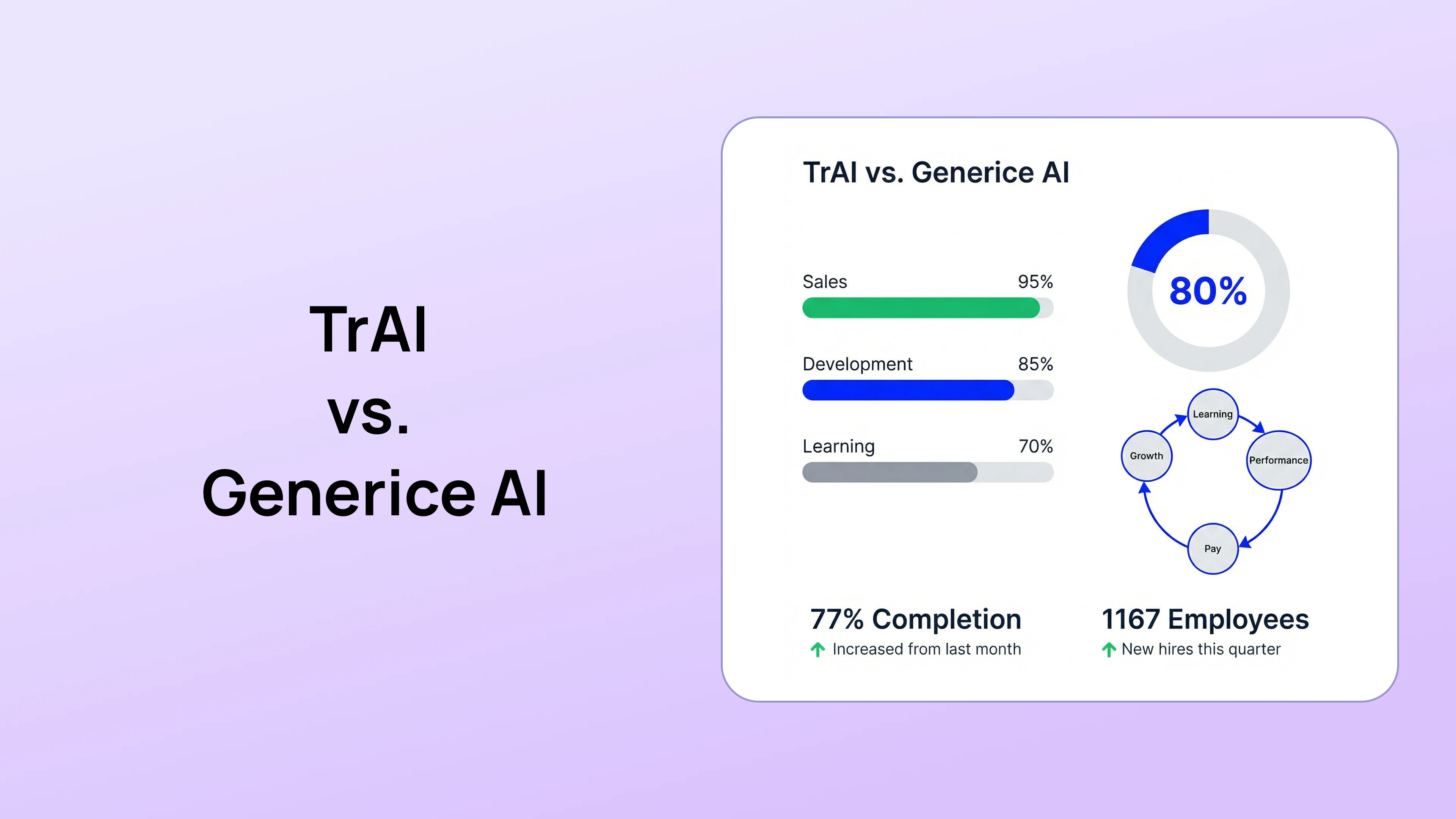
TrAI, PerformSpark's assistive AI layer, sits inside the performance workflow rather than acting as a separate generic chatbot. Current product materials document review and feedback summarization, manager writing assistance, language and rating consistency flags, survey-comment analysis, calibration narratives, goal support, manager preparation, and leadership-level performance insights.
For a BOFU evaluation, test each AI use case separately. The question is not “Does PerformSpark have AI?” It is which records each capability can use, which person can see the output, how the evidence is verified, and what happens after the insight is generated.
AI-assisted reviews grounded in performance context
Use one realistic employee case with performance reviews, goals, feedback, and check-in history. Ask TrAI to help summarize the period or improve the review draft, then inspect whether the manager can validate the underlying context before submitting anything. AI can reduce blank-page work, but the manager should still choose the rating and own the final assessment.
Manager coaching and 1-on-1 preparation
PerformSpark's manager-support use cases are most valuable when they connect to the normal rhythm of check-ins and 1-on-1s. Test whether the system can help a manager prepare from prior commitments, current goals, feedback, and authorized context while leaving the conversation and judgment with the manager. This is also where notification and cadence controls matter.
Feedback and survey summarization
Feedback and Surveys can generate large volumes of qualitative information. TrAI can help summarize authorized feedback and cluster open-text survey comments into themes so HR can identify where further investigation is useful. A theme should remain a prompt for review, not proof of why employees feel a certain way.
Calibration preparation and rating-consistency flags
Calibration is one of the higher-value AI use cases because HR often spends significant time assembling ratings, evidence, and manager context before the session. TrAI can surface rating-distribution risks, possible inconsistencies, or evidence gaps for human review. It should not automatically change a rating or determine whether unfair treatment occurred.
Goal alignment and development follow-through
AI becomes more useful when review outputs do not disappear after submission. Test how TrAI-supported context connects to Individual Development Plans, goal updates, coaching follow-up, or Performance Improvement Plans when a separate structured performance-support workflow is appropriate.
Admin controls, permissions, and source visibility
HR should be able to control where AI is used and which roles can see each output. During the demo, test a manager, HR administrator, employee, and executive role separately. Confirm that AI never exposes information the user could not otherwise access and that important human decisions remain documented.
Integrations and work context
Review the integration approach and available integrations alongside the AI feature itself. AI quality depends on the quality and permissions of the underlying data. More connected sources only help when ownership, synchronization, and access rules are clear.
Reporting and leadership insight
Reporting & Analytics gives HR a structured place to review performance trends, workflow progress, calibration context, and other approved signals. Executive summaries should help leaders ask better questions, not turn complex people decisions into a single AI-generated score.
2. 15Five
15Five's current 2026 positioning has moved beyond the older “Spark AI” wording that still appears in search demand. Its current AI-Assisted Reviews create review drafts from goals, feedback, 1-on-1s, past reviews, and connected work tools, with each claim linked back to its source. 15Five also documents Agents, Focus Briefs, Kona manager support, and work-system integrations.
For HR buyers, the key test is the context layer: which work tools are connected, how much history is imported, what the reviewer can see, how source evidence is exposed, and which package includes each AI capability.
3. Betterworks
Betterworks is increasingly positioning AI as part of real-time performance and talent intelligence rather than only review writing. Current Talent Intelligence materials document AI-generated performance summaries from goals, conversations, feedback, recognition, and calibration, plus skills intelligence and connected talent profiles.
Test how role-based permissions change the generated summary, how conflicting signals are represented, and whether the evidence can move cleanly into coaching, development, calibration, or other talent workflows.
4. Lattice
Lattice now documents Evidence-based Review Drafts built from existing 1-on-1s, feedback, goals, updates, and growth areas. Its July 2026 updates also document Lattice MCP for bringing permission-aware Lattice context into external AI tools such as OpenAI and Claude.
The buying question is where the AI actually runs. Separate native Lattice capabilities from MCP-enabled external workflows, then test permissions, evidence access, review approval, and calibration governance in the environment you would deploy.
5. Culture Amp
Culture Amp AI Coach in Performance supports manager reviews, self-reflections, and peer or upward feedback using task-appropriate data the user already has permission to see. Current documentation lists self-reflections, peer/upward feedback, Shoutouts, past manager reviews, and Anytime Feedback among available sources.
Culture Amp is especially relevant when performance and employee experience are connected. Test data boundaries carefully so engagement information, private feedback, and individual performance evidence remain appropriately separated.
6. Leapsome
Leapsome's current AI Review Assistant turns the review questionnaire into a guided conversation using goals, past reviews, peer feedback, employee information, and other permitted context. Its September 2026 AI calibration tools add pre-reads, evidence views, flags, and AI rating suggestions that committee members can accept or reject.
Because the calibration features are consequential, test administrator enablement, visibility rules, the evidence behind suggestions, accepted/rejected suggestion history, and the human rationale required for rating changes.
AI Performance Evaluation
Test the evidence, coaching, and calibration workflow together
Bring one review cycle, 1-on-1, goal record, feedback set, and calibration case to a PerformSpark walkthrough so you can inspect source context, controls, and human review.
7. PerformYard
PerformYard AI currently includes Review Assist for manager writing, individual review summaries, full-cycle summaries, and AI analysis across performance and engagement data. Its product materials also describe recommended actions and cohort-level insights.
Test what source material each summary can use, how contradictory feedback is represented, whether suggestions remain editable, and where manager or HR approval is required before anything becomes part of the official review record.
8. Engagedly
Engagedly's current performance suite uses Marissa AI across review summaries, people-data questions, feedback, goals, development, and wider talent workflows. Current help documentation also shows Marissa drawing from goals, feedback, praises, growth data, and 360 feedback when assisting with reviews.
Because Engagedly spans a broader talent suite, verify which Marissa capabilities belong to the proposed package, what employee data each role can access, and how AI-supported performance insights connect to learning, development, and talent mobility.
9. Workday
Workday belongs on an enterprise shortlist when AI performance workflows need to sit inside a wider HCM architecture, but release status matters. Workday currently lists its Performance Management Agent as Coming Soon, while the Talent Sentiment Agent is in early access.
Do not evaluate roadmap language as shipped functionality. Ask the vendor to separate what is live in your tenant now from early-access or announced capabilities, then confirm licensing, data boundaries, controls, and implementation effort.
10. BambooHR
BambooHR launched Bamboo AI as an intelligence layer across its broader people platform. For performance-management buyers, the safe approach is to verify the exact AI workflows currently available inside the Performance Management product rather than assuming every platform-level AI capability applies to reviews, goals, or coaching.
This is most relevant when the organization wants performance close to the core employee record. Test the specific AI actions, permissions, data sources, human approval points, and plan entitlement in the environment you would purchase.
What AI Should and Should Not Do in Performance Management
AI can be useful for organizing authorized evidence, drafting text for human review, summarizing feedback themes, preparing managers for conversations, surfacing rating or language patterns for investigation, and helping HR work through large volumes of performance information.
It should not be treated as proof that an employee is high-performing, underperforming, promotable, biased, disengaged, or suitable for a formal employment action. An AI flag is a prompt for review, not a decision.
A practical rule is simple: the higher the consequence of the decision, the stronger the requirement for human review, source evidence, access controls, documentation and an explainable workflow. That applies especially when AI output touches calibration, compensation, promotion, succession or performance improvement plans.
Managers should also understand how AI-assisted language fits into their own accountability. The performance review questions guide and review examples and phrases can help teams separate evidence from generic generated language.
Run the Same AI Demo With Every Vendor
Do not let each vendor choose the scenario that makes its AI look strongest. Use one controlled employee case across every finalist.
- Load a realistic employee record with goals, feedback and check-in context.
- Ask the system to prepare a review draft or performance summary.
- Show exactly which source records informed the output.
- Add contradictory evidence and show how the system responds.
- Correct an inaccurate AI statement and show what is retained.
- Demonstrate role-based access to sensitive information.
- Show what HR can audit after the review is submitted.
- Show how a manager rejects, edits or rewrites an AI suggestion.
- Explain whether customer data is used to improve shared models.
- Demonstrate which AI capabilities administrators can disable or restrict.
Then run the same case through the underlying review, goal, feedback and calibration workflow. AI should reduce administrative work without weakening accountability for the final assessment.
Use the HR software integration checklist to verify the employee-data foundation, security controls for data handling, and the integration catalog for your HR stack.
AI Performance Management Demo Scorecard
| Test | Pass condition | Red flag |
|---|---|---|
| Source evidence | User can identify the authorized records behind the output | Generated conclusion cannot be traced to source context |
| Conflicting evidence | Tool preserves uncertainty and allows the reviewer to inspect both sides | AI collapses conflicting inputs into one confident statement |
| Human control | Manager or HR can edit, reject and approve outputs | AI output automatically becomes a rating or employment decision |
| Permissions | AI respects the same role and data boundaries as the underlying system | Generated output exposes data the user could not otherwise access |
| Admin controls | HR can manage access or disable relevant capabilities where required | AI is an all-or-nothing feature with no governance controls |
| Auditability | Important changes and final human decisions remain documented | No record of what changed, who approved it or what evidence was used |
| Workflow fit | Output moves into reviews, coaching, goals, development or calibration without manual reconstruction | AI produces text but does not improve the operating workflow |
Which AI Performance Management Tool Fits Your Team?
Start with the workflow problem, not the AI label. If reviews are the main issue, prioritize source-grounded drafting, evidence access, manager approval and calibration. If manager coaching is the priority, test 1-on-1 context and follow-through. If strategic alignment is weak, test goal context and current performance signals. If HR wants a broader employee-experience architecture, evaluate how performance, engagement, development and people data are governed together.
Also compare the operating model behind the AI. A broader HCM suite may make sense when the priority is one connected system of record. A focused performance platform may be easier to evaluate when the priority is review depth, coaching, calibration and development. The right choice depends on your current stack, governance requirements and implementation capacity.
Before signing, compare total commercial scope using the performance management software pricing guide, test reporting needs through reporting and analytics, and confirm ongoing measures using the performance management metrics guide.
Bottom Line
The useful question is not “Which platform has AI?” Most major vendors now do. The better question is whether the AI uses the right evidence, respects permissions, keeps humans accountable, fits the workflow, and gives HR enough control to use it responsibly.
Shortlist two or three systems, use the same employee scenario, and require written confirmation of current functionality, plan entitlement, data use, integrations, implementation responsibilities and commercial terms.
AI Performance Management
Evaluate TrAI with your real performance workflow
Bring one review cycle, goal set, manager conversation, feedback set and calibration scenario to a focused PerformSpark walkthrough.
Book a PerformSpark Demo →Use your own data requirements and evaluation criteria.webp)



.svg)

.svg)
.svg)