



Table of Contents
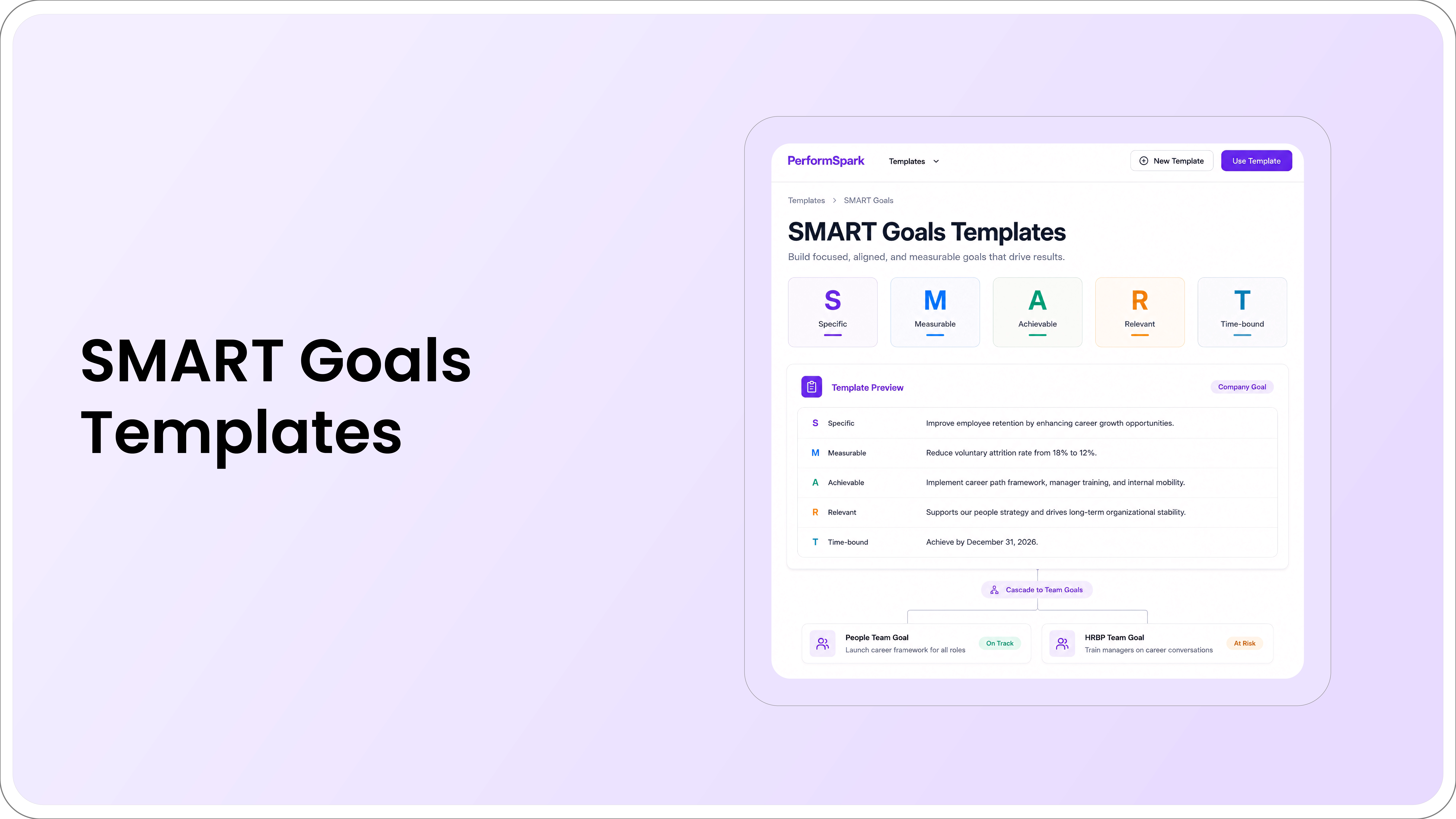
Almost every manager can recite the SMART acronym. Far fewer can look at a goal on a review form and say what the starting number was, where the proof will come from, or which parts of the result depend on a team the employee does not sit in. That gap is why so many goals pass the format check and still fail at evaluation time.
Consider a goal like "Improve communication by year-end." It has a deadline, and it sounds constructive, so it survives approval. But it does not define the behavior, the audience, the baseline, or the evidence that would show improvement, which means the rating conversation eleven months later comes down to whose impression is more persuasive. The employee and the manager can both argue honestly and reach opposite conclusions.
This guide gives you a sentence formula that closes those gaps, templates for nine functions with illustrative examples, the alignment method that connects individual goals to company priorities without copy-paste cascading, and the mid-cycle adjustment process most organizations skip. The sample numbers throughout are illustrative planning examples. Replace them with a verified baseline, a realistic target, and a data source that fit the role.
A Practical SMART Goal Formula
Use this sentence structure. It is deliberately long, because every clause it forces you to fill in is one that a vague goal leaves blank.
The two clauses that carry the most weight are the ones the SMART acronym does not name explicitly. The baseline decides whether the target means anything: "increase pipeline by 15 percent" is unevaluable until both parties agree what the pipeline was and how it is counted. The evidence source decides whether the goal can be closed out at all: if the report that would prove the result does not exist yet, the goal has a hidden dependency on someone building it.
Approval checklist
Before approving any goal, a manager should be able to answer all six of these. If any answer is unclear, the goal is not ready to approve.
- Influence: Is the outcome within the employeeβs reasonable influence, or does it depend on decisions made elsewhere?
- Baseline: Does a reliable baseline exist today, and do both parties agree on how it is calculated?
- Evidence: Will the evidence source be available, accurate, and accessible by the deadline?
- Relevance: Does the goal support a named team or company priority, and can the employee explain that connection?
- Constraints: Are resources, dependencies, and quality requirements written down rather than assumed?
- Checkpoints: Are there milestone dates before the deadline, or is the first real progress conversation eleven months away?
How to Set a Baseline When You Do Not Have One
A missing baseline is the most common reason goals get written vaguely. The instinct is to avoid numbers entirely rather than commit to one that might be wrong. There are three legitimate ways to handle it, and all three are better than dropping the number.
- Measure a short window first. Spend the first two to four weeks of the cycle establishing the baseline, and write that measurement period into the goal itself. The goal becomes: establish the baseline by [date], then improve from that baseline to [target] by [deadline].
- Use an absolute target instead of a percentage. "Reduce median first-response time to under five business hours" needs no baseline to evaluate. Percentage improvements need one; absolute thresholds do not.
- Make the measurement itself the goal. If no data exists and building it matters, the deliverable is the reporting, not the improvement. That is a legitimate goal for one cycle, and it makes every subsequent cycleβs goals better.
What does not work is approving a percentage improvement against an undefined starting point and resolving the ambiguity at review time. That conversation always favors whoever has the better memory or the more senior title.
SMART Goal Templates by Function
Each template below gives the sentence pattern, an illustrative example, and the specific failure mode that function tends to hit. Use the pattern; replace every bracketed value.
Sales
Template: Increase [pipeline, revenue, conversion, or retention metric] from [baseline] to [target] for [territory or segment] by [date], measured in [system].
Illustrative example: Increase qualified mid-market pipeline created from outbound activity by 15 percent compared with the previous quarter by September 30, measured through CRM opportunity-source reporting, while maintaining the agreed qualification standard.
Watch for: goals that measure only closed revenue in a business with a sales cycle longer than the goal period. The employee is then evaluated on deals sourced before the cycle started. Pair or replace with a leading indicator the employee controls within the window.
Customer Success and Support
Template: Improve [customer outcome] from [baseline] to [target] for [account segment] by [date], measured through [system or report].
Illustrative example: Reduce median first-response time for priority accounts from eight business hours to five by the end of Q3, measured in the support platform, without reducing customer satisfaction below the teamβs current baseline.
Watch for: single-metric goals that can be met by damaging something unmeasured. Response time improves easily if quality drops. The constraint clause exists precisely for this, so never leave it empty on a speed or volume goal.
Engineering and IT
Template: Deliver [technical outcome] with [performance or quality requirement] by [date], verified through [monitoring, testing, or review].
Illustrative example: Reduce median customer-dashboard load time from 3.2 seconds to below 2.5 seconds by the end of the release cycle, verified through the agreed production-monitoring report, without increasing the error rate.
Watch for: shipped-feature goals that are really roadmap commitments. If the roadmap can be reprioritized by someone else mid-cycle, the goal needs an explicit clause about what happens when that occurs, or the mid-cycle adjustment process covered below.
Product and Design
Template: Deliver [product outcome] validated by [evidence of user or business impact] for [user segment] by [date], measured through [analytics, research, or usage report].
Illustrative example: Increase completion rate of the account setup flow for self-serve signups from 61 percent to 70 percent by the end of Q4, measured through product analytics funnel reporting, without increasing support tickets tagged to setup.
Watch for: goals written as feature lists. "Ship three features" measures activity, not outcome, and it rewards shipping the easiest three. Anchor to what changes for the user.
Marketing
Template: Improve [audience or commercial outcome] from [baseline] to [target] for [channel or campaign] by [date], measured through [analytics source].
Illustrative example: Increase qualified organic visits to product pages by 20 percent compared with the previous two-quarter average by the end of Q4, measured through analytics landing-page and source reports.
Watch for: attribution disputes discovered at review time. Agree the attribution model and the reporting view when the goal is written, not when the result is being evaluated.
HR and People Operations
Template: Improve [people-process measure] from [baseline] to [target] by [date], measured through [HR system or documented process].
Illustrative example: Increase the percentage of managers completing documented quarterly development conversations from the current baseline to 85 percent by December 31, measured through the check-in workflow and supported by manager guidance.
Watch for: completion-rate goals that measure compliance instead of quality. A 100 percent completion rate on conversations nobody found useful is a worse outcome than 80 percent on conversations that changed something. Pair the completion metric with a quality signal, such as a single question in the next pulse survey.
Finance and Operations
Template: Reduce or improve [process or cost measure] from [baseline] to [target] by [date], measured through [system of record], without affecting [quality or control requirement].
Illustrative example: Reduce the month-end close cycle from nine working days to seven by the end of Q3, measured through the close calendar in the finance system, with no increase in post-close adjustments.
Watch for: efficiency goals with no control constraint. In finance and operations, the constraint clause is often the more important half of the goal.
Managers and Team Leads
Template: Improve [team outcome or team capability] from [baseline] to [target] for [team] by [date], measured through [system, review, or documented process].
Illustrative example: Increase the proportion of the team with a current, documented development plan from 40 percent to 90 percent by the end of Q4, measured through the development planning workflow, with each plan reviewed in at least one 1-on-1 during the quarter.
Watch for: manager goals that are just the sum of their reportsβ goals restated. A managerβs goal should measure something only a manager can do: capability building, retention of critical roles, quality of calibration inputs, or removal of a team-level blocker.
Individual Development Goals (any function)
Template: Build [specific capability] to the point of [observable evidence of application] by [date], supported by [learning activity or coaching], reviewed in [checkpoint].
Illustrative example: Build stakeholder presentation capability to the point of independently presenting the quarterly business review to the leadership team by the end of Q4, supported by two coaching sessions and one practice run, reviewed in the October and November 1-on-1s.
Watch for: development goals that stop at course completion. Completing training is an input. The goal should name what the employee will be able to do afterward that they cannot do now, and how that will be visible.
Common SMART Goal Mistakes
Measurable-sounding goals without a metric
"Improve collaboration" is not measurable until the goal identifies the behavior or result that will change. The measure could be a documented handoff standard, completion of a specific cross-functional deliverable, or a defined stakeholder outcome. The test is whether a third party could look at the evidence and reach the same conclusion as the manager.
A target without a baseline
A percentage improvement cannot be evaluated without a defined starting point and calculation method. Confirm the baseline before the goal is approved, or use one of the three approaches in the baseline section above.
A deadline without checkpoints
A year-end deadline lets a goal remain inactive for months and then arrive at review season with no progress and no early warning. Add milestone dates, or review progress inside regular manager check-ins so the goal has a recurring surface point rather than a single one.
Achievable becomes artificially easy
A goal should be realistic given resources and constraints, but it should still represent meaningful progress. The negotiation to have explicitly is which parts of the result the employee controls and which dependencies belong to someone else. Sandbagging is usually a symptom of a system where missing a stretch goal is punished, so treat a pattern of easy goals as a calibration problem, not an individual one.
The goal is written once and forgotten
Goals lose value when they are opened only during the formal performance review. Progress, changed assumptions, and blocked dependencies should be reviewed during the cycle, which is the entire argument for connecting goals to a recurring check-in rhythm rather than storing them in a separate document.
Too many goals
Three to five goals per employee per cycle is a workable range for most roles. Beyond that, the goals stop functioning as priorities, because a list where everything is a priority provides no guidance about what to drop when time runs short. If a role genuinely has eight commitments, some of them are responsibilities, not goals.
Rigid Cascading Versus Alignment Mapping
Rigid cascading takes a company objective and copies it down each level of the org chart with minor wording changes. It looks orderly on a slide, and it produces two predictable problems. First, it creates goals employees do not control, because a company-level metric is several steps removed from most individual work. Second, it delays everyone, because each level waits for the level above to finalize wording before it can write its own.
Alignment mapping starts from the same shared priority but asks a different question at each level: what is the outcome this team can influence directly? Individual goals then connect to the team outcome without repeating it verbatim. The connection is explicit and documented, but the metric changes at every level, because the thing each level controls is different.
The distinction matters most in organizations that use OKRs, where cascading is often assumed to be part of the method rather than a choice about it. Read more about why rigid OKR cascading fails.
A practical alignment exercise
- State the priority. Describe the business outcome in clear language, not only a slogan or a target number. If people cannot restate it in their own words, it is not usable as an anchor.
- Identify team contributions. Each team defines the outcome it can influence directly, in its own metric. This step happens in parallel across teams, not sequentially down the hierarchy.
- Map dependencies. Record where one teamβs goal depends on another teamβs decision or delivery. This is the step most organizations skip, and it is the one that prevents the mid-cycle argument about whose fault the miss was.
- Write individual SMART contributions. Employees and managers use role-specific baselines, targets, and evidence sources, following the formula above.
- Review the connection. Managers confirm the goal supports the priority without assigning results outside the employeeβs control. If a goal fails this test, the fix is usually narrowing the scope, not lowering the target.
- Check progress during the cycle. Update risks, assumptions, and timelines before they become review-season surprises.
Worked example: alignment without copy-paste cascading
Company priority: improve customer onboarding so new customers reach their first meaningful outcome sooner.
Every goal contributes to the same priority, and no two goals share a metric. Each owner is accountable for a different result inside their own control. Note also that the individual CSM goal includes documenting blocked dependencies: that is deliberate, because it makes the dependency map self-maintaining during the cycle rather than a document written once in planning.
Reviewing and Adjusting Goals Mid-Cycle
A goal may become irrelevant because the strategy changed, a project was canceled, a dependency moved, or the employeeβs role changed. Updating it is better practice than preserving an obsolete target for the appearance of consistency, because an obsolete goal produces one of two bad outcomes: the employee works toward something the business no longer needs, or everyone quietly ignores it and the review has nothing to reference.
What makes mid-cycle changes safe is documentation, not restraint. Record five things at the moment the change is agreed:
- Why the original goal changed, in one or two sentences naming the specific trigger.
- The date the change was agreed, not the date it was written up.
- Progress already completed against the original goal, so the work done is not erased.
- The replacement goal or revised target, written to the same standard as the original.
- How the change will affect evaluation at the end of the cycle.
That last point is the one most often left implicit, and it is the one that causes disputes. If a goal is replaced in month seven, both parties should know at that moment whether the year-end rating will consider the original work, the replacement, or a weighted view of both. Deciding it in month seven takes two minutes. Deciding it at review time takes an escalation.
For development-focused commitments, connect the revised goal with an individual development plan so the support, milestones, and learning activity stay visible alongside the target rather than living in a separate conversation.
How PerformSpark Supports Goal Alignment
PerformSpark connects individual, team, shared, and company goals while tracking progress and at-risk work. Managers can review current goal context during check-ins and formal reviews instead of rebuilding it from separate documents.
TrAI, PerformSpark's assistive AI layer, supports managers and HR without replacing human judgment. Pair goal visibility with reporting and analytics so teams can review trends, dependencies, and progress consistently.
Key Takeaways:
- The SMART acronym is not the hard part; the baseline, evidence source, and dependency list separate a usable goal from a well-formatted one.
- Use one sentence formula that forces the outcome, baseline, target, scope, deadline, evidence, and constraint into the same line.
- Alignment mapping connects each team to a shared priority through outcomes it can influence, instead of copying one objective down every level.
- A deadline without checkpoints lets a goal sit untouched until review season.
- When a goal becomes obsolete, document the change, date, completed progress, replacement goal, and evaluation impact.
Almost every manager can recite the SMART acronym. Far fewer can look at a goal on a review form and say what the starting number was, where the proof will come from, or which parts of the result depend on a team the employee does not sit in. That gap is why so many goals pass the format check and still fail at evaluation time.
Consider a goal like "Improve communication by year-end." It has a deadline, and it sounds constructive, so it survives approval. But it does not define the behavior, the audience, the baseline, or the evidence that would show improvement, which means the rating conversation eleven months later comes down to whose impression is more persuasive. The employee and the manager can both argue honestly and reach opposite conclusions.
This guide gives you a sentence formula that closes those gaps, templates for nine functions with illustrative examples, the alignment method that connects individual goals to company priorities without copy-paste cascading, and the mid-cycle adjustment process most organizations skip. The sample numbers throughout are illustrative planning examples. Replace them with a verified baseline, a realistic target, and a data source that fit the role.
A Practical SMART Goal Formula
Use this sentence structure. It is deliberately long, because every clause it forces you to fill in is one that a vague goal leaves blank.
The two clauses that carry the most weight are the ones the SMART acronym does not name explicitly. The baseline decides whether the target means anything: "increase pipeline by 15 percent" is unevaluable until both parties agree what the pipeline was and how it is counted. The evidence source decides whether the goal can be closed out at all: if the report that would prove the result does not exist yet, the goal has a hidden dependency on someone building it.
Approval checklist
Before approving any goal, a manager should be able to answer all six of these. If any answer is unclear, the goal is not ready to approve.
- Influence: Is the outcome within the employeeβs reasonable influence, or does it depend on decisions made elsewhere?
- Baseline: Does a reliable baseline exist today, and do both parties agree on how it is calculated?
- Evidence: Will the evidence source be available, accurate, and accessible by the deadline?
- Relevance: Does the goal support a named team or company priority, and can the employee explain that connection?
- Constraints: Are resources, dependencies, and quality requirements written down rather than assumed?
- Checkpoints: Are there milestone dates before the deadline, or is the first real progress conversation eleven months away?
How to Set a Baseline When You Do Not Have One
A missing baseline is the most common reason goals get written vaguely. The instinct is to avoid numbers entirely rather than commit to one that might be wrong. There are three legitimate ways to handle it, and all three are better than dropping the number.
- Measure a short window first. Spend the first two to four weeks of the cycle establishing the baseline, and write that measurement period into the goal itself. The goal becomes: establish the baseline by [date], then improve from that baseline to [target] by [deadline].
- Use an absolute target instead of a percentage. "Reduce median first-response time to under five business hours" needs no baseline to evaluate. Percentage improvements need one; absolute thresholds do not.
- Make the measurement itself the goal. If no data exists and building it matters, the deliverable is the reporting, not the improvement. That is a legitimate goal for one cycle, and it makes every subsequent cycleβs goals better.
What does not work is approving a percentage improvement against an undefined starting point and resolving the ambiguity at review time. That conversation always favors whoever has the better memory or the more senior title.
SMART Goal Templates by Function
Each template below gives the sentence pattern, an illustrative example, and the specific failure mode that function tends to hit. Use the pattern; replace every bracketed value.
Sales
Template: Increase [pipeline, revenue, conversion, or retention metric] from [baseline] to [target] for [territory or segment] by [date], measured in [system].
Illustrative example: Increase qualified mid-market pipeline created from outbound activity by 15 percent compared with the previous quarter by September 30, measured through CRM opportunity-source reporting, while maintaining the agreed qualification standard.
Watch for: goals that measure only closed revenue in a business with a sales cycle longer than the goal period. The employee is then evaluated on deals sourced before the cycle started. Pair or replace with a leading indicator the employee controls within the window.
Customer Success and Support
Template: Improve [customer outcome] from [baseline] to [target] for [account segment] by [date], measured through [system or report].
Illustrative example: Reduce median first-response time for priority accounts from eight business hours to five by the end of Q3, measured in the support platform, without reducing customer satisfaction below the teamβs current baseline.
Watch for: single-metric goals that can be met by damaging something unmeasured. Response time improves easily if quality drops. The constraint clause exists precisely for this, so never leave it empty on a speed or volume goal.
Engineering and IT
Template: Deliver [technical outcome] with [performance or quality requirement] by [date], verified through [monitoring, testing, or review].
Illustrative example: Reduce median customer-dashboard load time from 3.2 seconds to below 2.5 seconds by the end of the release cycle, verified through the agreed production-monitoring report, without increasing the error rate.
Watch for: shipped-feature goals that are really roadmap commitments. If the roadmap can be reprioritized by someone else mid-cycle, the goal needs an explicit clause about what happens when that occurs, or the mid-cycle adjustment process covered below.
Product and Design
Template: Deliver [product outcome] validated by [evidence of user or business impact] for [user segment] by [date], measured through [analytics, research, or usage report].
Illustrative example: Increase completion rate of the account setup flow for self-serve signups from 61 percent to 70 percent by the end of Q4, measured through product analytics funnel reporting, without increasing support tickets tagged to setup.
Watch for: goals written as feature lists. "Ship three features" measures activity, not outcome, and it rewards shipping the easiest three. Anchor to what changes for the user.
Marketing
Template: Improve [audience or commercial outcome] from [baseline] to [target] for [channel or campaign] by [date], measured through [analytics source].
Illustrative example: Increase qualified organic visits to product pages by 20 percent compared with the previous two-quarter average by the end of Q4, measured through analytics landing-page and source reports.
Watch for: attribution disputes discovered at review time. Agree the attribution model and the reporting view when the goal is written, not when the result is being evaluated.
HR and People Operations
Template: Improve [people-process measure] from [baseline] to [target] by [date], measured through [HR system or documented process].
Illustrative example: Increase the percentage of managers completing documented quarterly development conversations from the current baseline to 85 percent by December 31, measured through the check-in workflow and supported by manager guidance.
Watch for: completion-rate goals that measure compliance instead of quality. A 100 percent completion rate on conversations nobody found useful is a worse outcome than 80 percent on conversations that changed something. Pair the completion metric with a quality signal, such as a single question in the next pulse survey.
Finance and Operations
Template: Reduce or improve [process or cost measure] from [baseline] to [target] by [date], measured through [system of record], without affecting [quality or control requirement].
Illustrative example: Reduce the month-end close cycle from nine working days to seven by the end of Q3, measured through the close calendar in the finance system, with no increase in post-close adjustments.
Watch for: efficiency goals with no control constraint. In finance and operations, the constraint clause is often the more important half of the goal.
Managers and Team Leads
Template: Improve [team outcome or team capability] from [baseline] to [target] for [team] by [date], measured through [system, review, or documented process].
Illustrative example: Increase the proportion of the team with a current, documented development plan from 40 percent to 90 percent by the end of Q4, measured through the development planning workflow, with each plan reviewed in at least one 1-on-1 during the quarter.
Watch for: manager goals that are just the sum of their reportsβ goals restated. A managerβs goal should measure something only a manager can do: capability building, retention of critical roles, quality of calibration inputs, or removal of a team-level blocker.
Individual Development Goals (any function)
Template: Build [specific capability] to the point of [observable evidence of application] by [date], supported by [learning activity or coaching], reviewed in [checkpoint].
Illustrative example: Build stakeholder presentation capability to the point of independently presenting the quarterly business review to the leadership team by the end of Q4, supported by two coaching sessions and one practice run, reviewed in the October and November 1-on-1s.
Watch for: development goals that stop at course completion. Completing training is an input. The goal should name what the employee will be able to do afterward that they cannot do now, and how that will be visible.
Common SMART Goal Mistakes
Measurable-sounding goals without a metric
"Improve collaboration" is not measurable until the goal identifies the behavior or result that will change. The measure could be a documented handoff standard, completion of a specific cross-functional deliverable, or a defined stakeholder outcome. The test is whether a third party could look at the evidence and reach the same conclusion as the manager.
A target without a baseline
A percentage improvement cannot be evaluated without a defined starting point and calculation method. Confirm the baseline before the goal is approved, or use one of the three approaches in the baseline section above.
A deadline without checkpoints
A year-end deadline lets a goal remain inactive for months and then arrive at review season with no progress and no early warning. Add milestone dates, or review progress inside regular manager check-ins so the goal has a recurring surface point rather than a single one.
Achievable becomes artificially easy
A goal should be realistic given resources and constraints, but it should still represent meaningful progress. The negotiation to have explicitly is which parts of the result the employee controls and which dependencies belong to someone else. Sandbagging is usually a symptom of a system where missing a stretch goal is punished, so treat a pattern of easy goals as a calibration problem, not an individual one.
The goal is written once and forgotten
Goals lose value when they are opened only during the formal performance review. Progress, changed assumptions, and blocked dependencies should be reviewed during the cycle, which is the entire argument for connecting goals to a recurring check-in rhythm rather than storing them in a separate document.
Too many goals
Three to five goals per employee per cycle is a workable range for most roles. Beyond that, the goals stop functioning as priorities, because a list where everything is a priority provides no guidance about what to drop when time runs short. If a role genuinely has eight commitments, some of them are responsibilities, not goals.
Rigid Cascading Versus Alignment Mapping
Rigid cascading takes a company objective and copies it down each level of the org chart with minor wording changes. It looks orderly on a slide, and it produces two predictable problems. First, it creates goals employees do not control, because a company-level metric is several steps removed from most individual work. Second, it delays everyone, because each level waits for the level above to finalize wording before it can write its own.
Alignment mapping starts from the same shared priority but asks a different question at each level: what is the outcome this team can influence directly? Individual goals then connect to the team outcome without repeating it verbatim. The connection is explicit and documented, but the metric changes at every level, because the thing each level controls is different.
The distinction matters most in organizations that use OKRs, where cascading is often assumed to be part of the method rather than a choice about it. Read more about why rigid OKR cascading fails.
A practical alignment exercise
- State the priority. Describe the business outcome in clear language, not only a slogan or a target number. If people cannot restate it in their own words, it is not usable as an anchor.
- Identify team contributions. Each team defines the outcome it can influence directly, in its own metric. This step happens in parallel across teams, not sequentially down the hierarchy.
- Map dependencies. Record where one teamβs goal depends on another teamβs decision or delivery. This is the step most organizations skip, and it is the one that prevents the mid-cycle argument about whose fault the miss was.
- Write individual SMART contributions. Employees and managers use role-specific baselines, targets, and evidence sources, following the formula above.
- Review the connection. Managers confirm the goal supports the priority without assigning results outside the employeeβs control. If a goal fails this test, the fix is usually narrowing the scope, not lowering the target.
- Check progress during the cycle. Update risks, assumptions, and timelines before they become review-season surprises.
Worked example: alignment without copy-paste cascading
Company priority: improve customer onboarding so new customers reach their first meaningful outcome sooner.
Every goal contributes to the same priority, and no two goals share a metric. Each owner is accountable for a different result inside their own control. Note also that the individual CSM goal includes documenting blocked dependencies: that is deliberate, because it makes the dependency map self-maintaining during the cycle rather than a document written once in planning.
Reviewing and Adjusting Goals Mid-Cycle
A goal may become irrelevant because the strategy changed, a project was canceled, a dependency moved, or the employeeβs role changed. Updating it is better practice than preserving an obsolete target for the appearance of consistency, because an obsolete goal produces one of two bad outcomes: the employee works toward something the business no longer needs, or everyone quietly ignores it and the review has nothing to reference.
What makes mid-cycle changes safe is documentation, not restraint. Record five things at the moment the change is agreed:
- Why the original goal changed, in one or two sentences naming the specific trigger.
- The date the change was agreed, not the date it was written up.
- Progress already completed against the original goal, so the work done is not erased.
- The replacement goal or revised target, written to the same standard as the original.
- How the change will affect evaluation at the end of the cycle.
That last point is the one most often left implicit, and it is the one that causes disputes. If a goal is replaced in month seven, both parties should know at that moment whether the year-end rating will consider the original work, the replacement, or a weighted view of both. Deciding it in month seven takes two minutes. Deciding it at review time takes an escalation.
For development-focused commitments, connect the revised goal with an individual development plan so the support, milestones, and learning activity stay visible alongside the target rather than living in a separate conversation.
How PerformSpark Supports Goal Alignment
PerformSpark connects individual, team, shared, and company goals while tracking progress and at-risk work. Managers can review current goal context during check-ins and formal reviews instead of rebuilding it from separate documents.
TrAI, PerformSpark's assistive AI layer, supports managers and HR without replacing human judgment. Pair goal visibility with reporting and analytics so teams can review trends, dependencies, and progress consistently.
Frequently Asked Questions
What is a SMART goal?
A SMART goal is a commitment that is specific, measurable, achievable, relevant, and time-bound. In practice, a usable goal also names its baseline, evidence source, and dependencies outside the employee's control.
How many goals should an employee have per cycle?
Three to five goals per cycle works for most roles. Beyond five, goals stop functioning as priorities. If a role has more commitments, some are likely ongoing responsibilities rather than goals.
What is the difference between cascading goals and alignment mapping?
Cascading copies a company objective down each level with minor wording changes. Alignment mapping starts from a shared priority and asks each team what outcome it can directly influence, so the metrics differ by level.
How do you write a SMART goal without a baseline?
Establish the baseline during the first weeks of the cycle, use an absolute target instead of a percentage, or make building the measurement the goal for one cycle. Do not approve a percentage against an undefined starting point.
Can you change an employee's goal mid-cycle?
Yes. Document why it changed, the date agreed, progress already completed, the replacement goal, and how the change affects evaluation. This is fairer than rating someone against an obsolete target.