
.svg)





.webp)
Table of Contents

Key Takeaways:
- A PIP letter should summarize the documented concern, expected standard, support, measurement method, review schedule, and possible outcomes.
- Use one consistent structure, but adapt every letter to role requirements, verified facts, prior feedback, and available support.
- Describe observable work behavior and results instead of personality labels, assumptions, or vague judgments.
- The letter should match the detailed PIP, manager check-ins, evidence, and support commitments throughout the process.
- These examples are educational planning models, not legal advice. HR should review policy and seek qualified guidance when needed.
A performance improvement plan letter formally communicates that an employee is entering a structured improvement process. It should explain the documented concern, the performance standard required, the support available, how progress will be measured, and when the organization will review results.
The letter is not the entire PIP. It is the employee-facing summary of a broader process that should include evidence, milestones, manager notes, check-ins, and HR oversight. For the complete plan itself, including the readiness check, evidence fields, and support commitments this letter references, use PerformSpark's free performance improvement plan template Word version. Before issuing a letter, confirm that a formal plan is appropriate using the performance improvement plan guide, then follow the step-by-step PIP writing process.
These examples are adaptable planning models for educational purposes, not legal documents or legal advice. HR teams should review the actual facts, company policy, consistency with similar situations, and any circumstances requiring specialized HR or legal guidance before a letter is issued.
What Is a PIP Letter?
A PIP letter is a written notice that introduces or confirms a formal performance improvement plan. It typically accompanies a detailed plan or is incorporated into the first section of that plan.
A clear letter should answer seven questions:
- Why is the employee entering a PIP?
- What specific performance expectations are not being met?
- What evidence supports the concern?
- What standard must the employee meet?
- What support will the manager and organization provide?
- How and when will progress be reviewed?
- What outcomes may follow at the end of the process?
Using a connected PIP management workflow helps HR keep the letter, goals, milestones, evidence, and meeting records aligned.
Reusable PIP Letter Template
Subject: Performance Improvement Plan
Date: [Date]
Employee: [Employee name and role]
Manager: [Manager name and role]
Dear [Employee name],
This letter confirms that you are being placed on a performance improvement plan beginning [start date] and scheduled to conclude on [review date]. The purpose of the plan is to clearly communicate the performance expectations for your role, provide structured support, and give you an opportunity to demonstrate sustained improvement.
Performance concern
[Describe the specific work behavior or result that is not meeting expectations. Include relevant dates, assignments, prior feedback, or recurring patterns. Avoid personality labels and unsupported conclusions.]
Expected performance standard
[State what acceptable performance looks like. Define the required quality, timing, behavior, process, or output in terms the employee can understand and the manager can evaluate.]
Improvement objectives
- [Objective 1 with measurement method and deadline]
- [Objective 2 with measurement method and deadline]
- [Objective 3, when needed]
Support provided
- [Manager coaching or scheduled check-ins]
- [Training, job aids, examples, or resources]
- [Clarification of priorities, responsibilities, or authority]
- [Other support the organization can realistically provide]
Progress reviews
Progress will be reviewed on [dates or cadence]. Each review will document completed objectives, evidence, barriers, support provided, and the actions required before the next meeting.
Possible outcomes
At the end of the plan, the organization will review whether the required improvement has been achieved and sustained. Possible next steps may include successful completion of the plan, continuation or revision of the plan where appropriate, or further action consistent with company policy and the circumstances.
Please sign below to confirm receipt of this letter. Your signature confirms that the letter was received and discussed, not necessarily that you agree with every statement.
Sincerely,
[Manager or HR representative]
Example 1: PIP Letter for Missed Deadlines
Subject: Performance Improvement Plan for Project Delivery
Dear [Employee name],
This letter confirms a performance improvement plan from [start date] through [end date]. During the previous [review period], [number] assigned deliverables were completed after their agreed deadlines. The delays affected [teams, customers, or project milestones], and schedule risks were not consistently communicated early enough for the work to be reprioritized.
During the plan, you are expected to:
- Document the scope, owner, milestone dates, and final deadline for each assigned project.
- Complete agreed milestones by their due dates.
- Raise any material timeline risk in writing at least [number] business days before the affected deadline.
- Confirm revised priorities with your manager before accepting work that conflicts with existing commitments.
Your manager will provide a weekly priority review, clarify competing assignments, and help resolve documented dependencies. Progress will be reviewed through the goal management process and recorded during scheduled manager check-ins.
Example 2: PIP Letter for Quality and Accuracy
Subject: Performance Improvement Plan for Work Quality
Dear [Employee name],
This letter confirms a performance improvement plan related to accuracy and completion standards. During [review period], [number] submitted reports or deliverables required correction for [calculation errors, missing required information, unsupported conclusions, incomplete documentation, or another verified issue].
During the plan, you are expected to:
- Complete the approved quality checklist before each submission.
- Verify required fields, calculations, source information, formatting, and approvals.
- Request peer or manager review for the first [number] high-impact deliverables.
- Maintain an error log and document the prevention step added for each recurring issue.
The organization will provide refresher training, examples of acceptable work, job aids, and scheduled coaching. Progress will be measured through completed work, review records, and the agreed quality threshold. Relevant trends can be tracked through performance reporting and analytics.
Example 3: PIP Letter for Attendance and Punctuality
Subject: Performance Improvement Plan for Attendance and Punctuality
Dear [Employee name],
This letter confirms a performance improvement plan concerning attendance and punctuality expectations for your role. The plan should list only verified attendance events and should be reviewed by HR before delivery.
During the plan, you are expected to:
- Report ready to work by the scheduled start time.
- Follow the approved notification process when an absence or delay occurs.
- Provide required documentation through the designated process when applicable.
- Contact HR confidentially when a circumstance may require review under company policy or applicable protections.
Progress will be measured through the approved timekeeping and attendance records. HR should verify that the plan does not treat protected or approved absences as performance failures and should review the wording against current policy before the letter is issued.
Example 4: PIP Letter for Communication and Stakeholder Updates
Subject: Performance Improvement Plan for Stakeholder Communication
Dear [Employee name],
This letter confirms a performance improvement plan related to project communication. During [review period], required updates were missed or did not include the information stakeholders needed to understand status, risk, ownership, and next steps.
During the plan, you are expected to:
- Send project updates on the agreed schedule.
- Include current status, completed work, risks, decisions needed, owner, and next action.
- Escalate material timeline, quality, budget, or scope risks within [timeframe].
- Document decisions and follow-up actions in the shared project record.
Your manager will provide an approved communication template, examples of complete updates, and review support during the first [number] reporting cycles. Automated performance reminders can help maintain the required reporting and meeting cadence.
Example 5: PIP Letter for Customer Service Performance
Subject: Performance Improvement Plan for Customer Service Standards
Dear [Employee name],
This letter confirms a performance improvement plan related to customer service performance. The documented concern involves [response time, case documentation, escalation quality, resolution accuracy, customer communication, or another role requirement] during [review period].
During the plan, you are expected to:
- Meet the documented response and follow-up standards for assigned cases.
- Record complete case notes, decisions, and next actions in the designated system.
- Use the required escalation process when an issue exceeds role authority or service thresholds.
- Maintain the agreed quality standard while meeting volume expectations.
Support will include workflow coaching, knowledge-base access, example reviews, and regular case-quality discussions. Measures should balance speed with accuracy, customer impact, and factors within the employee's control.
Example 6: PIP Letter for Leadership and Manager Responsibilities
Subject: Performance Improvement Plan for Manager Responsibilities
Dear [Employee name],
This letter confirms a performance improvement plan related to the required responsibilities of your management role. During [review period], the documented gaps included [missed employee check-ins, unclear priorities, incomplete feedback records, delayed decisions, unaddressed commitments, or another verified issue].
During the plan, you are expected to:
- Maintain the required check-in cadence with every direct report.
- Publish clear team priorities, owners, and deadlines.
- Provide timely performance feedback and document agreed actions.
- Complete manager-development activities and apply the practices during the plan.
The next-level manager will provide coaching, priority clarification, and examples of the expected management practice. The manager performance workflow can be used to document coaching commitments and evidence of progress.
PIP Letter Cover Email
A PIP letter should normally be discussed in a live meeting before or at the time it is sent. A brief follow-up email can confirm delivery without repeating the entire plan.
Subject: Performance Improvement Plan Documents and Next Steps
Hi [Employee name],
Thank you for meeting today. Attached is the performance improvement plan letter and the detailed plan we reviewed. The documents summarize the performance expectations, objectives, support, measurement approach, and scheduled progress meetings.
Our first review meeting is scheduled for [date and time]. Please send any questions about the plan or the support listed in it to [manager or HR contact].
Regards,
[Name]
How to Deliver a PIP Letter
- Prepare the evidence. Verify dates, examples, expectations, and prior feedback before the meeting.
- Coordinate with HR. HR should review the process for consistency, policy alignment, and any issues requiring specialized guidance. The HR performance management workflow should provide visibility into every milestone.
- Explain the purpose directly. State that the employee is entering a formal improvement process and explain the performance concern without unnecessary buildup.
- Review the complete plan. Cover objectives, support, evidence, meeting dates, and possible outcomes.
- Allow questions. Give the employee an opportunity to clarify expectations and raise relevant barriers or support needs.
- Document receipt. Record that the letter and plan were delivered, even when the employee declines to sign.
- Begin follow-through immediately. Schedule the first milestone and provide the support promised in the letter.
Language to Avoid in a PIP Letter
- “Bad attitude,” “not committed,” or “not a culture fit” without observable work behavior.
- “Needs to improve immediately” without a defined standard or measurement method.
- “Despite many conversations” without documented dates and topics.
- Absolute guarantees about the outcome of the process.
- Targets that depend primarily on factors outside the employee's control.
- Different standards from those applied to comparable roles without a documented reason.
For ordinary development needs that do not require formal intervention, consider an individual development plan instead. When formal ratings are also involved, performance calibration can help HR test whether expectations and evidence are being applied consistently.
Maintain One Complete PIP Record
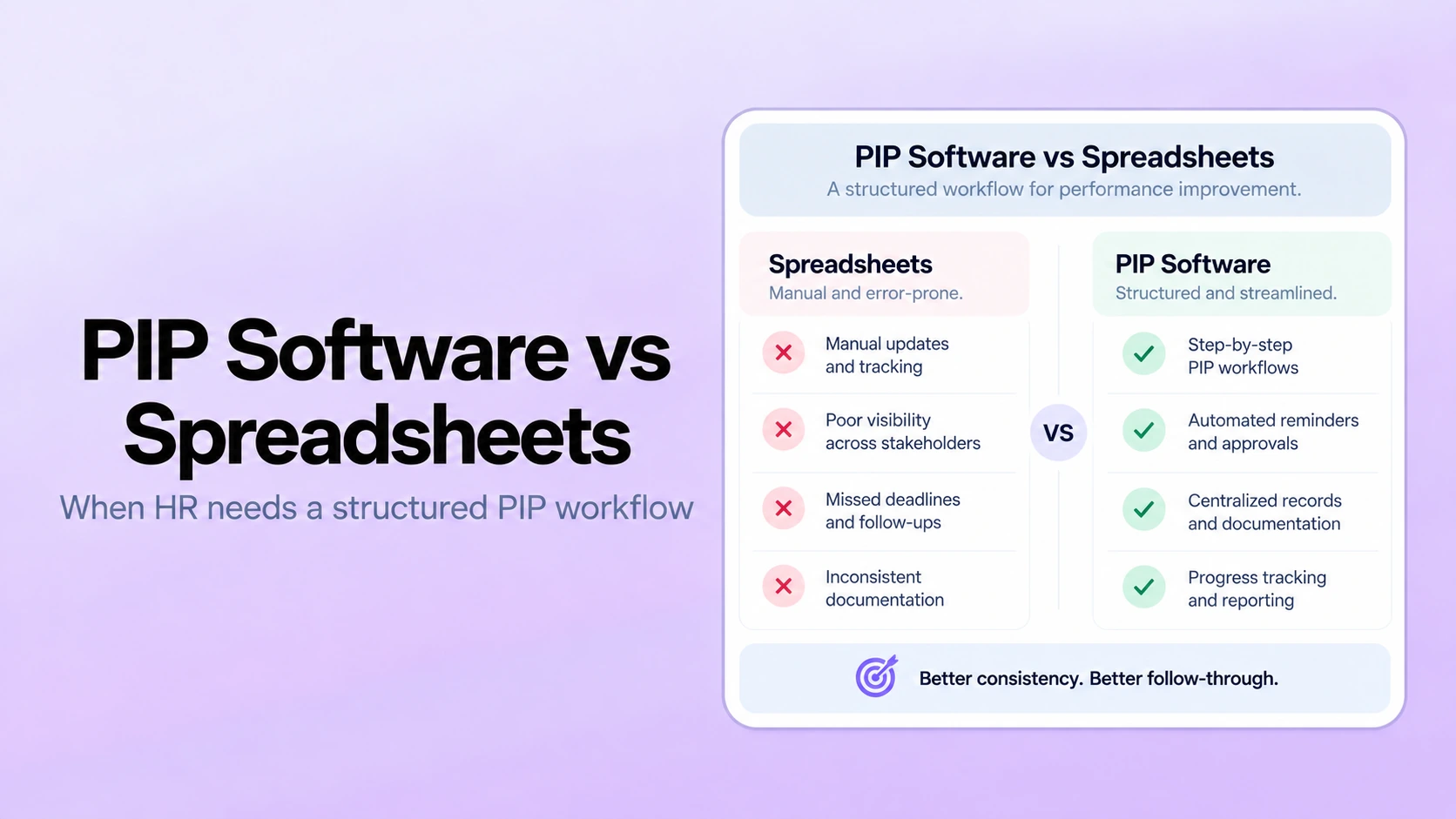
The letter, detailed plan, goals, evidence, meeting notes, support commitments, employee responses, and outcome should remain aligned throughout the process. A disconnected letter and spreadsheet workflow creates avoidable gaps in documentation and follow-through.
PerformSpark brings the PIP into the same performance management platform used for reviews, goals, check-ins, reporting, and development. Role-based access and security controls support appropriate handling of sensitive performance records.
Explore PerformSpark pricing or book a personalized demo to see how HR teams can manage PIP letters, milestones, evidence, and outcomes in one structured workflow.



.svg)

.svg)
.svg)

