




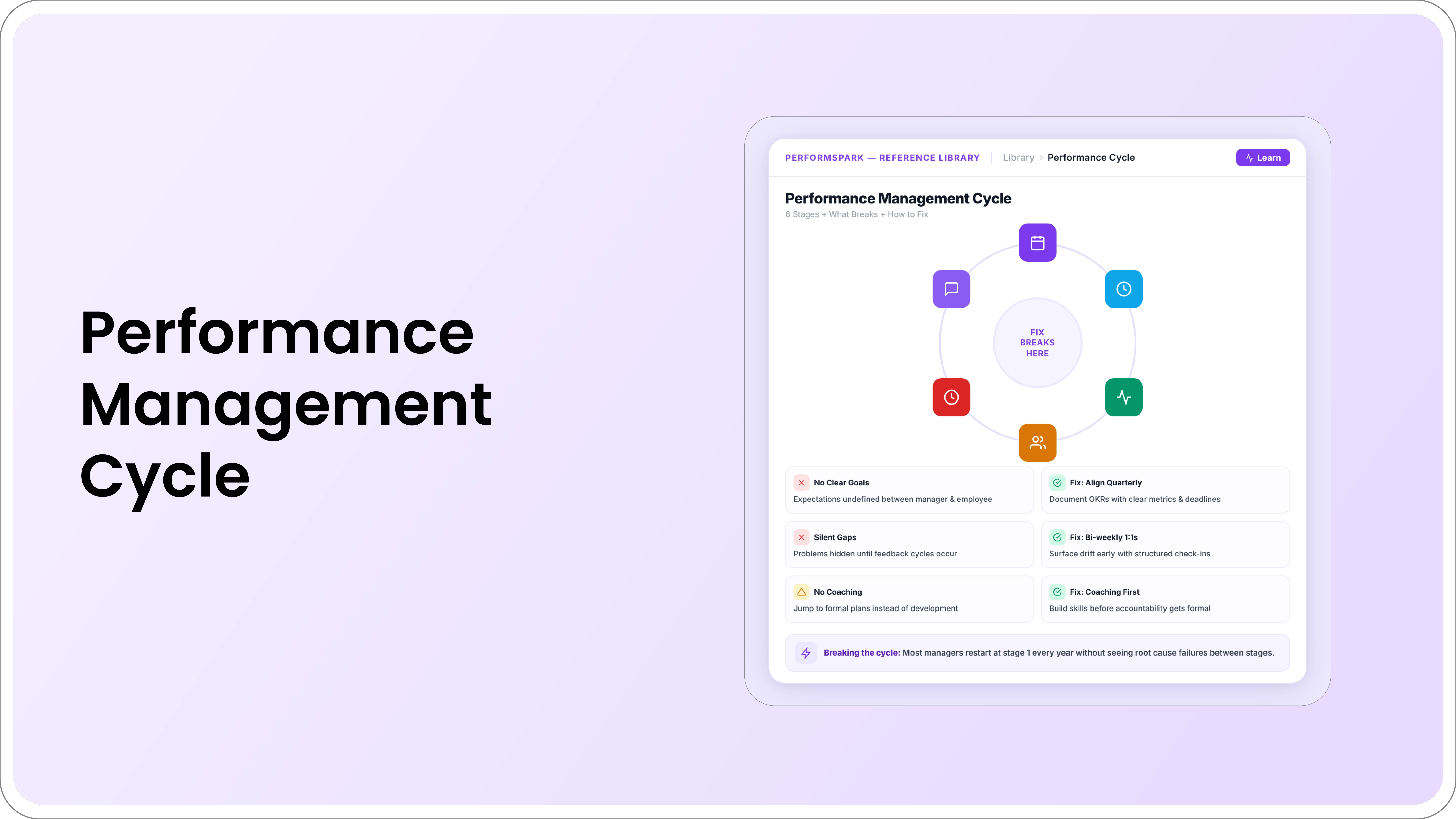
Performance Management Implementations

The Performance Management Cycle: 6 Stages, What Breaks Between Them, and How to Fix It

Updated :
June 30, 2026

Mahesh Kumar

Founder, TraineryHCM.com
The Performance Management Cycle

Table of Contents

What is the performance management cycle?

The performance management cycle is the structured, repeating process through which organizations set employee expectations, track performance, provide feedback, evaluate outcomes, and connect results to development and compensation decisions. A complete cycle includes six stages: goal setting, ongoing monitoring and check-ins, continuous feedback, performance review and rating, calibration, and development planning. Unlike a one-time annual appraisal, the performance management cycle is designed to repeat, with each iteration feeding into the next. When all six stages are connected and executed consistently, the cycle creates clarity for employees, accountability for managers, and organizational data that HR can use to make defensible decisions about development, compensation, and succession.

Every organization runs some version of a performance management cycle. Most run a version with too few stages, too wide a gap between them, and too little structure at the handoff points where things consistently break.

The standard 4-stage model plan, monitor, review, reward is a reasonable description of what performance management does at the highest level. It is less useful as an operational framework because it collapses three distinct processes into "review" and treats development as an afterthought following reward. The result is familiar: goal records go stale between planning and review, feedback conversations happen sporadically rather than continuously, calibration is skipped or informal, and development plans are created at review time and never revisited.

This guide presents the performance management cycle as six distinct stages, identifies the specific failure points between each, and explains how HR teams can design a cycle that actually produces the outcomes the model promises.

Why 6 Stages Instead of 4

The 4-stage model describes the cycle accurately at a conceptual level. The gap is operational. Two processes that typically get collapsed into "reviewing" are actually distinct enough to fail independently:

Calibration is the process of comparing ratings across managers and teams to ensure consistency. When it is subsumed within "review," it either does not happen at all or happens informally in conversations after ratings are submitted. In both cases, rating inconsistency across the organization survives unchallenged.

Development planning is the process of translating review outcomes into structured commitments about skills, behaviors, and career progression. When it is treated as the tail end of review rather than as a distinct stage with its own cadence, development plans become annual documents rather than living coaching tools.

Separating these two processes into their own stages does not make the cycle more complicated. It makes the cycle's failure points visible and addressable rather than invisible and structural.

The 6-Stage Performance Management Cycle

Stage 1: Goal Setting and Expectation Alignment

What it is: The opening stage of every cycle establishes what success looks like for each employee, how individual goals connect to team and organizational priorities, and what performance criteria will be applied throughout the cycle.

What a well-run Stage 1 produces: Written, measurable goals that both the employee and manager can reference without ambiguity. An explicit connection between the employee's objectives and the business outcomes their work supports. A shared understanding of how performance will be evaluated, not just what will be evaluated.

The most common failure at this stage: Goals are set in theory but not documented in a system where they remain visible. When goals exist only in a review form completed at the start of the cycle, they become invisible the moment the form is filed. The manager proceeds through the year without a shared reference point. By review time, neither party can accurately reconstruct whether the original goals were met, modified, or abandoned entirely.

What effective goal setting requires: Goals must be stored where both the manager and employee can update, reference, and discuss them continuously. SMART goals (Specific, Measurable, Achievable, Relevant, Time-bound) are the standard framework. OKRs (Objectives and Key Results) are increasingly used in organizations where strategic alignment from senior leadership down to individual contributors is a priority. The framework matters less than the discipline of keeping goal records current and accessible throughout the cycle.

Stage 2: Ongoing Monitoring and Check-In Cadence

What it is: The monitoring stage converts goal records into active performance tracking. It involves regular one-on-one meetings between manager and employee, progress updates on active goals, identification of blockers, and course corrections before issues become review-time discoveries.

What a well-run Stage 2 produces: A documented record of the conversations that happened during the cycle, the support provided, the obstacles encountered, and the adjustments made. This record becomes the evidence base for Stage 5 (review and rating) and Stage 6 (development planning). Without it, both of those stages operate on memory rather than documentation.

The most common failure at this stage: Check-ins happen inconsistently or become status updates rather than coaching conversations. A status update confirms that a task is complete. A coaching conversation addresses whether the employee is developing the capability required for their next goal, their next role, or their next level of responsibility. Organizations that track whether check-ins occur but not what quality of conversation happens inside them measure participation, not performance management.

What effective monitoring requires: A defined check-in cadence. For most roles, weekly or bi-weekly is appropriate for individual goal tracking; monthly is the minimum for meaningful performance conversation. Check-in notes should be documented in a shared system so both manager and employee have a record of what was discussed, what was committed to, and what remains open.
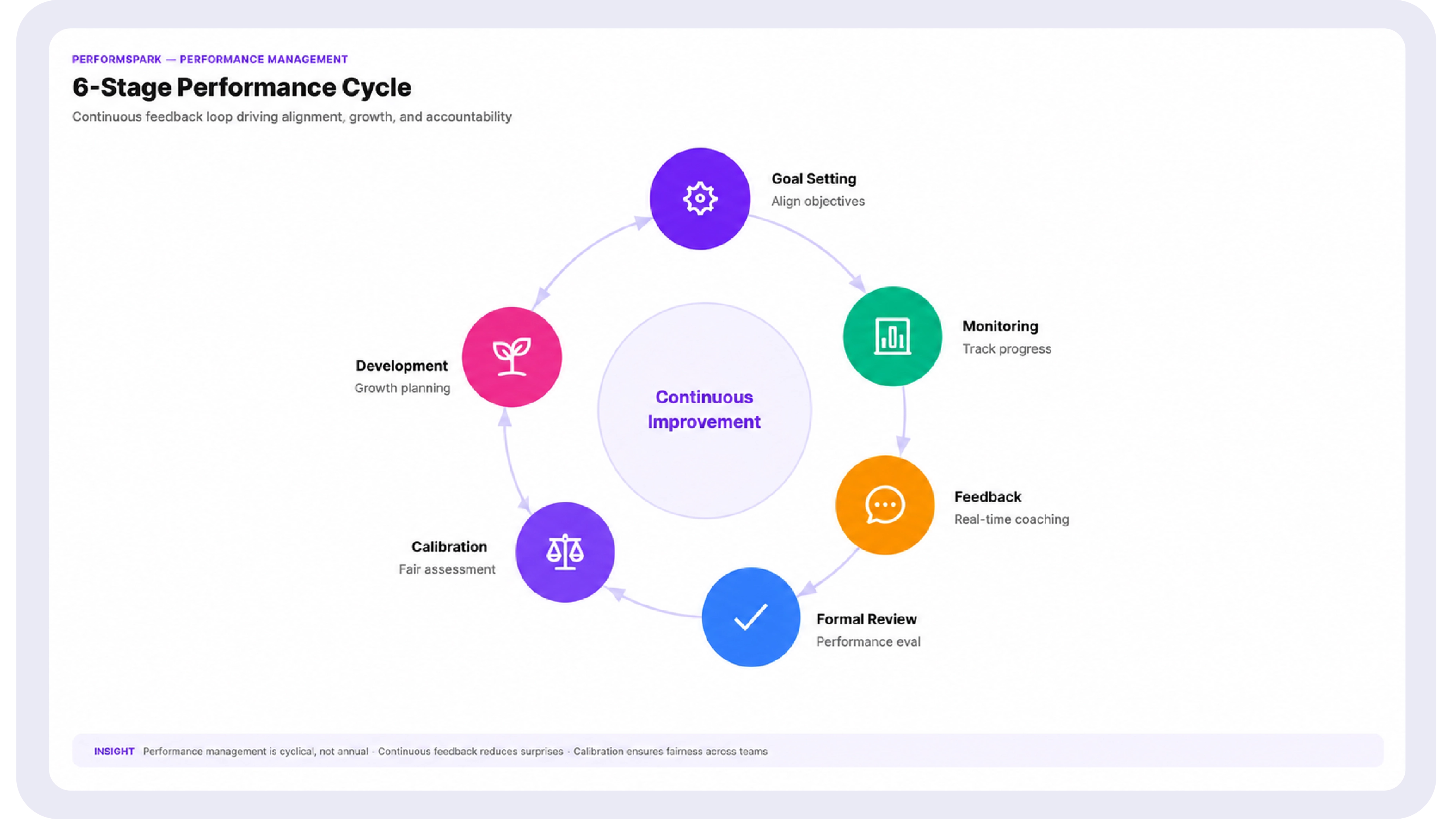
Circular diagram showing the six stages of the performance management cycle: goal setting, monitoring, continuous feedback, review, calibration, and development planning
⚑
Performance Management Cycle

Continuous Performance Tracking

PerformSpark's check-in module connects 1-on-1 meeting notes to goal records and the employee's performance review, creating a continuous paper trail between Stage 1 and Stage 5 that eliminates the "I can't remember what we discussed" problem at review time. See how check-ins work in PerformSpark.

Book a Demo β†’
15-minute personalized walkthrough

Stage 3: Continuous Feedback

What it is: Ongoing feedback is distinct from both check-in conversations (Stage 2) and formal performance reviews (Stage 4). It is the real-time acknowledgment of specific behaviors, contributions, and development signals throughout the cycle, not held for review season, not confined to scheduled meetings.

What a well-run Stage 3 produces: A culture in which employees know where they stand before the formal review rather than discovering it during it. A feedback record that captures peer observations, manager observations, and cross-functional contributions that the direct manager may not observe firsthand.

The most common failure at this stage: Continuous feedback is announced as an organizational priority and never operationalized. Managers intend to give frequent feedback but default to saving observations for the next check-in or the annual review. Employees have no mechanism to request feedback at natural moments rather than scheduled ones.

What effective continuous feedback requires: A structured channel for feedback that is accessible in the flow of daily work, not a separate system requiring a separate login. Peer recognition and peer feedback should be built into the feedback channel so that cross-functional contributions receive acknowledgment rather than existing only in the direct manager's peripheral vision.

360-degree feedback, where employees receive structured input from managers, peers, and, in some structures, direct reports or internal customers, is the formalized version of continuous feedback and is typically conducted in conjunction with the Stage 4 review cycle rather than in real time.

Stage 4: Performance Review and Rating

What it is: The formal evaluation stage, in which managers assess employee performance against the goals and expectations set in Stage 1, document their assessment in writing, and assign a rating that summarizes performance for the review period.

What a well-run Stage 4 produces: A written performance record grounded in documented evidence from Stages 1 through 3. Ratings that reflect the full review period rather than the most recent six weeks. Self-assessments from employees that inform the manager's view and create a record of how the employee understands their own contribution.

The most common failure at this stage: Reviews are written from memory. Without goal records updated throughout the cycle and check-in documentation from Stage 2, managers write reviews based on recent impressions. This is the mechanism behind recency bias, not a character flaw in managers, but a structural failure that Stage 2 documentation is designed to prevent.

A secondary failure: the review conversation becomes the first time the employee hears substantive feedback about their performance. When Stage 3 has been executed well, the review conversation should hold no surprises. When Stage 3 has been skipped, the review becomes a difficult conversation that a well-run continuous feedback stage would have made unnecessary.

Stage 5: Calibration

What it is: Calibration is the organizational process of comparing performance ratings across managers, teams, and departments to identify and correct rating inconsistency before ratings are communicated to employees or connected to compensation decisions.

What a well-run Stage 5 produces: A set of ratings that reflect consistent standards across the organization rather than the individual calibration tendencies of each manager. Documented evidence for rating decisions that supports legal defensibility and demographic equity analysis.

The most common failure at this stage: It is skipped entirely. In organizations without a formal calibration process, rating distributions reflect manager-level culture rather than organizational standards. A lenient manager produces a team with consistently high ratings. A rigorous manager produces a team with lower ratings for equivalent performance. Employees in both teams are being evaluated against different standards without knowing it.

When calibration does happen, it often happens informally and without documentation. Conversations in the hallway between review submission and employee communication change ratings without creating a record of why. This creates an audit trail problem and makes calibration decisions impossible to explain to employees who ask why their rating changed.

What effective calibration requires: A structured session with HR facilitation, pre-session analysis of rating distributions by manager and team, defined calibration criteria, evidence-based discussion of outlier ratings, and real-time documentation of changes and rationale. The pre-session analysis showing each manager how their distribution compares to the organizational norm is the single most effective input for a productive calibration session.
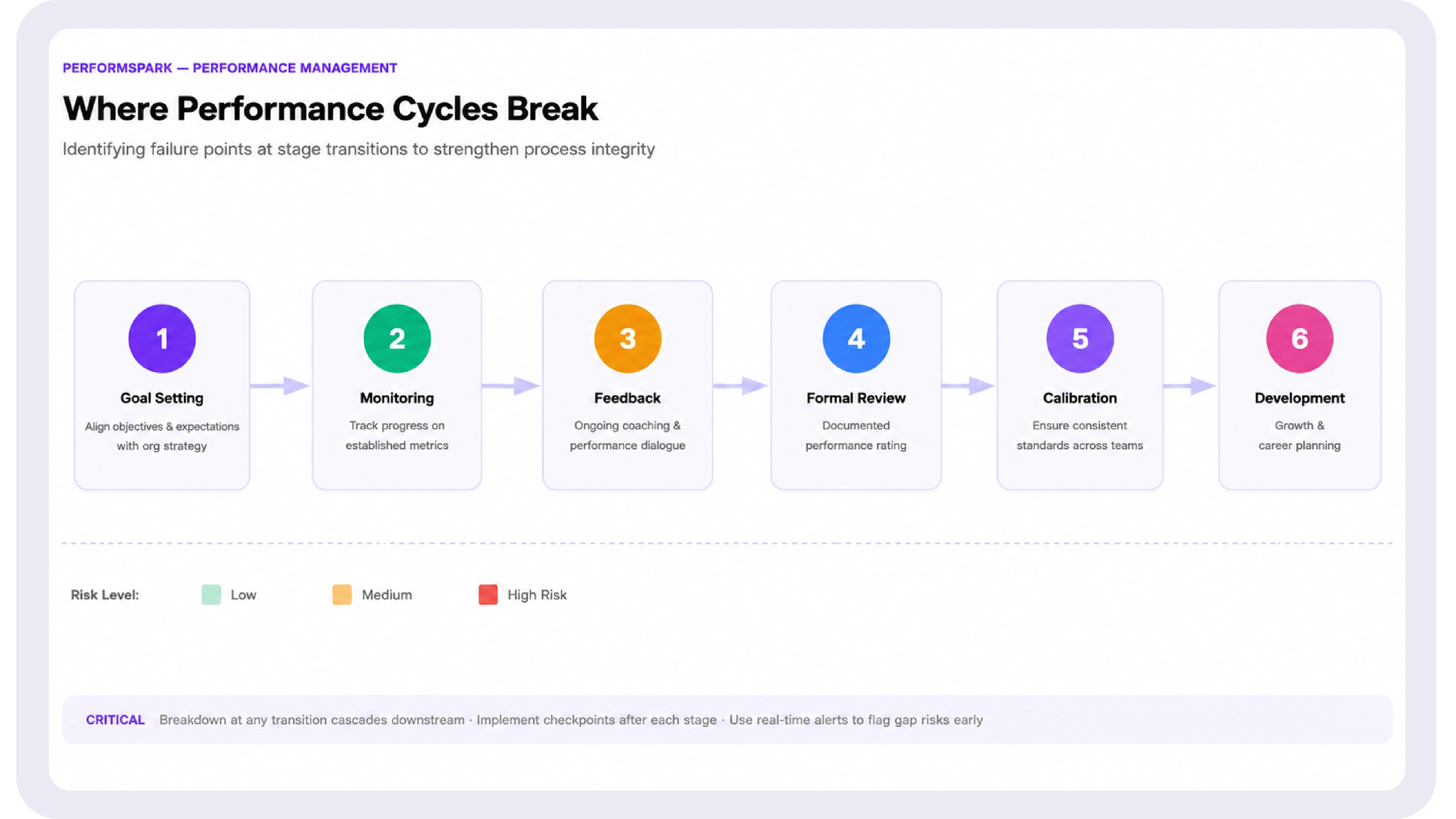
Diagram showing the six performance management cycle stages with arrows indicating the most common failure points at each stage transition
⚑
Calibration

Automated Calibration Engine

TrAI, PerformSpark's AI calibration engine, generates the pre-session calibration analysis automatically before every review cycle: rating distributions by manager, outlier flags, and bias pattern detection. HR teams spend calibration sessions making decisions, not preparing data. See how TrAI calibration works.

Book a Demo β†’
15-minute personalized walkthrough

Stage 6: Development Planning

What it is: The final stage of each cycle and the bridge to the next. Development planning translates review outcomes, calibration results, and manager observations into structured commitments: what skills the employee will build, how, by when, and with what organizational support.

What a well-run Stage 6 produces: An individual development plan (IDP) that is specific enough to guide coaching conversations, connected to the goal-setting that opens the next cycle, and realistic about the support the organization will actually provide. A succession planning input: HR can aggregate development plan data across teams to understand where the organization's capability gaps and talent pipeline gaps are concentrated.

The most common failure at this stage: Development plans are created at review time and never revisited. The review conversation produces a document. The document is filed. The next cycle begins, and neither manager nor employee opens the development plan until it is time to create a new one.

This failure is not primarily a motivation problem. It is a structural problem. When development plans exist in a separate document from the manager's check-in agenda, they are not accessible in the natural flow of coaching conversations. Making development an agenda item in every Stage 2 check-in is the simplest structural fix.

What effective development planning requires: Each IDP should include a specific skill or behavior to develop, the learning activity or experience that will develop it, a timeline with milestones, what the manager will specifically do to support it, and how progress will be assessed. IDPs created at year-end and not connected to the next cycle's goal-setting process are orphaned documents, not development commitments.

The Stage Transition Failures That Break Performance Management Cycles

The stages described above each have their own execution requirements. But many performance management cycles fail not within stages but between them. Understanding these transition failures is how HR teams diagnose why their cycle is not producing the outcomes they designed it to produce.

Stage Transition Common Failure Mode Consequence
Stage 1 to Stage 2 Goals are documented at the beginning of the cycle but are not stored in a visible, accessible system. Monitoring operates without a reference point, and check-ins become simple status updates.
Stage 2 to Stage 3 Check-ins take place but are not documented, with no feedback channel outside scheduled meetings. Performance reviews rely on memory, and cross-functional contributions remain unrecorded.
Stage 3 to Stage 4 Feedback is collected informally but is not aggregated for the review process. Manager recency bias increases, and self-assessments become disconnected from continuous feedback.
Stage 4 to Stage 5 Calibration is skipped or handled informally, with no pre-session analysis. Rating inconsistencies persist across managers, reducing confidence in compensation and talent decisions.
Stage 5 to Stage 6 Review results are communicated before development conversations and plans are completed. Individual Development Plans (IDPs) become reactive instead of being integrated into the review process.
Stage 6 to Stage 1 The previous cycle's development plan is not referenced during the next goal-setting cycle. Growth commitments are forgotten, and development becomes an annual document instead of an ongoing conversation.

The Performance Management Cycle and the Employee Lifecycle

The performance management cycle does not operate in isolation. It is one component of the broader employee lifecycle, and its effectiveness depends partly on how well it connects to adjacent lifecycle stages.

Onboarding and Stage 1: The first performance management cycle for a new employee should begin during onboarding. This means setting goals that are explicitly appropriate for the onboarding period, not the same goals as a tenured employee in the same role, but goals that create accountability for the learning and integration milestones onboarding is designed to produce.

Promotion decisions and Stage 5: Promotion decisions that are not grounded in calibrated performance data are at higher risk of demographic bias and inconsistency. A mature performance management cycle produces the evidence base that promotion decisions require: documented performance ratings, calibrated across the manager cohort, connected to observed behaviors over multiple review periods.

Exit data and cycle design: Exit interviews regularly surface that employees left because they did not receive adequate feedback, did not understand their development path, or felt their performance was not recognized fairly. Each of these is a specific stage failure in the performance management cycle: Stage 3 failure, Stage 6 failure, and Stage 5 failure, respectively. Exit data, analyzed systematically, is one of the most actionable inputs available for performance management cycle redesign.

Continuous vs. Annual: Choosing the Right Cycle Cadence

The 6-stage model described above can be run on multiple cadences. The right choice depends on the organization's size, rate of change, and management maturity.

Annual cycle with continuous feedback: One formal goal-setting, review, calibration, and development-planning sequence per year, with Stages 2 and 3 (monitoring and feedback) running throughout. Appropriate for stable organizations where role scope changes slowly, and manager capacity for frequent formal conversation is limited. Risk: One year is a long time for a goal to remain relevant. Build in a mid-year goal-review checkpoint.

Semi-annual cycle: Two complete cycles per year, with abbreviated reviews at mid-year and comprehensive reviews at year-end. More appropriate for high-growth organizations and roles where performance expectations shift with business priorities. Doubles the calibration and development planning work for HR, but produces more current and responsive performance data.

Quarterly review cadence with continuous feedback: Full goal-setting and review every quarter, with calibration and development planning either quarterly or semi-annually. Most appropriate for fast-moving products and sales organizations where objectives shift with market conditions. Requires strong automation support to be sustainable for HR teams.

How Automation Supports Each Stage

Automation in performance management does not replace conversation. It removes administrative work that prevents conversation from happening. The distinction matters because organizations that implement performance management software expect the technology to produce the outcomes, rather than create the conditions for outcomes, and are typically disappointed.

What automation can do at each stage:

  • Stage 1: Store goals in a shared, visible system. Notify both the manager and employee when goal progress has not been updated. Send reminders when the review cycle opens.
  • Stage 2: Document check-in notes and connect them to the employee's performance profile. Flag when check-in cadence drops below the configured threshold.
  • Stage 3: Provide a structured channel for real-time feedback. Aggregate peer feedback for 360 review cycles. Surface recognition patterns alongside pulse survey data.
  • Stage 4: Launch review cycles with configurable notification and escalation workflows. Connect self-assessment submissions to goal records and feedback history automatically. Reduce manual completion tracking through automated escalations.
  • Stage 5: Generate pre-calibration analysis rating distributions, outlier flags, and bias patterns automatically before calibration sessions. Document calibration decisions in real time.
  • Stage 6: Connect development plan milestones to check-in agendas. Alert HR when IDP discussion frequency drops below a defined threshold.

The performance management cycle provides the structure through which organizations convert business priorities into employee expectations, monitor progress, and make decisions about development and compensation. A 4-stage model captures the concept. A 6-stage model captures what actually goes wrong.

The additions that matter most are calibration and development planning as distinct stages, not subsections of review. Calibration prevents rating inconsistency from silently distorting the compensation and succession decisions that flow from review. Development planning, treated as a genuine stage rather than a review-time deliverable, creates the continuity between cycles that transforms the performance management cycle from an annual administrative exercise into an ongoing organizational capability.

The practical starting point for any HR team reviewing their cycle: map your current process against the six stages and identify which transitions are undocumented. The failure is almost always in the handoff, not the stage itself.
End-to-End Performance Automation

Run a performance management cycle that your managers will actually complete.

PerformSpark automates the administrative work at every stage of the performance management cycle, from goal tracking and smart notifications in Stage 1 through TrAI-powered calibration analysis in Stage 5, so HR teams spend their time facilitating conversations, not chasing completions. Book a demo to see the full 6-stage performance management cycle in PerformSpark.

Book a Demo See all 6 stages in a live walkthrough

Key Takeaways

  • Most organizations use a 4-stage performance management cycle, but two critical stages, calibration and development, are typically collapsed into others, which is why reviews feel inconsistent, and development plans go unused.
  • The performance management cycle and the employee lifecycle are connected: how well a cycle is designed directly determines whether onboarding, promotion, and exit decisions are grounded in evidence or impression.
  • Stage transitions are where performance management cycles most commonly fail. The planning-to-monitoring handoff, in particular, is where goals become invisible until review season.
  • A 6-stage cycle adds calibration as a distinct step before rating and adds ongoing development as distinct from review. Both additions require process investment but produce substantially better outcomes.
  • Automation can and should remove administrative work from at least four of the six stages. What it cannot replace is the quality of the conversations that happen inside each stage.

What is the performance management cycle?

The performance management cycle is the structured, repeating process through which organizations set employee expectations, track performance, provide feedback, evaluate outcomes, and connect results to development and compensation decisions. A complete cycle includes six stages: goal setting, ongoing monitoring and check-ins, continuous feedback, performance review and rating, calibration, and development planning. Unlike a one-time annual appraisal, the performance management cycle is designed to repeat, with each iteration feeding into the next. When all six stages are connected and executed consistently, the cycle creates clarity for employees, accountability for managers, and organizational data that HR can use to make defensible decisions about development, compensation, and succession.

Every organization runs some version of a performance management cycle. Most run a version with too few stages, too wide a gap between them, and too little structure at the handoff points where things consistently break.

The standard 4-stage model plan, monitor, review, reward is a reasonable description of what performance management does at the highest level. It is less useful as an operational framework because it collapses three distinct processes into "review" and treats development as an afterthought following reward. The result is familiar: goal records go stale between planning and review, feedback conversations happen sporadically rather than continuously, calibration is skipped or informal, and development plans are created at review time and never revisited.

This guide presents the performance management cycle as six distinct stages, identifies the specific failure points between each, and explains how HR teams can design a cycle that actually produces the outcomes the model promises.

Why 6 Stages Instead of 4

The 4-stage model describes the cycle accurately at a conceptual level. The gap is operational. Two processes that typically get collapsed into "reviewing" are actually distinct enough to fail independently:

Calibration is the process of comparing ratings across managers and teams to ensure consistency. When it is subsumed within "review," it either does not happen at all or happens informally in conversations after ratings are submitted. In both cases, rating inconsistency across the organization survives unchallenged.

Development planning is the process of translating review outcomes into structured commitments about skills, behaviors, and career progression. When it is treated as the tail end of review rather than as a distinct stage with its own cadence, development plans become annual documents rather than living coaching tools.

Separating these two processes into their own stages does not make the cycle more complicated. It makes the cycle's failure points visible and addressable rather than invisible and structural.

The 6-Stage Performance Management Cycle

Stage 1: Goal Setting and Expectation Alignment

What it is: The opening stage of every cycle establishes what success looks like for each employee, how individual goals connect to team and organizational priorities, and what performance criteria will be applied throughout the cycle.

What a well-run Stage 1 produces: Written, measurable goals that both the employee and manager can reference without ambiguity. An explicit connection between the employee's objectives and the business outcomes their work supports. A shared understanding of how performance will be evaluated, not just what will be evaluated.

The most common failure at this stage: Goals are set in theory but not documented in a system where they remain visible. When goals exist only in a review form completed at the start of the cycle, they become invisible the moment the form is filed. The manager proceeds through the year without a shared reference point. By review time, neither party can accurately reconstruct whether the original goals were met, modified, or abandoned entirely.

What effective goal setting requires: Goals must be stored where both the manager and employee can update, reference, and discuss them continuously. SMART goals (Specific, Measurable, Achievable, Relevant, Time-bound) are the standard framework. OKRs (Objectives and Key Results) are increasingly used in organizations where strategic alignment from senior leadership down to individual contributors is a priority. The framework matters less than the discipline of keeping goal records current and accessible throughout the cycle.

Stage 2: Ongoing Monitoring and Check-In Cadence

What it is: The monitoring stage converts goal records into active performance tracking. It involves regular one-on-one meetings between manager and employee, progress updates on active goals, identification of blockers, and course corrections before issues become review-time discoveries.

What a well-run Stage 2 produces: A documented record of the conversations that happened during the cycle, the support provided, the obstacles encountered, and the adjustments made. This record becomes the evidence base for Stage 5 (review and rating) and Stage 6 (development planning). Without it, both of those stages operate on memory rather than documentation.

The most common failure at this stage: Check-ins happen inconsistently or become status updates rather than coaching conversations. A status update confirms that a task is complete. A coaching conversation addresses whether the employee is developing the capability required for their next goal, their next role, or their next level of responsibility. Organizations that track whether check-ins occur but not what quality of conversation happens inside them measure participation, not performance management.

What effective monitoring requires: A defined check-in cadence. For most roles, weekly or bi-weekly is appropriate for individual goal tracking; monthly is the minimum for meaningful performance conversation. Check-in notes should be documented in a shared system so both manager and employee have a record of what was discussed, what was committed to, and what remains open.

Circular diagram showing the six stages of the performance management cycle: goal setting, monitoring, continuous feedback, review, calibration, and development planning
⚑
Performance Management Cycle

Continuous Performance Tracking

PerformSpark's check-in module connects 1-on-1 meeting notes to goal records and the employee's performance review, creating a continuous paper trail between Stage 1 and Stage 5 that eliminates the "I can't remember what we discussed" problem at review time. See how check-ins work in PerformSpark.

Book a Demo β†’
15-minute personalized walkthrough

Stage 3: Continuous Feedback

What it is: Ongoing feedback is distinct from both check-in conversations (Stage 2) and formal performance reviews (Stage 4). It is the real-time acknowledgment of specific behaviors, contributions, and development signals throughout the cycle, not held for review season, not confined to scheduled meetings.

What a well-run Stage 3 produces: A culture in which employees know where they stand before the formal review rather than discovering it during it. A feedback record that captures peer observations, manager observations, and cross-functional contributions that the direct manager may not observe firsthand.

The most common failure at this stage: Continuous feedback is announced as an organizational priority and never operationalized. Managers intend to give frequent feedback but default to saving observations for the next check-in or the annual review. Employees have no mechanism to request feedback at natural moments rather than scheduled ones.

What effective continuous feedback requires: A structured channel for feedback that is accessible in the flow of daily work, not a separate system requiring a separate login. Peer recognition and peer feedback should be built into the feedback channel so that cross-functional contributions receive acknowledgment rather than existing only in the direct manager's peripheral vision.

360-degree feedback, where employees receive structured input from managers, peers, and, in some structures, direct reports or internal customers, is the formalized version of continuous feedback and is typically conducted in conjunction with the Stage 4 review cycle rather than in real time.

Stage 4: Performance Review and Rating

What it is: The formal evaluation stage, in which managers assess employee performance against the goals and expectations set in Stage 1, document their assessment in writing, and assign a rating that summarizes performance for the review period.

What a well-run Stage 4 produces: A written performance record grounded in documented evidence from Stages 1 through 3. Ratings that reflect the full review period rather than the most recent six weeks. Self-assessments from employees that inform the manager's view and create a record of how the employee understands their own contribution.

The most common failure at this stage: Reviews are written from memory. Without goal records updated throughout the cycle and check-in documentation from Stage 2, managers write reviews based on recent impressions. This is the mechanism behind recency bias, not a character flaw in managers, but a structural failure that Stage 2 documentation is designed to prevent.

A secondary failure: the review conversation becomes the first time the employee hears substantive feedback about their performance. When Stage 3 has been executed well, the review conversation should hold no surprises. When Stage 3 has been skipped, the review becomes a difficult conversation that a well-run continuous feedback stage would have made unnecessary.

Stage 5: Calibration

What it is: Calibration is the organizational process of comparing performance ratings across managers, teams, and departments to identify and correct rating inconsistency before ratings are communicated to employees or connected to compensation decisions.

What a well-run Stage 5 produces: A set of ratings that reflect consistent standards across the organization rather than the individual calibration tendencies of each manager. Documented evidence for rating decisions that supports legal defensibility and demographic equity analysis.

The most common failure at this stage: It is skipped entirely. In organizations without a formal calibration process, rating distributions reflect manager-level culture rather than organizational standards. A lenient manager produces a team with consistently high ratings. A rigorous manager produces a team with lower ratings for equivalent performance. Employees in both teams are being evaluated against different standards without knowing it.

When calibration does happen, it often happens informally and without documentation. Conversations in the hallway between review submission and employee communication change ratings without creating a record of why. This creates an audit trail problem and makes calibration decisions impossible to explain to employees who ask why their rating changed.

What effective calibration requires: A structured session with HR facilitation, pre-session analysis of rating distributions by manager and team, defined calibration criteria, evidence-based discussion of outlier ratings, and real-time documentation of changes and rationale. The pre-session analysis showing each manager how their distribution compares to the organizational norm is the single most effective input for a productive calibration session.

Diagram showing the six performance management cycle stages with arrows indicating the most common failure points at each stage transition
⚑
Calibration

Automated Calibration Engine

TrAI, PerformSpark's AI calibration engine, generates the pre-session calibration analysis automatically before every review cycle: rating distributions by manager, outlier flags, and bias pattern detection. HR teams spend calibration sessions making decisions, not preparing data. See how TrAI calibration works.

Book a Demo β†’
15-minute personalized walkthrough

Stage 6: Development Planning

What it is: The final stage of each cycle and the bridge to the next. Development planning translates review outcomes, calibration results, and manager observations into structured commitments: what skills the employee will build, how, by when, and with what organizational support.

What a well-run Stage 6 produces: An individual development plan (IDP) that is specific enough to guide coaching conversations, connected to the goal-setting that opens the next cycle, and realistic about the support the organization will actually provide. A succession planning input: HR can aggregate development plan data across teams to understand where the organization's capability gaps and talent pipeline gaps are concentrated.

The most common failure at this stage: Development plans are created at review time and never revisited. The review conversation produces a document. The document is filed. The next cycle begins, and neither manager nor employee opens the development plan until it is time to create a new one.

This failure is not primarily a motivation problem. It is a structural problem. When development plans exist in a separate document from the manager's check-in agenda, they are not accessible in the natural flow of coaching conversations. Making development an agenda item in every Stage 2 check-in is the simplest structural fix.

What effective development planning requires: Each IDP should include a specific skill or behavior to develop, the learning activity or experience that will develop it, a timeline with milestones, what the manager will specifically do to support it, and how progress will be assessed. IDPs created at year-end and not connected to the next cycle's goal-setting process are orphaned documents, not development commitments.

The Stage Transition Failures That Break Performance Management Cycles

The stages described above each have their own execution requirements. But many performance management cycles fail not within stages but between them. Understanding these transition failures is how HR teams diagnose why their cycle is not producing the outcomes they designed it to produce.

Stage Transition Common Failure Mode Consequence
Stage 1 to Stage 2 Goals are documented at the beginning of the cycle but are not stored in a visible, accessible system. Monitoring operates without a reference point, and check-ins become simple status updates.
Stage 2 to Stage 3 Check-ins take place but are not documented, with no feedback channel outside scheduled meetings. Performance reviews rely on memory, and cross-functional contributions remain unrecorded.
Stage 3 to Stage 4 Feedback is collected informally but is not aggregated for the review process. Manager recency bias increases, and self-assessments become disconnected from continuous feedback.
Stage 4 to Stage 5 Calibration is skipped or handled informally, with no pre-session analysis. Rating inconsistencies persist across managers, reducing confidence in compensation and talent decisions.
Stage 5 to Stage 6 Review results are communicated before development conversations and plans are completed. Individual Development Plans (IDPs) become reactive instead of being integrated into the review process.
Stage 6 to Stage 1 The previous cycle's development plan is not referenced during the next goal-setting cycle. Growth commitments are forgotten, and development becomes an annual document instead of an ongoing conversation.

The Performance Management Cycle and the Employee Lifecycle

The performance management cycle does not operate in isolation. It is one component of the broader employee lifecycle, and its effectiveness depends partly on how well it connects to adjacent lifecycle stages.

Onboarding and Stage 1: The first performance management cycle for a new employee should begin during onboarding. This means setting goals that are explicitly appropriate for the onboarding period, not the same goals as a tenured employee in the same role, but goals that create accountability for the learning and integration milestones onboarding is designed to produce.

Promotion decisions and Stage 5: Promotion decisions that are not grounded in calibrated performance data are at higher risk of demographic bias and inconsistency. A mature performance management cycle produces the evidence base that promotion decisions require: documented performance ratings, calibrated across the manager cohort, connected to observed behaviors over multiple review periods.

Exit data and cycle design: Exit interviews regularly surface that employees left because they did not receive adequate feedback, did not understand their development path, or felt their performance was not recognized fairly. Each of these is a specific stage failure in the performance management cycle: Stage 3 failure, Stage 6 failure, and Stage 5 failure, respectively. Exit data, analyzed systematically, is one of the most actionable inputs available for performance management cycle redesign.

Continuous vs. Annual: Choosing the Right Cycle Cadence

The 6-stage model described above can be run on multiple cadences. The right choice depends on the organization's size, rate of change, and management maturity.

Annual cycle with continuous feedback: One formal goal-setting, review, calibration, and development-planning sequence per year, with Stages 2 and 3 (monitoring and feedback) running throughout. Appropriate for stable organizations where role scope changes slowly, and manager capacity for frequent formal conversation is limited. Risk: One year is a long time for a goal to remain relevant. Build in a mid-year goal-review checkpoint.

Semi-annual cycle: Two complete cycles per year, with abbreviated reviews at mid-year and comprehensive reviews at year-end. More appropriate for high-growth organizations and roles where performance expectations shift with business priorities. Doubles the calibration and development planning work for HR, but produces more current and responsive performance data.

Quarterly review cadence with continuous feedback: Full goal-setting and review every quarter, with calibration and development planning either quarterly or semi-annually. Most appropriate for fast-moving products and sales organizations where objectives shift with market conditions. Requires strong automation support to be sustainable for HR teams.

How Automation Supports Each Stage

Automation in performance management does not replace conversation. It removes administrative work that prevents conversation from happening. The distinction matters because organizations that implement performance management software expect the technology to produce the outcomes, rather than create the conditions for outcomes, and are typically disappointed.

What automation can do at each stage:

  • Stage 1: Store goals in a shared, visible system. Notify both the manager and employee when goal progress has not been updated. Send reminders when the review cycle opens.
  • Stage 2: Document check-in notes and connect them to the employee's performance profile. Flag when check-in cadence drops below the configured threshold.
  • Stage 3: Provide a structured channel for real-time feedback. Aggregate peer feedback for 360 review cycles. Surface recognition patterns alongside pulse survey data.
  • Stage 4: Launch review cycles with configurable notification and escalation workflows. Connect self-assessment submissions to goal records and feedback history automatically. Reduce manual completion tracking through automated escalations.
  • Stage 5: Generate pre-calibration analysis rating distributions, outlier flags, and bias patterns automatically before calibration sessions. Document calibration decisions in real time.
  • Stage 6: Connect development plan milestones to check-in agendas. Alert HR when IDP discussion frequency drops below a defined threshold.

The performance management cycle provides the structure through which organizations convert business priorities into employee expectations, monitor progress, and make decisions about development and compensation. A 4-stage model captures the concept. A 6-stage model captures what actually goes wrong.

The additions that matter most are calibration and development planning as distinct stages, not subsections of review. Calibration prevents rating inconsistency from silently distorting the compensation and succession decisions that flow from review. Development planning, treated as a genuine stage rather than a review-time deliverable, creates the continuity between cycles that transforms the performance management cycle from an annual administrative exercise into an ongoing organizational capability.

The practical starting point for any HR team reviewing their cycle: map your current process against the six stages and identify which transitions are undocumented. The failure is almost always in the handoff, not the stage itself.
End-to-End Performance Automation

Run a performance management cycle that your managers will actually complete.

PerformSpark automates the administrative work at every stage of the performance management cycle, from goal tracking and smart notifications in Stage 1 through TrAI-powered calibration analysis in Stage 5, so HR teams spend their time facilitating conversations, not chasing completions. Book a demo to see the full 6-stage performance management cycle in PerformSpark.

Book a Demo See all 6 stages in a live walkthrough

Frequently Asked Questions

What is the difference between a performance management cycle and a performance review?

How often should the performance management cycle run?

What typically breaks between stages in a performance management cycle?

What is calibration in the performance management cycle, and why does it need to be a separate stage?

How does the performance management cycle connect to the employee lifecycle?

Make performance reviews your growth lever

No credit card required β€’ Free setup & training included β€’ Cancel anytime

CTA ShapeCTA Shape