



Table of Contents
Performance improvement plans have a reputation problem, and it is not entirely unearned. The Wall Street Journal reporting found that formal performance procedures, the broad category PIPs fall under, rose from roughly 33 workers per 1,000 in 2020 to about 44 per 1,000 in 2023, even as companies publicly frame PIPs as a development tool. That gap between stated intent and lived employee experience is exactly why so many workers hear βyou've been placed on a PIPβ and immediately start updating their resume, regardless of what the document itself says about coaching and support.
This puts HR and people leaders in a genuinely difficult position. A PIP, done well, is one of the few tools that gives a struggling employee a real, structured chance to recover, while also protecting the organization with a clear, documented record if the outcome is termination. A PIP done badly, rushed, vague, or issued after a termination decision has effectively already been made, does neither. It damages trust, invites legal risk through inconsistent application, and confirms every employee's worst assumption about what a PIP actually means.
The stakes are also organizational, not just individual. A workforce that has watched several colleagues go through PIPs that clearly ended in termination,n regardless of effort, rt develops a shared, accurate read on what the tool actually means at that company. Once that read sets in, even a manager with genuine intent to help an employee recover is fighting an uphill perception battle the moment the word βPIPβ enters the conversation, which makes the upfront decision of whether to use one at all even more consequential than it might first appear.
Most existing PIP guidance jumps straight to the how: how to write one, what sections to include, what timeline to use. Fewer resources stop at the more important question first: whether a PIP is the right intervention at all, and what the realistic alternatives look like when it isn't. This guide focuses on that earlier decision: the real benefits a PIP can deliver, the risks it carries even when executed well, and the situations where a different tool entirely will serve the employee and the organization better.
What Are the Key Benefits of a Performance Improvement Plan?
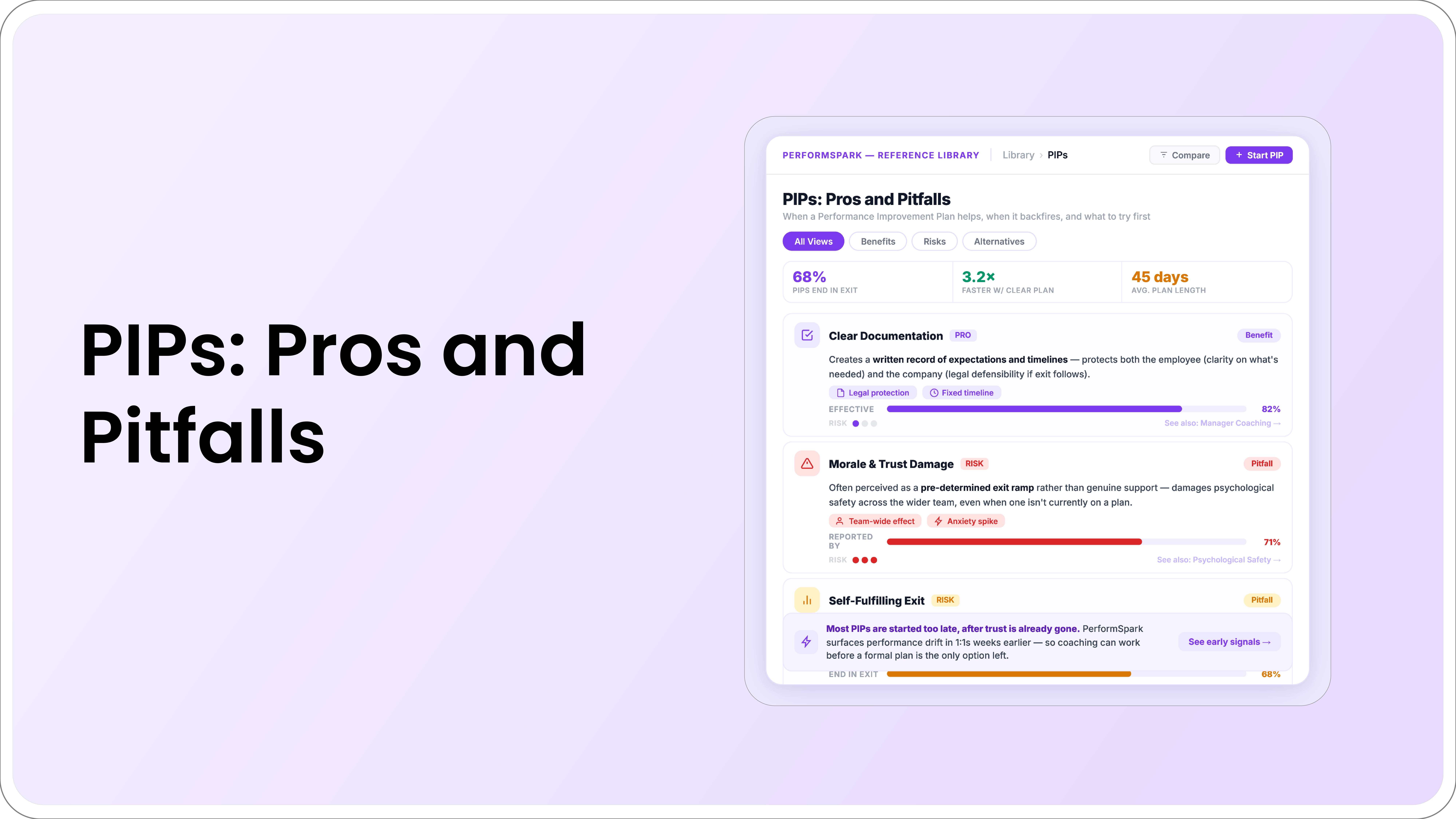
A well-designed performance improvement plan benefits both the organization and the employee by converting a vague sense of underperformance into a specific, time-bound, and measurable path forward. For the organization, a PIP creates a documented record of the performance gap, the support offered, and the employee's response, which is the single strongest protection against a wrongful termination claim if the outcome is separation. For the employee, a properly run PIP provides clarity that informal feedback often lacks: exactly what is expected, by when, and what support the manager and organization commit to providing along the way. The benefit only materializes, however, when the PIP is issued in good faith, with a genuine possibility of success, rather than as a procedural formality before a decision that has already been made.
The Real Risks of Performance Improvement Plans
The risks of a PIP are not hypothetical, and they show up even in well-intentioned implementations.
The most cited risk is reputational and cultural: PIPs are widely perceived as a precursor to termination rather than a genuine development tool, a perception reinforced by the 2022 Harvard Business Review concept of βquiet firing,β where unreasonable targets or unfair evaluations push an employee toward resignation. When employees across an organization share that perception, even a PIP issued with real intent to help can land as a signal to start job hunting, which becomes self-fulfilling: an employee who disengages because they assume the outcome is predetermined is less likely to put in the effort a recovery requires.
The second risk is inconsistency. PIPs are designed to be standardized, but in practice, they are shaped heavily by each manager's individual interpretation, tone, and follow-through. One manager runs weekly, supportive check-ins. Another sets the plan and disappears until the 60-day deadline. That inconsistency does more than create unfair outcomes for employees; it creates exactly the kind of documented pattern that turns into legal exposure if a terminated employee can show that PIPs were applied unevenly across similar situations, particularly across protected characteristics.
The third risk is legal exposure from poor documentation, somewhat counterintuitively, the opposite problem from the reputational one. A PIP that is vague, that sets unrealistic timelines, or that was never actually reviewed with HR before issuance, can do more legal harm than no PIP at all, since it creates a paper trail showing the company recognized a performance issue but failed to apply a fair, documented process before terminating.

When a PIP Is the Right Tool
A PIP is most appropriate when several conditions are true at once: the performance gap is real and has already been raised informally, expectations were clearly communicated before the formal process began, the employee has shown some willingness or capacity to improve, and the organization genuinely intends to provide the support the plan describes. A PIP issued as the first response to a single missed deadline, or issued after leadership has already decided to terminate, fails this test regardless of how well the document itself is written. The plan should answer a real open question: can this person recover, rather than serve as a formality on the way to an answer everyone already knows.
Consider two employees with the same surface-level problem: missed deliverable deadlines over the past quarter. The first has received clear feedback twice already, has expressed frustration with an unclear handoff process rather than disinterest in the work, and asks specific questions about what improvement would look like when the conversation comes up. The second has received the same feedback, shrugs it off in the moment, and shows no change in behavior in the following weeks despite saying the right things. The first situation is a strong candidate for a genuine PIP. The second situation, where the pattern itself signals the gap is not really about clarity or support, may be better served by moving more directly toward the conversation about whether this is the right fit at all, rather than running a 60-day process that both people can sense is unlikely to change the outcome.
When a PIP Is the Wrong Tool, and What to Use Instead
Plenty of performance situations are better served by something other than a formal PIP.
Continuous feedback and coaching fit best when an issue is caught early, before it has compounded into a pattern. A direct, documented conversation with a clear expectation and a short follow-up window often resolves a single-incident problem faster and with far less disruption than a formal 30-to-90-day process.
Role realignment or a development plan fits when the underlying issue is a skills or fit mismatch rather than a behavioral or effort problem. An employee who is conscientious and engaged but mismatched to the scope of their current role is better served by a structured development plan, or in some cases a role change, than by a PIP that treats a fit problem as a performance failure.
A direct, documented conversation without a formal PIP fits one-off incidents, a missed deadline, a single uncharacteristic lapse, where escalating immediately to a formal plan is disproportionate and can itself feel punitive in a way that damages trust for a problem that was never actually a pattern.
A negotiated separation or severance offer fits when trust has already broken down significantly, when the timeline pressure of the business makes a 60-to-90-day improvement window impractical, or when leadership has, candidly, already decided the outcome regardless of performance during a plan. In these cases, offering a clean separation rather than running an employee through a PIP that is not really intended to succeed is often more honest and can reduce legal exposure rather than increase it, since it avoids creating a paper trail of a process conducted in bad faith.
Calibration-driven early intervention fits as a structural fix rather than a single-employee decision: when performance ratings are calibrated across managers and teams before they finalize, inconsistent standards and early warning signs surface long before a situation has deteriorated to the point where a PIP or a separation is the only remaining option.

Industry and Role-Specific Considerations
Healthcare and nursing environments add a layer that most general PIP guidance does not address: documentation standards already exist for clinical competency and patient safety incidents, and a performance plan for a clinical role often needs to integrate with those existing credentialing and incident-review processes rather than exist as a separate HR-only document. In hospital settings, particularly, the timeline for a PIP may also need to account for shift-based scheduling and licensing or certification renewal cycles that affect when check-ins and reassessments can realistically happen. PerformSpark's performance management for healthcare organizations addresses this compliance and scheduling overlap in more depth.
Sales roles raise a different consideration: performance is usually tied to a quantifiable metric, quota attainment, conversion rate, or pipeline activity, which makes the plan easier to write in measurable terms but also easier to game in the short term without addressing the underlying skill gap. A sales PIP that focuses purely on the lagging metric, without examining the specific behaviors driving it- prospecting volume, call quality, follow-up discipline- risks producing a short-term spike that does not hold once the plan ends.
Legal Considerations for Performance Improvement Plans
PIPs intersect with employment law in ways that vary meaningfully by jurisdiction, and California is a frequently cited example because of its strong at-will employment doctrine combined with extensive employee protections around documentation, leave, and discrimination claims. California does not legally require a PIP before termination, but courts and juries in wrongful termination cases often expect to see evidence of a fair, documented process, which makes a well-run PIP a practical risk-reduction tool even where it is not a legal requirement. The same logic generally applies across most US states: a PIP is rarely legally mandatory, but its absence, or its inconsistent application, can become a meaningful factor if a termination is later challenged.
Timing also matters in ways that are easy to overlook. Issuing a PIP immediately after an employee returns from protected leave, files a complaint, or discloses a disability can create the appearance of retaliation even when the underlying performance concern is genuine and well-documented, which is exactly the kind of timing question HR should review before a plan goes out, not after a dispute arises. This is general information rather than legal advice, and organizations facing a specific termination decision or PIP-related dispute should consult employment counsel familiar with their jurisdiction.
What the Data Actually Says About PIP Success Rates
Cited PIP success rates vary enormously depending on the source and methodology, from HR-practitioner estimates in the 30 to 50 percent range for well-designed plans with genuine manager engagement, down to far lower figures in sources that define βsuccessβ more strictly or that draw from specific industries with higher attrition. No single, methodologically rigorous, industry-wide success rate exists publicly, which is itself a useful data point: any specific percentage cited without a named source and a clear definition of βsuccessβ should be treated with caution rather than repeated as fact. What is more consistently supported across sources is the qualitative finding: manager engagement during the plan, not the employee's starting skill level, is the strongest predictor of whether a PIP results in genuine improvement.
How Software Changes the Calculus
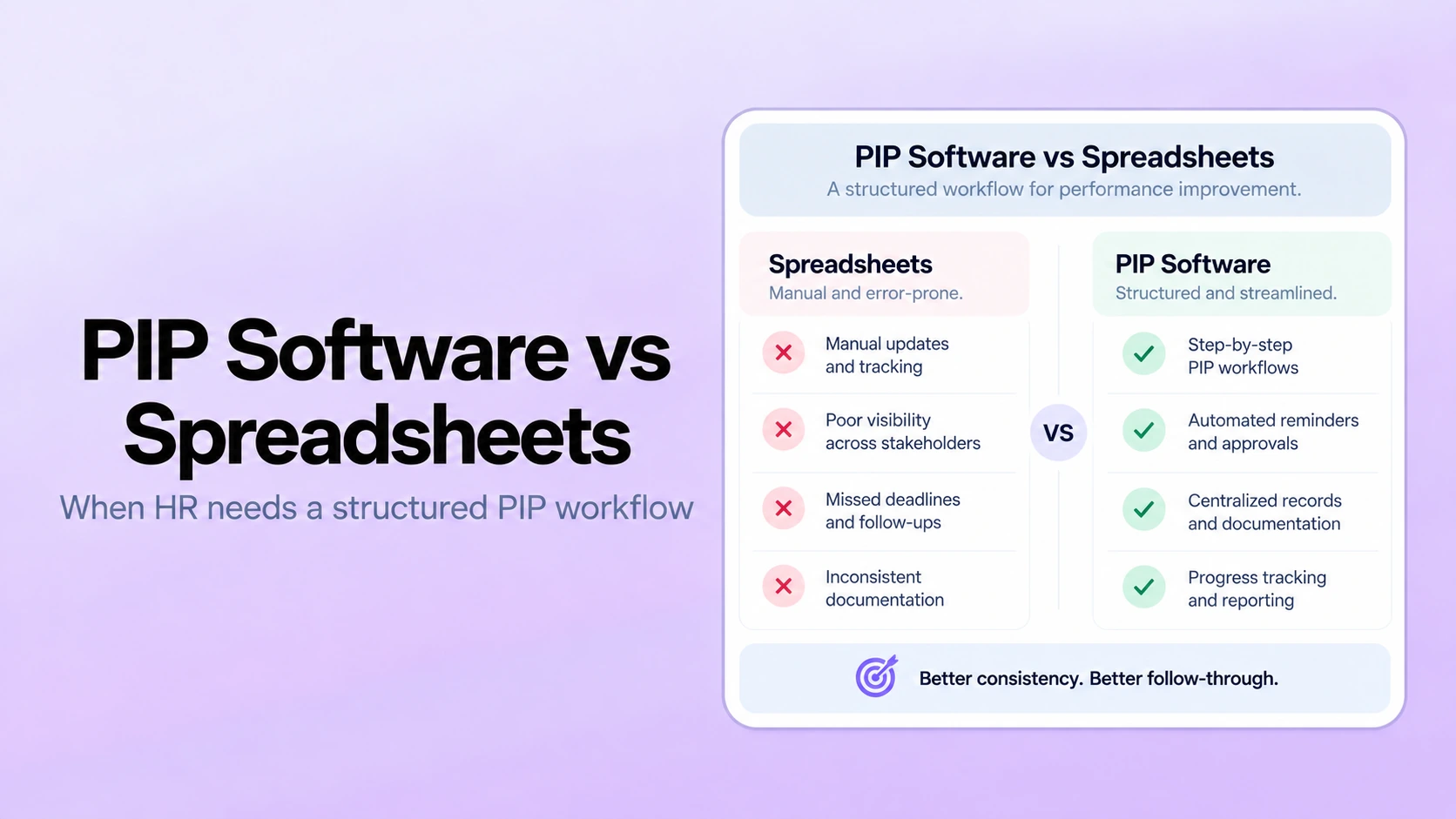
A PIP tracked in a shared document or a manager's personal notes creates exactly the inconsistency problem described above: no visibility for HR until something goes wrong, no standardized milestone structure, and no record that survives a manager leaving the company. PIP software built specifically for this addresses it by giving every plan a consistent structure, milestones, check-in cadence, and documentation, while giving HR visibility across every active plan without having to chase individual managers for updates. The stronger version of this connects PIP data to the same calibration and continuous feedback system used for regular performance management, so a PIP is not a separate, disconnected process but a natural extension of data the organization is already collecting, which both strengthens the legal record and makes early intervention before a formal PIP becomes necessary far more realistic.
The most important PIP decision happens before a single section of the document gets written: whether a formal improvement plan is actually the right response to this specific situation, or whether continuous coaching, role realignment, a direct conversation, or a negotiated separation would serve the employee and the organization better. A PIP executed well, with genuine intent, consistent management, and clear documentation, remains a legitimate and valuable tool. A PIP executed as a formality before a decision already made delivers none of its real benefits while still carrying all of its risk.
Key Takeaways
- Performance improvement plans are on the rise, with formal performance procedures up roughly 30 percent between 2020 and 2023, according to the Wall Street Journal reporting, yet most employees still encounter a PIP as the final step before termination rather than as a genuine improvement tool.
- A well-run PIP offers real benefits: documented expectations, a defensible audit trail, and a structured path back to standard. A poorly run PIP delivers none of those benefits while still carrying all of the morale and legal risk.
- The decision that matters most is not how to write a PIP, but whether a PIP is the right tool at all. Continuous feedback, role realignment, a direct documented conversation, or a mutual separation are often better fits depending on the situation.
- Reported PIP success rates vary widely across sources, from roughly 30 to 50 percent in HR-practitioner estimates to far lower figures depending on methodology, which itself is a signal that no single number should be treated as authoritative.
- Software that connects PIPs to calibration and continuous check-in data gives managers and HR a documented, consistent record, which matters more for legal defensibility and consistency than any single template.
Performance improvement plans have a reputation problem, and it is not entirely unearned. The Wall Street Journal reporting found that formal performance procedures, the broad category PIPs fall under, rose from roughly 33 workers per 1,000 in 2020 to about 44 per 1,000 in 2023, even as companies publicly frame PIPs as a development tool. That gap between stated intent and lived employee experience is exactly why so many workers hear βyou've been placed on a PIPβ and immediately start updating their resume, regardless of what the document itself says about coaching and support.
This puts HR and people leaders in a genuinely difficult position. A PIP, done well, is one of the few tools that gives a struggling employee a real, structured chance to recover, while also protecting the organization with a clear, documented record if the outcome is termination. A PIP done badly, rushed, vague, or issued after a termination decision has effectively already been made, does neither. It damages trust, invites legal risk through inconsistent application, and confirms every employee's worst assumption about what a PIP actually means.
The stakes are also organizational, not just individual. A workforce that has watched several colleagues go through PIPs that clearly ended in termination,n regardless of effort, rt develops a shared, accurate read on what the tool actually means at that company. Once that read sets in, even a manager with genuine intent to help an employee recover is fighting an uphill perception battle the moment the word βPIPβ enters the conversation, which makes the upfront decision of whether to use one at all even more consequential than it might first appear.
Most existing PIP guidance jumps straight to the how: how to write one, what sections to include, what timeline to use. Fewer resources stop at the more important question first: whether a PIP is the right intervention at all, and what the realistic alternatives look like when it isn't. This guide focuses on that earlier decision: the real benefits a PIP can deliver, the risks it carries even when executed well, and the situations where a different tool entirely will serve the employee and the organization better.
What Are the Key Benefits of a Performance Improvement Plan?
A well-designed performance improvement plan benefits both the organization and the employee by converting a vague sense of underperformance into a specific, time-bound, and measurable path forward. For the organization, a PIP creates a documented record of the performance gap, the support offered, and the employee's response, which is the single strongest protection against a wrongful termination claim if the outcome is separation. For the employee, a properly run PIP provides clarity that informal feedback often lacks: exactly what is expected, by when, and what support the manager and organization commit to providing along the way. The benefit only materializes, however, when the PIP is issued in good faith, with a genuine possibility of success, rather than as a procedural formality before a decision that has already been made.
The Real Risks of Performance Improvement Plans
The risks of a PIP are not hypothetical, and they show up even in well-intentioned implementations.
The most cited risk is reputational and cultural: PIPs are widely perceived as a precursor to termination rather than a genuine development tool, a perception reinforced by the 2022 Harvard Business Review concept of βquiet firing,β where unreasonable targets or unfair evaluations push an employee toward resignation. When employees across an organization share that perception, even a PIP issued with real intent to help can land as a signal to start job hunting, which becomes self-fulfilling: an employee who disengages because they assume the outcome is predetermined is less likely to put in the effort a recovery requires.
The second risk is inconsistency. PIPs are designed to be standardized, but in practice, they are shaped heavily by each manager's individual interpretation, tone, and follow-through. One manager runs weekly, supportive check-ins. Another sets the plan and disappears until the 60-day deadline. That inconsistency does more than create unfair outcomes for employees; it creates exactly the kind of documented pattern that turns into legal exposure if a terminated employee can show that PIPs were applied unevenly across similar situations, particularly across protected characteristics.
The third risk is legal exposure from poor documentation, somewhat counterintuitively, the opposite problem from the reputational one. A PIP that is vague, that sets unrealistic timelines, or that was never actually reviewed with HR before issuance, can do more legal harm than no PIP at all, since it creates a paper trail showing the company recognized a performance issue but failed to apply a fair, documented process before terminating.

When a PIP Is the Right Tool
A PIP is most appropriate when several conditions are true at once: the performance gap is real and has already been raised informally, expectations were clearly communicated before the formal process began, the employee has shown some willingness or capacity to improve, and the organization genuinely intends to provide the support the plan describes. A PIP issued as the first response to a single missed deadline, or issued after leadership has already decided to terminate, fails this test regardless of how well the document itself is written. The plan should answer a real open question: can this person recover, rather than serve as a formality on the way to an answer everyone already knows.
Consider two employees with the same surface-level problem: missed deliverable deadlines over the past quarter. The first has received clear feedback twice already, has expressed frustration with an unclear handoff process rather than disinterest in the work, and asks specific questions about what improvement would look like when the conversation comes up. The second has received the same feedback, shrugs it off in the moment, and shows no change in behavior in the following weeks despite saying the right things. The first situation is a strong candidate for a genuine PIP. The second situation, where the pattern itself signals the gap is not really about clarity or support, may be better served by moving more directly toward the conversation about whether this is the right fit at all, rather than running a 60-day process that both people can sense is unlikely to change the outcome.
When a PIP Is the Wrong Tool, and What to Use Instead
Plenty of performance situations are better served by something other than a formal PIP.
Continuous feedback and coaching fit best when an issue is caught early, before it has compounded into a pattern. A direct, documented conversation with a clear expectation and a short follow-up window often resolves a single-incident problem faster and with far less disruption than a formal 30-to-90-day process.
Role realignment or a development plan fits when the underlying issue is a skills or fit mismatch rather than a behavioral or effort problem. An employee who is conscientious and engaged but mismatched to the scope of their current role is better served by a structured development plan, or in some cases a role change, than by a PIP that treats a fit problem as a performance failure.
A direct, documented conversation without a formal PIP fits one-off incidents, a missed deadline, a single uncharacteristic lapse, where escalating immediately to a formal plan is disproportionate and can itself feel punitive in a way that damages trust for a problem that was never actually a pattern.
A negotiated separation or severance offer fits when trust has already broken down significantly, when the timeline pressure of the business makes a 60-to-90-day improvement window impractical, or when leadership has, candidly, already decided the outcome regardless of performance during a plan. In these cases, offering a clean separation rather than running an employee through a PIP that is not really intended to succeed is often more honest and can reduce legal exposure rather than increase it, since it avoids creating a paper trail of a process conducted in bad faith.
Calibration-driven early intervention fits as a structural fix rather than a single-employee decision: when performance ratings are calibrated across managers and teams before they finalize, inconsistent standards and early warning signs surface long before a situation has deteriorated to the point where a PIP or a separation is the only remaining option.

Industry and Role-Specific Considerations
Healthcare and nursing environments add a layer that most general PIP guidance does not address: documentation standards already exist for clinical competency and patient safety incidents, and a performance plan for a clinical role often needs to integrate with those existing credentialing and incident-review processes rather than exist as a separate HR-only document. In hospital settings, particularly, the timeline for a PIP may also need to account for shift-based scheduling and licensing or certification renewal cycles that affect when check-ins and reassessments can realistically happen. PerformSpark's performance management for healthcare organizations addresses this compliance and scheduling overlap in more depth.
Sales roles raise a different consideration: performance is usually tied to a quantifiable metric, quota attainment, conversion rate, or pipeline activity, which makes the plan easier to write in measurable terms but also easier to game in the short term without addressing the underlying skill gap. A sales PIP that focuses purely on the lagging metric, without examining the specific behaviors driving it- prospecting volume, call quality, follow-up discipline- risks producing a short-term spike that does not hold once the plan ends.
Legal Considerations for Performance Improvement Plans
PIPs intersect with employment law in ways that vary meaningfully by jurisdiction, and California is a frequently cited example because of its strong at-will employment doctrine combined with extensive employee protections around documentation, leave, and discrimination claims. California does not legally require a PIP before termination, but courts and juries in wrongful termination cases often expect to see evidence of a fair, documented process, which makes a well-run PIP a practical risk-reduction tool even where it is not a legal requirement. The same logic generally applies across most US states: a PIP is rarely legally mandatory, but its absence, or its inconsistent application, can become a meaningful factor if a termination is later challenged.
Timing also matters in ways that are easy to overlook. Issuing a PIP immediately after an employee returns from protected leave, files a complaint, or discloses a disability can create the appearance of retaliation even when the underlying performance concern is genuine and well-documented, which is exactly the kind of timing question HR should review before a plan goes out, not after a dispute arises. This is general information rather than legal advice, and organizations facing a specific termination decision or PIP-related dispute should consult employment counsel familiar with their jurisdiction.
What the Data Actually Says About PIP Success Rates
Cited PIP success rates vary enormously depending on the source and methodology, from HR-practitioner estimates in the 30 to 50 percent range for well-designed plans with genuine manager engagement, down to far lower figures in sources that define βsuccessβ more strictly or that draw from specific industries with higher attrition. No single, methodologically rigorous, industry-wide success rate exists publicly, which is itself a useful data point: any specific percentage cited without a named source and a clear definition of βsuccessβ should be treated with caution rather than repeated as fact. What is more consistently supported across sources is the qualitative finding: manager engagement during the plan, not the employee's starting skill level, is the strongest predictor of whether a PIP results in genuine improvement.
How Software Changes the Calculus
A PIP tracked in a shared document or a manager's personal notes creates exactly the inconsistency problem described above: no visibility for HR until something goes wrong, no standardized milestone structure, and no record that survives a manager leaving the company. PIP software built specifically for this addresses it by giving every plan a consistent structure, milestones, check-in cadence, and documentation, while giving HR visibility across every active plan without having to chase individual managers for updates. The stronger version of this connects PIP data to the same calibration and continuous feedback system used for regular performance management, so a PIP is not a separate, disconnected process but a natural extension of data the organization is already collecting, which both strengthens the legal record and makes early intervention before a formal PIP becomes necessary far more realistic.
The most important PIP decision happens before a single section of the document gets written: whether a formal improvement plan is actually the right response to this specific situation, or whether continuous coaching, role realignment, a direct conversation, or a negotiated separation would serve the employee and the organization better. A PIP executed well, with genuine intent, consistent management, and clear documentation, remains a legitimate and valuable tool. A PIP executed as a formality before a decision already made delivers none of its real benefits while still carrying all of its risk.
Frequently Asked Questions
How long should a performance improvement plan last?
Most PIPs run 30, 60, or 90 days, with the right length depending on the nature of the issue and the role. A 30-day plan suits a narrow, easily measured behavior, while a role with a longer sales or project cycle often needs 60 to 90 days to generate a fair amount of data on whether the employee is actually improving.
What questions should a manager ask before deciding to issue a PIP?
Has this issue already been raised informally, with specific examples? Has the employee had a genuine opportunity to improve before now? Is the organization prepared to provide the support the plan will describe? And honestly, is the outcome of this plan still an open question, or has a decision already effectively been made? A no to any of the first three, or a no to the last one, suggests a PIP may not be the right next step.
How should a manager start the conversation when issuing a PIP?
Ground the conversation in specific, previously discussed examples rather than introducing new criticism. State the gap clearly, explain why it matters, present the plan as a genuine opportunity with defined support, and give the employee space to respond and ask questions, rather than treating the meeting as a one-way notification.
What is the difference between a PIP for behavior issues versus performance issues?
A performance-focused PIP typically centers on measurable output, missed targets, error rates, or deliverable timelines. A behavior-focused PIP addresses conduct, communication, reliability, or professionalism, and tends to rely more heavily on documented specific incidents since behavioral concerns are inherently harder to quantify than output metrics
Does a performance improvement plan always lead to termination?
No, though the perception that it does is widespread and well documented. A PIP issued in good faith, with realistic targets and genuine manager support, gives a meaningful share of employees a real path to stay in their role. The outcome depends heavily on whether the plan was designed as a genuine improvement opportunity or as a procedural step before a decision already made
What should HR do differently for a performance improvement plan in a unionized or healthcare environment?
In unionized environments, PIPs typically need to align with the specific disciplinary process defined in the collective bargaining agreement, which may dictate timelines, representation rights, or required steps beyond standard HR practice. In healthcare settings, a PIP often needs to coordinate with existing clinical competency and credentialing processes rather than operate as a fully separate HR document, since both processes may be reviewing the same underlying performance concern.


.webp)