
.svg)





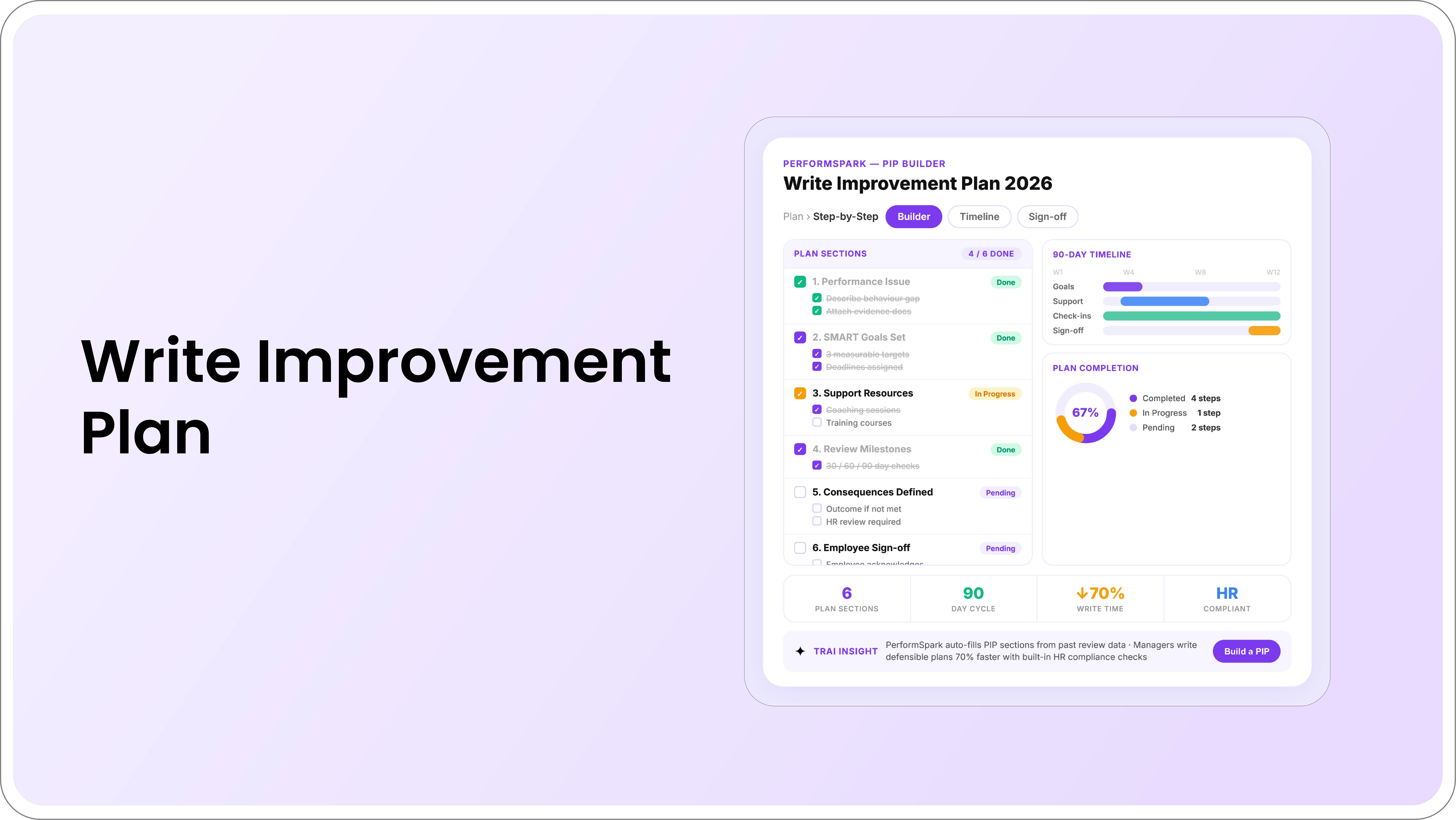
Table of Contents

Quick Takeaways: How to Write a Performance Improvement Plan
- Begin with a documented, job-related performance concern and an established standard the employee was expected to understand.
- Write each objective with a required action, measurement method, evidence source, quality requirement, and review date.
- Document the support the manager and organization will provide, then deliver that support throughout the plan.
- Schedule progress reviews in advance and evaluate the final outcome against the written criteria rather than a general impression.
A performance improvement plan should tell an employee exactly what performance needs to change, what acceptable performance looks like, what support the organization will provide, how progress will be measured, and when the plan will be reviewed.
The document should be specific enough that the employee, manager, and HR can read the same evidence and understand whether progress is occurring. It should also support a genuine improvement process rather than function as vague warning language or paperwork for a predetermined decision.
This guide explains how to write a performance improvement plan in eight steps. Before drafting, confirm that a formal plan is the right response using the PIP decision guide. HR teams establishing organization-wide standards should also review the performance improvement plan best practices.
What Should a Performance Improvement Plan Include?
A complete PIP should include:
- The employee, role, manager, start date, and planned review date
- The job-related performance concern
- Relevant evidence and prior feedback
- The required performance standard
- Measurable improvement objectives
- Employee and manager responsibilities
- Training, coaching, tools, or other support
- Progress-review dates and documentation requirements
- Possible outcomes at the end of the plan
- Employee comments and acknowledgment of receipt
The PIP should connect to the employee's broader performance record, including relevant performance reviews, goals, and documented coaching. It should not introduce an important expectation that the employee was never reasonably told about before the plan.
How to Write a Performance Improvement Plan in 8 Steps
Step 1: Confirm the issue belongs in a PIP
Identify the actual problem before writing the document. Underperformance may result from a skill gap, unclear priorities, missing tools, unrealistic workload, unresolved dependencies, a conduct concern, or a mismatch between the role and the employee's current capabilities.
A PIP is generally intended for a defined performance gap against current role expectations. Routine development may be better handled through an individual development plan. A policy violation, investigation, accommodation request, or protected-leave issue may require a different HR process.
HR should confirm that the expectation is job-related, previously communicated, supported by evidence, and substantially within the employee's influence.
Step 2: Write the performance concern using facts
Describe what happened without using personality labels or assumptions about motivation. The concern should identify:
- The relevant job expectation
- The work behavior or result that did not meet it
- Specific examples, dates, or recurring patterns
- The effect on quality, customers, deadlines, safety, cost, or colleagues
- Previous feedback or coaching
- Relevant context provided by the employee
Too vague: “Taylor does not take enough ownership.”
More specific: “During the last two project cycles, three identified delivery risks were not communicated to the project lead until after the affected milestones had passed. The delays reduced the time available for the receiving teams to adjust their plans.”
The areas of improvement examples provide additional models for converting vague judgments into observable performance language.
Step 3: State the expected performance standard
Explain what acceptable performance requires. The standard should come from the role, policy, agreed goal, quality requirement, service level, workflow, or another established expectation.
A useful standard answers:
- What must the employee do?
- How often or under what conditions?
- What quality level is required?
- Who receives the work or communication?
- Which process, template, or system must be used?
Example: “Project owners must communicate a material risk within one business day of identifying it and include the affected milestone, likely impact, proposed response, and decision needed.”
Step 4: Create measurable improvement objectives
Each objective should include one required result or behavior. Avoid combining several unrelated concerns into a single goal.
For each objective, define:
- The required action or outcome
- The measurement method
- The quality requirement
- The evidence source
- The deadline or review milestone
- Any dependency that must be considered
When PIP objectives connect to current work, track them through a structured goal management process. Measures should reflect work the employee can meaningfully influence rather than outcomes controlled primarily by another team, customer, or market condition.
Step 5: Define the support the organization will provide
The plan should document manager and organizational responsibilities as clearly as employee responsibilities. Support may include:
- Scheduled manager coaching
- Training, job aids, or examples of acceptable work
- Access to systems, information, or subject-matter experts
- Clarification of role scope, priorities, or decision authority
- Peer review for initial deliverables
- Removal or escalation of documented blockers
- More frequent feedback during the plan
Use regular 1-on-1 check-ins to deliver the promised coaching and clarify expectations. Do not list support that the organization cannot realistically provide.
Step 6: Choose the timeline and review schedule
There is no single correct duration for every PIP. The plan period should fit the type of work and give the employee a reasonable opportunity to demonstrate the required change.
Consider:
- How frequently the relevant work occurs
- How long one complete work cycle takes
- Whether training or system access is required first
- How many observations are needed to assess sustained performance
- The operational impact of continuing gaps
Write every progress-review date into the plan before it begins. Automated reminders can help managers and HR complete scheduled meetings without maintaining a separate tracker.
Step 7: Explain how progress and outcomes will be evaluated
The employee should know what evidence the organization will review at each milestone and at the end of the plan. The PIP should explain how the manager will record completed objectives, partial progress, continued gaps, support provided, employee comments, and any approved changes.
Possible outcomes may include successful completion, continued normal coaching, an approved revision or extension, movement to another process, or another employment decision under company policy and the circumstances.
Avoid promising a particular outcome or writing the plan as though the conclusion has already been decided. When ratings or standards vary across managers, performance calibration can help HR test whether similar evidence is being evaluated consistently.
Step 8: Review the plan with HR and deliver it clearly
Before the employee meeting, HR should review:
- Whether the evidence supports the concern
- Whether the expectations are role-related and consistent
- Whether the objectives are measurable and achievable
- Whether the organization can provide the listed support
- Whether the timeline fits the work
- Whether accommodation, leave, retaliation, or another issue requires specialized review
- Whether the language matches company policy
The manager should explain the concern, required standard, objectives, support, dates, documentation process, and possible outcomes directly. The employee should have an opportunity to ask questions and provide context.
For the employee-facing notice and delivery language, use the PIP letter examples and templates.
Fill-In Performance Improvement Plan Structure
The structure below mirrors PerformSpark's free, downloadable performance improvement plan template, which covers the same sections in an editable Word document and print-ready PDF if you would rather start from a completed layout than build each section from scratch.
1. Plan information
- Employee name and role: [Insert]
- Manager and HR contact: [Insert]
- Plan start date: [Insert]
- Planned final-review date: [Insert]
- Progress-review dates: [Insert]
2. Performance concern
[Describe the established role expectation, verified examples, relevant dates, impact, and prior feedback.]
3. Required performance standard
[State what acceptable performance requires, including the process, quality level, frequency, recipients, and conditions.]
4. Improvement objectives
- Objective: [Required behavior or result]
- Measure: [How progress will be evaluated]
- Evidence source: [System, work sample, record, or observation]
- Deadline or milestone: [Date]
Repeat this structure for each essential objective.
5. Employee responsibilities
[List the actions, communication, documentation, and participation expected from the employee.]
6. Manager and organizational support
[List coaching, training, tools, access, examples, priority clarification, and other support.]
7. Progress-review process
[Explain the meeting cadence, documentation format, employee-comment process, and how approved changes will be recorded.]
8. Possible outcomes
[Describe the possible next steps accurately and in language consistent with company policy.]
9. Acknowledgment
[Provide space to confirm delivery and receipt. Clarify whether acknowledgment indicates receipt rather than agreement.]
Measurable PIP Goal Examples
Missed deadlines
“For each active project, document milestone dates and provide a written risk update at least two business days before any milestone likely to be missed. Complete at least [defined standard] of agreed milestones by their original or approved revised dates during the plan.”
Quality and accuracy
“Complete the approved quality checklist before each report submission and meet the documented accuracy standard across the next four reporting cycles. Record any identified error and the prevention step added.”
Stakeholder communication
“Send the required weekly update by 3:00 p.m. Friday and include status, completed work, material risks, decisions needed, owner, and next action, with no required section omitted.”
Customer service
“Meet the documented response and follow-up requirements for assigned cases while maintaining the required case-note and quality standards during each review period.”
Manager responsibilities
“Hold the scheduled check-in with each direct report, record agreed actions within one business day, and complete every follow-up commitment by the stated date unless an approved change is documented.”
These examples must be adapted to the actual role, evidence, and policies. The PerformSpark PIP workflow can connect objectives, milestones, meetings, and HR oversight in one record.
How to Document PIP Progress Meetings
At every milestone, record:
- The objectives reviewed
- The evidence considered
- What improved
- What remains below the required standard
- Support provided since the previous meeting
- Barriers or context raised by the employee
- Clarifications or approved changes
- Actions and dates before the next review
Document favorable evidence with the same care used for continued gaps. A PIP record should reflect what occurred throughout the plan, not only the evidence supporting one possible outcome.
HR teams can use performance reporting and analytics to monitor overdue milestones and process completion while keeping access to sensitive case details appropriately restricted.
Common PIP Writing Mistakes
- Using personality labels such as “bad attitude” or “not committed”
- Making the PIP the employee's first notice of a long-standing concern
- Writing objectives that cannot be measured consistently
- Using outcomes outside the employee's control as the only measure
- Listing support that the manager does not deliver
- Setting a timeframe that does not match the work cycle
- Changing the success criteria without a documented revision
- Omitting positive progress from milestone records
- Using the same template language without adapting it to the role
- Assuming that a written PIP automatically makes the process fair or compliant
Performance Improvement Plan Writing Checklist
- The concern is specific, role-related, and supported by evidence.
- The expectation existed and was communicated before the plan.
- The employee understands what acceptable performance requires.
- Each objective has a measure, evidence source, and date.
- The measures are substantially within the employee's influence.
- Manager and organizational support are documented.
- The timeframe fits the work cycle.
- Progress meetings are scheduled in advance.
- The employee can provide questions, comments, and context.
- HR has reviewed policy, consistency, and specialized issues.
- Possible outcomes are explained accurately.
- The plan will be assessed against the written criteria.
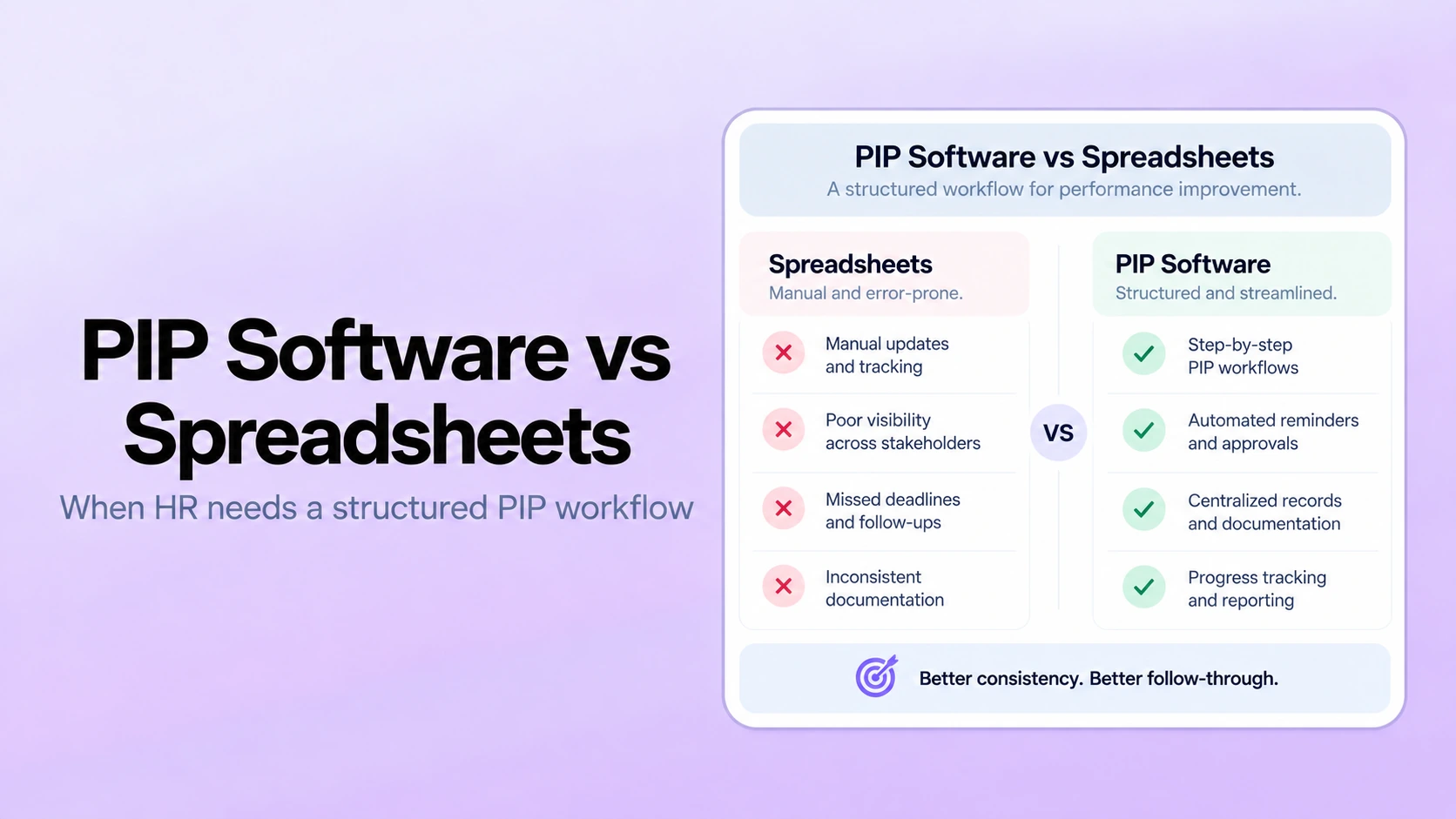
Manage the PIP as a Workflow, Not a Static Document
A well-written plan still requires consistent follow-through. PerformSpark connects PIPs with the broader performance management platform, including goals, check-ins, reviews, reminders, and reporting. Role-based access and security controls support appropriate handling of sensitive records.
The PIP management software buyer guide explains the workflow, permission, integration, and reporting capabilities to evaluate.
Explore PerformSpark pricing or book a personalized demo to see how HR teams can create, review, track, and close performance improvement plans in one structured process.




.svg)

.svg)
.svg)