
.svg)





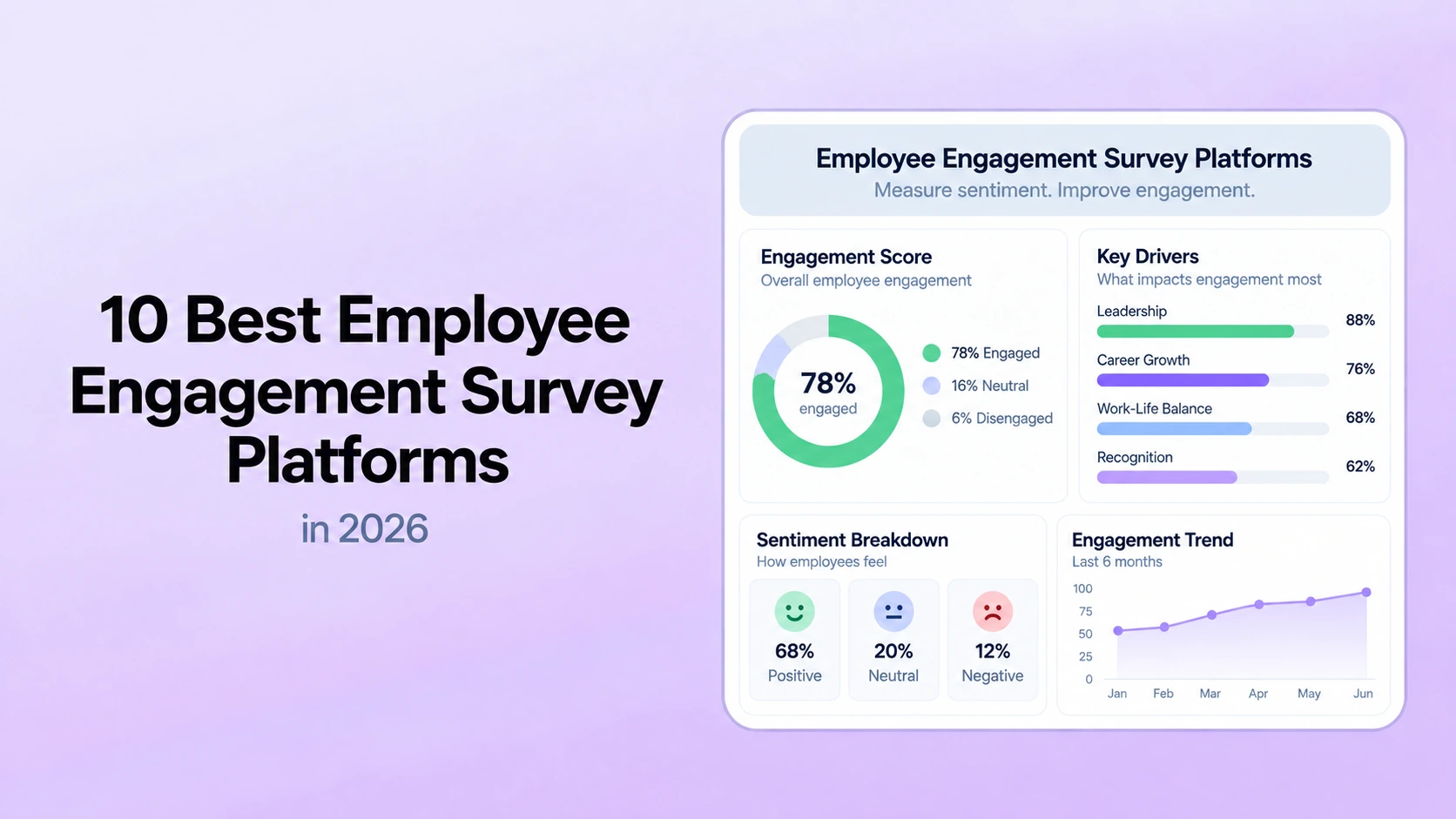
Table of Contents

Key Takeaways:
- Choose the listening model first: annual engagement, pulse, lifecycle, manager-led feedback, or a combination.
- Confidentiality, reporting thresholds, manager access, and small-group safeguards matter as much as survey design.
- Compare what happens after results arrive, including analysis, action ownership, employee communication, and follow-up measurement.
- Use benchmarks only when the comparison population, methodology, question set, and time period fit your decision.
- Run the same survey and small-team reporting scenario with every finalist, then verify current features, integrations, services, and commercial terms.
Employee engagement survey software should help HR do more than launch a questionnaire and download a score. A useful platform has to support the listening program you can actually sustain, protect the right level of respondent confidentiality, make trends and comments understandable, give managers appropriate access, and turn findings into visible follow-up.
This 2026 buyer guide compares 10 platforms for annual engagement surveys, recurring pulse programs, manager-led listening, lifecycle feedback, benchmarking, action planning, and broader employee-experience use cases.
Research date: October 1, 2026. PerformSpark publishes this comparison and has a commercial interest in the category. This is an editorial shortlist, not a universal 1-to-10 ranking and not hands-on testing of every product configuration. Survey methodology, anonymity rules, benchmarks, AI features, integrations, services, and pricing can change, so verify current scope directly with each finalist.
If your team is still defining the operating model, start with this employee engagement software buyer guide and the PerformSpark Feedback & Surveys workflow.
Employee Engagement Survey Software Compared
| Platform | Current documented strengths | Best-fit listening model | What to verify |
|---|---|---|---|
| PerformSpark | Pulse and engagement surveys, scheduled feedback, live dashboards, reminders, trend analysis and action follow-through connected to performance workflows | HR teams that want listening close to manager conversations, goals and development | Confidentiality configuration, segmentation, comment handling, HRIS integration and manager access |
| Culture Amp | Research-backed engagement surveys, pulse surveys, extensive benchmarks, AI-assisted insight summaries and Action Framework | Structured employee-experience programs with benchmark and people-science depth | Benchmark relevance, report sharing, confidentiality model and manager action process |
| Qualtrics EX | Flexible survey programs, advanced analytics, text analysis, manager action planning and broader employee-journey measurement | Enterprise listening programs with complex analytics and governance needs | Implementation scope, dashboard governance, benchmark methodology and services |
| Lattice | Engagement and pulse surveys, eNPS, updated Mercer and Lattice benchmarks, segmentation, action planning and broader people workflows | Teams that want engagement close to performance, goals and development | Anonymity configuration, manager access, packaging and how survey data is used with other people data |
| 15Five Engage | Validated engagement surveys, eNPS, targeted assessments, benchmarking, heat maps, AI synthesis, predictive impact and action planning | Manager-oriented engagement programs with recurring action support | Package scope, confidentiality, predictive-model use, action ownership and manager workflow |
| Workday Peakon Employee Voice | Confidential listening, intelligent surveys, True Benchmark, AI themes and summaries, personalized dashboards and recommended actions | Enterprise organizations, especially Workday-centered environments | Flexible Listening model, licensing, benchmark configuration, historical reporting and integration ownership |
| Microsoft Viva Glint + Viva Pulse | Glint for organization-wide listening; Pulse for manager and project-team feedback, with research-backed templates, trends and recommendations | Microsoft-centered organizations that need both enterprise and team-level listening | Which product is required, licensing prerequisites, privacy, reporting ownership and separation of Glint vs. Pulse use cases |
| Workleap Officevibe | Recurring anonymous pulse surveys, team engagement metrics, anonymous feedback and manager reporting | Lightweight continuous listening and manager follow-up | Response thresholds, feedback visibility, survey cadence and reporting depth |
| QuestionPro Workforce | Engagement, pulse, lifecycle and 360 surveys, analytics, action planning and HR-system integration options | Flexible employee-experience programs across the lifecycle | Benchmark methodology, access controls, services, integration design and reporting model |
| Achievers Pulse | Research-backed pulse surveys, flexible cadence, team insights, company-wide benchmarks, heatmaps and Leader Action Guide | Continuous listening tied closely to broader recognition and engagement programs | Action planning depth, manager reporting, benchmark fit and dependency on wider Achievers products |
How We Evaluated the 10 Platforms
We used current first-party product pages and support documentation available on October 1, 2026. We did not independently test every survey type, confidentiality rule, benchmark set, integration, dashboard, AI feature, or service commitment.
- Survey design: annual engagement, pulse, lifecycle, eNPS, custom questions and repeatable templates.
- Confidentiality: response modes, small-group safeguards, manager access and administrator visibility.
- Analysis: trends, segments, comments, themes, benchmarks and manager-level reporting.
- Action planning: ownership, manager follow-up, communication and measurement after the survey.
- Employee experience: survey clarity, accessibility, reminders and participation flow.
- Administration: audience management, scheduling, permissions, integrations and ongoing HR workload.
- Workflow fit: whether insights can connect to 1-on-1s, goals, development or other manager actions when appropriate.
For a lighter recurring program, compare these requirements with the PerformSpark guide to employee pulse survey software.
10 Employee Engagement Survey Software Platforms to Compare in 2026
1. PerformSpark
PerformSpark Feedback & Surveys is most relevant when HR wants employee listening to stay connected to the same performance environment used for manager conversations, goals, development, and follow-up. The product supports pulse surveys, requested feedback, peer and upward input, role-based access, reminders, reporting, and action tracking.
For a BOFU evaluation, do not stop at the survey builder. Test the full listening loop from configuration through follow-up.
Define the purpose, audience, and question set
Start with one real listening use case. PerformSpark lets HR configure the eligible population, question set, dates, visibility, confidentiality approach, and administrator responsibilities before launch. That matters because survey design should follow the decision HR is trying to make, not the other way around.
Set confidentiality and access rules before launch
Employee listening becomes risky when users do not understand who can see what. In the demo, test attributed, confidential, or aggregated workflows where applicable, manager visibility, administrator access, group thresholds, open-text handling, exports, and retention. The security controls should be reviewed alongside the survey workflow rather than after vendor selection.
Use the right cadence for the question
A short pulse and a broad engagement survey solve different problems. PerformSpark supports scheduled survey workflows, so test annual, quarterly, or focused pulse cadences using the actual employee population you plan to survey. The interval should match how quickly the organization can review results and respond.
Automate invitations and reminders without creating noise
Smart Notifications can support survey launches, participation reminders, closing dates, and administrative follow-up. Ask the vendor to show exactly who is reminded, how often, and what HR sees when participation is still incomplete.
Review participation, scores, comments, and patterns
PerformSpark's feedback workflow is designed to review response counts, ratings, comments, and group comparisons as evidence for investigation rather than proof of a single cause. During the demo, use a small-team scenario and show what is withheld, what is visible, and how HR moves from a pattern to a practical question.
Turn feedback into owned follow-up
The differentiator is what happens after the dashboard is opened. Approved themes can move into a manager check-in, goal, development plan, or another defined action without automatically converting survey sentiment into an individual performance judgment.
Track action and reassess later
Reporting & Analytics can help HR track participation, approved reports, assigned actions, and follow-through. The useful test is whether HR can return later and answer: what action was assigned, who owned it, whether it happened, and whether another listening cycle is warranted.
Connect employee data without replacing the HRIS
For organizations keeping their core HR system, review the integration approach and available integrations for employee, manager, and organizational data. Changes in teams and reporting lines should not force HR to rebuild the listening population manually.
Evaluate TrAI with source-level review
If TrAI, PerformSpark's assistive AI layer, is used to help summarize authorized feedback or surface themes, require reviewers to inspect the underlying evidence and keep human ownership of interpretation and follow-up. An AI-generated theme should prompt investigation, not become an automatic conclusion about a team or employee.
2. Culture Amp
Culture Amp Engage is a strong option when benchmark depth, research-backed survey design, and a structured employee-experience program are central to the project. Its current platform combines engagement and pulse surveys with benchmarking, AI-assisted insight summaries, and an Action Framework for turning feedback into follow-up.
The demo should focus on benchmark relevance, confidentiality thresholds, report sharing, and the manager action workflow rather than only the size of the benchmark database.
3. Qualtrics Employee Experience
Qualtrics Employee Experience fits enterprise listening programs that need flexible survey design, advanced analytics, text analysis, segmentation, dashboards, and broader employee-journey measurement.
That flexibility can bring more implementation and governance work. Ask the vendor to show your proposed dashboard model, benchmark methodology, text-analysis workflow, access rules, integrations, services, and the operating effort HR would own after launch.
4. Lattice
Lattice Engagement connects engagement and pulse surveys with eNPS, segmentation, benchmarks, and action planning inside a broader people platform. Lattice's 2026 updates include refreshed Mercer and Lattice benchmarks and additional survey-result filters.
This is most useful when survey findings need to sit close to performance, goals, and development. Test anonymity options, manager access, module packaging, and the governance rules for keeping survey information separate from individual performance decisions.
5. 15Five Engage
15Five Engage combines validated engagement surveys, eNPS, targeted assessments, benchmarking, heat maps, AI-synthesized feedback insights, predictive-impact analysis, and action planning.
Use the demo to understand confidentiality, how predictive scores are presented, which actions managers are expected to own, and which capabilities depend on other 15Five products or services.
Employee Listening
Test the follow-through, not just the survey builder
Bring one engagement survey, one pulse, one small-team reporting case, and one manager action to a PerformSpark walkthrough.
6. Workday Peakon Employee Voice
Workday Peakon Employee Voice is suited to enterprise listening, particularly in Workday-centered environments. Workday's 2026 documentation shows a transition to a Flexible Listening Question model for newer deployments, with recurring survey scheduling and changes to the question model and scoring approach.
Confirm which model applies to your tenant, how benchmark and historical reporting behave, the confidentiality model, manager action workflow, integration ownership, and the implementation scope.
7. Microsoft Viva Glint and Viva Pulse
Microsoft positions Viva Glint and Viva Pulse as complementary listening tools. Glint supports organization-level listening, while Pulse is designed for shorter manager- or team-led feedback.
The evaluation should make that boundary explicit. Determine whether you need one or both products, which licenses are prerequisites, how privacy is handled, who owns reporting, and how the listening experience works inside Teams and outside it.
8. Workleap Officevibe
Workleap Officevibe is a lighter continuous-listening option built around recurring pulse surveys, anonymous feedback, engagement metrics, and manager-facing team insights. Current documentation requires at least three survey responses for certain team scores to appear and uses a higher threshold for anonymous written feedback.
That makes the confidentiality demo concrete. Test team-size thresholds, survey cadence, manager visibility, trend windows, feedback access, exports, and what happens when a team falls below the reporting threshold.
9. QuestionPro Workforce
QuestionPro Workforce spans engagement, pulse, lifecycle, 360, onboarding, exit listening, analytics, action planning, and HR-system integrations.
It is a flexible option for organizations running several employee-experience programs. Verify benchmark methodology, access controls, dashboard design, integration ownership, customer-success services, exports, and the commercial model for the programs you will actually run.
10. Achievers Pulse
Achievers Pulse combines research-backed surveys, flexible cadence, team insights, company-wide benchmarks, heatmaps, and a Leader Action Guide inside the broader Achievers engagement ecosystem.
Test how much action planning is native to Pulse, the benchmark population, manager reporting, and whether the listening workflow depends on wider recognition or engagement products in the proposed package.
Choose the Listening Model Before the Vendor
Choose an employee-experience platform when deep methodology, benchmarking, enterprise segmentation, specialized analytics and a large listening program are the main requirements.
Choose a connected performance platform when survey findings need to feed manager conversations, development plans, goals and visible follow-up. The value comes from keeping listening connected to the actions managers already run.
Choose a lightweight pulse platform when the organization primarily needs short, recurring listening with straightforward manager reporting.
Choose an ecosystem-native option when reducing platform sprawl and keeping listening close to an existing HCM or collaboration environment matters more than specialist depth.
The right answer also depends on who will act. HR leaders should define governance and program ownership, while managers need a realistic action workflow. Compare both perspectives using the HR leader workflow and manager workflow.
Run the Same Survey Demo With Every Vendor
- Create an annual engagement survey with a stable core and two custom questions.
- Configure a recurring five-question pulse for one employee population.
- Show exactly how anonymous, confidential and identified response modes differ.
- Create a small team below the reporting threshold and show what HR and the manager can see.
- Analyze a set of open-ended comments and inspect the source comments behind a theme.
- Compare the same question across two survey cycles.
- Assign one action to a leader and one action to a manager.
- Show how employees are told what changed after the survey.
- Change a manager or department and demonstrate historical-reporting behavior.
- Export the data and explain integration, retention and deletion options.
Then connect the findings to a real operating workflow. Show how the manager would use the result in a check-in, how HR would track action through reporting and analytics, and whether any follow-up goal belongs in goal management.
Employee Survey Software Demo Scorecard
| Test | Pass condition | Red flag |
|---|---|---|
| Confidentiality | HR can explain exactly what each role can see and what happens below reporting thresholds | “Anonymous” is used without a clear threshold or administrator-access explanation |
| Segmentation | HR can analyze meaningful groups without exposing small populations | Filters create an easy path to indirect identification |
| Open-text analysis | Themes can be checked against authorized source comments | Automated themes cannot be traced or reviewed |
| Trend continuity | Comparable questions can be followed across cycles and org changes | Historical results break when teams or managers change |
| Manager action | Managers can see appropriate results, choose a focus area and document follow-up | Managers receive a dashboard but no practical action workflow |
| Employee follow-through | The organization can communicate actions and close the listening loop | Survey completion is treated as the end of the program |
| Integration and export | Required HRIS data and survey outputs move in documented, governable ways | The buyer cannot confirm field ownership, export scope or retention behavior |
For the integration portion of this test, use the PerformSpark HR software integration checklist, review security controls, and verify the relevant integration options.
Common Employee Survey Software Buying Mistakes
Buying benchmarks without checking relevance. A benchmark is useful only when the comparison population, question wording, methodology and time period make sense for the decision.
Promising anonymity without understanding the system. HR should know what administrators can access, how small groups are handled, whether thresholds differ for scores and comments, and how free text may reveal identity.
Optimizing collection but not action. Response rate matters, but an employee listening program fails when nobody owns the follow-up.
Running pulses faster than the organization can respond. Frequent surveys can create more data without creating more trust. Cadence should match the speed at which leaders and managers can act.
Combining survey and performance data without governance. Engagement results can guide organizational investigation, but an employee sentiment response should not automatically become an individual performance judgment. Keep purpose, access and decision rules explicit.
Ignoring manager capability. If managers receive survey results but do not know how to discuss them, action stalls. Use regular 1-on-1s and structured manager coaching prompts to support the follow-through process.
Which Employee Engagement Survey Software Fits Your Team?
Define the listening decision first: what you need to learn, who will act, what confidentiality model applies, how often the organization can respond, which benchmarks matter, and which systems need the results.
For most HR teams, the decisive demo is not survey creation. It is what happens after results arrive. Require every vendor to show analysis, manager access, action ownership, follow-up communication and the next measurement cycle from end to end.
If executive reporting matters, define the measures before implementation using the performance management metrics guide. If the broader goal is to connect employee voice with other people practices, compare the survey workflow with employee recognition, 360 reviews and TrAI-assisted analysis.
Bottom Line
The strongest employee engagement survey platform is the one that fits the listening program your organization can run responsibly. Survey design matters, but confidentiality, manager access, benchmarking, comment analysis, action ownership and follow-up determine whether the program creates useful change.
Shortlist two or three platforms, use the same survey and small-team scenario, and require written confirmation of confidentiality rules, current features, benchmark scope, integrations, implementation responsibilities and commercial terms.
Employee Engagement Surveys
Turn employee listening into visible action
Bring one engagement survey, pulse program, manager reporting case and action workflow to a focused PerformSpark walkthrough.
Book a PerformSpark Demo →Use your own confidentiality and reporting requirements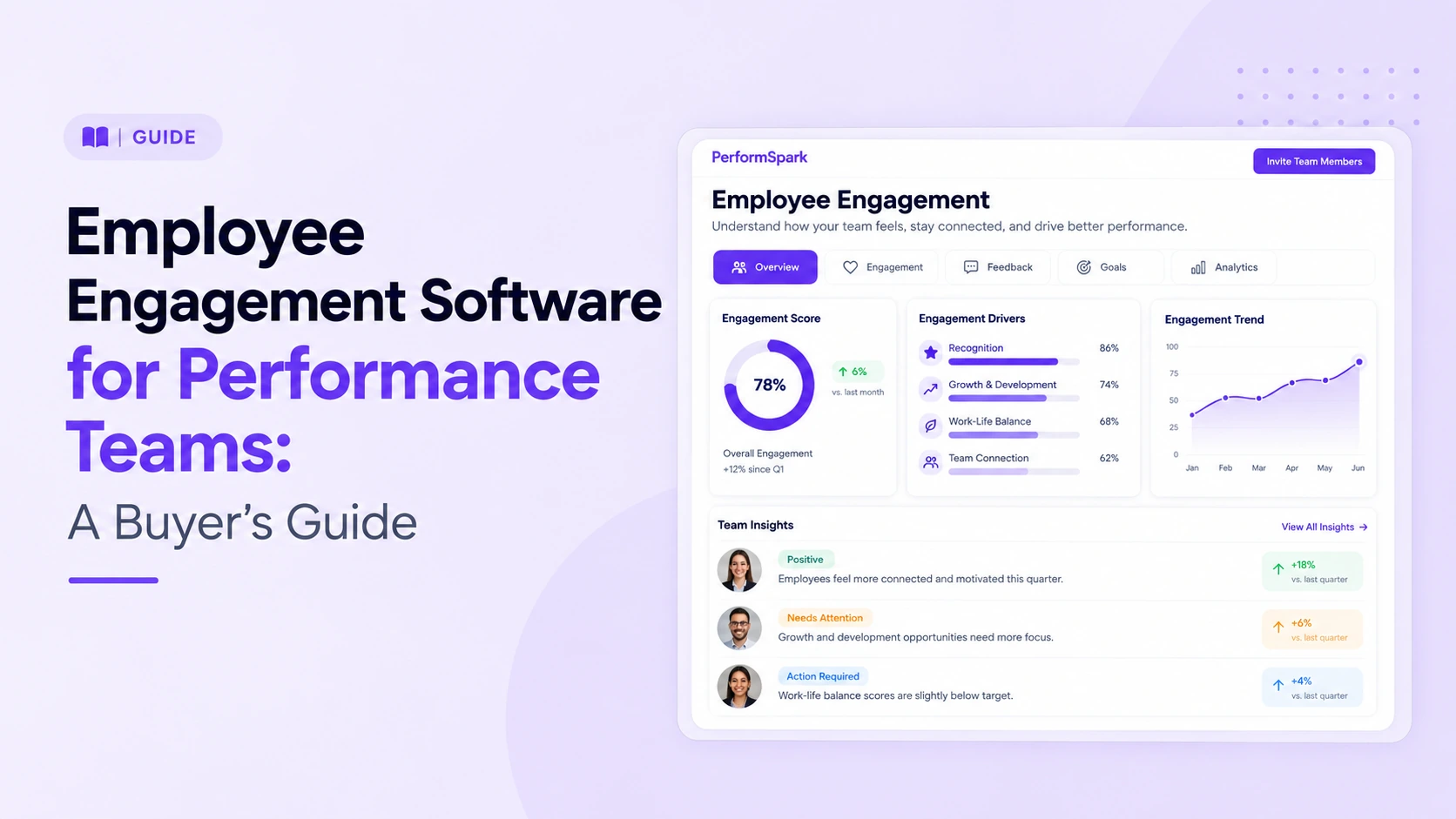



.svg)

.svg)
.svg)