




Goal Alignment

The Ultimate Guide to SMART Goals: Achieving Measurable Success in Business and Work

Updated :
June 24, 2026

Mahesh Kumar

Founder, TraineryHCM.com

Table of Contents

Most goals fail before a single task gets assigned. "Improve customer satisfaction" or "grow the business" sound directionally correct but give a team nothing to actually act on: no number to hit, no owner, no deadline, no way to know if the goal was reached. The SMART framework exists to close that gap, not by adding bureaucracy, but by forcing five specific questions to get answered before a goal is allowed to count as a real commitment.

The framework is decades old, first described by consultant George T. Doran in a 1981 issue of Management Review, and it has remained in steady use precisely because it solves a problem that has not changed: people and teams default to vague language unless something forces precision. What has changed is the context SMART goals now operate in. Teams are more often distributed, goal-tracking increasingly lives inside software rather than spreadsheets, and SMART goals frequently sit alongside OKRs rather than replacing them.

This guide covers the full framework, a step-by-step process for writing a SMART goal from a vague starting point, five varied real-world examples, how SMART goals differ from and work alongside OKRs, and the tools, templates, and common mistakes that determine whether a well-written goal actually gets achieved.

What Are SMART Goals? Defining the Framework

SMART goals are objectives structured around five specific criteria: Specific, Measurable, Achievable, Relevant, and Time-bound. The framework was introduced by George T. Doran in a 1981 Management Review article titled "There’s a S.M.A.R.T. Way to Write Management’s Goals and Objectives," and it was later reinforced through Peter Drucker’s Management by Objectives theory, a workplace strategy built around aligning individual objectives with broader organizational targets.

Each letter addresses a distinct failure mode in how people naturally set goals.

  • Specific. A vague goal like "improve sales" gives no target. A specific goal names who is responsible, what exactly will change, and why it matters.
  • Measurable. If progress cannot be quantified, it cannot be managed. A measurable goal defines the exact metric and number that signals success.
  • Achievable. A goal should stretch a team without setting it up to fail. This requires an honest read of current resources, skills, and time available.
  • Relevant. A goal needs to connect to a larger objective, whether that is a team priority, a company goal, or an individual’s career direction. Goals disconnected from the bigger picture become busy work.
  • Time-bound. Every goal needs a deadline. Without one, a goal has no natural point of accountability and tends to get pushed back indefinitely.

A common variant, SMARTER, adds Evaluate and Revise as two final steps, addressing one of the most cited criticisms of the original framework: that it can feel rigid for goals that need to flex as circumstances change mid-cycle.

Why SMART Goals Matter for Business and Personal Growth

Adopting the framework is a structural shift, not just a writing exercise. It converts goal setting from a passive, aspirational habit into an active planning discipline with built-in accountability.

  • Clarity and focus across teams. When a goal is specific and measurable, every person involved understands exactly what success looks like and what their role is in reaching it.
  • Better resource allocation. Clear objectives let leaders direct budget, time, and headcount toward what actually moves the needle instead of spreading effort thin across ambiguous priorities.
  • Real accountability. Measurable, time-bound goals make progress visible, which is what allows performance to be evaluated on evidence rather than impression.
  • Stronger engagement. Achievable but challenging goals give people a genuine sense of progress. Hitting a clearly defined milestone is one of the more reliable motivators available to a manager.
  • Cross-department alignment. When every team’s goals are written against the same framework, it becomes far easier to see where priorities overlap, conflict, or leave gaps.

On the individual side, the same structure applies to career development: a specific, measurable goal around a skill, certification, or promotion target gives a person a concrete plan rather than a vague hope.

Practitioner Insight: Teams often write a goal that is specific and time-bound but skip the measurable criterion entirely, something like "launch the new onboarding flow by Q3." That statement has a deadline, but no way to know whether the launch actually worked. The fix is rarely more ambitious; it is one added sentence: what number, measured how, tells us this succeeded.

How to Write a SMART Goal: A Step-by-Step Process

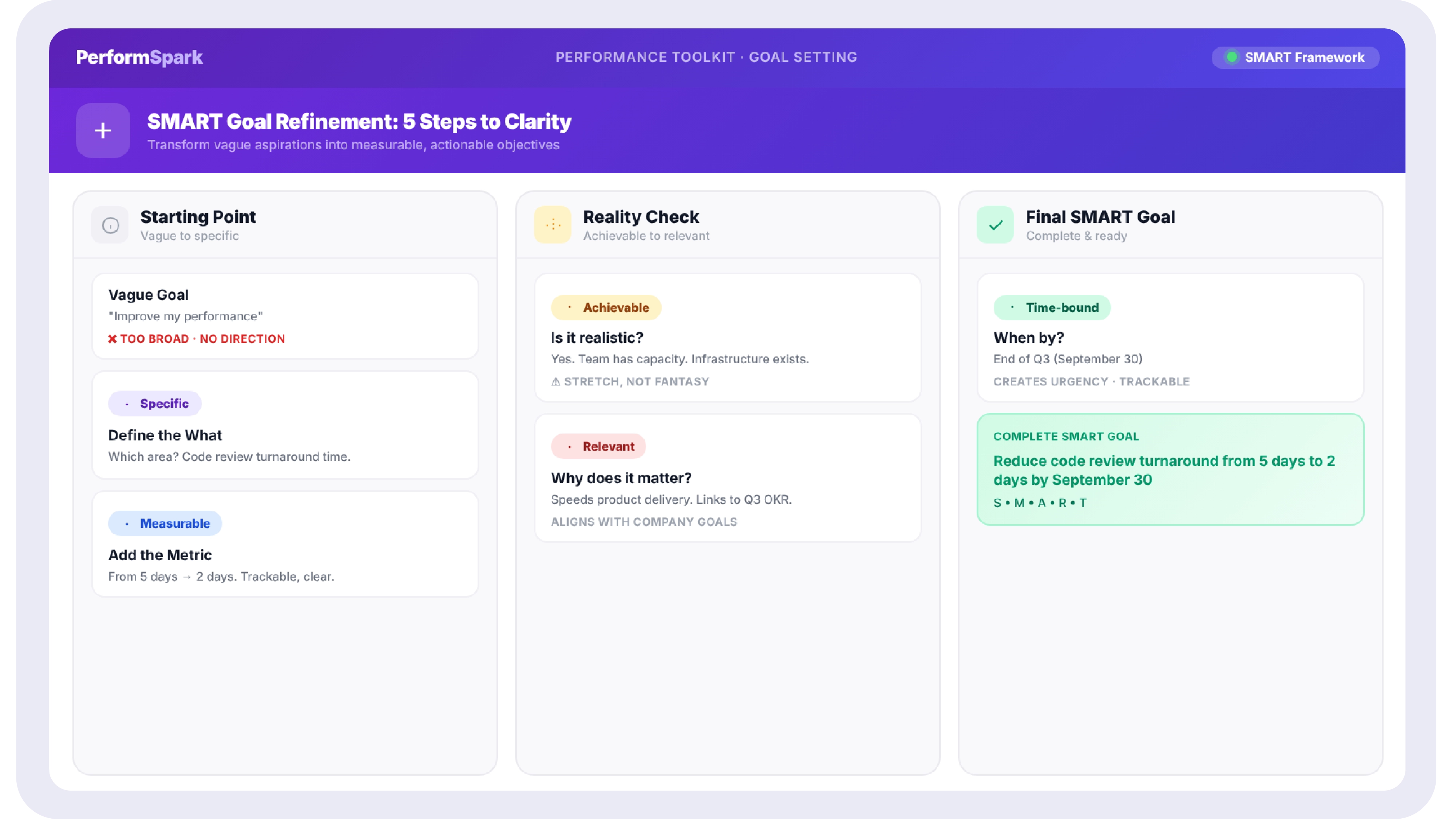
Writing a strong SMART goal is iterative. Start broad and sharpen the statement one criterion at a time. Here is the process applied to a single running example, a customer service team trying to improve response times.

Step 1: Make It Specific

Start by naming exactly what will change and for whom. "Improve customer service" becomes "reduce average ticket resolution time for Tier 1 support inquiries," which already clarifies the team, the metric category, and the scope.

Step 2: Make It Measurable

Add the number. "Reduce average ticket resolution time for Tier 1 support inquiries by 25 percent" now has a quantifiable target that can be tracked against a baseline.

Step 3: Confirm It Is Achievable

Check the number against actual capacity. A 25 percent reduction might be unrealistic without new tooling, but achievable if paired with a new internal knowledge base and two training sessions, both of which the team can reasonably deliver this quarter.

Step 4: Confirm It Is Relevant

Tie the goal to something bigger. If the company’s broader objective this quarter is improving customer satisfaction scores, faster resolution times are a direct contributor, not a side project.

Step 5: Add the Deadline

The completed goal: "To support the company’s Q3 objective of improving customer satisfaction scores, the customer service team will reduce average ticket resolution time for Tier 1 support inquiries by 25 percent by the end of Q3, supported by a new internal knowledge base and two mandatory training sessions."
A Goal Only Works If People Can See It

Writing the goal is the easy part. Most SMART goals stall because nobody is tracking progress between the start date and the deadline. See how goal management software keeps a goal visible instead of forgotten in a document.

Book a Demo

SMART Goals vs OKRs: What Is the Difference?

SMART goals and OKRs both structure goal-setting, but they solve different problems and operate at different altitudes. Confusing the two is one of the most common reasons a goal-setting rollout produces inconsistent results.

SMART Goals vs OKRs

A side-by-side comparison for goal-setting frameworks

Factor SMART Goals OKRs
Format A single goal statement meeting all five criteria One objective paired with 2 to 5 measurable key results
Best altitude Individual, team, or project-level goals Company-wide and department-wide alignment
Ambition level Realistic and fully achievable by design Intentionally aspirational, a stretch target
Typical cadence Ad hoc, tied to a specific project or deadline Quarterly cycles, revisited in regular check-ins
Cascading Does not cascade by design Built to cascade from company to team to individual

The two frameworks are not competing choices. SMART goals are well suited for one-off, individual, or project-bound objectives that don't need to cascade through an organization, while OKR software for HR teams handles the company-wide alignment problem SMART goals were never designed to solve. Many of the strongest implementations use SMART criteria to sharpen the wording of individual key results inside an OKR, combining the rigor of one framework with the alignment structure of the other.

SMART Goal Examples Across Industries and Roles

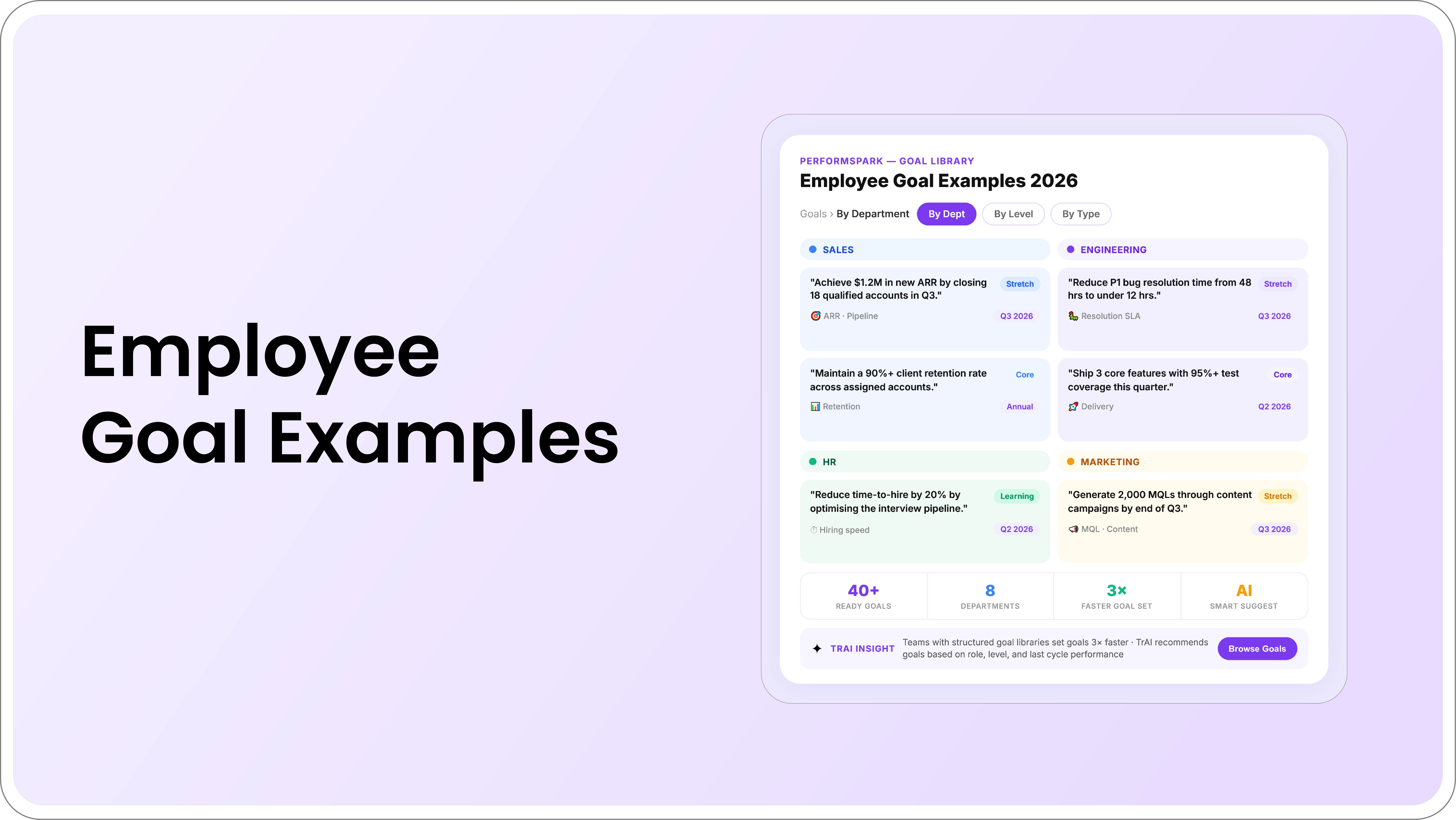
The framework looks different depending on the function being applied. These five examples show the same five criteria producing very different goals.

Marketing

A content team aiming to grow inbound leads might land on: "Increase qualified marketing leads from the company blog by 30 percent in Q3 by publishing four new search-optimized articles and promoting them through email and social channels." The specificity is in the channel mix, the measurability is the 30 percent target tracked through marketing analytics, and the relevance ties directly to pipeline growth.

Human Resources

An HR team focused on new-hire experience could write: "Achieve an average satisfaction score of 90 percent or higher on post-onboarding surveys for all new hires in the second half of the year, through a structured 30-day onboarding plan and a peer buddy system." This goal is measurable through a clear survey metric and relevant to broader retention and engagement objectives.

Project Management

A software team finishing testing might set: "Complete user acceptance testing for the new CRM platform by July 31, with a 95 percent resolution rate on all critical bugs, within the allocated $25,000 testing budget." Three constraints- a deadline, a quality threshold, and a budget ceiling- make this goal unusually precise without losing clarity.

Operations

A manufacturing operations lead targeting cost control might write: "Reduce operational costs in the manufacturing department by 5 percent by fiscal year-end without compromising product quality, through renegotiated supplier contracts and a new predictive maintenance schedule." The achievability check here matters most: a 5 percent target only holds up if the two named initiatives are realistically deliverable in the timeframe.

Personal and Career Development

An individual contributor working toward a promotion might commit to: "Earn the PMP certification by December 15 to qualify for a senior project manager opening, by completing an accredited 35-hour course by September 30, and studying 8 hours weekly afterward." The interim milestone, course completion by September 30, keeps the longer-term goal from feeling distant until the final deadline.

Implementing SMART Goals in Project Management

SMART objectives apply differently at each phase of a project lifecycle. At initiation, a high-level SMART objective defines the overall scope and success criteria for the project, something like launching a new release by a fixed date with a defined quality threshold. During planning, that top-level objective breaks down into smaller, task-level SMART goals owned by individual teams: a development team’s coding deadline, a QA team’s bug-resolution target, a marketing team’s pre-launch signup goal.

During execution, those measurable targets become the basis for tracking actual progress against plan, surfacing risk early enough to act on it rather than discovering a miss at the deadline. At closure, the original SMART objectives become the criteria the finished project gets evaluated against, providing a clear, evidence-based read on whether the work delivered what was promised rather than a subjective sense of how it went.

Project-level SMART goals carry the most weight when they connect back to the formal performance reviews managers run with their teams, so a missed or exceeded project target shows up in the same conversation as the rest of an employee’s performance record instead of living in a separate project-tracking tool nobody outside the project ever sees.

SMART Goals for Remote and Distributed Teams

Remote and hybrid teams need more structure around SMART goals than co-located teams, not less. In an office, a manager notices when a goal has gone quiet simply by walking past a desk. Remote teams lose that informal signal entirely, which means the structure has to be built into the process deliberately.

  • Make the goal visible by default, not on request. A SMART goal sitting in a private document nobody else can see might as well not exist for a distributed team. Shared visibility replaces the hallway conversation.
  • Shorten the check-in cycle. Remote teams benefit from shorter, more frequent progress touchpoints than co-located teams, since there is no ambient awareness of how a colleague’s work is actually going.
  • Separate async updates from synchronous discussion. The status on a SMART goal’s metric can update asynchronously. The conversation about what to do if it is off track deserves a real-time conversation, not a comment thread.

Structured check-ins and 1:1s are where a remote manager actually catches a SMART goal drifting off track early enough to do something about it, since the goal's progress data and the coaching conversation about it need to live in the same place rather than a project tool the manager checks separately from the conversation that addresses what they find there.

Keep Goals, OKRs, And Reviews Connected

See how PerformSpark keeps SMART goals, OKRs, and performance reviews in one system instead of a spreadsheet, a project tool, and a review form that never talk to each other.

Book a Demo

Making a SMART Goal Actionable

A well-written SMART goal is the starting point, not the finish line. Translating it into daily work requires three things most teams skip.

  • Break it into smaller tasks. A six-month objective feels distant. Monthly or weekly sub-goals create momentum and give a team something concrete to act on this week, not just this quarter.
  • Assign clear ownership for each piece. A team-level SMART goal with no individual owner for each component tends to default to nobody, since shared responsibility without a named owner rarely produces action.
  • Build in a regular review cadence. Weekly or biweekly check-ins keep a goal top of mind and catch drift early, well before a deadline arrives with no warning that the target was at risk.

Accountability also matters more than most teams expect. A goal reviewed only by the person who set it tends to slip quietly. A goal reviewed with a manager or peer on a regular cadence gets the social pressure that keeps momentum alive between the start date and the deadline.

Common Mistakes to Avoid When Setting SMART Goals

  • Writing a "SMART-ish" goal that fails one criterion. A goal can be specific and time-bound while still missing a real measurement, like "launch a new campaign by Q4" with no defined success metric attached.
  • Setting an unrealistic, achievable target. Ambition without a capacity check produces burnout, not results. A target to double revenue in a year means little without the budget and headcount to support it.
  • Skipping the relevance check. A perfectly written goal that does not connect to a team or company priority is effort spent on the wrong thing, however well-constructed the statement is.
  • Treating the deadline as a suggestion. A missed deadline with no follow-up conversation quietly teaches a team that deadlines do not actually matter, which erodes the accountability the framework exists to create.
  • Setting the goal once and never revisiting it. A SMART goal filed away after the initial planning meeting and reviewed only at year-end misses every opportunity to course-correct while correction is still possible.

SMART Goal Tracking Software and Tools

A SMART goal written in a document and never revisited rarely survives contact with a busy quarter. The right tooling keeps a goal visible, current, and connected to the rest of an employee’s performance record instead of living in isolation.

  • Spreadsheets work for very small teams. A simple spreadsheet can track a handful of goals for a small team, but it requires someone to manually update it, and it disconnects entirely from reviews, feedback, and development planning.
  • Standalone project tools track tasks, not goal outcomes. General project and task tools are useful for the work underneath a goal, but were not built to score goal attainment or feed that data into a performance conversation.

Performance management software that includes goal management software keeps SMART goals, OKRs, progress tracking, and the performance review that eventually scores them all in one connected record, which is the difference between a goal someone has to remember to check on and a goal that surfaces automatically inside the conversations where it actually gets discussed.

PerformSpark's TrAI assists with drafting clearer goal language and surfaces stalled goals to managers automatically, rather than relying on someone to notice a goal has gone quiet during a busy quarter.

Reporting and analytics that show goal completion trends across a team give managers and HR leaders the same real-time visibility into goal health that they already expect from any other part of the performance record, instead of a status update that is stale by the time anyone reads it.

Templates, Coaching, and Workshops for SMART Goal Setting

A reusable template removes the blank-page problem and helps a team apply the framework consistently. A practical SMART goal template includes the same fields used throughout this guide: the specific statement, the measurable metric and baseline, the achievability check, the relevance tie-in, and the deadline, ideally captured directly inside whichever system the goal will actually be tracked in, rather than a separate document that gets forgotten once the goal is set.

For organizations rolling SMART goals out alongside formal development plans, pairing the goal with an individual development plan gives an employee's manager a single place to track both what someone is working toward this quarter and the longer-term skill growth the goal is meant to support.

External workshops, coaching programs, and short courses on goal-setting frameworks are widely available through HR consulting firms and corporate learning platforms, and they can be useful for getting managers fluent in the framework quickly. The limiting factor is rarely the training itself. It is whether the organization has a system that keeps the goals written in that workshop visible and tracked months later, which is what determines whether the investment in training actually pays off.

The SMART framework has stayed relevant for more than four decades because it solves a problem that does not go away on its own: people default to vague goals unless something forces precision. Specific, measurable, achievable, relevant, and time-bound criteria turn good intentions into commitments a team can actually execute against.

Writing the goal correctly is necessary but not sufficient. The goals that survive past the planning meeting are the ones tracked inside the same system used for reviews, check-ins, and development conversations, with manager effectiveness reflected in whether their team’s goals stay current rather than going quiet halfway through the quarter.
Goals Connected to Everything That Drives Performance

SMART Goals & OKRs β€” Tracked, Scored & Connected

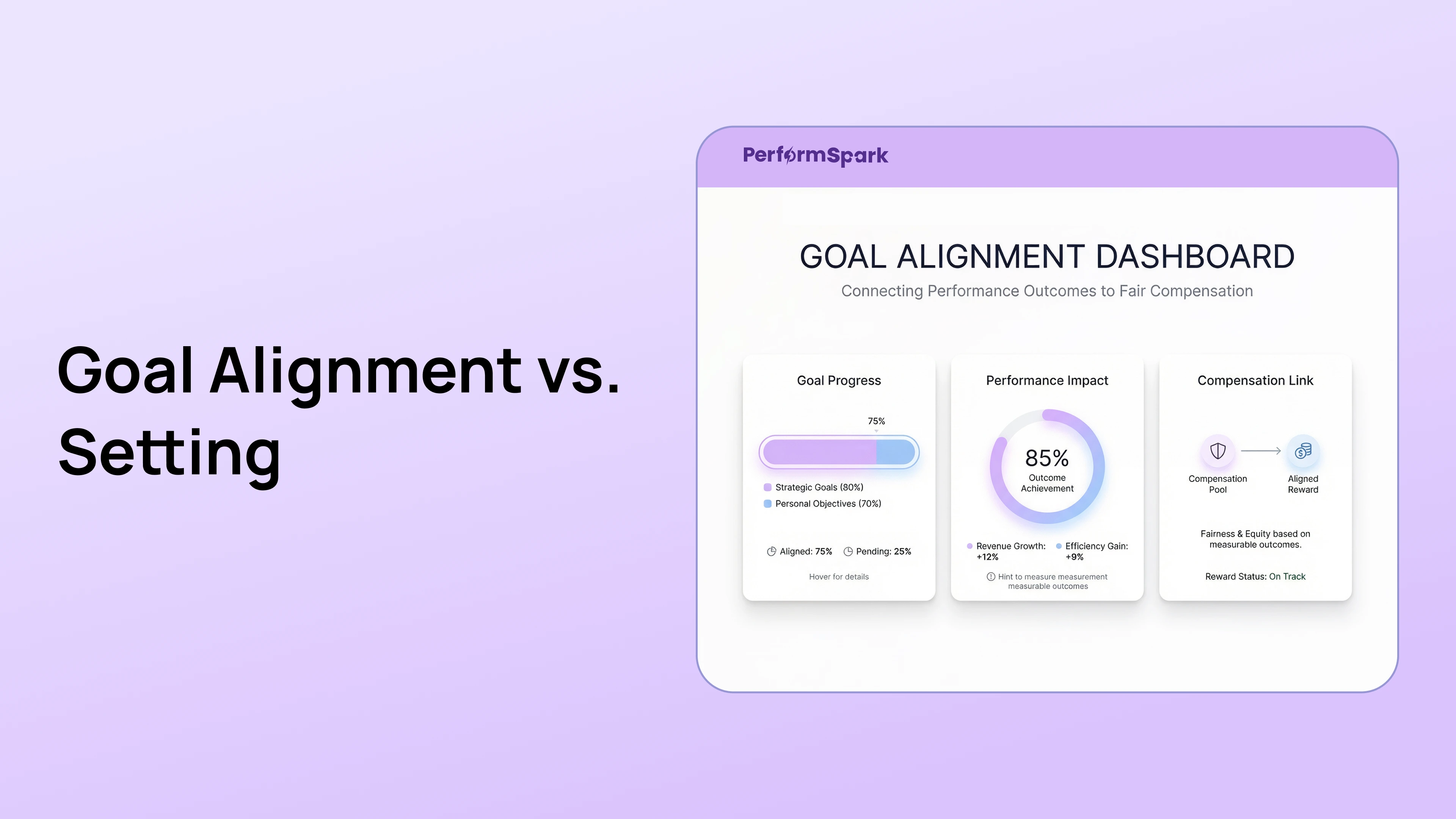
PerformSpark connects SMART goals and OKRs to check-ins, performance reviews, and development plans, so HR leaders and managers see goal progress in the same place as everything else that drives performance.

Book a Demo β†’

Key Takeaways

  • SMART goals were first introduced by George T. Doran in a 1981 Management Review article and later popularized through Peter Drucker’s Management by Objectives theory.
  • The five criteria work as an interconnected system, not a checklist. A specific goal is easier to measure, a measurable goal is easier to assess for achievability, and so on through the full framework.
  • SMART goals and OKRs solve different problems. SMART goals work best for individual and project-level objectives, while OKRs are designed for ambitious, cascading, organization-wide alignment, and most mature companies use both.
  • The single most common reason SMART goals fail is not the writing; it is the absence of a follow-through system: no calibration, no progress tracking, no link back to the rest of the performance record.
  • Remote and distributed teams need more structure around SMART goals than co-located teams, since informal hallway check-ins that used to surface stalled progress no longer happen by default.

Most goals fail before a single task gets assigned. "Improve customer satisfaction" or "grow the business" sound directionally correct but give a team nothing to actually act on: no number to hit, no owner, no deadline, no way to know if the goal was reached. The SMART framework exists to close that gap, not by adding bureaucracy, but by forcing five specific questions to get answered before a goal is allowed to count as a real commitment.

The framework is decades old, first described by consultant George T. Doran in a 1981 issue of Management Review, and it has remained in steady use precisely because it solves a problem that has not changed: people and teams default to vague language unless something forces precision. What has changed is the context SMART goals now operate in. Teams are more often distributed, goal-tracking increasingly lives inside software rather than spreadsheets, and SMART goals frequently sit alongside OKRs rather than replacing them.

This guide covers the full framework, a step-by-step process for writing a SMART goal from a vague starting point, five varied real-world examples, how SMART goals differ from and work alongside OKRs, and the tools, templates, and common mistakes that determine whether a well-written goal actually gets achieved.

What Are SMART Goals? Defining the Framework

SMART goals are objectives structured around five specific criteria: Specific, Measurable, Achievable, Relevant, and Time-bound. The framework was introduced by George T. Doran in a 1981 Management Review article titled "There’s a S.M.A.R.T. Way to Write Management’s Goals and Objectives," and it was later reinforced through Peter Drucker’s Management by Objectives theory, a workplace strategy built around aligning individual objectives with broader organizational targets.

Each letter addresses a distinct failure mode in how people naturally set goals.

  • Specific. A vague goal like "improve sales" gives no target. A specific goal names who is responsible, what exactly will change, and why it matters.
  • Measurable. If progress cannot be quantified, it cannot be managed. A measurable goal defines the exact metric and number that signals success.
  • Achievable. A goal should stretch a team without setting it up to fail. This requires an honest read of current resources, skills, and time available.
  • Relevant. A goal needs to connect to a larger objective, whether that is a team priority, a company goal, or an individual’s career direction. Goals disconnected from the bigger picture become busy work.
  • Time-bound. Every goal needs a deadline. Without one, a goal has no natural point of accountability and tends to get pushed back indefinitely.

A common variant, SMARTER, adds Evaluate and Revise as two final steps, addressing one of the most cited criticisms of the original framework: that it can feel rigid for goals that need to flex as circumstances change mid-cycle.

Why SMART Goals Matter for Business and Personal Growth

Adopting the framework is a structural shift, not just a writing exercise. It converts goal setting from a passive, aspirational habit into an active planning discipline with built-in accountability.

  • Clarity and focus across teams. When a goal is specific and measurable, every person involved understands exactly what success looks like and what their role is in reaching it.
  • Better resource allocation. Clear objectives let leaders direct budget, time, and headcount toward what actually moves the needle instead of spreading effort thin across ambiguous priorities.
  • Real accountability. Measurable, time-bound goals make progress visible, which is what allows performance to be evaluated on evidence rather than impression.
  • Stronger engagement. Achievable but challenging goals give people a genuine sense of progress. Hitting a clearly defined milestone is one of the more reliable motivators available to a manager.
  • Cross-department alignment. When every team’s goals are written against the same framework, it becomes far easier to see where priorities overlap, conflict, or leave gaps.

On the individual side, the same structure applies to career development: a specific, measurable goal around a skill, certification, or promotion target gives a person a concrete plan rather than a vague hope.

Practitioner Insight: Teams often write a goal that is specific and time-bound but skip the measurable criterion entirely, something like "launch the new onboarding flow by Q3." That statement has a deadline, but no way to know whether the launch actually worked. The fix is rarely more ambitious; it is one added sentence: what number, measured how, tells us this succeeded.

How to Write a SMART Goal: A Step-by-Step Process

Writing a strong SMART goal is iterative. Start broad and sharpen the statement one criterion at a time. Here is the process applied to a single running example, a customer service team trying to improve response times.

Step 1: Make It Specific

Start by naming exactly what will change and for whom. "Improve customer service" becomes "reduce average ticket resolution time for Tier 1 support inquiries," which already clarifies the team, the metric category, and the scope.

Step 2: Make It Measurable

Add the number. "Reduce average ticket resolution time for Tier 1 support inquiries by 25 percent" now has a quantifiable target that can be tracked against a baseline.

Step 3: Confirm It Is Achievable

Check the number against actual capacity. A 25 percent reduction might be unrealistic without new tooling, but achievable if paired with a new internal knowledge base and two training sessions, both of which the team can reasonably deliver this quarter.

Step 4: Confirm It Is Relevant

Tie the goal to something bigger. If the company’s broader objective this quarter is improving customer satisfaction scores, faster resolution times are a direct contributor, not a side project.

Step 5: Add the Deadline

The completed goal: "To support the company’s Q3 objective of improving customer satisfaction scores, the customer service team will reduce average ticket resolution time for Tier 1 support inquiries by 25 percent by the end of Q3, supported by a new internal knowledge base and two mandatory training sessions."

A Goal Only Works If People Can See It

Writing the goal is the easy part. Most SMART goals stall because nobody is tracking progress between the start date and the deadline. See how goal management software keeps a goal visible instead of forgotten in a document.

Book a Demo

SMART Goals vs OKRs: What Is the Difference?

SMART goals and OKRs both structure goal-setting, but they solve different problems and operate at different altitudes. Confusing the two is one of the most common reasons a goal-setting rollout produces inconsistent results.

SMART Goals vs OKRs

A side-by-side comparison for goal-setting frameworks

Factor SMART Goals OKRs
Format A single goal statement meeting all five criteria One objective paired with 2 to 5 measurable key results
Best altitude Individual, team, or project-level goals Company-wide and department-wide alignment
Ambition level Realistic and fully achievable by design Intentionally aspirational, a stretch target
Typical cadence Ad hoc, tied to a specific project or deadline Quarterly cycles, revisited in regular check-ins
Cascading Does not cascade by design Built to cascade from company to team to individual

The two frameworks are not competing choices. SMART goals are well suited for one-off, individual, or project-bound objectives that don't need to cascade through an organization, while OKR software for HR teams handles the company-wide alignment problem SMART goals were never designed to solve. Many of the strongest implementations use SMART criteria to sharpen the wording of individual key results inside an OKR, combining the rigor of one framework with the alignment structure of the other.

SMART Goal Examples Across Industries and Roles

The framework looks different depending on the function being applied. These five examples show the same five criteria producing very different goals.

Marketing

A content team aiming to grow inbound leads might land on: "Increase qualified marketing leads from the company blog by 30 percent in Q3 by publishing four new search-optimized articles and promoting them through email and social channels." The specificity is in the channel mix, the measurability is the 30 percent target tracked through marketing analytics, and the relevance ties directly to pipeline growth.

Human Resources

An HR team focused on new-hire experience could write: "Achieve an average satisfaction score of 90 percent or higher on post-onboarding surveys for all new hires in the second half of the year, through a structured 30-day onboarding plan and a peer buddy system." This goal is measurable through a clear survey metric and relevant to broader retention and engagement objectives.

Project Management

A software team finishing testing might set: "Complete user acceptance testing for the new CRM platform by July 31, with a 95 percent resolution rate on all critical bugs, within the allocated $25,000 testing budget." Three constraints- a deadline, a quality threshold, and a budget ceiling- make this goal unusually precise without losing clarity.

Operations

A manufacturing operations lead targeting cost control might write: "Reduce operational costs in the manufacturing department by 5 percent by fiscal year-end without compromising product quality, through renegotiated supplier contracts and a new predictive maintenance schedule." The achievability check here matters most: a 5 percent target only holds up if the two named initiatives are realistically deliverable in the timeframe.

Personal and Career Development

An individual contributor working toward a promotion might commit to: "Earn the PMP certification by December 15 to qualify for a senior project manager opening, by completing an accredited 35-hour course by September 30, and studying 8 hours weekly afterward." The interim milestone, course completion by September 30, keeps the longer-term goal from feeling distant until the final deadline.

Implementing SMART Goals in Project Management

SMART objectives apply differently at each phase of a project lifecycle. At initiation, a high-level SMART objective defines the overall scope and success criteria for the project, something like launching a new release by a fixed date with a defined quality threshold. During planning, that top-level objective breaks down into smaller, task-level SMART goals owned by individual teams: a development team’s coding deadline, a QA team’s bug-resolution target, a marketing team’s pre-launch signup goal.

During execution, those measurable targets become the basis for tracking actual progress against plan, surfacing risk early enough to act on it rather than discovering a miss at the deadline. At closure, the original SMART objectives become the criteria the finished project gets evaluated against, providing a clear, evidence-based read on whether the work delivered what was promised rather than a subjective sense of how it went.

Project-level SMART goals carry the most weight when they connect back to the formal performance reviews managers run with their teams, so a missed or exceeded project target shows up in the same conversation as the rest of an employee’s performance record instead of living in a separate project-tracking tool nobody outside the project ever sees.

SMART Goals for Remote and Distributed Teams

Remote and hybrid teams need more structure around SMART goals than co-located teams, not less. In an office, a manager notices when a goal has gone quiet simply by walking past a desk. Remote teams lose that informal signal entirely, which means the structure has to be built into the process deliberately.

  • Make the goal visible by default, not on request. A SMART goal sitting in a private document nobody else can see might as well not exist for a distributed team. Shared visibility replaces the hallway conversation.
  • Shorten the check-in cycle. Remote teams benefit from shorter, more frequent progress touchpoints than co-located teams, since there is no ambient awareness of how a colleague’s work is actually going.
  • Separate async updates from synchronous discussion. The status on a SMART goal’s metric can update asynchronously. The conversation about what to do if it is off track deserves a real-time conversation, not a comment thread.

Structured check-ins and 1:1s are where a remote manager actually catches a SMART goal drifting off track early enough to do something about it, since the goal's progress data and the coaching conversation about it need to live in the same place rather than a project tool the manager checks separately from the conversation that addresses what they find there.

Keep Goals, OKRs, And Reviews Connected

See how PerformSpark keeps SMART goals, OKRs, and performance reviews in one system instead of a spreadsheet, a project tool, and a review form that never talk to each other.

Book a Demo

Making a SMART Goal Actionable

A well-written SMART goal is the starting point, not the finish line. Translating it into daily work requires three things most teams skip.

  • Break it into smaller tasks. A six-month objective feels distant. Monthly or weekly sub-goals create momentum and give a team something concrete to act on this week, not just this quarter.
  • Assign clear ownership for each piece. A team-level SMART goal with no individual owner for each component tends to default to nobody, since shared responsibility without a named owner rarely produces action.
  • Build in a regular review cadence. Weekly or biweekly check-ins keep a goal top of mind and catch drift early, well before a deadline arrives with no warning that the target was at risk.

Accountability also matters more than most teams expect. A goal reviewed only by the person who set it tends to slip quietly. A goal reviewed with a manager or peer on a regular cadence gets the social pressure that keeps momentum alive between the start date and the deadline.

Common Mistakes to Avoid When Setting SMART Goals

  • Writing a "SMART-ish" goal that fails one criterion. A goal can be specific and time-bound while still missing a real measurement, like "launch a new campaign by Q4" with no defined success metric attached.
  • Setting an unrealistic, achievable target. Ambition without a capacity check produces burnout, not results. A target to double revenue in a year means little without the budget and headcount to support it.
  • Skipping the relevance check. A perfectly written goal that does not connect to a team or company priority is effort spent on the wrong thing, however well-constructed the statement is.
  • Treating the deadline as a suggestion. A missed deadline with no follow-up conversation quietly teaches a team that deadlines do not actually matter, which erodes the accountability the framework exists to create.
  • Setting the goal once and never revisiting it. A SMART goal filed away after the initial planning meeting and reviewed only at year-end misses every opportunity to course-correct while correction is still possible.

SMART Goal Tracking Software and Tools

A SMART goal written in a document and never revisited rarely survives contact with a busy quarter. The right tooling keeps a goal visible, current, and connected to the rest of an employee’s performance record instead of living in isolation.

  • Spreadsheets work for very small teams. A simple spreadsheet can track a handful of goals for a small team, but it requires someone to manually update it, and it disconnects entirely from reviews, feedback, and development planning.
  • Standalone project tools track tasks, not goal outcomes. General project and task tools are useful for the work underneath a goal, but were not built to score goal attainment or feed that data into a performance conversation.

Performance management software that includes goal management software keeps SMART goals, OKRs, progress tracking, and the performance review that eventually scores them all in one connected record, which is the difference between a goal someone has to remember to check on and a goal that surfaces automatically inside the conversations where it actually gets discussed.

PerformSpark's TrAI assists with drafting clearer goal language and surfaces stalled goals to managers automatically, rather than relying on someone to notice a goal has gone quiet during a busy quarter.

Reporting and analytics that show goal completion trends across a team give managers and HR leaders the same real-time visibility into goal health that they already expect from any other part of the performance record, instead of a status update that is stale by the time anyone reads it.

Templates, Coaching, and Workshops for SMART Goal Setting

A reusable template removes the blank-page problem and helps a team apply the framework consistently. A practical SMART goal template includes the same fields used throughout this guide: the specific statement, the measurable metric and baseline, the achievability check, the relevance tie-in, and the deadline, ideally captured directly inside whichever system the goal will actually be tracked in, rather than a separate document that gets forgotten once the goal is set.

For organizations rolling SMART goals out alongside formal development plans, pairing the goal with an individual development plan gives an employee's manager a single place to track both what someone is working toward this quarter and the longer-term skill growth the goal is meant to support.

External workshops, coaching programs, and short courses on goal-setting frameworks are widely available through HR consulting firms and corporate learning platforms, and they can be useful for getting managers fluent in the framework quickly. The limiting factor is rarely the training itself. It is whether the organization has a system that keeps the goals written in that workshop visible and tracked months later, which is what determines whether the investment in training actually pays off.

The SMART framework has stayed relevant for more than four decades because it solves a problem that does not go away on its own: people default to vague goals unless something forces precision. Specific, measurable, achievable, relevant, and time-bound criteria turn good intentions into commitments a team can actually execute against.

Writing the goal correctly is necessary but not sufficient. The goals that survive past the planning meeting are the ones tracked inside the same system used for reviews, check-ins, and development conversations, with manager effectiveness reflected in whether their team’s goals stay current rather than going quiet halfway through the quarter.

Goals Connected to Everything That Drives Performance

SMART Goals & OKRs β€” Tracked, Scored & Connected

PerformSpark connects SMART goals and OKRs to check-ins, performance reviews, and development plans, so HR leaders and managers see goal progress in the same place as everything else that drives performance.

Book a Demo β†’

Table of Contents

Most goals fail before a single task gets assigned. "Improve customer satisfaction" or "grow the business" sound directionally correct but give a team nothing to actually act on: no number to hit, no owner, no deadline, no way to know if the goal was reached. The SMART framework exists to close that gap, not by adding bureaucracy, but by forcing five specific questions to get answered before a goal is allowed to count as a real commitment.

The framework is decades old, first described by consultant George T. Doran in a 1981 issue of Management Review, and it has remained in steady use precisely because it solves a problem that has not changed: people and teams default to vague language unless something forces precision. What has changed is the context SMART goals now operate in. Teams are more often distributed, goal-tracking increasingly lives inside software rather than spreadsheets, and SMART goals frequently sit alongside OKRs rather than replacing them.

This guide covers the full framework, a step-by-step process for writing a SMART goal from a vague starting point, five varied real-world examples, how SMART goals differ from and work alongside OKRs, and the tools, templates, and common mistakes that determine whether a well-written goal actually gets achieved.

What Are SMART Goals? Defining the Framework

SMART goals are objectives structured around five specific criteria: Specific, Measurable, Achievable, Relevant, and Time-bound. The framework was introduced by George T. Doran in a 1981 Management Review article titled "There’s a S.M.A.R.T. Way to Write Management’s Goals and Objectives," and it was later reinforced through Peter Drucker’s Management by Objectives theory, a workplace strategy built around aligning individual objectives with broader organizational targets.

Each letter addresses a distinct failure mode in how people naturally set goals.

  • Specific. A vague goal like "improve sales" gives no target. A specific goal names who is responsible, what exactly will change, and why it matters.
  • Measurable. If progress cannot be quantified, it cannot be managed. A measurable goal defines the exact metric and number that signals success.
  • Achievable. A goal should stretch a team without setting it up to fail. This requires an honest read of current resources, skills, and time available.
  • Relevant. A goal needs to connect to a larger objective, whether that is a team priority, a company goal, or an individual’s career direction. Goals disconnected from the bigger picture become busy work.
  • Time-bound. Every goal needs a deadline. Without one, a goal has no natural point of accountability and tends to get pushed back indefinitely.

A common variant, SMARTER, adds Evaluate and Revise as two final steps, addressing one of the most cited criticisms of the original framework: that it can feel rigid for goals that need to flex as circumstances change mid-cycle.

Why SMART Goals Matter for Business and Personal Growth

Adopting the framework is a structural shift, not just a writing exercise. It converts goal setting from a passive, aspirational habit into an active planning discipline with built-in accountability.

  • Clarity and focus across teams. When a goal is specific and measurable, every person involved understands exactly what success looks like and what their role is in reaching it.
  • Better resource allocation. Clear objectives let leaders direct budget, time, and headcount toward what actually moves the needle instead of spreading effort thin across ambiguous priorities.
  • Real accountability. Measurable, time-bound goals make progress visible, which is what allows performance to be evaluated on evidence rather than impression.
  • Stronger engagement. Achievable but challenging goals give people a genuine sense of progress. Hitting a clearly defined milestone is one of the more reliable motivators available to a manager.
  • Cross-department alignment. When every team’s goals are written against the same framework, it becomes far easier to see where priorities overlap, conflict, or leave gaps.

On the individual side, the same structure applies to career development: a specific, measurable goal around a skill, certification, or promotion target gives a person a concrete plan rather than a vague hope.

Practitioner Insight: Teams often write a goal that is specific and time-bound but skip the measurable criterion entirely, something like "launch the new onboarding flow by Q3." That statement has a deadline, but no way to know whether the launch actually worked. The fix is rarely more ambitious; it is one added sentence: what number, measured how, tells us this succeeded.

How to Write a SMART Goal: A Step-by-Step Process

Writing a strong SMART goal is iterative. Start broad and sharpen the statement one criterion at a time. Here is the process applied to a single running example, a customer service team trying to improve response times.

Step 1: Make It Specific

Start by naming exactly what will change and for whom. "Improve customer service" becomes "reduce average ticket resolution time for Tier 1 support inquiries," which already clarifies the team, the metric category, and the scope.

Step 2: Make It Measurable

Add the number. "Reduce average ticket resolution time for Tier 1 support inquiries by 25 percent" now has a quantifiable target that can be tracked against a baseline.

Step 3: Confirm It Is Achievable

Check the number against actual capacity. A 25 percent reduction might be unrealistic without new tooling, but achievable if paired with a new internal knowledge base and two training sessions, both of which the team can reasonably deliver this quarter.

Step 4: Confirm It Is Relevant

Tie the goal to something bigger. If the company’s broader objective this quarter is improving customer satisfaction scores, faster resolution times are a direct contributor, not a side project.

Step 5: Add the Deadline

The completed goal: "To support the company’s Q3 objective of improving customer satisfaction scores, the customer service team will reduce average ticket resolution time for Tier 1 support inquiries by 25 percent by the end of Q3, supported by a new internal knowledge base and two mandatory training sessions."

A Goal Only Works If People Can See It

Writing the goal is the easy part. Most SMART goals stall because nobody is tracking progress between the start date and the deadline. See how goal management software keeps a goal visible instead of forgotten in a document.

Book a Demo

SMART Goals vs OKRs: What Is the Difference?

SMART goals and OKRs both structure goal-setting, but they solve different problems and operate at different altitudes. Confusing the two is one of the most common reasons a goal-setting rollout produces inconsistent results.

SMART Goals vs OKRs

A side-by-side comparison for goal-setting frameworks

Factor SMART Goals OKRs
Format A single goal statement meeting all five criteria One objective paired with 2 to 5 measurable key results
Best altitude Individual, team, or project-level goals Company-wide and department-wide alignment
Ambition level Realistic and fully achievable by design Intentionally aspirational, a stretch target
Typical cadence Ad hoc, tied to a specific project or deadline Quarterly cycles, revisited in regular check-ins
Cascading Does not cascade by design Built to cascade from company to team to individual

The two frameworks are not competing choices. SMART goals are well suited for one-off, individual, or project-bound objectives that don't need to cascade through an organization, while OKR software for HR teams handles the company-wide alignment problem SMART goals were never designed to solve. Many of the strongest implementations use SMART criteria to sharpen the wording of individual key results inside an OKR, combining the rigor of one framework with the alignment structure of the other.

SMART Goal Examples Across Industries and Roles

The framework looks different depending on the function being applied. These five examples show the same five criteria producing very different goals.

Marketing

A content team aiming to grow inbound leads might land on: "Increase qualified marketing leads from the company blog by 30 percent in Q3 by publishing four new search-optimized articles and promoting them through email and social channels." The specificity is in the channel mix, the measurability is the 30 percent target tracked through marketing analytics, and the relevance ties directly to pipeline growth.

Human Resources

An HR team focused on new-hire experience could write: "Achieve an average satisfaction score of 90 percent or higher on post-onboarding surveys for all new hires in the second half of the year, through a structured 30-day onboarding plan and a peer buddy system." This goal is measurable through a clear survey metric and relevant to broader retention and engagement objectives.

Project Management

A software team finishing testing might set: "Complete user acceptance testing for the new CRM platform by July 31, with a 95 percent resolution rate on all critical bugs, within the allocated $25,000 testing budget." Three constraints- a deadline, a quality threshold, and a budget ceiling- make this goal unusually precise without losing clarity.

Operations

A manufacturing operations lead targeting cost control might write: "Reduce operational costs in the manufacturing department by 5 percent by fiscal year-end without compromising product quality, through renegotiated supplier contracts and a new predictive maintenance schedule." The achievability check here matters most: a 5 percent target only holds up if the two named initiatives are realistically deliverable in the timeframe.

Personal and Career Development

An individual contributor working toward a promotion might commit to: "Earn the PMP certification by December 15 to qualify for a senior project manager opening, by completing an accredited 35-hour course by September 30, and studying 8 hours weekly afterward." The interim milestone, course completion by September 30, keeps the longer-term goal from feeling distant until the final deadline.

Implementing SMART Goals in Project Management

SMART objectives apply differently at each phase of a project lifecycle. At initiation, a high-level SMART objective defines the overall scope and success criteria for the project, something like launching a new release by a fixed date with a defined quality threshold. During planning, that top-level objective breaks down into smaller, task-level SMART goals owned by individual teams: a development team’s coding deadline, a QA team’s bug-resolution target, a marketing team’s pre-launch signup goal.

During execution, those measurable targets become the basis for tracking actual progress against plan, surfacing risk early enough to act on it rather than discovering a miss at the deadline. At closure, the original SMART objectives become the criteria the finished project gets evaluated against, providing a clear, evidence-based read on whether the work delivered what was promised rather than a subjective sense of how it went.

Project-level SMART goals carry the most weight when they connect back to the formal performance reviews managers run with their teams, so a missed or exceeded project target shows up in the same conversation as the rest of an employee’s performance record instead of living in a separate project-tracking tool nobody outside the project ever sees.

SMART Goals for Remote and Distributed Teams

Remote and hybrid teams need more structure around SMART goals than co-located teams, not less. In an office, a manager notices when a goal has gone quiet simply by walking past a desk. Remote teams lose that informal signal entirely, which means the structure has to be built into the process deliberately.

  • Make the goal visible by default, not on request. A SMART goal sitting in a private document nobody else can see might as well not exist for a distributed team. Shared visibility replaces the hallway conversation.
  • Shorten the check-in cycle. Remote teams benefit from shorter, more frequent progress touchpoints than co-located teams, since there is no ambient awareness of how a colleague’s work is actually going.
  • Separate async updates from synchronous discussion. The status on a SMART goal’s metric can update asynchronously. The conversation about what to do if it is off track deserves a real-time conversation, not a comment thread.

Structured check-ins and 1:1s are where a remote manager actually catches a SMART goal drifting off track early enough to do something about it, since the goal's progress data and the coaching conversation about it need to live in the same place rather than a project tool the manager checks separately from the conversation that addresses what they find there.

Keep Goals, OKRs, And Reviews Connected

See how PerformSpark keeps SMART goals, OKRs, and performance reviews in one system instead of a spreadsheet, a project tool, and a review form that never talk to each other.

Book a Demo

Making a SMART Goal Actionable

A well-written SMART goal is the starting point, not the finish line. Translating it into daily work requires three things most teams skip.

  • Break it into smaller tasks. A six-month objective feels distant. Monthly or weekly sub-goals create momentum and give a team something concrete to act on this week, not just this quarter.
  • Assign clear ownership for each piece. A team-level SMART goal with no individual owner for each component tends to default to nobody, since shared responsibility without a named owner rarely produces action.
  • Build in a regular review cadence. Weekly or biweekly check-ins keep a goal top of mind and catch drift early, well before a deadline arrives with no warning that the target was at risk.

Accountability also matters more than most teams expect. A goal reviewed only by the person who set it tends to slip quietly. A goal reviewed with a manager or peer on a regular cadence gets the social pressure that keeps momentum alive between the start date and the deadline.

Common Mistakes to Avoid When Setting SMART Goals

  • Writing a "SMART-ish" goal that fails one criterion. A goal can be specific and time-bound while still missing a real measurement, like "launch a new campaign by Q4" with no defined success metric attached.
  • Setting an unrealistic, achievable target. Ambition without a capacity check produces burnout, not results. A target to double revenue in a year means little without the budget and headcount to support it.
  • Skipping the relevance check. A perfectly written goal that does not connect to a team or company priority is effort spent on the wrong thing, however well-constructed the statement is.
  • Treating the deadline as a suggestion. A missed deadline with no follow-up conversation quietly teaches a team that deadlines do not actually matter, which erodes the accountability the framework exists to create.
  • Setting the goal once and never revisiting it. A SMART goal filed away after the initial planning meeting and reviewed only at year-end misses every opportunity to course-correct while correction is still possible.

SMART Goal Tracking Software and Tools

A SMART goal written in a document and never revisited rarely survives contact with a busy quarter. The right tooling keeps a goal visible, current, and connected to the rest of an employee’s performance record instead of living in isolation.

  • Spreadsheets work for very small teams. A simple spreadsheet can track a handful of goals for a small team, but it requires someone to manually update it, and it disconnects entirely from reviews, feedback, and development planning.
  • Standalone project tools track tasks, not goal outcomes. General project and task tools are useful for the work underneath a goal, but were not built to score goal attainment or feed that data into a performance conversation.

Performance management software that includes goal management software keeps SMART goals, OKRs, progress tracking, and the performance review that eventually scores them all in one connected record, which is the difference between a goal someone has to remember to check on and a goal that surfaces automatically inside the conversations where it actually gets discussed.

PerformSpark's TrAI assists with drafting clearer goal language and surfaces stalled goals to managers automatically, rather than relying on someone to notice a goal has gone quiet during a busy quarter.

Reporting and analytics that show goal completion trends across a team give managers and HR leaders the same real-time visibility into goal health that they already expect from any other part of the performance record, instead of a status update that is stale by the time anyone reads it.

Templates, Coaching, and Workshops for SMART Goal Setting

A reusable template removes the blank-page problem and helps a team apply the framework consistently. A practical SMART goal template includes the same fields used throughout this guide: the specific statement, the measurable metric and baseline, the achievability check, the relevance tie-in, and the deadline, ideally captured directly inside whichever system the goal will actually be tracked in, rather than a separate document that gets forgotten once the goal is set.

For organizations rolling SMART goals out alongside formal development plans, pairing the goal with an individual development plan gives an employee's manager a single place to track both what someone is working toward this quarter and the longer-term skill growth the goal is meant to support.

External workshops, coaching programs, and short courses on goal-setting frameworks are widely available through HR consulting firms and corporate learning platforms, and they can be useful for getting managers fluent in the framework quickly. The limiting factor is rarely the training itself. It is whether the organization has a system that keeps the goals written in that workshop visible and tracked months later, which is what determines whether the investment in training actually pays off.

The SMART framework has stayed relevant for more than four decades because it solves a problem that does not go away on its own: people default to vague goals unless something forces precision. Specific, measurable, achievable, relevant, and time-bound criteria turn good intentions into commitments a team can actually execute against.

Writing the goal correctly is necessary but not sufficient. The goals that survive past the planning meeting are the ones tracked inside the same system used for reviews, check-ins, and development conversations, with manager effectiveness reflected in whether their team’s goals stay current rather than going quiet halfway through the quarter.

Goals Connected to Everything That Drives Performance

SMART Goals & OKRs β€” Tracked, Scored & Connected

PerformSpark connects SMART goals and OKRs to check-ins, performance reviews, and development plans, so HR leaders and managers see goal progress in the same place as everything else that drives performance.

Book a Demo β†’

Key Takeaways

  • SMART goals were first introduced by George T. Doran in a 1981 Management Review article and later popularized through Peter Drucker’s Management by Objectives theory.
  • The five criteria work as an interconnected system, not a checklist. A specific goal is easier to measure, a measurable goal is easier to assess for achievability, and so on through the full framework.
  • SMART goals and OKRs solve different problems. SMART goals work best for individual and project-level objectives, while OKRs are designed for ambitious, cascading, organization-wide alignment, and most mature companies use both.
  • The single most common reason SMART goals fail is not the writing; it is the absence of a follow-through system: no calibration, no progress tracking, no link back to the rest of the performance record.
  • Remote and distributed teams need more structure around SMART goals than co-located teams, since informal hallway check-ins that used to surface stalled progress no longer happen by default.

Most goals fail before a single task gets assigned. "Improve customer satisfaction" or "grow the business" sound directionally correct but give a team nothing to actually act on: no number to hit, no owner, no deadline, no way to know if the goal was reached. The SMART framework exists to close that gap, not by adding bureaucracy, but by forcing five specific questions to get answered before a goal is allowed to count as a real commitment.

The framework is decades old, first described by consultant George T. Doran in a 1981 issue of Management Review, and it has remained in steady use precisely because it solves a problem that has not changed: people and teams default to vague language unless something forces precision. What has changed is the context SMART goals now operate in. Teams are more often distributed, goal-tracking increasingly lives inside software rather than spreadsheets, and SMART goals frequently sit alongside OKRs rather than replacing them.

This guide covers the full framework, a step-by-step process for writing a SMART goal from a vague starting point, five varied real-world examples, how SMART goals differ from and work alongside OKRs, and the tools, templates, and common mistakes that determine whether a well-written goal actually gets achieved.

What Are SMART Goals? Defining the Framework

SMART goals are objectives structured around five specific criteria: Specific, Measurable, Achievable, Relevant, and Time-bound. The framework was introduced by George T. Doran in a 1981 Management Review article titled "There’s a S.M.A.R.T. Way to Write Management’s Goals and Objectives," and it was later reinforced through Peter Drucker’s Management by Objectives theory, a workplace strategy built around aligning individual objectives with broader organizational targets.

Each letter addresses a distinct failure mode in how people naturally set goals.

  • Specific. A vague goal like "improve sales" gives no target. A specific goal names who is responsible, what exactly will change, and why it matters.
  • Measurable. If progress cannot be quantified, it cannot be managed. A measurable goal defines the exact metric and number that signals success.
  • Achievable. A goal should stretch a team without setting it up to fail. This requires an honest read of current resources, skills, and time available.
  • Relevant. A goal needs to connect to a larger objective, whether that is a team priority, a company goal, or an individual’s career direction. Goals disconnected from the bigger picture become busy work.
  • Time-bound. Every goal needs a deadline. Without one, a goal has no natural point of accountability and tends to get pushed back indefinitely.

A common variant, SMARTER, adds Evaluate and Revise as two final steps, addressing one of the most cited criticisms of the original framework: that it can feel rigid for goals that need to flex as circumstances change mid-cycle.

Why SMART Goals Matter for Business and Personal Growth

Adopting the framework is a structural shift, not just a writing exercise. It converts goal setting from a passive, aspirational habit into an active planning discipline with built-in accountability.

  • Clarity and focus across teams. When a goal is specific and measurable, every person involved understands exactly what success looks like and what their role is in reaching it.
  • Better resource allocation. Clear objectives let leaders direct budget, time, and headcount toward what actually moves the needle instead of spreading effort thin across ambiguous priorities.
  • Real accountability. Measurable, time-bound goals make progress visible, which is what allows performance to be evaluated on evidence rather than impression.
  • Stronger engagement. Achievable but challenging goals give people a genuine sense of progress. Hitting a clearly defined milestone is one of the more reliable motivators available to a manager.
  • Cross-department alignment. When every team’s goals are written against the same framework, it becomes far easier to see where priorities overlap, conflict, or leave gaps.

On the individual side, the same structure applies to career development: a specific, measurable goal around a skill, certification, or promotion target gives a person a concrete plan rather than a vague hope.

Practitioner Insight: Teams often write a goal that is specific and time-bound but skip the measurable criterion entirely, something like "launch the new onboarding flow by Q3." That statement has a deadline, but no way to know whether the launch actually worked. The fix is rarely more ambitious; it is one added sentence: what number, measured how, tells us this succeeded.

How to Write a SMART Goal: A Step-by-Step Process

Writing a strong SMART goal is iterative. Start broad and sharpen the statement one criterion at a time. Here is the process applied to a single running example, a customer service team trying to improve response times.

Step 1: Make It Specific

Start by naming exactly what will change and for whom. "Improve customer service" becomes "reduce average ticket resolution time for Tier 1 support inquiries," which already clarifies the team, the metric category, and the scope.

Step 2: Make It Measurable

Add the number. "Reduce average ticket resolution time for Tier 1 support inquiries by 25 percent" now has a quantifiable target that can be tracked against a baseline.

Step 3: Confirm It Is Achievable

Check the number against actual capacity. A 25 percent reduction might be unrealistic without new tooling, but achievable if paired with a new internal knowledge base and two training sessions, both of which the team can reasonably deliver this quarter.

Step 4: Confirm It Is Relevant

Tie the goal to something bigger. If the company’s broader objective this quarter is improving customer satisfaction scores, faster resolution times are a direct contributor, not a side project.

Step 5: Add the Deadline

The completed goal: "To support the company’s Q3 objective of improving customer satisfaction scores, the customer service team will reduce average ticket resolution time for Tier 1 support inquiries by 25 percent by the end of Q3, supported by a new internal knowledge base and two mandatory training sessions."

A Goal Only Works If People Can See It

Writing the goal is the easy part. Most SMART goals stall because nobody is tracking progress between the start date and the deadline. See how goal management software keeps a goal visible instead of forgotten in a document.

Book a Demo

SMART Goals vs OKRs: What Is the Difference?

SMART goals and OKRs both structure goal-setting, but they solve different problems and operate at different altitudes. Confusing the two is one of the most common reasons a goal-setting rollout produces inconsistent results.

SMART Goals vs OKRs

A side-by-side comparison for goal-setting frameworks

Factor SMART Goals OKRs
Format A single goal statement meeting all five criteria One objective paired with 2 to 5 measurable key results
Best altitude Individual, team, or project-level goals Company-wide and department-wide alignment
Ambition level Realistic and fully achievable by design Intentionally aspirational, a stretch target
Typical cadence Ad hoc, tied to a specific project or deadline Quarterly cycles, revisited in regular check-ins
Cascading Does not cascade by design Built to cascade from company to team to individual

The two frameworks are not competing choices. SMART goals are well suited for one-off, individual, or project-bound objectives that don't need to cascade through an organization, while OKR software for HR teams handles the company-wide alignment problem SMART goals were never designed to solve. Many of the strongest implementations use SMART criteria to sharpen the wording of individual key results inside an OKR, combining the rigor of one framework with the alignment structure of the other.

SMART Goal Examples Across Industries and Roles

The framework looks different depending on the function being applied. These five examples show the same five criteria producing very different goals.

Marketing

A content team aiming to grow inbound leads might land on: "Increase qualified marketing leads from the company blog by 30 percent in Q3 by publishing four new search-optimized articles and promoting them through email and social channels." The specificity is in the channel mix, the measurability is the 30 percent target tracked through marketing analytics, and the relevance ties directly to pipeline growth.

Human Resources

An HR team focused on new-hire experience could write: "Achieve an average satisfaction score of 90 percent or higher on post-onboarding surveys for all new hires in the second half of the year, through a structured 30-day onboarding plan and a peer buddy system." This goal is measurable through a clear survey metric and relevant to broader retention and engagement objectives.

Project Management

A software team finishing testing might set: "Complete user acceptance testing for the new CRM platform by July 31, with a 95 percent resolution rate on all critical bugs, within the allocated $25,000 testing budget." Three constraints- a deadline, a quality threshold, and a budget ceiling- make this goal unusually precise without losing clarity.

Operations

A manufacturing operations lead targeting cost control might write: "Reduce operational costs in the manufacturing department by 5 percent by fiscal year-end without compromising product quality, through renegotiated supplier contracts and a new predictive maintenance schedule." The achievability check here matters most: a 5 percent target only holds up if the two named initiatives are realistically deliverable in the timeframe.

Personal and Career Development

An individual contributor working toward a promotion might commit to: "Earn the PMP certification by December 15 to qualify for a senior project manager opening, by completing an accredited 35-hour course by September 30, and studying 8 hours weekly afterward." The interim milestone, course completion by September 30, keeps the longer-term goal from feeling distant until the final deadline.

Implementing SMART Goals in Project Management

SMART objectives apply differently at each phase of a project lifecycle. At initiation, a high-level SMART objective defines the overall scope and success criteria for the project, something like launching a new release by a fixed date with a defined quality threshold. During planning, that top-level objective breaks down into smaller, task-level SMART goals owned by individual teams: a development team’s coding deadline, a QA team’s bug-resolution target, a marketing team’s pre-launch signup goal.

During execution, those measurable targets become the basis for tracking actual progress against plan, surfacing risk early enough to act on it rather than discovering a miss at the deadline. At closure, the original SMART objectives become the criteria the finished project gets evaluated against, providing a clear, evidence-based read on whether the work delivered what was promised rather than a subjective sense of how it went.

Project-level SMART goals carry the most weight when they connect back to the formal performance reviews managers run with their teams, so a missed or exceeded project target shows up in the same conversation as the rest of an employee’s performance record instead of living in a separate project-tracking tool nobody outside the project ever sees.

SMART Goals for Remote and Distributed Teams

Remote and hybrid teams need more structure around SMART goals than co-located teams, not less. In an office, a manager notices when a goal has gone quiet simply by walking past a desk. Remote teams lose that informal signal entirely, which means the structure has to be built into the process deliberately.

  • Make the goal visible by default, not on request. A SMART goal sitting in a private document nobody else can see might as well not exist for a distributed team. Shared visibility replaces the hallway conversation.
  • Shorten the check-in cycle. Remote teams benefit from shorter, more frequent progress touchpoints than co-located teams, since there is no ambient awareness of how a colleague’s work is actually going.
  • Separate async updates from synchronous discussion. The status on a SMART goal’s metric can update asynchronously. The conversation about what to do if it is off track deserves a real-time conversation, not a comment thread.

Structured check-ins and 1:1s are where a remote manager actually catches a SMART goal drifting off track early enough to do something about it, since the goal's progress data and the coaching conversation about it need to live in the same place rather than a project tool the manager checks separately from the conversation that addresses what they find there.

Keep Goals, OKRs, And Reviews Connected

See how PerformSpark keeps SMART goals, OKRs, and performance reviews in one system instead of a spreadsheet, a project tool, and a review form that never talk to each other.

Book a Demo

Making a SMART Goal Actionable

A well-written SMART goal is the starting point, not the finish line. Translating it into daily work requires three things most teams skip.

  • Break it into smaller tasks. A six-month objective feels distant. Monthly or weekly sub-goals create momentum and give a team something concrete to act on this week, not just this quarter.
  • Assign clear ownership for each piece. A team-level SMART goal with no individual owner for each component tends to default to nobody, since shared responsibility without a named owner rarely produces action.
  • Build in a regular review cadence. Weekly or biweekly check-ins keep a goal top of mind and catch drift early, well before a deadline arrives with no warning that the target was at risk.

Accountability also matters more than most teams expect. A goal reviewed only by the person who set it tends to slip quietly. A goal reviewed with a manager or peer on a regular cadence gets the social pressure that keeps momentum alive between the start date and the deadline.

Common Mistakes to Avoid When Setting SMART Goals

  • Writing a "SMART-ish" goal that fails one criterion. A goal can be specific and time-bound while still missing a real measurement, like "launch a new campaign by Q4" with no defined success metric attached.
  • Setting an unrealistic, achievable target. Ambition without a capacity check produces burnout, not results. A target to double revenue in a year means little without the budget and headcount to support it.
  • Skipping the relevance check. A perfectly written goal that does not connect to a team or company priority is effort spent on the wrong thing, however well-constructed the statement is.
  • Treating the deadline as a suggestion. A missed deadline with no follow-up conversation quietly teaches a team that deadlines do not actually matter, which erodes the accountability the framework exists to create.
  • Setting the goal once and never revisiting it. A SMART goal filed away after the initial planning meeting and reviewed only at year-end misses every opportunity to course-correct while correction is still possible.

SMART Goal Tracking Software and Tools

A SMART goal written in a document and never revisited rarely survives contact with a busy quarter. The right tooling keeps a goal visible, current, and connected to the rest of an employee’s performance record instead of living in isolation.

  • Spreadsheets work for very small teams. A simple spreadsheet can track a handful of goals for a small team, but it requires someone to manually update it, and it disconnects entirely from reviews, feedback, and development planning.
  • Standalone project tools track tasks, not goal outcomes. General project and task tools are useful for the work underneath a goal, but were not built to score goal attainment or feed that data into a performance conversation.

Performance management software that includes goal management software keeps SMART goals, OKRs, progress tracking, and the performance review that eventually scores them all in one connected record, which is the difference between a goal someone has to remember to check on and a goal that surfaces automatically inside the conversations where it actually gets discussed.

PerformSpark's TrAI assists with drafting clearer goal language and surfaces stalled goals to managers automatically, rather than relying on someone to notice a goal has gone quiet during a busy quarter.

Reporting and analytics that show goal completion trends across a team give managers and HR leaders the same real-time visibility into goal health that they already expect from any other part of the performance record, instead of a status update that is stale by the time anyone reads it.

Templates, Coaching, and Workshops for SMART Goal Setting

A reusable template removes the blank-page problem and helps a team apply the framework consistently. A practical SMART goal template includes the same fields used throughout this guide: the specific statement, the measurable metric and baseline, the achievability check, the relevance tie-in, and the deadline, ideally captured directly inside whichever system the goal will actually be tracked in, rather than a separate document that gets forgotten once the goal is set.

For organizations rolling SMART goals out alongside formal development plans, pairing the goal with an individual development plan gives an employee's manager a single place to track both what someone is working toward this quarter and the longer-term skill growth the goal is meant to support.

External workshops, coaching programs, and short courses on goal-setting frameworks are widely available through HR consulting firms and corporate learning platforms, and they can be useful for getting managers fluent in the framework quickly. The limiting factor is rarely the training itself. It is whether the organization has a system that keeps the goals written in that workshop visible and tracked months later, which is what determines whether the investment in training actually pays off.

The SMART framework has stayed relevant for more than four decades because it solves a problem that does not go away on its own: people default to vague goals unless something forces precision. Specific, measurable, achievable, relevant, and time-bound criteria turn good intentions into commitments a team can actually execute against.

Writing the goal correctly is necessary but not sufficient. The goals that survive past the planning meeting are the ones tracked inside the same system used for reviews, check-ins, and development conversations, with manager effectiveness reflected in whether their team’s goals stay current rather than going quiet halfway through the quarter.

Goals Connected to Everything That Drives Performance

SMART Goals & OKRs β€” Tracked, Scored & Connected

PerformSpark connects SMART goals and OKRs to check-ins, performance reviews, and development plans, so HR leaders and managers see goal progress in the same place as everything else that drives performance.

Book a Demo β†’

Frequently Asked Questions

How can I effectively set SMART goals for business growth?

What are good SMART goal examples for a small business?

What tools help track SMART goals for remote teams?

Where can I find templates for creating SMART goals?

How do companies successfully implement SMART goals in remote teams?

How do performance management platforms integrate SMART goal tracking?

What are common mistakes to avoid when setting SMART goals in the workplace?

What is the best practice for cascading SMART goals throughout an organization?

Make performance reviews your growth lever

No credit card required β€’ Free setup & training included β€’ Cancel anytime

CTA ShapeCTA Shape