
.svg)





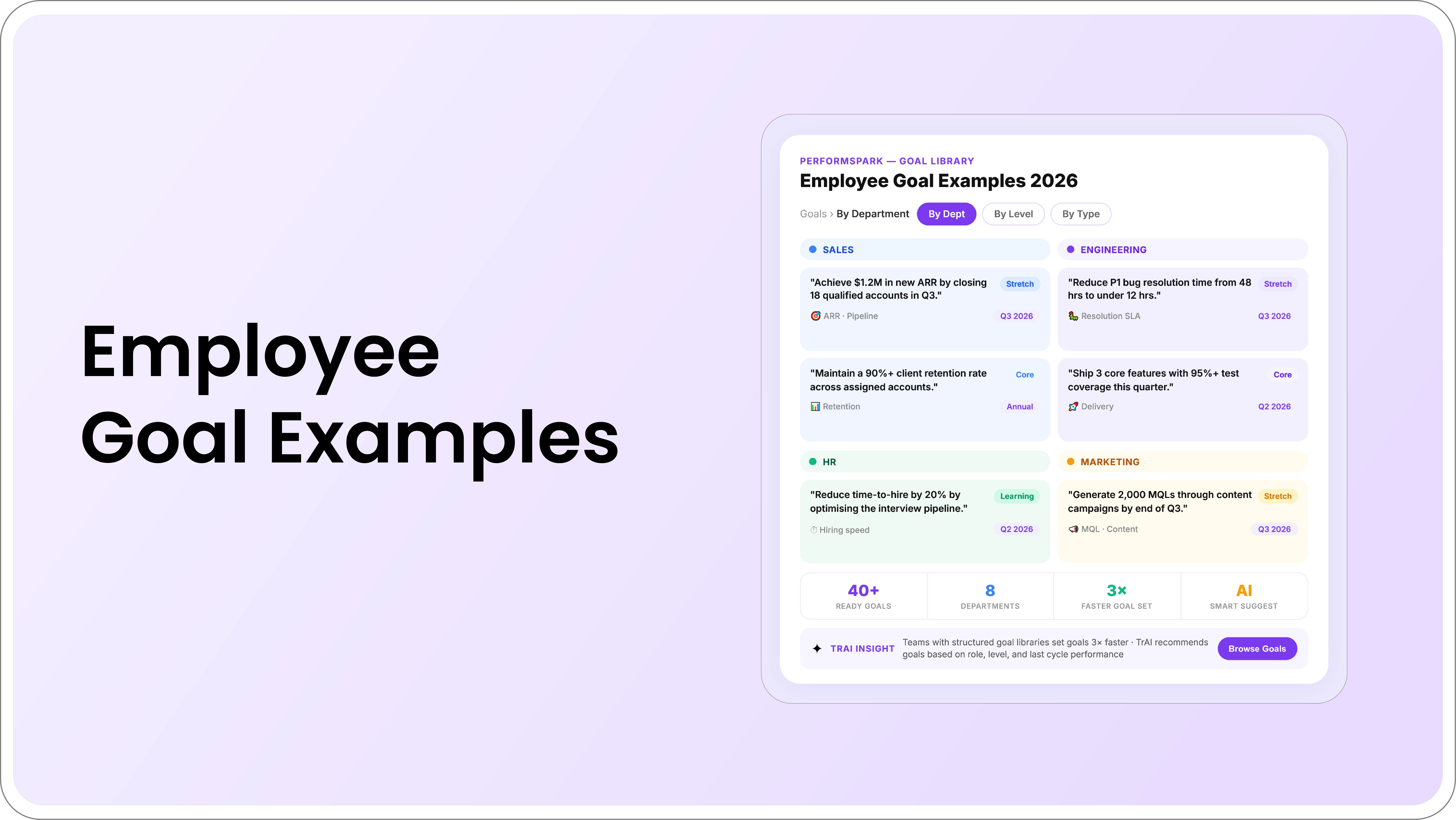
Table of Contents

Quick Takeaways: Employee Performance Goals
- Adapt every goal with a verified baseline, realistic target, quality requirement, review date, and relevant dependencies.
- Use a collaborative manager-employee process and document the support required.
- Revise obsolete goals through a controlled process instead of rating employees against outdated expectations.
- Goal outcomes inform performance reviews, but they should not automatically determine the overall rating or compensation.
Employee performance goals define the results, behaviors, or capabilities an employee is expected to demonstrate during a review period. A useful goal states what should happen, how progress will be assessed, when it will be reviewed, and which dependencies or support matter.
The 40 examples below are starting points. Replace bracketed details with realistic baselines, dates, measures, quality requirements, and responsibilities from the employee's actual role.
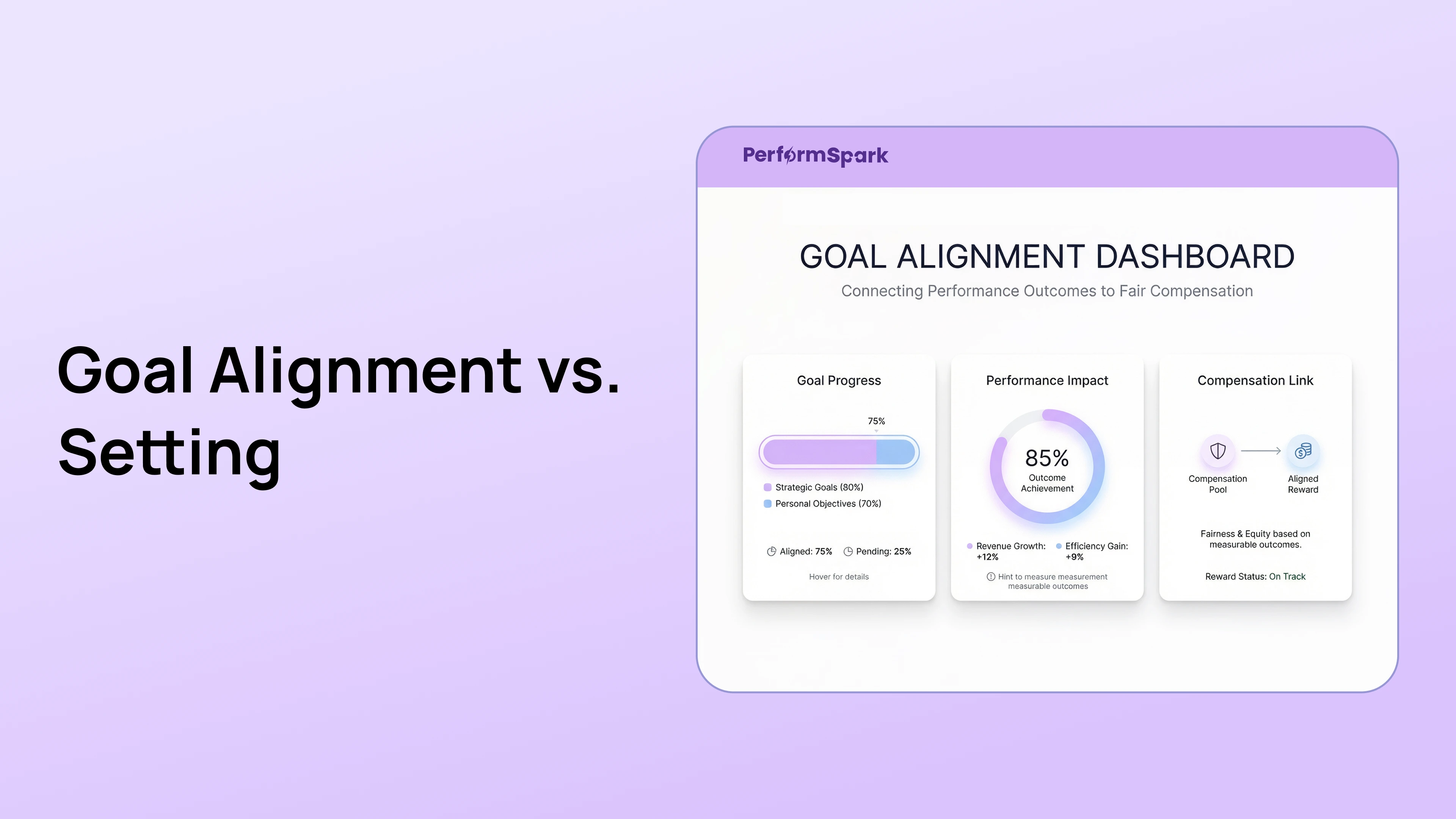
Use goal management to keep current priorities, progress evidence, approved changes, and manager support connected to performance reviews.
What Makes a Performance Goal Useful?
A useful goal should answer:
- What result or behavior is expected?
- Why does it matter?
- How will progress or completion be assessed?
- Which quality requirement applies?
- What is the target or review date?
- Which dependencies are outside the employee's direct control?
- What support will the manager or organization provide?
Do not add a percentage merely to make a goal appear measurable. Use a verified baseline and a target the employee can meaningfully influence.
Engineering and Product Goals
- Complete the agreed feature scope for [project] by [date], meeting the documented acceptance, testing, and review requirements.
- Reduce the recurring [defect or incident type] from the verified baseline by [target] through [specific prevention or quality action], reviewed on [date].
- Prepare a technical design for [system or feature] that documents requirements, alternatives, dependencies, risks, testing, and implementation stages by [date].
- Improve code-review follow-through by responding to assigned reviews within [agreed timeframe] and documenting substantive feedback during the review period.
- Lead one supported production release for [feature], including readiness review, communication, monitoring, and a post-release assessment.
- Mentor [employee or role] on [specific capability] through observation, supported practice, independent work, and a final review by [date].
- Address [technical-debt area] by producing an approved improvement plan and completing the agreed first milestone by [date].
Sales and Business Development Goals
- Achieve the agreed [revenue, bookings, or opportunity] target for [period] using the approved reporting definition.
- Improve discovery quality by documenting the customer's priority, decision criteria, stakeholders, risks, and next step for each qualified opportunity.
- Maintain an active qualified pipeline that meets the team's agreed coverage standard, reviewed during each pipeline meeting.
- Improve forecast reliability by updating opportunity stage, amount, close date, dependencies, and evidence before the weekly review.
- Prepare [number] competitive enablement resources based on verified customer questions and obtain sales-leadership approval by [date].
- Identify and advance [number] appropriate expansion opportunities within assigned accounts by [date], following the team's qualification standard.
- Lead one internal knowledge-sharing session on [sales technique, market pattern, or customer need] and provide a reusable resource.
HR and People Operations Goals
- Complete the approved performance management implementation milestone for [population or workflow] by [date], including data, permissions, testing, and communication.
- Reduce avoidable scheduling delay in [recruiting or onboarding process] from the verified baseline by implementing [specific workflow change] and reviewing the result on [date].
- Launch the next review cycle with approved templates, accurate assignments, manager training, employee communication, and completion reporting.
- Establish a calibration process for [population], including standards, prework, participants, decision rights, and documentation.
- Create an IDP process for [eligible population] with required fields, manager support, milestones, and scheduled progress reviews.
- Build an HR dashboard for [defined questions] using agreed data definitions, owners, access, and refresh frequency.
- Review access to development opportunities across [relevant employee groups] and recommend actions based on documented differences.
Customer Success and Account Management Goals
- Maintain the agreed renewal or retention outcome for the assigned portfolio using the approved definition and account list.
- Create a current success plan for each priority account, including objectives, owners, risks, next actions, and review dates.
- Reduce time to the agreed first-value milestone from the verified baseline through [specific onboarding change], reviewed after [number] completed implementations.
- Improve risk management by documenting evidence, owner, response, and next review date for every material customer risk.
- Complete scheduled business reviews for priority accounts and record agreed actions within [timeframe].
- Improve renewal forecasting by documenting customer intent, decision process, dependencies, commercial risks, and confidence evidence.
Operations and Finance Goals
- Reduce the verified processing time for [workflow] by [target] through [specific change] without lowering the documented quality or control standard.
- Complete the month-end close by the agreed deadline while meeting reconciliation, review, and approval requirements.
- Map [number] priority workflows, identify control or handoff gaps, and present an approved improvement plan by [date].
- Complete the annual budget or forecast update with documented assumptions, owners, review steps, and delivery dates.
- Improve reporting accuracy by implementing [validation step] and tracking corrections across [number] reporting cycles.
- Complete the vendor review for [scope] before renewal, comparing cost, service, risk, obligations, and transition requirements.
- Resolve [recurring operational exception] by identifying the root cause, testing a controlled change, and reviewing the outcome by [date].
Marketing and Content Goals
- Publish the approved [campaign or content cluster] by [date], meeting the brief, quality, review, distribution, and measurement requirements.
- Improve qualified organic visibility for [topic or page group] from the verified baseline through content updates, internal linking, and technical corrections.
- Complete a competitor content audit for [defined competitors and scope] and present prioritized opportunities by [date].
- Improve campaign reporting by connecting objective, audience, channel, cost, conversion definition, and next recommendation in each monthly review.
- Create [number] sales-enablement assets based on documented customer questions and obtain stakeholder approval by [date].
- Test [message, audience, channel, or landing-page change] using a defined hypothesis, success measure, review period, and documented conclusion.
How to Adapt a Goal Example
Generic: “Improve project communication.”
Adapted: “Send the project update by 3:00 p.m. every Friday during the next quarter, including completed work, current status, material risks, decisions needed, owner, and next action. Review completeness during the weekly manager check-in.”
The adapted goal defines the action, cadence, required information, evidence source, and review process.
SMART Goals and OKRs
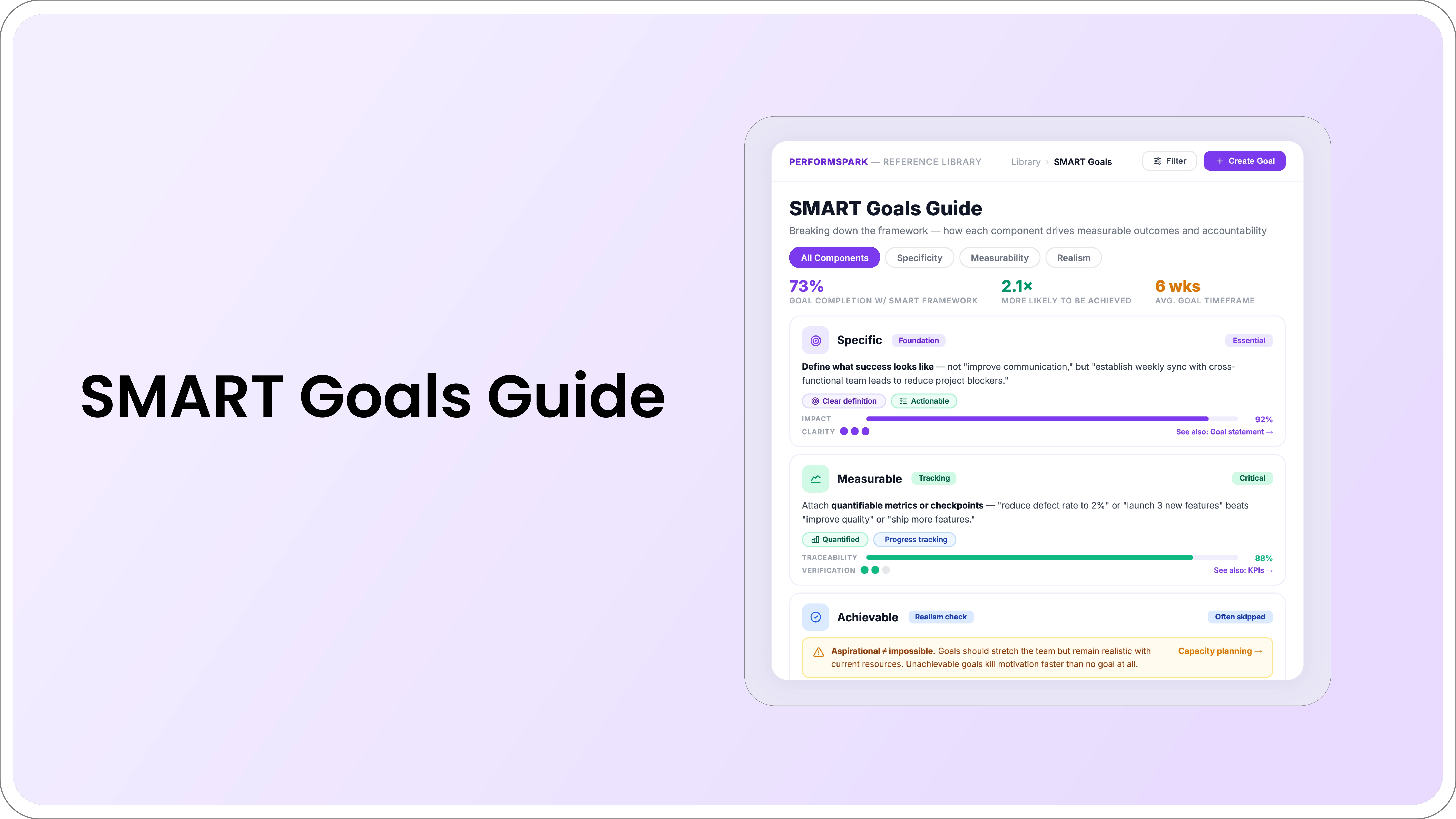
A SMART goal is a goal written to be specific, measurable, achievable, relevant, and time-bound. An OKR pairs an objective with measurable key results.
Organizations may use OKRs for company or team direction and SMART-style commitments for individual work. The method matters less than whether the employee understands the expectation, measure, influence, dependencies, and review process.
Review the SMART goals guide and the OKR vs. KPI comparison for additional structure.
How Many Goals Should an Employee Have?
There is no universal number. Use the smallest set that represents the employee's most important responsibilities and priorities without hiding essential work.
Consider role scope, review period, project cycle, workload, and the amount of manager attention required. A role with several distinct responsibilities may need more goals than a role focused on one major delivery.
Who Should Set the Goals?
Goals should normally be developed through a manager-employee discussion. The manager provides organizational priorities and role expectations. The employee provides workload, dependency, technical, and implementation context.
HR may define required process fields or company-wide objectives, while the manager remains responsible for setting fair role expectations and providing the support needed.
How to Change a Goal Mid-Cycle
Update a goal when the business priority, role, project, baseline, dependency, or available support changes materially. Do not leave an obsolete goal in place and rate the employee against it later.
A controlled change should preserve:
- The original goal
- The reason for revision
- The approved new wording
- The date and decision owner
- Any effect on other goals or workload
Goal reminders and scheduled check-ins can prompt review, but the manager and employee must decide whether the goal is still relevant.
How Goals Connect to Performance Reviews
Goal outcomes are one part of the performance record. Managers should also consider role expectations, quality, behaviors, approved changes, employee influence, feedback, and context.
A mathematical completion rate should not automatically determine the overall rating. During calibration, participants should review the importance and difficulty of the goals, the evidence, and whether comparable standards were used.
How Goals Connect to Compensation
Performance goals may inform the performance assessment, which may then be one input into compensation. Organizations should define the relationship between performance, market position, salary range, budget, eligibility, internal equity, and other approved factors.
Do not promise that completing a goal automatically produces a particular raise, bonus, or promotion.
Goal-Setting Mistakes
- Using arbitrary percentages without a verified baseline
- Measuring outcomes outside the employee's influence
- Ignoring quality while measuring volume or speed
- Creating too many competing goals
- Setting goals without employee or dependency context
- Leaving changed or canceled goals active
- Reviewing goals only at the end of the period
- Using completion as the only evidence for the overall rating
Performance Goal Checklist
- The result or behavior is clear.
- The measure uses a reliable definition.
- The quality requirement is stated.
- The target and review dates are included.
- Dependencies and employee influence are considered.
- Manager support is documented.
- Progress will be reviewed during the period.
- Changes will be recorded through an approved process.
Track Goals Throughout the Review Period
PerformSpark connects goals with check-ins, feedback, reviews, reporting, calibration, development plans, and recognition.
Explore PerformSpark pricing or book a personalized demo to see how employees and managers can maintain goals, evidence, revisions, and progress in one workflow.



.svg)

.svg)
.svg)