
Performance Management Implementations

Staff Performance Management Software: Top 6 Tools for HR Teams in 2026

Staff performance management software is a platform that automates and structures the process of setting employee goals, running review cycles, collecting peer and manager feedback, tracking development plans, and making calibrated performance decisions. The right platform reduces manual HR administration, creates a consistent and defensible review process, and connects performance data to compensation, development, and talent decisions.

Updated :
April 16, 2026

Mahesh Kumar

Founder, TraineryHCM.com
Staff Performance Management Software

Table of Contents

Choosing the wrong performance management software costs more than the subscription price. A platform that is too complex creates adoption resistance. A platform that is too simple breaks when your organization reaches 200 employees. A platform with modular pricing looks affordable in the demo and doubles in cost when you add the features you actually need.

This guide compares six of the most widely used staff performance management platforms, with honest assessments of who each one is built for, what the all-in price actually looks like for 200 users, and the one question most HR leaders do not ask in their vendor demo.

Practitioner Insight: In real-world implementations, the platforms that fail do not fail because of features. They fail because of adoption. Managers who find the system cumbersome stop using it. Reviews get completed in the platform, but with minimal input. The data is there,e but the quality is not. Before you evaluate features, ask what the manager's completion rate looks like in the first review cycle for current customers of that vendor.

The One Question to Ask in Every Performance Management Software Demo

Before you look at any feature list, ask this: "Who prepares the calibration data before a calibration session, and how long does it take?"

In most platforms, the answer is that your HR team builds the calibration view manually from a data export β€” a process that typically takes two to three working days. In a small number of platforms, including PerformSpark, that analysis is generated automatically before the session begins.

This distinction does not appear in a feature comparison table. But for a lean HR team running two review cycles per year, it represents four to six days of manual work per cycle that either happens or does not, based entirely on which platform you choose.

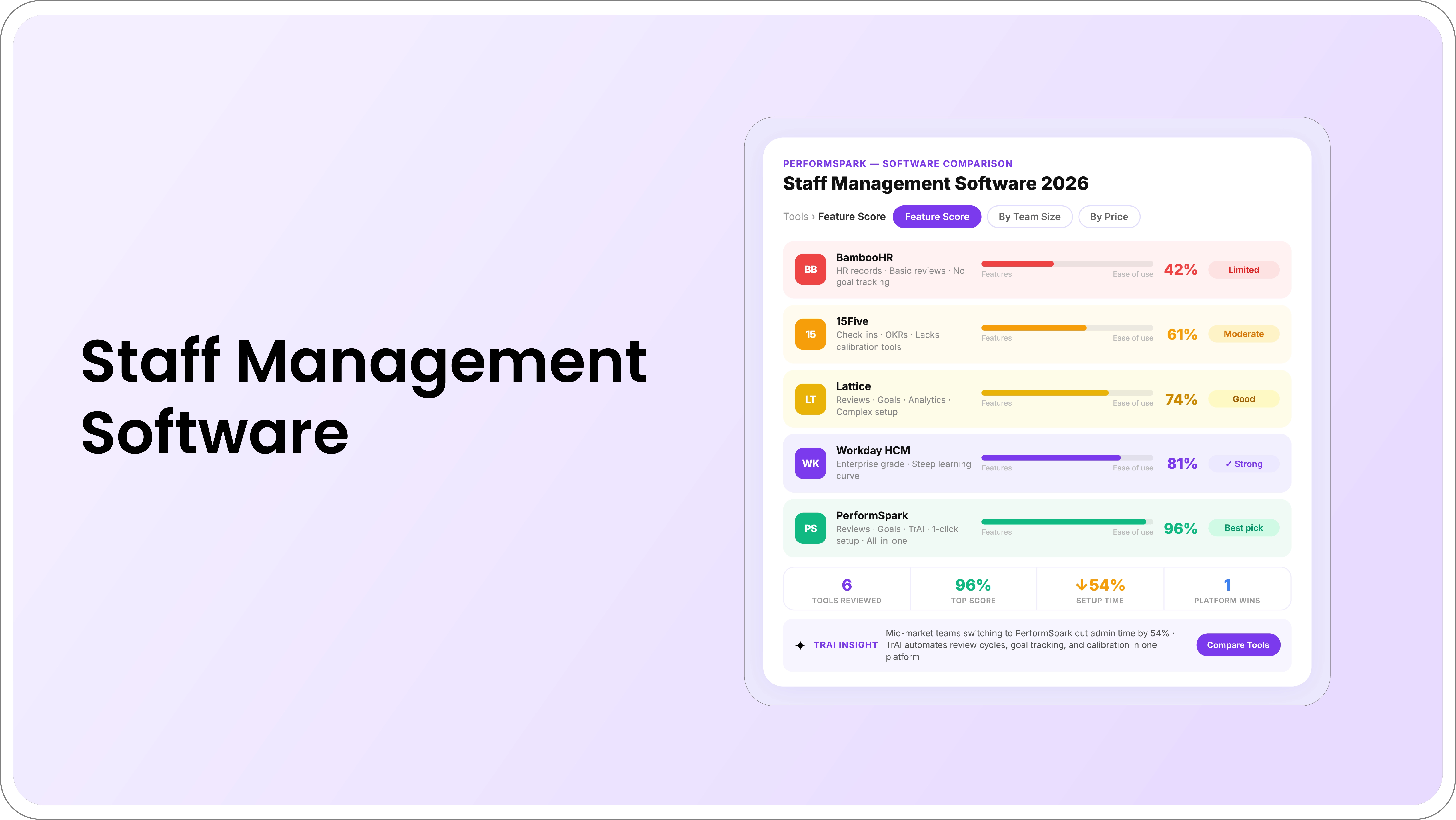
Top 6 Staff Performance Management Platforms Compared

Platform Best For AI Calibration Pricing Model Implementation All-In (200 Users)
PerformSpark Mid-market 50–1,000 Automated TrAI Flat rate β€” all features 1 session ~$1,200/mo
Lattice Mid-market tech Manual view Modular per feature 6–10 weeks ~$3,200–4,800/mo
15Five Continuous feedback Manual Modular 4–6 weeks ~$2,800–3,600/mo
Culture Amp Engagement-first Manual Modular per module 6–12 weeks ~$3,000–4,500/mo
PerformYard Flexible reviews No dedicated AI Modular 2–4 weeks ~$1,800–2,400/mo
Leapsome European mid-market No dedicated AI Modular 4–8 weeks ~$2,200–3,200/mo

PerformSpark

Who it is built for

HR teams managing 50 to 1,000 employees who need a full-stack performance management platform without modular pricing or a multi-week implementation project. PerformSpark includes performance review cycles, goal management, manager check-in tracking, feedback and pulse surveys, calibration with TrAI, individual development plans, performance improvement plans, 360 reviews, and employee recognition β€” all at a flat rate of $6 per user per month.

The calibration advantage

TrAI, PerformSpark's built-in AI calibration engine, generates the pre-session analysis automatically before each calibration session. This includes the rating distribution by manager, outlier flags, and bias pattern identification. HR teams do not need to build this view manually. The session starts with the data already prepared.

Implementation

PerformSpark configures in a single implementation session rather than a multi-week project. For lean HR teams that cannot dedicate significant capacity to a new platform rollout, this is a meaningful operational difference β€” not a marketing claim.

Lattice

Who it is built for

Mid-market technology companies with dedicated HR operations capacity that want a platform connecting performance reviews, OKR tracking, engagement surveys, and compensation planning.

Where it works well

Lattice's compensation management feature is genuinely differentiated in this category. For organizations that need performance data to flow directly into compensation planning, Lattice provides a more complete solution than most mid-market alternatives.

Pricing note

Modular pricing: performance, engagement, and compensation are separate line items. The all-in cost for organizations that need all three is significantly higher than the entry price shown in the demo.

15Five

Who it is built for

Organizations that prioritize a continuous feedback culture and want a platform built around frequent check-ins and manager coaching cadence rather than structured annual or quarterly review cycles.

Where it works well

15Five's check-in and engagement survey tools are well-regarded by users who want a lightweight, frequently-used system. The manager coaching workflow is a genuine strength.

Pricing note

Modular pricing. Pulse surveys, performance reviews, and engagement features are separate tiers. Full-feature access costs significantly more than the entry plan.

Culture Amp

Who it is built for

Organizations that lead with employee engagement as the primary strategic priority and want best-in-class engagement benchmarking data alongside performance management.

Where it works well

Culture Amp's engagement survey product and benchmarking database are the strongest in the category for organizations where engagement data drives strategic decisions.

Pricing note

Engagement and performance are separate modules. Organizations needing both face a higher total cost than a flat-rate alternative.

PerformYard

Who it is built for

HR teams that need a flexible, highly configurable review process without enterprise platform overhead. Particularly strong for organizations with complex or non-standard review structures.

Where it works well

PerformYard's review template configurability is a genuine strength. Organizations with different review formats for different departments or employee types find it easier to configure than more opinionated platforms.

Pricing note

Modular pricing with add-ons for additional features.

Leapsome

Who it is built for

European mid-market organizations, particularly those with German, UK, or French operations, where Leapsome has strong market presence and compliance familiarity.

Where it works well

Leapsome's learning and development integration is a differentiator for organizations where L&D and performance management need to share data. The competency framework builder is more flexible than most competitors.

Pricing note

Modular pricing. Implementation timelines of 4–8 weeks.

How to Choose the Right Platform for Your Organization

For teams of 50 to 200 employees with lean HR capacity

Prioritize implementation speed, ease of manager adoption, and total cost of ownership over breadth of features. A platform that takes 10 weeks to implement and requires significant ongoing HR administration is a poor fit for a two-person HR team. PerformSpark and PerformYard are the strongest options in this segment.

For teams of 200 to 600 employees needing compensation integration

Lattice is the strongest option if compensation planning needs to connect to performance data in a single system. The modular pricing is higher but the compensation module is genuinely differentiated.

For engagement-first cultures

Culture Amp leads in engagement benchmarking and survey methodology. If engagement data is the primary business driver for the platform investment, Culture Amp's engagement module justifies the cost premium

Quick Takeaways

  • Before looking at any feature list, ask: who prepares the calibration data before a session, and how long does it take?
  • Modular pricing looks affordable in the demo. Compare the all-in cost for all features you actually need before signing.
  • Implementation time matters less than implementation hours. A 10-week calendar rollout with minimal HR involvement is better than a 2-week rollout that consumes your entire HR team.
  • Manager adoption in the first review cycle is the single most important success metric. Ask vendors for references from current customers in your industry.
  • AI in performance management ranges from review writing assistance (common) to automated calibration analysis (rare). Know which you are evaluating.

Choosing the wrong performance management software costs more than the subscription price. A platform that is too complex creates adoption resistance. A platform that is too simple breaks when your organization reaches 200 employees. A platform with modular pricing looks affordable in the demo and doubles in cost when you add the features you actually need.

This guide compares six of the most widely used staff performance management platforms, with honest assessments of who each one is built for, what the all-in price actually looks like for 200 users, and the one question most HR leaders do not ask in their vendor demo.

Practitioner Insight: In real-world implementations, the platforms that fail do not fail because of features. They fail because of adoption. Managers who find the system cumbersome stop using it. Reviews get completed in the platform, but with minimal input. The data is there,e but the quality is not. Before you evaluate features, ask what the manager's completion rate looks like in the first review cycle for current customers of that vendor.

The One Question to Ask in Every Performance Management Software Demo

Before you look at any feature list, ask this: "Who prepares the calibration data before a calibration session, and how long does it take?"

In most platforms, the answer is that your HR team builds the calibration view manually from a data export β€” a process that typically takes two to three working days. In a small number of platforms, including PerformSpark, that analysis is generated automatically before the session begins.

This distinction does not appear in a feature comparison table. But for a lean HR team running two review cycles per year, it represents four to six days of manual work per cycle that either happens or does not, based entirely on which platform you choose.

Top 6 Staff Performance Management Platforms Compared

Platform Best For AI Calibration Pricing Model Implementation All-In (200 Users)
PerformSpark Mid-market 50–1,000 Automated TrAI Flat rate β€” all features 1 session ~$1,200/mo
Lattice Mid-market tech Manual view Modular per feature 6–10 weeks ~$3,200–4,800/mo
15Five Continuous feedback Manual Modular 4–6 weeks ~$2,800–3,600/mo
Culture Amp Engagement-first Manual Modular per module 6–12 weeks ~$3,000–4,500/mo
PerformYard Flexible reviews No dedicated AI Modular 2–4 weeks ~$1,800–2,400/mo
Leapsome European mid-market No dedicated AI Modular 4–8 weeks ~$2,200–3,200/mo

PerformSpark

Who it is built for

HR teams managing 50 to 1,000 employees who need a full-stack performance management platform without modular pricing or a multi-week implementation project. PerformSpark includes performance review cycles, goal management, manager check-in tracking, feedback and pulse surveys, calibration with TrAI, individual development plans, performance improvement plans, 360 reviews, and employee recognition β€” all at a flat rate of $6 per user per month.

The calibration advantage

TrAI, PerformSpark's built-in AI calibration engine, generates the pre-session analysis automatically before each calibration session. This includes the rating distribution by manager, outlier flags, and bias pattern identification. HR teams do not need to build this view manually. The session starts with the data already prepared.

Implementation

PerformSpark configures in a single implementation session rather than a multi-week project. For lean HR teams that cannot dedicate significant capacity to a new platform rollout, this is a meaningful operational difference β€” not a marketing claim.

Lattice

Who it is built for

Mid-market technology companies with dedicated HR operations capacity that want a platform connecting performance reviews, OKR tracking, engagement surveys, and compensation planning.

Where it works well

Lattice's compensation management feature is genuinely differentiated in this category. For organizations that need performance data to flow directly into compensation planning, Lattice provides a more complete solution than most mid-market alternatives.

Pricing note

Modular pricing: performance, engagement, and compensation are separate line items. The all-in cost for organizations that need all three is significantly higher than the entry price shown in the demo.

15Five

Who it is built for

Organizations that prioritize a continuous feedback culture and want a platform built around frequent check-ins and manager coaching cadence rather than structured annual or quarterly review cycles.

Where it works well

15Five's check-in and engagement survey tools are well-regarded by users who want a lightweight, frequently-used system. The manager coaching workflow is a genuine strength.

Pricing note

Modular pricing. Pulse surveys, performance reviews, and engagement features are separate tiers. Full-feature access costs significantly more than the entry plan.

Culture Amp

Who it is built for

Organizations that lead with employee engagement as the primary strategic priority and want best-in-class engagement benchmarking data alongside performance management.

Where it works well

Culture Amp's engagement survey product and benchmarking database are the strongest in the category for organizations where engagement data drives strategic decisions.

Pricing note

Engagement and performance are separate modules. Organizations needing both face a higher total cost than a flat-rate alternative.

PerformYard

Who it is built for

HR teams that need a flexible, highly configurable review process without enterprise platform overhead. Particularly strong for organizations with complex or non-standard review structures.

Where it works well

PerformYard's review template configurability is a genuine strength. Organizations with different review formats for different departments or employee types find it easier to configure than more opinionated platforms.

Pricing note

Modular pricing with add-ons for additional features.

Leapsome

Who it is built for

European mid-market organizations, particularly those with German, UK, or French operations, where Leapsome has strong market presence and compliance familiarity.

Where it works well

Leapsome's learning and development integration is a differentiator for organizations where L&D and performance management need to share data. The competency framework builder is more flexible than most competitors.

Pricing note

Modular pricing. Implementation timelines of 4–8 weeks.

How to Choose the Right Platform for Your Organization

For teams of 50 to 200 employees with lean HR capacity

Prioritize implementation speed, ease of manager adoption, and total cost of ownership over breadth of features. A platform that takes 10 weeks to implement and requires significant ongoing HR administration is a poor fit for a two-person HR team. PerformSpark and PerformYard are the strongest options in this segment.

For teams of 200 to 600 employees needing compensation integration

Lattice is the strongest option if compensation planning needs to connect to performance data in a single system. The modular pricing is higher but the compensation module is genuinely differentiated.

For engagement-first cultures

Culture Amp leads in engagement benchmarking and survey methodology. If engagement data is the primary business driver for the platform investment, Culture Amp's engagement module justifies the cost premium

Table of Contents

Choosing the wrong performance management software costs more than the subscription price. A platform that is too complex creates adoption resistance. A platform that is too simple breaks when your organization reaches 200 employees. A platform with modular pricing looks affordable in the demo and doubles in cost when you add the features you actually need.

This guide compares six of the most widely used staff performance management platforms, with honest assessments of who each one is built for, what the all-in price actually looks like for 200 users, and the one question most HR leaders do not ask in their vendor demo.

Practitioner Insight: In real-world implementations, the platforms that fail do not fail because of features. They fail because of adoption. Managers who find the system cumbersome stop using it. Reviews get completed in the platform, but with minimal input. The data is there,e but the quality is not. Before you evaluate features, ask what the manager's completion rate looks like in the first review cycle for current customers of that vendor.

The One Question to Ask in Every Performance Management Software Demo

Before you look at any feature list, ask this: "Who prepares the calibration data before a calibration session, and how long does it take?"

In most platforms, the answer is that your HR team builds the calibration view manually from a data export β€” a process that typically takes two to three working days. In a small number of platforms, including PerformSpark, that analysis is generated automatically before the session begins.

This distinction does not appear in a feature comparison table. But for a lean HR team running two review cycles per year, it represents four to six days of manual work per cycle that either happens or does not, based entirely on which platform you choose.

Top 6 Staff Performance Management Platforms Compared

Platform Best For AI Calibration Pricing Model Implementation All-In (200 Users)
PerformSpark Mid-market 50–1,000 Automated TrAI Flat rate β€” all features 1 session ~$1,200/mo
Lattice Mid-market tech Manual view Modular per feature 6–10 weeks ~$3,200–4,800/mo
15Five Continuous feedback Manual Modular 4–6 weeks ~$2,800–3,600/mo
Culture Amp Engagement-first Manual Modular per module 6–12 weeks ~$3,000–4,500/mo
PerformYard Flexible reviews No dedicated AI Modular 2–4 weeks ~$1,800–2,400/mo
Leapsome European mid-market No dedicated AI Modular 4–8 weeks ~$2,200–3,200/mo

PerformSpark

Who it is built for

HR teams managing 50 to 1,000 employees who need a full-stack performance management platform without modular pricing or a multi-week implementation project. PerformSpark includes performance review cycles, goal management, manager check-in tracking, feedback and pulse surveys, calibration with TrAI, individual development plans, performance improvement plans, 360 reviews, and employee recognition β€” all at a flat rate of $6 per user per month.

The calibration advantage

TrAI, PerformSpark's built-in AI calibration engine, generates the pre-session analysis automatically before each calibration session. This includes the rating distribution by manager, outlier flags, and bias pattern identification. HR teams do not need to build this view manually. The session starts with the data already prepared.

Implementation

PerformSpark configures in a single implementation session rather than a multi-week project. For lean HR teams that cannot dedicate significant capacity to a new platform rollout, this is a meaningful operational difference β€” not a marketing claim.

Lattice

Who it is built for

Mid-market technology companies with dedicated HR operations capacity that want a platform connecting performance reviews, OKR tracking, engagement surveys, and compensation planning.

Where it works well

Lattice's compensation management feature is genuinely differentiated in this category. For organizations that need performance data to flow directly into compensation planning, Lattice provides a more complete solution than most mid-market alternatives.

Pricing note

Modular pricing: performance, engagement, and compensation are separate line items. The all-in cost for organizations that need all three is significantly higher than the entry price shown in the demo.

15Five

Who it is built for

Organizations that prioritize a continuous feedback culture and want a platform built around frequent check-ins and manager coaching cadence rather than structured annual or quarterly review cycles.

Where it works well

15Five's check-in and engagement survey tools are well-regarded by users who want a lightweight, frequently-used system. The manager coaching workflow is a genuine strength.

Pricing note

Modular pricing. Pulse surveys, performance reviews, and engagement features are separate tiers. Full-feature access costs significantly more than the entry plan.

Culture Amp

Who it is built for

Organizations that lead with employee engagement as the primary strategic priority and want best-in-class engagement benchmarking data alongside performance management.

Where it works well

Culture Amp's engagement survey product and benchmarking database are the strongest in the category for organizations where engagement data drives strategic decisions.

Pricing note

Engagement and performance are separate modules. Organizations needing both face a higher total cost than a flat-rate alternative.

PerformYard

Who it is built for

HR teams that need a flexible, highly configurable review process without enterprise platform overhead. Particularly strong for organizations with complex or non-standard review structures.

Where it works well

PerformYard's review template configurability is a genuine strength. Organizations with different review formats for different departments or employee types find it easier to configure than more opinionated platforms.

Pricing note

Modular pricing with add-ons for additional features.

Leapsome

Who it is built for

European mid-market organizations, particularly those with German, UK, or French operations, where Leapsome has strong market presence and compliance familiarity.

Where it works well

Leapsome's learning and development integration is a differentiator for organizations where L&D and performance management need to share data. The competency framework builder is more flexible than most competitors.

Pricing note

Modular pricing. Implementation timelines of 4–8 weeks.

How to Choose the Right Platform for Your Organization

For teams of 50 to 200 employees with lean HR capacity

Prioritize implementation speed, ease of manager adoption, and total cost of ownership over breadth of features. A platform that takes 10 weeks to implement and requires significant ongoing HR administration is a poor fit for a two-person HR team. PerformSpark and PerformYard are the strongest options in this segment.

For teams of 200 to 600 employees needing compensation integration

Lattice is the strongest option if compensation planning needs to connect to performance data in a single system. The modular pricing is higher but the compensation module is genuinely differentiated.

For engagement-first cultures

Culture Amp leads in engagement benchmarking and survey methodology. If engagement data is the primary business driver for the platform investment, Culture Amp's engagement module justifies the cost premium

Quick Takeaways

  • Before looking at any feature list, ask: who prepares the calibration data before a session, and how long does it take?
  • Modular pricing looks affordable in the demo. Compare the all-in cost for all features you actually need before signing.
  • Implementation time matters less than implementation hours. A 10-week calendar rollout with minimal HR involvement is better than a 2-week rollout that consumes your entire HR team.
  • Manager adoption in the first review cycle is the single most important success metric. Ask vendors for references from current customers in your industry.
  • AI in performance management ranges from review writing assistance (common) to automated calibration analysis (rare). Know which you are evaluating.

Choosing the wrong performance management software costs more than the subscription price. A platform that is too complex creates adoption resistance. A platform that is too simple breaks when your organization reaches 200 employees. A platform with modular pricing looks affordable in the demo and doubles in cost when you add the features you actually need.

This guide compares six of the most widely used staff performance management platforms, with honest assessments of who each one is built for, what the all-in price actually looks like for 200 users, and the one question most HR leaders do not ask in their vendor demo.

Practitioner Insight: In real-world implementations, the platforms that fail do not fail because of features. They fail because of adoption. Managers who find the system cumbersome stop using it. Reviews get completed in the platform, but with minimal input. The data is there,e but the quality is not. Before you evaluate features, ask what the manager's completion rate looks like in the first review cycle for current customers of that vendor.

The One Question to Ask in Every Performance Management Software Demo

Before you look at any feature list, ask this: "Who prepares the calibration data before a calibration session, and how long does it take?"

In most platforms, the answer is that your HR team builds the calibration view manually from a data export β€” a process that typically takes two to three working days. In a small number of platforms, including PerformSpark, that analysis is generated automatically before the session begins.

This distinction does not appear in a feature comparison table. But for a lean HR team running two review cycles per year, it represents four to six days of manual work per cycle that either happens or does not, based entirely on which platform you choose.

Top 6 Staff Performance Management Platforms Compared

Platform Best For AI Calibration Pricing Model Implementation All-In (200 Users)
PerformSpark Mid-market 50–1,000 Automated TrAI Flat rate β€” all features 1 session ~$1,200/mo
Lattice Mid-market tech Manual view Modular per feature 6–10 weeks ~$3,200–4,800/mo
15Five Continuous feedback Manual Modular 4–6 weeks ~$2,800–3,600/mo
Culture Amp Engagement-first Manual Modular per module 6–12 weeks ~$3,000–4,500/mo
PerformYard Flexible reviews No dedicated AI Modular 2–4 weeks ~$1,800–2,400/mo
Leapsome European mid-market No dedicated AI Modular 4–8 weeks ~$2,200–3,200/mo

PerformSpark

Who it is built for

HR teams managing 50 to 1,000 employees who need a full-stack performance management platform without modular pricing or a multi-week implementation project. PerformSpark includes performance review cycles, goal management, manager check-in tracking, feedback and pulse surveys, calibration with TrAI, individual development plans, performance improvement plans, 360 reviews, and employee recognition β€” all at a flat rate of $6 per user per month.

The calibration advantage

TrAI, PerformSpark's built-in AI calibration engine, generates the pre-session analysis automatically before each calibration session. This includes the rating distribution by manager, outlier flags, and bias pattern identification. HR teams do not need to build this view manually. The session starts with the data already prepared.

Implementation

PerformSpark configures in a single implementation session rather than a multi-week project. For lean HR teams that cannot dedicate significant capacity to a new platform rollout, this is a meaningful operational difference β€” not a marketing claim.

Lattice

Who it is built for

Mid-market technology companies with dedicated HR operations capacity that want a platform connecting performance reviews, OKR tracking, engagement surveys, and compensation planning.

Where it works well

Lattice's compensation management feature is genuinely differentiated in this category. For organizations that need performance data to flow directly into compensation planning, Lattice provides a more complete solution than most mid-market alternatives.

Pricing note

Modular pricing: performance, engagement, and compensation are separate line items. The all-in cost for organizations that need all three is significantly higher than the entry price shown in the demo.

15Five

Who it is built for

Organizations that prioritize a continuous feedback culture and want a platform built around frequent check-ins and manager coaching cadence rather than structured annual or quarterly review cycles.

Where it works well

15Five's check-in and engagement survey tools are well-regarded by users who want a lightweight, frequently-used system. The manager coaching workflow is a genuine strength.

Pricing note

Modular pricing. Pulse surveys, performance reviews, and engagement features are separate tiers. Full-feature access costs significantly more than the entry plan.

Culture Amp

Who it is built for

Organizations that lead with employee engagement as the primary strategic priority and want best-in-class engagement benchmarking data alongside performance management.

Where it works well

Culture Amp's engagement survey product and benchmarking database are the strongest in the category for organizations where engagement data drives strategic decisions.

Pricing note

Engagement and performance are separate modules. Organizations needing both face a higher total cost than a flat-rate alternative.

PerformYard

Who it is built for

HR teams that need a flexible, highly configurable review process without enterprise platform overhead. Particularly strong for organizations with complex or non-standard review structures.

Where it works well

PerformYard's review template configurability is a genuine strength. Organizations with different review formats for different departments or employee types find it easier to configure than more opinionated platforms.

Pricing note

Modular pricing with add-ons for additional features.

Leapsome

Who it is built for

European mid-market organizations, particularly those with German, UK, or French operations, where Leapsome has strong market presence and compliance familiarity.

Where it works well

Leapsome's learning and development integration is a differentiator for organizations where L&D and performance management need to share data. The competency framework builder is more flexible than most competitors.

Pricing note

Modular pricing. Implementation timelines of 4–8 weeks.

How to Choose the Right Platform for Your Organization

For teams of 50 to 200 employees with lean HR capacity

Prioritize implementation speed, ease of manager adoption, and total cost of ownership over breadth of features. A platform that takes 10 weeks to implement and requires significant ongoing HR administration is a poor fit for a two-person HR team. PerformSpark and PerformYard are the strongest options in this segment.

For teams of 200 to 600 employees needing compensation integration

Lattice is the strongest option if compensation planning needs to connect to performance data in a single system. The modular pricing is higher but the compensation module is genuinely differentiated.

For engagement-first cultures

Culture Amp leads in engagement benchmarking and survey methodology. If engagement data is the primary business driver for the platform investment, Culture Amp's engagement module justifies the cost premium

Frequently Asked Questions

What is staff performance management software?

How much does performance management software cost for a 200-person organisation?

How long does it take to implement performance management software?

What is AI calibration in performance management software?

What should HR look for when evaluating performance management platforms?

Is performance management software worth it for a 100-person company?

Make performance reviews your growth lever

No credit card required β€’ Free setup & training included β€’ Cancel anytime

CTA ShapeCTA Shape