

.svg)





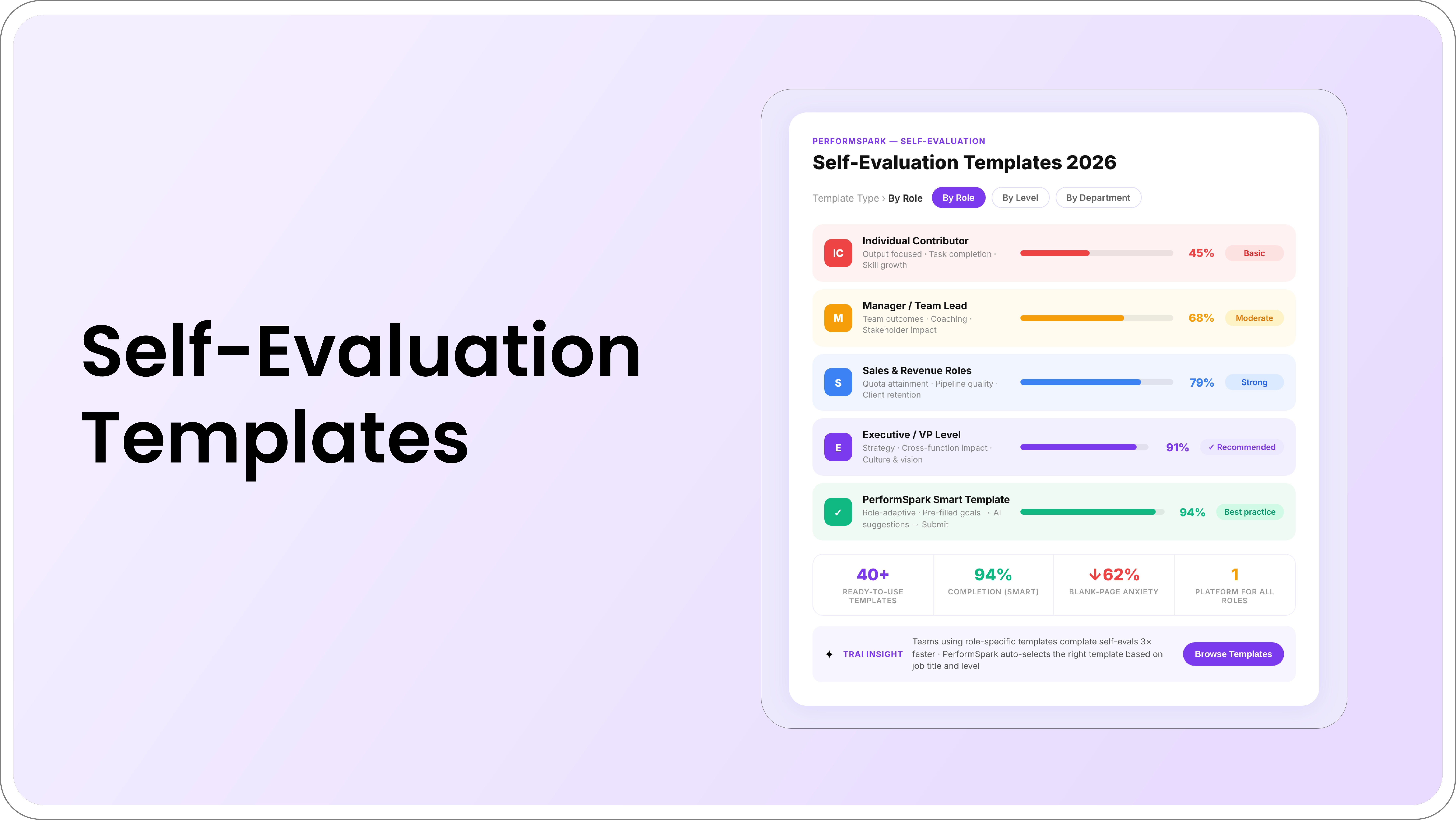
Table of Contents

Quick Takeaways: Self-Evaluation Examples
- Adapt every example with real goals, project names, evidence, feedback, and review-period context.
- Explain the employee's specific contribution and acknowledge shared team results accurately.
- Address incomplete goals directly and describe the action being taken.
- Use this page for longer role examples; use the self-appraisal comments guide for complete comments and the keywords and power phrases guide for shorter wording.
A self-evaluation should explain the employee's contribution, evidence, impact, learning, and next step. The strongest examples are specific enough to be credible and balanced enough to support a useful conversation with the manager.
This page provides 15 longer self-evaluation examples by role and performance situation. Adapt the wording with real goals, project names, dates, results, and feedback from the employee's review period.
For the step-by-step writing process, use the self-assessment performance review guide. For complete employee comment examples, use the 100 self-appraisal comments guide. For shorter wording, use the 150 self-appraisal keywords and power phrases guide.
What Should a Self-Evaluation Include?
A useful self-evaluation usually includes:
- Review-period and role context
- Major accomplishments
- Progress against agreed goals
- Feedback received and applied
- Challenges or incomplete work
- Strengths demonstrated
- One or two development priorities
- Next-period goals and support needed
Use reliable evidence. Replace bracketed details in the examples with information from work records, check-ins, project reviews, customer feedback, or other approved sources.
How to Use These Examples
- Select an example with a similar role or situation.
- Replace general wording with the employee's actual work.
- Add evidence that the manager can verify.
- Remove sections that do not apply.
- Check that team outcomes and individual contribution are distinguished.
- End with a useful next step or support request.
Do not submit a sample unchanged. Generic language reduces the value of the self-evaluation and may conflict with the employee's actual performance record.
1. HR Leader: Exceeding Expectations
“During this review period, I led the redesign of our performance review process. I mapped the existing workflow, removed duplicate approval steps, coordinated testing with managers from different departments, and created new guidance for employees and reviewers. The first cycle using the revised process had fewer access and assignment questions, and HR could monitor completion without maintaining a separate tracker. My strongest contribution was translating policy requirements into a workflow managers could use. In the next period, I want to improve how we measure review quality after completion, not only whether the forms were submitted.”
2. HR Leader: Meeting Expectations
“I managed the review calendar, supported managers, prepared calibration materials, and completed the required process reporting. I responded consistently to questions and escalated sensitive cases to the appropriate HR leader. One area I want to improve is post-cycle communication. Several managers needed additional clarification about development follow-up, so I am creating a standard closeout checklist and will review its use after the next cycle.”
3. Software Engineer: Exceeding Expectations
“I delivered the agreed feature scope and also addressed a recurring reliability issue that affected dependent teams. I documented the technical options, coordinated the change with platform and quality partners, and created monitoring guidance for future incidents. The work improved the team's ability to identify the issue earlier and reduced repeated investigation. I also supported two engineers through design and code reviews. My next development priority is leading a full technical design review independently, including risks, alternatives, and implementation stages.”
4. Software Engineer: Meeting Expectations
“I completed the main commitments in my current goal plan and contributed consistently to code reviews and team planning. I raised dependencies when I identified them and corrected defects within the agreed process. I need to improve the clarity of my design documentation. Feedback from recent reviews showed that some assumptions were explained verbally but not written. I have started using the team's design checklist and will ask a senior engineer to review my next two documents before the formal meeting.”
5. Sales Representative: Exceeding Expectations
“I achieved the agreed sales outcome for the review period and contributed beyond my assigned opportunities by documenting objections and competitive questions that appeared repeatedly in customer conversations. I worked with marketing and product teams to turn those observations into an updated enablement resource. I also supported a new team member during call preparation. My next goal is to improve forecasting consistency by documenting decision criteria, dependencies, and next actions more clearly for every active opportunity.”
6. Sales Representative: Development Needed
“I did not achieve the full target for this period. The main gap was not activity volume but the quality of opportunity qualification. Several opportunities remained active without clear decision criteria or an agreed next step. I should have raised these concerns earlier and focused my time on better-qualified accounts. I have reviewed the qualification framework with my manager, will use it in every discovery conversation, and will discuss selected opportunity notes during our weekly 1-on-1.”
7. Customer Success Manager: Exceeding Expectations
“I maintained clear success plans for my assigned customers and identified several material risks before they affected renewal discussions. For each risk, I documented the evidence, owner, response, and next review date, then coordinated action with the relevant internal team. I also created a reusable customer handoff checklist after noticing recurring gaps in implementation records. My next development priority is executive communication, particularly presenting customer risk and recommended action more concisely.”
8. Customer Success Manager: Development Needed
“My customer relationships remained constructive, but I was not consistent in documenting risks and follow-up actions in the approved system. This made it harder for partner teams to understand the current status when I was unavailable. I have moved active risks into the shared workflow, added an owner and review date, and will review the record with my manager during each check-in until the habit is consistent.”
9. Finance Analyst: Exceeding Expectations
“I completed the required reporting and identified a recurring reconciliation issue that was creating avoidable review work. I traced the difference to the source process, documented the control gap, and worked with the process owner to test a correction. The updated workflow gives reviewers a clearer record of the source, adjustment, and approval. I want to build stronger executive communication by presenting analysis as a decision, key evidence, risks, and recommendation rather than leading with technical detail.”
10. Finance Analyst: Meeting Expectations
“I delivered my scheduled reports accurately and raised questions when source information was incomplete. I also supported the annual planning process by documenting assumptions and changes. Feedback indicated that my analysis is reliable but sometimes arrives too close to the decision deadline. I am improving the work plan by identifying dependencies earlier and setting internal review dates before the final due date.”
11. Operations Specialist: Meeting Expectations
“I managed the assigned operational workflow, resolved exceptions, and maintained the required service and quality records. I also mapped a recurring handoff problem and proposed a limited pilot to test a clearer owner and escalation step. The pilot is still in progress, so I am not treating the result as complete. During the next period, I will review the outcome, document what changed, and recommend whether the process should be expanded or revised.”
12. Healthcare or Frontline Employee: Meeting Expectations
“I completed my assigned responsibilities, followed required procedures, and raised safety or service concerns through the approved process. I contributed to team handoffs by using the standard checklist and confirming unresolved actions with the incoming employee. One area I am developing is communication during high-volume periods. I have asked my manager to observe one handoff and provide specific feedback on clarity, prioritization, and escalation.”
Employees in regulated or clinical environments should adapt the wording to their role, policy, professional standards, and approved documentation process.
13. First-Time Manager: Exceeding Expectations
“I established a regular check-in structure with each direct report, clarified current goals, and documented employee and manager actions. I used feedback from my own manager to ask more open questions instead of moving immediately to a solution. Team members began bringing risks and support needs earlier, which gave us more time to respond. My next development priority is delegation. I want to define outcomes and decision authority more clearly while avoiding unnecessary control of the employee's approach.”
14. People Manager: Development Needed
“I delivered the team's main work commitments, but I was not consistent in providing timely individual feedback. I relied too heavily on project meetings and did not create enough space for employee development conversations. I have scheduled recurring check-ins, added feedback and development to the agenda, and will track the commitments I make to each employee. I will review this progress with my manager during our monthly conversation.”
15. Employee in a New or Expanded Role
“This was my first review period after taking on expanded responsibilities. I learned the new workflow, built relationships with key partners, and completed the initial deliverables agreed with my manager. Some goals changed as the role became clearer, and those revisions are documented in the goal record. My main development need is prioritizing requests from multiple stakeholders. In the next period, I will use an agreed priority framework, raise conflicts earlier, and review the approach with my manager after major planning meetings.”
Blank Self-Evaluation Template
The fields below mirror PerformSpark's free, downloadable employee self-appraisal template, available as an editable Word document and print-ready PDF if you would rather fill in a ready-made form than copy this structure by hand.
Review-period context
[Describe your role, review period, and any significant changes to responsibilities or priorities.]
Major accomplishments
[Describe two to four important contributions. For each, explain the objective, your role, evidence, and impact.]
Goal progress
[State the original target, current result, and relevant context for each important goal.]
Feedback received and applied
[Describe one or two pieces of feedback, the action you took, and what changed afterward.]
Strengths
[Describe observable behaviors or capabilities you should continue.]
Development priorities
[Describe one or two capabilities to build, why they matter, and the action you will take.]
Next-period goals and support
[List your next priorities and the manager or organizational support required.]
Self-Evaluation Examples by Section
Accomplishment
“I owned [project or responsibility], completed [specific contribution], and used [evidence source] to confirm the result. The work helped [team, customer, process, or business impact].”
Missed goal
“I did not complete [goal] as planned. [Relevant context] affected the outcome, and I was responsible for [employee action or decision]. I have changed [specific behavior or process] and will review progress through [evidence and date].”
Feedback applied
“I received feedback that [observable behavior]. I responded by [action]. In the following [project or period], [evidence of change].”
Development priority
“I want to build [capability] because it will improve [current role or realistic next responsibility]. I will practice through [activity], and I need [manager support].”
How Self-Evaluations Support the Review Process
A self-evaluation adds the employee's perspective to the broader performance record. The manager should consider it alongside goals, project outcomes, feedback, survey information, recognition, and documented check-ins.
When the organization uses performance calibration, relevant evidence from the employee may help the manager explain the proposed rating. Calibration still requires the complete evidence and rating standard. A strong self-evaluation does not guarantee a particular rating.
Development priorities may move into an individual development plan. Current performance gaps may require coaching, clarified expectations, or a separate formal process after HR review.
Common Self-Evaluation Mistakes
- Copying examples without adding real evidence
- Listing tasks instead of explaining contribution and impact
- Using invented percentages or financial results
- Claiming full credit for a team outcome
- Ignoring incomplete goals
- Using personality labels instead of behavior
- Creating a false weakness
- Writing only to argue for a rating
- Leaving out next steps and support
Self-Evaluation Checklist
- The context and review period are clear.
- Examples represent the most important work.
- Evidence is accurate and available.
- Team and individual contributions are separated.
- Missed goals are addressed directly.
- Feedback includes the action taken.
- Development priorities are observable and actionable.
- Next goals include manager support.
- The final version uses clear US English.
Use One Connected Review Record
PerformSpark connects employee self-evaluations with manager assessments, goals, check-ins, recognition, feedback, calibration, development plans, and reporting.
Explore PerformSpark pricing or book a personalized demo to see how employee and manager input can remain connected throughout the review cycle.




.svg)

.svg)
.svg)