
.svg)





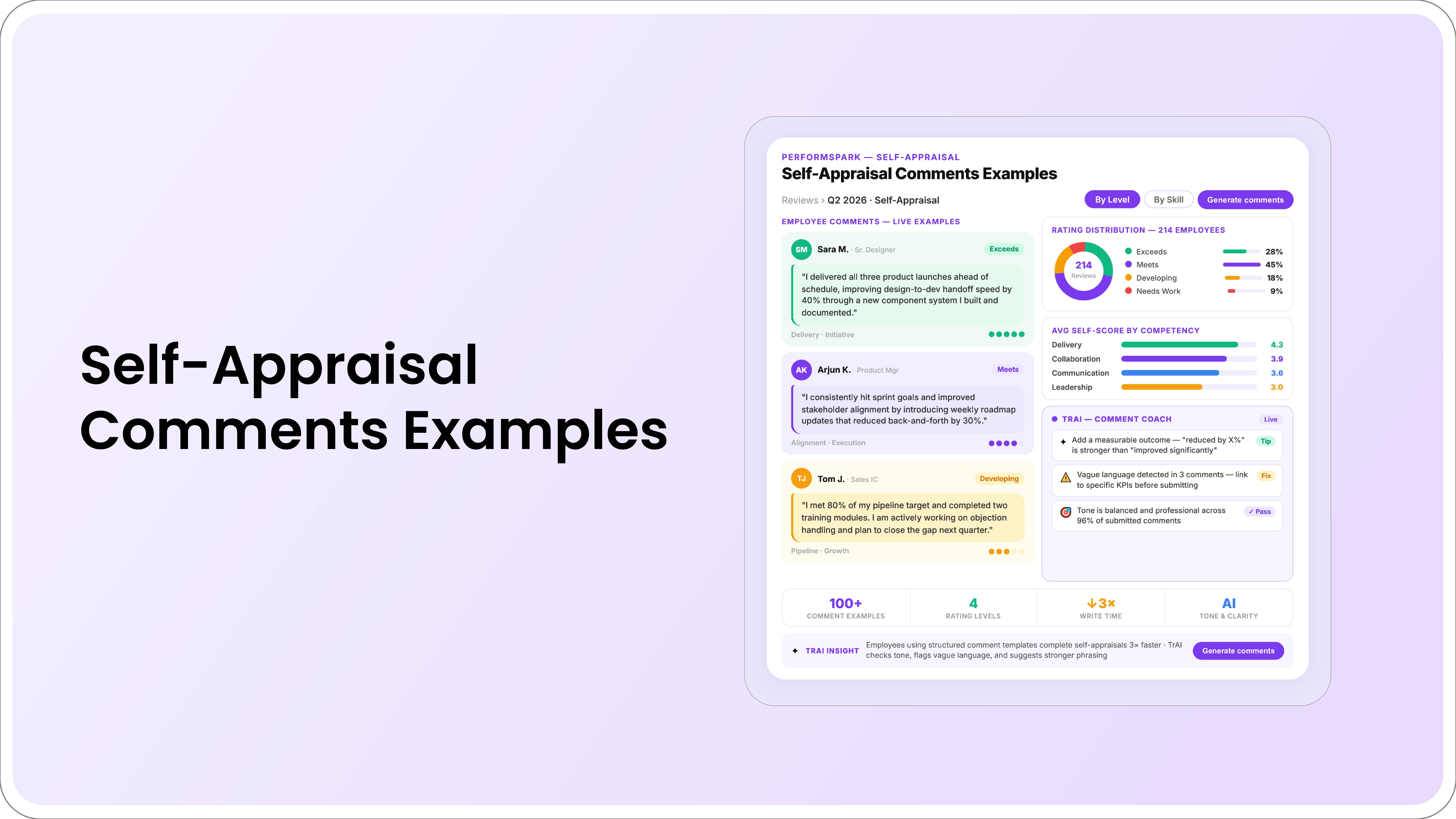
Table of Contents

Key Takeaways: Self-Appraisal Comments
- Use these 100 self-appraisal comments by employee examples as starting points, then replace sample details with evidence from your actual review period.
- Strong overall self-appraisal comments connect a specific action with evidence and its impact on a goal, customer, team, or business result.
- Review the full performance period using goals, project records, check-ins, recognition, and feedback instead of relying on recent memory.
- Need a structured form? Use the free Employee Self-Appraisal Template to document results, evidence, ratings, and development priorities.
- For HR teams, PerformSpark performance reviews connect employee self-appraisals with manager reviews, goals, feedback, calibration, and development follow-through.
Self-appraisal comments give employees an opportunity to document their performance before the manager completes the formal review. The strongest comments do more than describe effort. They identify a specific action, show evidence, and explain the impact on a customer, team, goal, or business result.
The 100 examples below are organized across ten common performance competencies. Use them as starting points, then replace the sample details with your actual projects, results, dates, and feedback. A credible self-appraisal should reflect the full review period, not only the work completed during the last few weeks.
In a structured performance review process, employee comments become part of the evidence managers use when writing ratings, preparing development plans, and participating in performance calibration.
Remote and hybrid employees should lean harder on written evidence than employees who share an office with their manager, since a manager who does not see the day-to-day work by default has to rely on what gets documented. Reference specific artifacts your manager can independently check, such as a shipped deliverable, a closed deal in the CRM, a shared document with version history, or a recorded demo, rather than general statements about staying visible and communicative.
How to Write a Strong Self-Appraisal Comment
A useful self-appraisal comment contains three parts:
- Action: What did you personally do?
- Evidence: What result, feedback, milestone, or behavior demonstrates it?
- Impact: Why did it matter to the team or organization?
For example, replace “I communicated well with stakeholders” with “I introduced a weekly stakeholder update covering decisions, risks, and owners, which reduced follow-up clarification requests during the final six weeks of the project.”
Writing About Weaknesses Without Sounding Defensive
Most self-appraisals fail on the weakness half, not the strength half. Employees either skip a real weakness in favor of a safe, rehearsed answer, or name one honestly and then undercut it by over-explaining. The stronger pattern uses the same Action, Evidence, Impact formula, followed by one sentence naming what is already changing. State the gap plainly, name one piece of evidence, and name one concrete step already underway, without apologizing for the gap in the same sentence that names it. “I missed the filing deadline twice this quarter because I was tracking it manually, and I have since moved it into our shared calendar with a 3-day buffer” reads as more credible than a longer, hedged version of the same fact. If you want shorter phrasing to adapt rather than full comments, PerformSpark also has 150 self-appraisal keywords and power phrases organized by the same competencies.
Review your goal records, project notes, 1-on-1 check-in history, recognition, and peer feedback before writing. These sources help you avoid vague statements and recency bias.
1. Goal Achievement Self-Appraisal Comments
- “I completed all priority goals for the review period and delivered the final customer migration two weeks before the committed deadline.”
- “I achieved 108% of my annual target by improving follow-up consistency and prioritizing the highest-value opportunities in my pipeline.”
- “I completed four of five goals. The remaining goal was formally reprioritized after the team shifted resources to a higher-impact customer request.”
- “I exceeded the service-level target for three consecutive quarters and maintained quality while handling a larger workload.”
- “I translated my annual objective into monthly milestones, which helped me identify a Q2 delay early and recover the timeline by Q3.”
- “I met the core expectations for my role and delivered all assigned work without missed deadlines during the second half of the year.”
- “I made steady progress against my development goal and completed the required certification before the year-end deadline.”
- “I achieved the project outcome, but I relied too heavily on last-minute effort. Next cycle, I will establish milestone dates and review progress with my manager monthly.”
- “I completed 80% of my goals and recognize that I underestimated the time required for two cross-functional dependencies. I have added dependency reviews to my planning process.”
- “One goal was not achieved because priorities changed mid-cycle. I documented the decision, aligned with my manager, and redirected the available time to the new business priority.”
Employees and managers can track progress throughout the cycle with employee goal management software instead of reconstructing results at review time.
2. Communication Self-Appraisal Comments
- “I introduced a concise weekly project update that gave stakeholders clear visibility into progress, risks, decisions, and owners.”
- “I adapted technical information for nontechnical audiences, which helped leadership approve the proposed solution without additional clarification meetings.”
- “I communicated a delivery risk six weeks before the deadline and coordinated a revised plan with all affected teams.”
- “I improved meeting effectiveness by circulating agendas in advance and documenting decisions and action items afterward.”
- “I received positive feedback from peers on the clarity and responsiveness of my cross-functional communication.”
- “I consistently responded within the expected timeframe and kept stakeholders informed when a complete answer required additional investigation.”
- “I participated constructively in team discussions and raised concerns respectfully, with proposed alternatives rather than criticism alone.”
- “My written updates were sometimes too detailed for executive audiences. I now begin with the decision required, the business impact, and the recommended next step.”
- “I did not communicate two schedule changes quickly enough. I have added a same-day stakeholder notification step to my project workflow.”
- “I sometimes move too quickly during presentations. I am practicing shorter explanations, planned pauses, and explicit checks for understanding.”
Regular employee feedback and documented manager conversations help employees understand how their communication is experienced by others.
3. Teamwork and Collaboration Self-Appraisal Comments
- “I coordinated work across three departments and clarified ownership early, which prevented duplicate work during the implementation phase.”
- “I supported two colleagues during a high-volume period while maintaining my own delivery commitments.”
- “I created a shared documentation process that reduced repeated questions and improved onboarding for new team members.”
- “I resolved a disagreement between two teams by separating the shared objective from the preferred methods and proposing a phased approach.”
- “I actively requested input from colleagues whose expertise was needed before finalizing the recommendation.”
- “I completed all cross-functional handoffs on time and provided the information required by the receiving teams.”
- “I contributed consistently to team priorities and volunteered for work that was necessary but did not have a clear owner.”
- “I sometimes waited too long before involving other teams. I am now identifying cross-functional dependencies during project planning.”
- “Two handoffs required follow-up because the documentation was incomplete. I created a checklist and have had no incomplete handoffs since.”
- “I need to balance independent problem solving with earlier collaboration. I will involve relevant partners when an issue affects their processes or customers.”
360-degree feedback can provide broader evidence about collaboration, reliability, and influence across teams.
4. Leadership Self-Appraisal Comments
Leadership evidence differs by role. Individual contributors should describe influence, initiative, mentoring, and decisions made without formal authority. People managers should focus on direction, delegation, coaching, feedback, and team outcomes.
- “I helped a team member progress from a supporting role to independently leading a customer project.”
- “I maintained a consistent coaching cadence with my direct reports and documented commitments from each conversation.”
- “I clarified priorities during a period of organizational change and helped the team focus on the work with the greatest business impact.”
- “I delegated ownership more deliberately, giving team members clear outcomes, decision boundaries, and support.”
- “I addressed a performance concern early, agreed on measurable expectations, and provided weekly coaching until performance stabilized.”
- “I communicated team goals clearly and followed up on progress without taking ownership away from the responsible employee.”
- “I created regular opportunities for team members to raise blockers, discuss development, and request support.”
- “I sometimes made decisions without enough input from the people responsible for implementation. I am adding a structured consultation step for high-impact changes.”
- “My coaching became less consistent during a busy quarter. I have restored recurring check-ins and track completion as a manager accountability measure.”
- “I need to provide difficult feedback sooner. I will document concerns close to the event and address them during the next scheduled conversation.”
Managers can use structured performance management tools for managers and automated reminders to maintain coaching and review commitments.
5. Problem-Solving Self-Appraisal Comments
A credible problem-solving comment explains how you diagnosed the issue, which constraints or alternatives you considered, and why you chose the final action. Describing the decision process helps reviewers evaluate judgment instead of seeing only the result.
- “I traced a recurring reporting error to an upstream data change and worked with the system owner to prevent the issue from recurring.”
- “I separated the immediate customer issue from the underlying process failure and proposed actions for both.”
- “I evaluated three alternatives before recommending the option that best balanced cost, timing, and operational risk.”
- “I created a temporary workaround that protected the deadline while the technical team developed a permanent solution.”
- “I used customer and workflow data to challenge an assumption that had been guiding the team toward the wrong solution.”
- “I resolved routine issues independently and escalated decisions appropriately when they involved broader business risk.”
- “I documented the cause, decision, and prevention steps after a significant issue so the team could reuse the learning.”
- “I sometimes move from diagnosis to solution too quickly. I am building a habit of confirming the root cause before proposing action.”
- “I delayed one decision while waiting for complete information. I am learning to make provisional decisions with clear assumptions and review points.”
- “I need to involve subject-matter experts earlier when a problem extends beyond my area of expertise.”
Patterns in goals, feedback, ratings, and review data become easier to evaluate through performance reporting and analytics.
6. Time Management and Productivity Self-Appraisal Comments
- “I delivered all major commitments on schedule and communicated early when dependencies created risk.”
- “I automated two recurring reporting tasks, creating additional time for analysis and customer support.”
- “I improved prioritization by reviewing work against business impact rather than responding only to the most recent request.”
- “I protected focused work time for complex assignments and reduced avoidable task switching.”
- “I completed a high-volume period without reducing quality or missing critical service commitments.”
- “I maintained reliable delivery across routine responsibilities and planned work in weekly priority blocks.”
- “I adjusted my schedule when priorities changed and confirmed the impact on existing commitments with my manager.”
- “I accepted too many requests without discussing tradeoffs. I now review active commitments before agreeing to additional work.”
- “I missed two internal deadlines because I underestimated review time. Future plans will include separate drafting and approval milestones.”
- “I need to reduce time spent perfecting low-risk work and match the level of effort to the importance of the decision.”
Consistent goals and check-ins help employees and managers identify workload risks before they become missed deadlines or performance concerns.
7. Adaptability and Change Self-Appraisal Comments
- “I adjusted quickly when the project scope changed and helped the team revise priorities without losing the original business objective.”
- “I learned the new system ahead of launch and supported colleagues during the transition period.”
- “I remained productive during a team restructure and clarified expectations whenever responsibilities changed.”
- “I tested the new process, documented issues, and proposed improvements before broader rollout.”
- “I responded constructively to feedback and changed my approach when the original method was not producing the required result.”
- “I adapted to revised priorities and communicated clearly about which existing tasks would be delayed.”
- “I remained open to new tools and methods while evaluating whether they improved the actual workflow.”
- “I initially resisted a process change because I focused on the disruption rather than the intended outcome. I now ask for the objective and success criteria first.”
- “I need to communicate uncertainty more calmly during change. I am separating confirmed information from assumptions when updating others.”
- “I sometimes continue using familiar methods longer than necessary. I will test new approaches on a small scale and compare results.”
Employees can turn development needs identified during change into tracked commitments through individual development plans.
8. Customer Focus Self-Appraisal Comments
- “I identified a recurring customer issue and coordinated a process change that reduced repeat contacts.”
- “I clarified customer expectations at the beginning of each project, reducing scope confusion during delivery.”
- “I used customer feedback to improve the onboarding materials and make the first-use experience easier.”
- “I managed a difficult customer conversation by acknowledging the impact, explaining the resolution plan, and following through on each commitment.”
- “I shared recurring customer themes with the product team and provided examples that supported prioritization.”
- “I maintained expected response times and kept customers informed when resolution required additional time.”
- “I balanced customer requests with contractual scope and internal operational requirements.”
- “I sometimes focused on resolving the immediate request without documenting the underlying pattern. I am now categorizing repeat issues for monthly review.”
- “I need to ask more discovery questions before proposing a solution so that I fully understand the customer’s desired outcome.”
- “One customer update lacked a clear next step. I have adopted a standard closing format with the action, owner, and expected date.”
Customer-facing contributions can be included in employee recognition and formal review evidence when they occur, rather than relying on year-end memory.
9. Learning and Development Self-Appraisal Comments
- “I completed the required certification and applied the learning to a live project within the same quarter.”
- “I requested feedback after major deliverables and documented the specific behavior changes I made in response.”
- “I developed a new technical skill that allowed me to complete work previously assigned to another team.”
- “I shared key lessons from training with colleagues and created a reference guide the team can reuse.”
- “I asked for stretch assignments aligned with the next-level expectations discussed with my manager.”
- “I completed the development activities agreed on at mid-year and reviewed progress during recurring check-ins.”
- “I remained open to coaching and applied manager feedback within the expected timeframe.”
- “Two development milestones were delayed because I did not reserve time for them. I have added monthly learning blocks to my schedule.”
- “I need to define clearer success measures for development goals rather than treating course completion as the outcome.”
- “I have identified presentation skills as a development priority and will lead two internal sessions before the next review.”
A structured IDP workflow connects review feedback to milestones, deadlines, manager support, and career-development goals.
10. Accountability and Ownership Self-Appraisal Comments
- “I took ownership of a delayed project, rebuilt the plan, clarified responsibilities, and returned delivery to the agreed timeline.”
- “I communicated mistakes directly, corrected the immediate impact, and documented preventive steps.”
- “I followed through on commitments without repeated manager reminders and raised risks before deadlines were missed.”
- “I made decisions within my authority and escalated only when the issue required broader approval or carried significant risk.”
- “I maintained accurate records and ensured that stakeholders could verify progress and decisions.”
- “I consistently completed the responsibilities expected for my role and communicated promptly when circumstances changed.”
- “I accepted responsibility for a missed handoff and worked with the affected team to correct the process.”
- “I sometimes waited for direction when I had enough information to act. I am clarifying decision boundaries with my manager.”
- “I need to raise concerns earlier rather than attempting to resolve every issue independently.”
- “I did not document one important decision clearly enough. I now record the decision, rationale, owner, and follow-up date.”
When performance concerns require formal support, managers should use a documented performance improvement plan with clear expectations, milestones, coaching, and review dates.
Self-Appraisal Examples by Role
The competencies above apply broadly, but the strongest evidence looks different depending on the role. A manager's self-appraisal should show what happened through other people, not just individual output. A technical individual contributor should cite artifacts a reviewer can independently check. A customer-facing employee should cite account-level outcomes, not just activity volume.
Self-Appraisal Examples for Managers
- “I ran weekly 1-on-1s with all 6 direct reports through the review period and used the notes to catch two performance issues before they showed up in a formal review, though I still default to giving feedback in group settings when a 1-on-1 conversation would land better.”
- “I delegated the vendor renewal process to a direct report as a stretch assignment, which freed up roughly 4 hours a week for me and gave them ownership of a process end to end. I did not build in a checkpoint until week 3, which let a pricing error go longer than it should have.”
- “I held the line on our sprint commitment during a leadership push to add scope mid-cycle, which protected the team's delivery date, but I did not document the tradeoff decision anywhere, so it was not visible to my own manager.”
- “I promoted one direct report and helped two others build development plans this period, though I have not yet had the harder conversation with the underperformer on the team.”
Self-Appraisal Examples for Individual Contributors in Technical Roles
- “I shipped the payments migration two weeks ahead of schedule and wrote the rollback plan that the on-call engineer used during the one incident we had, but my code review comments on other people's changes are often too terse to be useful.”
- “I reduced our test suite runtime from 40 minutes to 11 by parallelizing the integration tests, which gave the whole team faster feedback loops, but I did not document the change, so two people asked me directly instead of finding it themselves.”
- “I was the primary point of contact for the API redesign and kept the spec updated through three rounds of stakeholder changes, but I underestimated the migration timeline by roughly 30 percent.”
- “I mentored our newest hire through their first on-call rotation and they resolved their first page without escalating, though I have not yet written up the runbook gaps that rotation surfaced.”
Self-Appraisal Examples for Customer-Facing Roles
- “I closed 4 of my 6 renewal accounts at or above list price this period by tying the renewal conversation to usage data instead of a generic check-in, but I lost visibility on the two accounts that churned until it was too late to intervene.”
- “I built a shared objection-handling document from my own calls that two other reps are now using, though I still improvise pricing conversations instead of following our documented framework.”
- “I brought in product and engineering directly for a technical escalation instead of relaying messages between teams, which cut the resolution time from 9 days to 3, but I should have looped in my manager sooner given the account's size.”
- “I hit 108 percent of quota this period largely on inbound leads, and I have not yet built a repeatable outbound motion of my own.”
These role-specific patterns pair well with the general competency examples above. A manager writing a leadership comment, for example, can combine the coaching evidence here with the delegation language from the Leadership section above. For shorter phrasing, see the 150 self-appraisal keywords and power phrases guide.
Common Self-Appraisal Mistakes That Weaken Your Review
Even accurate comments can lose credibility when they do not help the manager evaluate contribution and impact. Avoid these common mistakes:
- Writing from recent memory only: Review the full performance period so earlier achievements, feedback, and challenges are not missed.
- Listing activities without outcomes: Explain what changed because of the work and why the result mattered.
- Claiming a team result as individual work: State your specific contribution while recognizing shared ownership.
- Using a false weakness: Identify a genuine development area and the practical action you will take.
- Reporting an outcome without your judgment: Describe the decision, constraint, or tradeoff that shows how you contributed.
A strong self-appraisal gives the reviewer enough evidence to understand performance without turning the comment into a complete project history.
How to Adapt These Self-Appraisal Examples
Do not copy an example without adding your evidence. Replace general language with:
- The name of the project, customer, process, or goal
- The exact period in which the work occurred
- The result, metric, milestone, or feedback received
- Your personal contribution rather than the team’s contribution alone
- The business, customer, or team impact
Use a balanced mix of strengths and development areas. A self-appraisal that claims perfect performance can appear less credible than one that identifies a genuine gap and explains the improvement plan.
Employees can review their own performance records through employee performance tracking, while HR leaders can standardize self-assessment forms, rating scales, approvals, and calibration across the organization.
HR leaders standardizing this process can start from PerformSpark's free employee self-appraisal template, which gives employees a structured place to adapt comments like these alongside goal evidence and a shared rating scale.
Build Better Self-Appraisal Workflows
PerformSpark connects self-assessments with goals, feedback, 1-on-1 notes, manager reviews, development plans, and calibration data. Employees write from a complete performance record, managers receive stronger evidence, and HR can monitor review completion and rating consistency in one performance management platform.
Review PerformSpark pricing or book a personalized demo to see how structured self-appraisal and performance review workflows work.




.svg)

.svg)
.svg)