
.svg)





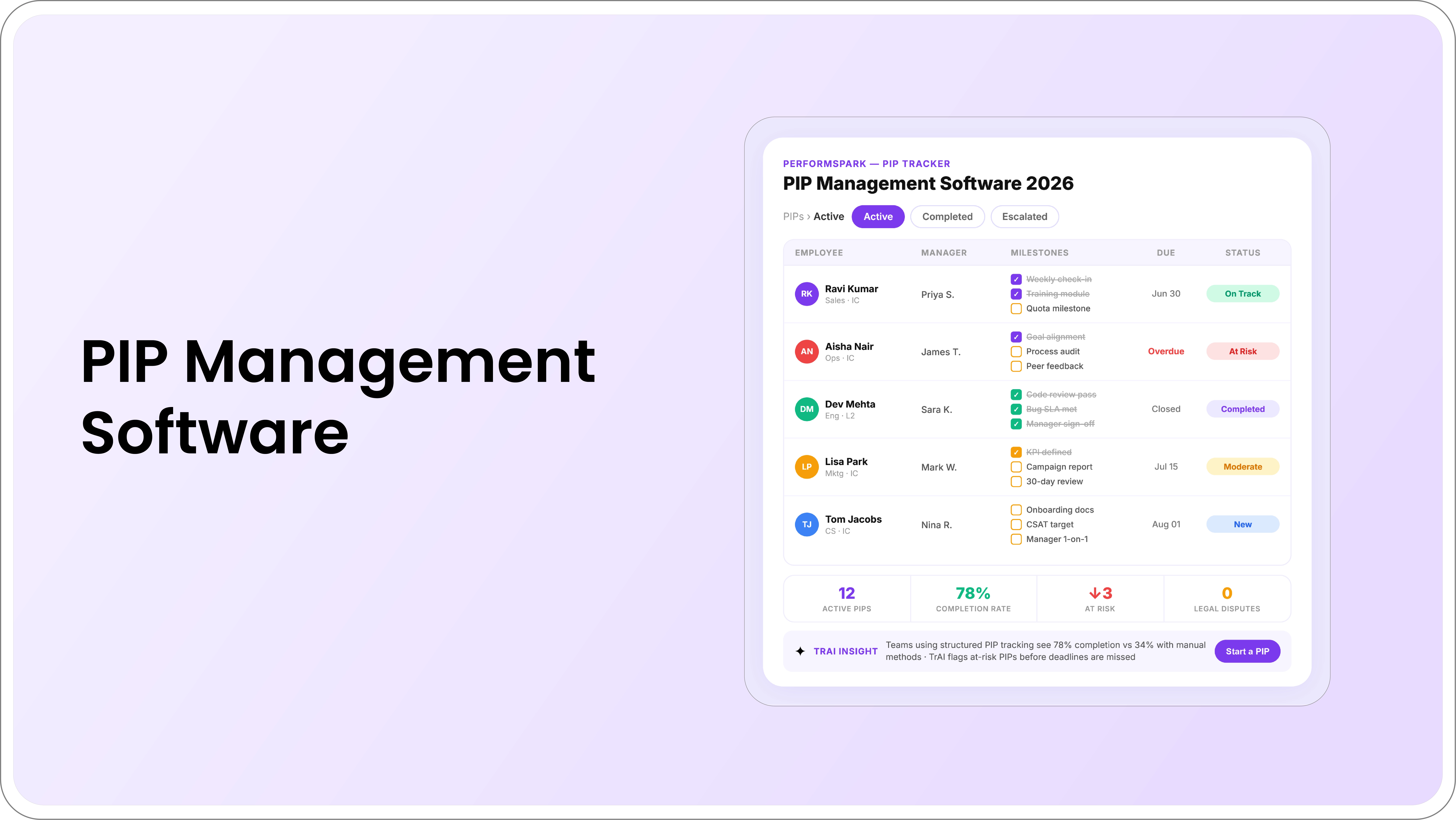
Table of Contents

Key Takeaways:
- PIP software should organize objectives, support, meetings, evidence, approvals, and outcomes without replacing HR or manager judgment.
- Evaluate workflow configuration, permissions, reminders, reporting, integrations, security, exports, and implementation, not only templates.
- Ask vendors to demonstrate a complete PIP workflow from manager request through final review and export.
- Dedicated software is most useful when HR needs consistent oversight across multiple managers, plans, milestones, and records.
- Software cannot determine whether a PIP is fair, lawful, or appropriate. HR must review policy, facts, and applicable requirements.
PIP software helps HR teams and managers create, track, and complete performance improvement plans in a consistent workflow. It brings objectives, evidence, employee meetings, manager support, milestone dates, reminders, and outcomes into one system instead of distributing the process across documents, spreadsheets, email, and calendar notes.
Software does not make a performance improvement plan fair, compliant, or effective by itself. Those outcomes still depend on clear expectations, job-related evidence, consistent treatment, meaningful support, appropriate HR review, and responsible manager decisions. The software should make those practices easier to follow and easier for HR to oversee.
This guide explains the capabilities to evaluate, the questions to ask in a vendor demo, and the differences between a dedicated workflow and a manual process. For process design, start with the performance improvement plan best-practices guide. For broader PIP purpose, alternatives, and risks, use the complete performance improvement plan guide.
This article provides general educational information, not legal advice. PIP decisions should be reviewed against company policy, applicable requirements, and the specific facts, with qualified HR or legal guidance when needed.
What Is PIP Management Software?
PIP management software is a structured system for administering formal employee performance improvement plans from preparation through final review. A useful platform should help the organization manage:
- The documented performance concern
- The expected performance standard
- Measurable improvement objectives
- Manager and organizational support
- Start, milestone, and outcome dates
- Meeting notes and employee responses
- Relevant work evidence
- HR approvals and oversight
- Completion, revision, extension, or other outcome workflows
The PIP should also connect to the employee's broader performance record, including performance reviews, goals, feedback, and prior 1-on-1 check-ins. This context helps HR understand whether the plan reflects a documented performance pattern or begins without sufficient preparation.
When Does Dedicated PIP Software Become Useful?
A document-based process may be manageable when an organization has very few employees, rarely uses formal plans, and has one experienced HR leader closely involved in every case. The limitations become more visible as the organization grows.
Dedicated software becomes more valuable when:
- Multiple HR partners or managers administer PIPs.
- The organization needs a common process across departments or locations.
- Milestones are frequently missed or tracked manually.
- HR cannot see the status of active plans without requesting updates.
- Evidence and meeting notes are stored in several places.
- Managers use inconsistent templates or success criteria.
- Leadership needs aggregated reporting without exposing unnecessary employee details.
- The organization wants PIPs connected to goals, check-ins, and development records.
Before buying software, clarify the process the platform must support. A well-designed system cannot compensate for an unclear policy or inconsistent manager practice.
12 PIP Management Software Features to Evaluate
1. Configurable PIP workflow
The platform should support the organization's actual stages, approval rules, and responsibilities. A typical workflow may include manager preparation, HR review, employee delivery, scheduled milestones, outcome review, and closure.
Ask whether HR can configure required fields, approvers, plan stages, meeting cadence, and outcome options without relying on custom development. The workflow should align with the organization's HR performance management process, not force HR to work around a generic task list.
2. Role-based access and confidentiality
PIP records contain sensitive employee information. The system should limit access based on role and case involvement. HR may need broader oversight, while a manager should generally see only the employees and plans they are authorized to manage.
During the demo, ask who can view, edit, approve, export, or close a plan. Review the vendor's security and access controls, including authentication, data handling, administrative permissions, and account-removal processes.
3. Structured plan creation
The software should guide managers through the information required for a complete plan. Useful fields include:
- Performance expectation
- Supporting examples
- Required improvement
- Measurement method
- Employee-controlled actions
- Manager support
- Milestone dates
- Outcome criteria
Templates should improve consistency without encouraging managers to copy generic language into every case. HR teams can use the PIP writing guide to define the information every plan should contain.
4. Goal and measurement tracking
Each objective should have an owner, measure, due date, and status. The platform should allow HR and managers to distinguish between an activity, a milestone, and the final expected performance standard.
Connection with goal management is useful when the PIP objectives relate to work already tracked in the employee's role. Ask whether the system preserves the original objective and records approved changes rather than silently overwriting the plan.
5. Connected coaching and check-in history
A formal plan should not exist in isolation from the conversations that preceded it. The system should make relevant coaching records available to authorized reviewers without requiring HR to search across email, private documents, and meeting notes.
Ask how manager check-ins before and during the plan connect to the PIP record. The purpose is not to collect every informal conversation. It is to preserve the relevant expectations, support, employee questions, and agreed actions.
6. Milestone scheduling and reminders
The platform should schedule progress meetings and remind the responsible people before a milestone is due. HR should be able to identify overdue reviews without maintaining a separate tracker.
Evaluate whether automated reminders can be configured by plan stage, owner, due date, and escalation path. Notifications should support follow-through without exposing confidential details in email or chat previews.
7. Meeting notes and employee responses
Each progress review should record what was assessed, what evidence was discussed, what support was provided, what barriers were raised, and what must happen before the next milestone.
The system should allow the employee's comments or disagreement to be recorded without changing the manager's original assessment. Ask whether notes can be edited after submission, whether changes are visible, and how the platform handles an employee who declines to acknowledge receipt.
8. Evidence and attachment management
HR teams may need to reference work samples, quality reviews, goal reports, customer feedback, schedules, or other relevant evidence. The system should organize evidence by objective or milestone rather than creating an unstructured file repository.
Ask which file types are supported, who can upload and view attachments, how retention works, and whether sensitive information can be redacted or restricted. Evidence should remain relevant and proportionate to the performance issue.
9. HR oversight dashboard
HR should be able to see the operational status of active plans without reading every confidential note. Useful dashboard information may include:
- Plan stage
- Responsible manager
- Upcoming and overdue milestones
- Required HR approvals
- Plans approaching their end date
- Cases needing follow-up
Ask whether the dashboard can be filtered by business unit, HR partner, manager, stage, and date while maintaining appropriate permissions. Performance reporting and analytics should help HR identify process gaps such as missed reviews or inconsistent completion patterns.
10. Outcome and closure workflow
The system should guide the final assessment against the objectives established at the beginning of the plan. It should support a documented conclusion and next steps without forcing every case into a simplistic pass-or-fail result.
Depending on policy and circumstances, possible next steps may include successful completion, continued monitoring, an approved revision, an extension, movement to another process, or another employment decision. The software should record who reviewed and approved the outcome.
11. Exports, integrations, and data portability
Ask how the platform connects to the organization's HRIS, identity provider, calendar, communication tools, or other performance systems. Review available integrations and determine whether employee, manager, department, and employment-status changes update automatically.
The organization should also understand how to export a complete plan record when needed and what happens to data if the contract ends. Avoid a system that makes core records difficult to retrieve in a readable format.
12. Implementation and administration
Evaluate the work required to launch and maintain the system. Ask about:
- Workflow configuration
- Template setup
- User and permission mapping
- HRIS integration
- Historical-data migration
- Manager and HR training
- Ongoing support
- Change management
A strong product with a weak implementation plan can still produce inconsistent use. Request a realistic timeline, named responsibilities, and criteria for determining whether the launch is successful.
PIP Software vs. Documents and Spreadsheets
Documents and spreadsheets
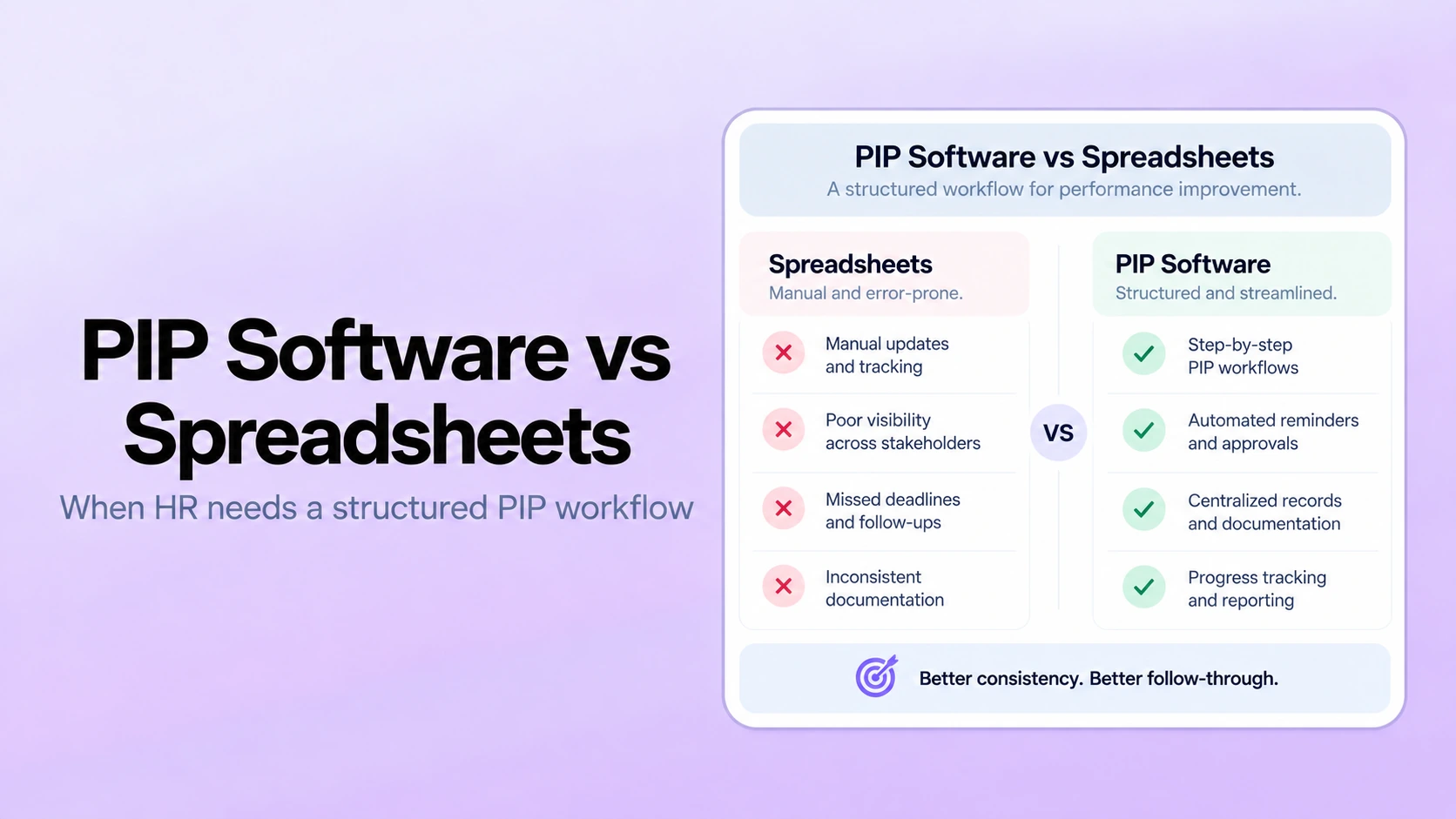
A manual process can be flexible and inexpensive, but it depends heavily on individual discipline. HR must maintain templates, monitor dates, chase managers, combine evidence, control access, and reconstruct the final record.
Teams starting with this approach can use PerformSpark's free performance improvement plan template for consistent formatting from the outset, though the limitations below are worth planning around as the number of active plans grows.
Common limitations include version confusion, inconsistent formats, missed milestones, unclear ownership, fragmented evidence, and limited organizational reporting.
Dedicated PIP software
A dedicated workflow can standardize required steps, assign responsibilities, schedule reminders, connect related performance information, and provide HR visibility across active cases.
Its limitations can include implementation effort, licensing cost, unnecessary complexity, or poor fit with company policy. The goal is not to digitize every existing form. It is to simplify the process while preserving appropriate judgment and HR oversight.
PIP Management Software Demo Checklist
Ask the vendor to demonstrate a complete case from preparation through closure. Do not evaluate only screenshots or feature descriptions.
- Create a new plan from a manager request.
- Route it to HR for review and return it for changes.
- Add three measurable objectives with different owners and dates.
- Connect relevant prior goals or check-in notes.
- Schedule milestone meetings and show the reminder behavior.
- Record a progress review with positive evidence, a continued gap, and an employee comment.
- Change one objective through an approved revision.
- Show what an HR leader sees across several active plans.
- Demonstrate role-based access for HR, manager, employee, and administrator.
- Complete the outcome review and export the final record.
For employee-facing document structure, compare the system against the PIP letter examples and templates. The platform should support clear communication without forcing HR to maintain separate versions of the same information.
Questions to Ask PIP Software Vendors
- Can HR configure the workflow, fields, approvals, and milestone cadence?
- How are plan changes recorded?
- Can managers see relevant prior coaching without accessing unrelated confidential notes?
- How are overdue milestones escalated?
- Can employees add comments or acknowledge receipt?
- How does the system prevent unauthorized access?
- What audit history is available for edits, approvals, and status changes?
- Can HR report on process completion without exposing sensitive content?
- Which HRIS, identity, calendar, and communication integrations are supported?
- How can the organization export all records and attachments?
- What implementation, training, and ongoing support are included?
- How is pricing calculated, and which capabilities require additional fees?
Common Buying Mistakes
Buying a template library instead of a workflow
Templates help managers begin, but they do not provide approvals, reminders, oversight, evidence tracking, or outcome management.
Prioritizing automation over judgment
The platform should support HR and manager decisions, not automatically determine whether an employee should enter, pass, fail, or exit a PIP.
Ignoring manager usability
If the workflow is difficult to use, managers may continue working in private documents and update the platform only at the end. Test the actual manager experience during the evaluation.
Overlooking confidentiality
General project-management tools may expose sensitive information through broad permissions, notifications, or integrations. Review access and message content carefully.
Failing to define success
Before implementation, define what should improve. Measures may include milestone completion, HR review time, manager adoption, document completeness, or reduced reliance on manual trackers. Do not use software adoption alone as proof that the underlying PIP process is fair or effective.
How PerformSpark Supports PIP Management
PerformSpark brings performance improvement plans into the same performance management platform used for goals, reviews, check-ins, development, and reporting. This helps HR teams maintain one structured workflow while managers retain the context needed to support employees throughout the plan.
Organizations can use connected goals, check-ins, reminders, progress records, and HR oversight to reduce dependence on disconnected files. When a performance concern is developmental rather than formal, HR can direct the employee toward an individual development plan instead of using the PIP workflow.
Review PerformSpark pricing or book a personalized demo to evaluate how the PIP workflow fits your policy, manager process, permissions, and reporting requirements.



.svg)

.svg)
.svg)