



HR & People

The 9-Box Grid in Talent Review Meetings: A Complete Guide for HR Teams

Updated :
June 29, 2026

Mahesh Kumar

Founder, TraineryHCM.com
The 9-Box Grid in Talent Review Meetings

Table of Contents

What is a 9-box grid talent review?

A 9-box grid talent review is a structured process in which HR teams and senior leaders assess employees across two dimensions: current performance and future potential. The resulting 3x3 matrix places each employee into one of nine categories, each indicating a different combination of how well they perform today and how much growth capacity they demonstrate. Talent review meetings use the grid to guide succession planning, development investment, and retention decisions. The grid's origin is widely attributed to McKinsey's work with GE in the 1970s, though its modern application in HR spans industries and organizational sizes.

Most HR teams know what the 9-box grid is. Fewer know how to use the meeting that produces it.

The diagram itself is simple: nine boxes, two axes, a room full of managers trying to place their direct reports. But the conversation that happens in that room determines whether the talent review meeting produces genuine organizational insight or a set of placements that reflect who spoke most confidently about their team rather than who actually has the highest potential.

This guide covers the full process: what the 9-box grid measures, how talent review meetings should be run, how to manage the calibration challenges that consistently undermine the grid's usefulness, and what HR teams should do with the data once the meeting ends.

How the 9-Box Grid Works

The 9-box grid plots employees on a matrix where the horizontal axis represents current performance and the vertical axis represents future potential. Each axis has three levels (typically low, medium, and high), creating nine quadrants that capture different combinations of where an employee stands today and where they could go.

The grid looks like this:

Low Performance Moderate Performance High Performance
High Potential Rough Diamond Rising Star Star
Moderate Potential Underperformer Core Employee High Performer
Low Potential Risk Solid Contributor Veteran/Expert

The labels vary by organization, but the logic is consistent. An employee in the top-right box (high performance, high potential) is a strong succession candidate. An employee in the bottom-left box (low performance, low potential) is a different kind of conversation entirely.

Defining the Two Axes

Performance is typically the more straightforward axis because it draws from documented data: goal completion, performance review ratings, manager feedback, and output against agreed objectives. Organizations with structured performance management cycles have a data foundation here. Organizations running informal or inconsistent reviews face subjectivity at the first step.

Potential is where most 9-box processes encounter difficulty. Potential is forward-looking and inherently harder to define. Without an explicit definition of what "potential" means in this organization, for these roles, and at this career stage, the axis becomes a proxy for whoever made the strongest impression in recent meetings.

Strong talent review processes define potential across at least three dimensions before the meeting begins:

  • Learning agility: How quickly does this person acquire new skills and adapt to unfamiliar challenges?
  • Leadership readiness: Can this person influence outcomes beyond their direct authority?
  • Scope expansion capacity: Has this person consistently grown into roles larger than what they were hired to do?

Without this definition, different managers apply different mental models of "potential" to their teams, and the resulting calibration is comparing incompatible assessments.

How to Run an Effective Talent Review Meeting

The talent review meeting is where 9-box placements happen, are challenged, and are finalized. How this meeting is structured determines whether the grid reflects organizational reality or accumulated bias.

Step 1: Prepare the data before the room fills

Managers should come to the talent review meeting with pre-work completed, not forming opinions in the moment. Each manager should complete a preliminary 9-box placement for their direct reports before the session, with a written rationale for each placement addressing both axes. Performance data from the previous review cycle and any available 360-degree feedback should be distributed in advance.

HR's role at this stage is to review preliminary placements for obvious inconsistencies and flag patterns. If one manager has rated 80% of their team as high potential, that is a calibration problem to address before the meeting, not during it.

Step 2: Set calibration ground rules at the start of every session

The most productive talent review meetings open with explicit calibration standards before any names are discussed. This means:

  • Defining what high performance looks like using actual criteria from the organization's review framework, not informal impressions
  • Agreeing on the definition of potential being applied in this session
  • Establishing that the group norm is "high potential" rather than the individual norm is the reference point

This step alone eliminates a substantial proportion of the rating inflation that makes 9-box outputs unreliable.

Step 3: Discuss placements using evidence, not advocacy

Managers naturally advocate for their own team members. This is appropriate, but it must be structured. The facilitator's job is to ensure each placement discussion answers a specific set of questions:

  • What evidence from the past 12 months supports this performance level?
  • What specific observations of learning, leadership, or scope expansion support this potential level?
  • Has this employee been evaluated against the same criteria as comparable employees across other teams?

When discussions shift from evidence to advocacy, the facilitator brings them back to the framework. The goal is not to make every conversation a challenge, but to ensure that placements on the grid reflect something the organization has actually observed, not something managers believe to be true based on general impressions.

Step 4: Manage the calibration dynamics that consistently distort results

Several predictable patterns emerge in talent review meetings that HR leaders should recognize and address:

The halo effect: An employee who performed exceptionally on one high-visibility project receives a uniformly positive assessment across all dimensions. Counter by asking what evidence exists outside the flagship project.

Recency bias: Placements are driven by performance in the most recent quarter rather than the full review period. Counter by referencing goal-completion data from the full cycle.

Proximity advantage: Employees who work closely with senior leaders are rated higher than equally capable employees with less visibility. Counter by requiring managers to compare ratings across similar roles, not just within their own teams.

Potential ceiling based on role, not capability: Some managers unconsciously limit potential ratings for employees in non-leadership tracks. Counter by distinguishing between leadership potential and contribution potential, recognizing that both are legitimate forms of high potential.

Step 5: Finalize placements and assign action categories

Once calibration is complete, the facilitator confirms final placements and assigns each employee to an action category. This is the step most talent review processes skip, which is why the grid rarely produces behavioral change. Placement without assigned action is documentation, not talent management.
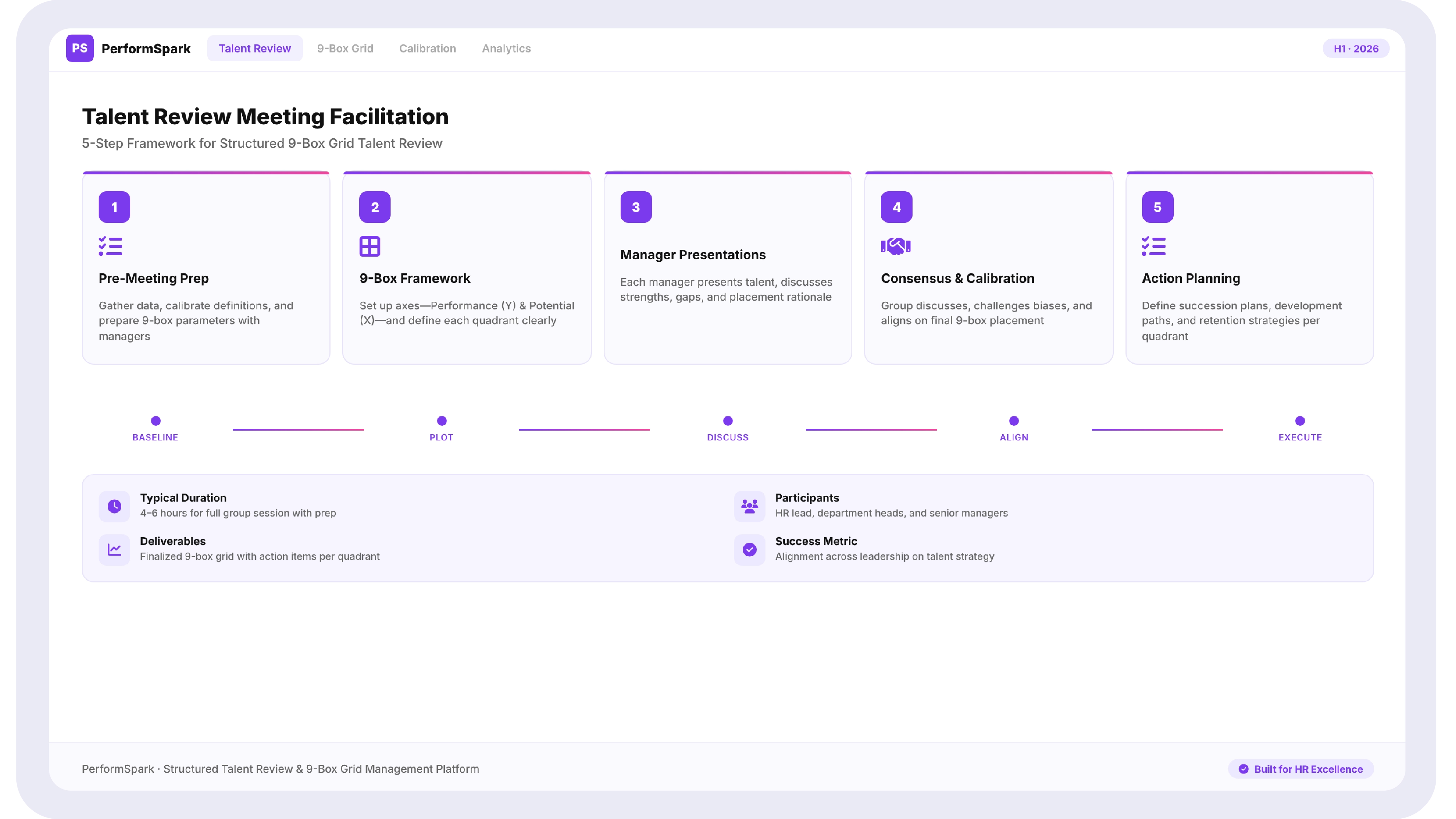
 Five-step process diagram showing how HR teams facilitate a structured 9-box grid talent review meeting
⚑
Talent Review

PERFORMANCE CALIBRATION

performSpark's calibration module connects manager ratings, goal-completion records, and check-in history to the talent review process, giving HR teams the data foundation that makes 9-box placements more accurate and easier to defend. See how performance calibration works in PerformSpark.

Book a Demo β†’
15-minute personalized walkthrough

What to Do With Each 9-Box Quadrant After the Meeting

The 9-box grid produces value in proportion to what happens after the meeting ends. Nine categories require nine different responses. Here is how to structure the action planning:

High Performance, High Potential (Stars)

These employees are your succession candidates. The action priorities are: accelerate development into roles that expand scope and leadership exposure, protect them from being exploited as reliable contributors without growth investment, and ensure they have visibility with senior leadership through sponsorship rather than just recognition.

Common mistake: Assuming stars will wait. Research from DDI's Global Leadership Forecast consistently shows that high-potential employees are significantly more likely to be actively searching for other roles than their peers. Identifying them without acting quickly is a retention risk.

High Potential, Moderate or Low Performance (Rough Diamonds / Rising Stars)

These employees have the capacity to grow but are not yet delivering at the expected level. The question to answer is why. The most common reasons are misalignment between role and capability, insufficient development investment, unclear expectations, or under-management. The action priority is diagnosis before development investment.

High Performance, Moderate Potential (High Performers)

These employees are reliable, high-value contributors who have likely reached the ceiling of their growth in the current direction. The priority is retention and engagement rather than acceleration. Forced movement into leadership roles they are not suited for is one of the most consistent ways organizations lose their best individual contributors.

Moderate Performance, Moderate Potential (Core Employees)

Core employees represent the bulk of most organizations. They should receive consistent development investment, clear goals, and regular feedback. They should not be ignored simply because they are not flagged as high potential. An organization that only invests in the top-right boxes will see core employee engagement and retention erode.

Low Performance, Low Potential (Underperformers/Risk)

These placements require the most immediate and carefully managed action. HR should work with managers to assess whether a performance improvement plan is appropriate, whether the role is misaligned, or whether the situation has reached the threshold for a different conversation entirely. Leaving these placements without action creates both performance and culture risk.

The 9-Box Grid's Limitations (and How to Address Them)

No talent management tool is without limitations, and the 9-box grid has several that HR leaders need to actively manage.

The subjectivity problem: Potential, in particular, is difficult to measure consistently. Without rigorous calibration and defined criteria, the axis reflects manager perception more than observable behavior. The mitigation is structural: define potential explicitly, use multi-rater input where available, and build calibration discipline into the meeting process.

The static snapshot problem: The 9-box is a point-in-time assessment. An employee placed in a quadrant during one talent review cycle can move significantly in any direction within 12 months, particularly through role changes, new challenges, or sustained development investment. Organizations that do one talent review per year without cyclical reassessment are working with outdated maps.

The 9-box drift problem: Employees who are placed in a quadrant once tend to stay there. Research on anchoring bias in talent assessment suggests that initial placements influence subsequent evaluations even when observable behavior contradicts the original placement. The mitigation is to treat each talent review cycle as a fresh calibration, not a confirmation of last year's grid.

The demographic bias risk: Studies on talent assessment tools consistently show that potential ratings are disproportionately affected by proximity to existing leadership, affinity-based bias, and in-group dynamics. HR leaders should analyze 9-box distributions across demographic groups after each talent review and investigate patterns that do not reflect organizational intent.
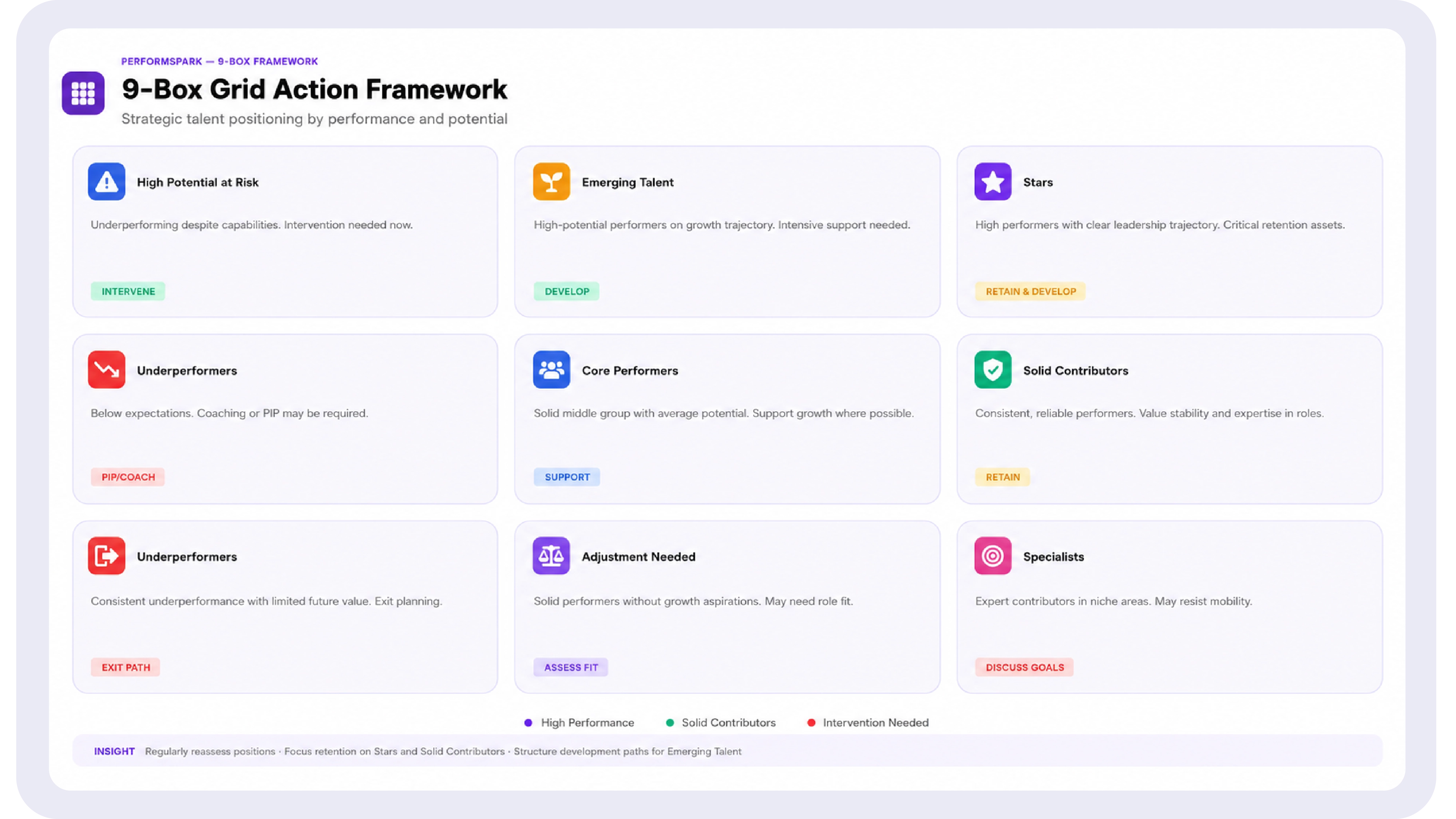
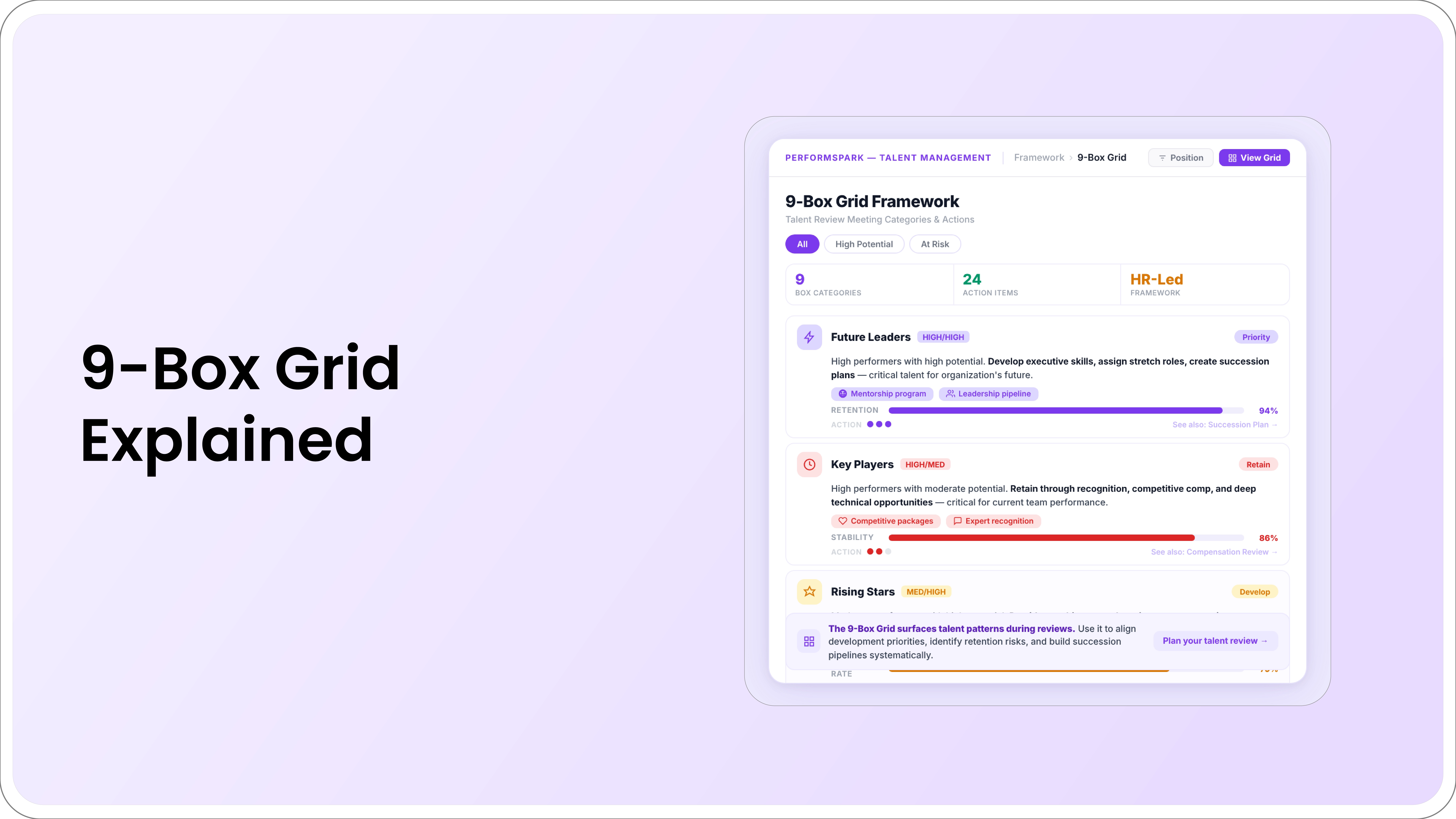
 9-box grid showing distinct action priorities for each of the nine quadrants, from Stars to Underperformers
⚑
PERFORMANCE MANAGEMENT

TALENT REVIEW & PERFORMANCE MANAGEMENT

When 9-box placements are connected to continuous feedback, development plans, and performance history in a single platform, the talent review meeting works from evidence rather than impression. PerformSpark's performance management suite brings all of this data into one view for HR and managers alike. Book a demo to see the full talent review workflow.

Book a Demo β†’
15-minute personalized walkthrough

From Talent Review to Succession Plan: Making the Connection

The talent review meeting produces the data that succession planning requires. Without deliberate process design, the two activities exist in parallel rather than in sequence.

The connection works as follows:

  1. Talent review meeting produces calibrated 9-box placements for the relevant employee population.
  2. HR identifies which leadership roles require succession plans based on retirement risk, growth targets, and critical role dependencies.
  3. High-potential employees from the top tier of the 9-box are mapped against open succession slots, with explicit consideration of development gap and readiness timeline.
  4. Development plans are created for succession candidates that address the specific gaps between their current capabilities and the target role's requirements.
  5. Progress is tracked through regular check-ins, goal completion data, and periodic reassessment on the 9-box.

The failure point in most organizations is step four. Succession plans are created but not funded with development investment, time, or managerial attention. An employee identified as a succession candidate who receives no different treatment than their non-identified peers will not be ready when the succession slot opens.

Readiness Classification for Succession Candidates

A practical framework for categorizing succession candidates after a 9-box talent review:

Classification Definition Action
Ready Now Could step into the role within 90 days with orientation support. Actively develop a relationship with the current role holder and assign stretch projects.
Ready in 1–2 Years Requires targeted development in two to three critical capability gaps. Create a formal Individual Development Plan (IDP) with milestones, executive exposure, and cross-functional assignments.
Ready in 3+ Years Strong long-term candidate, but significant development investment is still required. Follow a long-term development plan with entry-level leadership responsibilities and progressive stretch assignments.
Developmental Watch High potential, but placement is too early to accurately assess succession readiness. Monitor performance through each review cycle and reassess during the next talent review.

How Performance Management Platforms Improve 9-Box Calibration

The 9-box grid has been run in conference rooms with sticky notes and marker boards for decades. This approach works at a small scale but creates specific problems at mid-market and enterprise scale.

When performance data, feedback records, goal-completion history, and check-in notes exist in separate systems or are distributed across managers' inboxes, the talent review meeting runs on incomplete information. Managers pull from memory and recent impressions. The calibration suffers.

Performance management platforms that connect performance review ratings, goal records, continuous feedback, and development plan data into a single view change the quality of the input to the talent review process. HR leaders can come to the meeting with a pre-populated view of each employee's performance trajectory rather than starting from each manager's verbal summary.

This does two things. First, it raises the floor on placement quality: managers cannot place an employee as "high performance" when the review data shows missed targets across two consecutive cycles. Second, it creates a documented basis for calibration decisions that supports fairness, defensibility, and demographic equity analysis after the fact.

For PerformSpark users, the calibration module surfaces rating distributions, check-in frequency data, and goal-completion records in a pre-session view that HR leaders can distribute before the talent review meeting, reducing preparation time and improving the quality of the calibration discussion.

The 9-box grid is one of the most widely used frameworks in talent management for a straightforward reason: it makes a complex set of assessments navigable. Two axes, nine categories, a shared vocabulary for discussing development and potential across an organization.

But the grid is only as good as the meeting that produces it and the action planning that follows. A talent review process that fills in boxes without calibrating for bias, assigning action plans, or connecting outcomes to succession and development produces documentation rather than development.

The organizations that use the 9-box grid effectively treat it as a living tool. They run calibrated, evidence-based talent review meetings, assign differentiated action plans by quadrant, reassess placements cyclically, and track succession readiness as a business metric rather than an annual HR exercise.

The practical next steps: define your potential criteria before your next talent review cycle, build calibration standards into the meeting agenda, connect 9-box outcomes to individual development plans, and ensure the data that informs placements comes from documented performance records rather than manager impressions alone.
Data-Driven Talent Management

Run talent reviews that actually move the needle.

PerformSpark connects performance review data, goal records, check-in history, and calibration workflows into a single platform, giving HR teams the evidence base that makes 9-box talent reviews more accurate, more defensible, and more useful for succession planning. Book a demo to see PerformSpark's talent review and calibration workflow in action.

Book a Demo See all 6 stages in a live walkthrough

Key Takeaways

  • The 9-box grid maps employees across performance and potential axes, but its real value depends on how the talent review meeting is facilitated, not just how the grid is filled in.
  • Calibration quality determines whether 9-box placements reflect organizational reality or individual manager bias. Without structured facilitation, both are possible.
  • Each of the nine boxes requires a distinct action plan; treating the grid as a snapshot rather than a decision tool is the most common reason talent reviews fail to change anything.
  • Employees should not stay in the same box indefinitely. The 9-box only works when it is reviewed cyclically and connected to development, feedback, and performance data.
  • Performance management platforms that connect review data, goal records, and check-in history to talent review workflows make 9-box calibration more accurate and more defensible.

What is a 9-box grid talent review?

A 9-box grid talent review is a structured process in which HR teams and senior leaders assess employees across two dimensions: current performance and future potential. The resulting 3x3 matrix places each employee into one of nine categories, each indicating a different combination of how well they perform today and how much growth capacity they demonstrate. Talent review meetings use the grid to guide succession planning, development investment, and retention decisions. The grid's origin is widely attributed to McKinsey's work with GE in the 1970s, though its modern application in HR spans industries and organizational sizes.

Most HR teams know what the 9-box grid is. Fewer know how to use the meeting that produces it.

The diagram itself is simple: nine boxes, two axes, a room full of managers trying to place their direct reports. But the conversation that happens in that room determines whether the talent review meeting produces genuine organizational insight or a set of placements that reflect who spoke most confidently about their team rather than who actually has the highest potential.

This guide covers the full process: what the 9-box grid measures, how talent review meetings should be run, how to manage the calibration challenges that consistently undermine the grid's usefulness, and what HR teams should do with the data once the meeting ends.

How the 9-Box Grid Works

The 9-box grid plots employees on a matrix where the horizontal axis represents current performance and the vertical axis represents future potential. Each axis has three levels (typically low, medium, and high), creating nine quadrants that capture different combinations of where an employee stands today and where they could go.

The grid looks like this:

Low Performance Moderate Performance High Performance
High Potential Rough Diamond Rising Star Star
Moderate Potential Underperformer Core Employee High Performer
Low Potential Risk Solid Contributor Veteran/Expert

The labels vary by organization, but the logic is consistent. An employee in the top-right box (high performance, high potential) is a strong succession candidate. An employee in the bottom-left box (low performance, low potential) is a different kind of conversation entirely.

Defining the Two Axes

Performance is typically the more straightforward axis because it draws from documented data: goal completion, performance review ratings, manager feedback, and output against agreed objectives. Organizations with structured performance management cycles have a data foundation here. Organizations running informal or inconsistent reviews face subjectivity at the first step.

Potential is where most 9-box processes encounter difficulty. Potential is forward-looking and inherently harder to define. Without an explicit definition of what "potential" means in this organization, for these roles, and at this career stage, the axis becomes a proxy for whoever made the strongest impression in recent meetings.

Strong talent review processes define potential across at least three dimensions before the meeting begins:

  • Learning agility: How quickly does this person acquire new skills and adapt to unfamiliar challenges?
  • Leadership readiness: Can this person influence outcomes beyond their direct authority?
  • Scope expansion capacity: Has this person consistently grown into roles larger than what they were hired to do?

Without this definition, different managers apply different mental models of "potential" to their teams, and the resulting calibration is comparing incompatible assessments.

How to Run an Effective Talent Review Meeting

The talent review meeting is where 9-box placements happen, are challenged, and are finalized. How this meeting is structured determines whether the grid reflects organizational reality or accumulated bias.

Step 1: Prepare the data before the room fills

Managers should come to the talent review meeting with pre-work completed, not forming opinions in the moment. Each manager should complete a preliminary 9-box placement for their direct reports before the session, with a written rationale for each placement addressing both axes. Performance data from the previous review cycle and any available 360-degree feedback should be distributed in advance.

HR's role at this stage is to review preliminary placements for obvious inconsistencies and flag patterns. If one manager has rated 80% of their team as high potential, that is a calibration problem to address before the meeting, not during it.

Step 2: Set calibration ground rules at the start of every session

The most productive talent review meetings open with explicit calibration standards before any names are discussed. This means:

  • Defining what high performance looks like using actual criteria from the organization's review framework, not informal impressions
  • Agreeing on the definition of potential being applied in this session
  • Establishing that the group norm is "high potential" rather than the individual norm is the reference point

This step alone eliminates a substantial proportion of the rating inflation that makes 9-box outputs unreliable.

Step 3: Discuss placements using evidence, not advocacy

Managers naturally advocate for their own team members. This is appropriate, but it must be structured. The facilitator's job is to ensure each placement discussion answers a specific set of questions:

  • What evidence from the past 12 months supports this performance level?
  • What specific observations of learning, leadership, or scope expansion support this potential level?
  • Has this employee been evaluated against the same criteria as comparable employees across other teams?

When discussions shift from evidence to advocacy, the facilitator brings them back to the framework. The goal is not to make every conversation a challenge, but to ensure that placements on the grid reflect something the organization has actually observed, not something managers believe to be true based on general impressions.

Step 4: Manage the calibration dynamics that consistently distort results

Several predictable patterns emerge in talent review meetings that HR leaders should recognize and address:

The halo effect: An employee who performed exceptionally on one high-visibility project receives a uniformly positive assessment across all dimensions. Counter by asking what evidence exists outside the flagship project.

Recency bias: Placements are driven by performance in the most recent quarter rather than the full review period. Counter by referencing goal-completion data from the full cycle.

Proximity advantage: Employees who work closely with senior leaders are rated higher than equally capable employees with less visibility. Counter by requiring managers to compare ratings across similar roles, not just within their own teams.

Potential ceiling based on role, not capability: Some managers unconsciously limit potential ratings for employees in non-leadership tracks. Counter by distinguishing between leadership potential and contribution potential, recognizing that both are legitimate forms of high potential.

Step 5: Finalize placements and assign action categories

Once calibration is complete, the facilitator confirms final placements and assigns each employee to an action category. This is the step most talent review processes skip, which is why the grid rarely produces behavioral change. Placement without assigned action is documentation, not talent management.

 Five-step process diagram showing how HR teams facilitate a structured 9-box grid talent review meeting
⚑
Talent Review

PERFORMANCE CALIBRATION

performSpark's calibration module connects manager ratings, goal-completion records, and check-in history to the talent review process, giving HR teams the data foundation that makes 9-box placements more accurate and easier to defend. See how performance calibration works in PerformSpark.

Book a Demo β†’
15-minute personalized walkthrough

What to Do With Each 9-Box Quadrant After the Meeting

The 9-box grid produces value in proportion to what happens after the meeting ends. Nine categories require nine different responses. Here is how to structure the action planning:

High Performance, High Potential (Stars)

These employees are your succession candidates. The action priorities are: accelerate development into roles that expand scope and leadership exposure, protect them from being exploited as reliable contributors without growth investment, and ensure they have visibility with senior leadership through sponsorship rather than just recognition.

Common mistake: Assuming stars will wait. Research from DDI's Global Leadership Forecast consistently shows that high-potential employees are significantly more likely to be actively searching for other roles than their peers. Identifying them without acting quickly is a retention risk.

High Potential, Moderate or Low Performance (Rough Diamonds / Rising Stars)

These employees have the capacity to grow but are not yet delivering at the expected level. The question to answer is why. The most common reasons are misalignment between role and capability, insufficient development investment, unclear expectations, or under-management. The action priority is diagnosis before development investment.

High Performance, Moderate Potential (High Performers)

These employees are reliable, high-value contributors who have likely reached the ceiling of their growth in the current direction. The priority is retention and engagement rather than acceleration. Forced movement into leadership roles they are not suited for is one of the most consistent ways organizations lose their best individual contributors.

Moderate Performance, Moderate Potential (Core Employees)

Core employees represent the bulk of most organizations. They should receive consistent development investment, clear goals, and regular feedback. They should not be ignored simply because they are not flagged as high potential. An organization that only invests in the top-right boxes will see core employee engagement and retention erode.

Low Performance, Low Potential (Underperformers/Risk)

These placements require the most immediate and carefully managed action. HR should work with managers to assess whether a performance improvement plan is appropriate, whether the role is misaligned, or whether the situation has reached the threshold for a different conversation entirely. Leaving these placements without action creates both performance and culture risk.

The 9-Box Grid's Limitations (and How to Address Them)

No talent management tool is without limitations, and the 9-box grid has several that HR leaders need to actively manage.

The subjectivity problem: Potential, in particular, is difficult to measure consistently. Without rigorous calibration and defined criteria, the axis reflects manager perception more than observable behavior. The mitigation is structural: define potential explicitly, use multi-rater input where available, and build calibration discipline into the meeting process.

The static snapshot problem: The 9-box is a point-in-time assessment. An employee placed in a quadrant during one talent review cycle can move significantly in any direction within 12 months, particularly through role changes, new challenges, or sustained development investment. Organizations that do one talent review per year without cyclical reassessment are working with outdated maps.

The 9-box drift problem: Employees who are placed in a quadrant once tend to stay there. Research on anchoring bias in talent assessment suggests that initial placements influence subsequent evaluations even when observable behavior contradicts the original placement. The mitigation is to treat each talent review cycle as a fresh calibration, not a confirmation of last year's grid.

The demographic bias risk: Studies on talent assessment tools consistently show that potential ratings are disproportionately affected by proximity to existing leadership, affinity-based bias, and in-group dynamics. HR leaders should analyze 9-box distributions across demographic groups after each talent review and investigate patterns that do not reflect organizational intent.

 9-box grid showing distinct action priorities for each of the nine quadrants, from Stars to Underperformers
⚑
PERFORMANCE MANAGEMENT

TALENT REVIEW & PERFORMANCE MANAGEMENT

When 9-box placements are connected to continuous feedback, development plans, and performance history in a single platform, the talent review meeting works from evidence rather than impression. PerformSpark's performance management suite brings all of this data into one view for HR and managers alike. Book a demo to see the full talent review workflow.

Book a Demo β†’
15-minute personalized walkthrough

From Talent Review to Succession Plan: Making the Connection

The talent review meeting produces the data that succession planning requires. Without deliberate process design, the two activities exist in parallel rather than in sequence.

The connection works as follows:

  1. Talent review meeting produces calibrated 9-box placements for the relevant employee population.
  2. HR identifies which leadership roles require succession plans based on retirement risk, growth targets, and critical role dependencies.
  3. High-potential employees from the top tier of the 9-box are mapped against open succession slots, with explicit consideration of development gap and readiness timeline.
  4. Development plans are created for succession candidates that address the specific gaps between their current capabilities and the target role's requirements.
  5. Progress is tracked through regular check-ins, goal completion data, and periodic reassessment on the 9-box.

The failure point in most organizations is step four. Succession plans are created but not funded with development investment, time, or managerial attention. An employee identified as a succession candidate who receives no different treatment than their non-identified peers will not be ready when the succession slot opens.

Readiness Classification for Succession Candidates

A practical framework for categorizing succession candidates after a 9-box talent review:

Classification Definition Action
Ready Now Could step into the role within 90 days with orientation support. Actively develop a relationship with the current role holder and assign stretch projects.
Ready in 1–2 Years Requires targeted development in two to three critical capability gaps. Create a formal Individual Development Plan (IDP) with milestones, executive exposure, and cross-functional assignments.
Ready in 3+ Years Strong long-term candidate, but significant development investment is still required. Follow a long-term development plan with entry-level leadership responsibilities and progressive stretch assignments.
Developmental Watch High potential, but placement is too early to accurately assess succession readiness. Monitor performance through each review cycle and reassess during the next talent review.

How Performance Management Platforms Improve 9-Box Calibration

The 9-box grid has been run in conference rooms with sticky notes and marker boards for decades. This approach works at a small scale but creates specific problems at mid-market and enterprise scale.

When performance data, feedback records, goal-completion history, and check-in notes exist in separate systems or are distributed across managers' inboxes, the talent review meeting runs on incomplete information. Managers pull from memory and recent impressions. The calibration suffers.

Performance management platforms that connect performance review ratings, goal records, continuous feedback, and development plan data into a single view change the quality of the input to the talent review process. HR leaders can come to the meeting with a pre-populated view of each employee's performance trajectory rather than starting from each manager's verbal summary.

This does two things. First, it raises the floor on placement quality: managers cannot place an employee as "high performance" when the review data shows missed targets across two consecutive cycles. Second, it creates a documented basis for calibration decisions that supports fairness, defensibility, and demographic equity analysis after the fact.

For PerformSpark users, the calibration module surfaces rating distributions, check-in frequency data, and goal-completion records in a pre-session view that HR leaders can distribute before the talent review meeting, reducing preparation time and improving the quality of the calibration discussion.

The 9-box grid is one of the most widely used frameworks in talent management for a straightforward reason: it makes a complex set of assessments navigable. Two axes, nine categories, a shared vocabulary for discussing development and potential across an organization.

But the grid is only as good as the meeting that produces it and the action planning that follows. A talent review process that fills in boxes without calibrating for bias, assigning action plans, or connecting outcomes to succession and development produces documentation rather than development.

The organizations that use the 9-box grid effectively treat it as a living tool. They run calibrated, evidence-based talent review meetings, assign differentiated action plans by quadrant, reassess placements cyclically, and track succession readiness as a business metric rather than an annual HR exercise.

The practical next steps: define your potential criteria before your next talent review cycle, build calibration standards into the meeting agenda, connect 9-box outcomes to individual development plans, and ensure the data that informs placements comes from documented performance records rather than manager impressions alone.
Data-Driven Talent Management

Run talent reviews that actually move the needle.

PerformSpark connects performance review data, goal records, check-in history, and calibration workflows into a single platform, giving HR teams the evidence base that makes 9-box talent reviews more accurate, more defensible, and more useful for succession planning. Book a demo to see PerformSpark's talent review and calibration workflow in action.

Book a Demo See all 6 stages in a live walkthrough

Frequently Asked Questions

What is the difference between a talent review and a performance review?

How often should organizations run a 9-box talent review?

How do you define "potential" consistently across a 9-box process?

What are the most common mistakes HR teams make when using the 9-box grid?

Can the 9-box grid be used for all levels of an organization?

How does a performance management platform improve the 9-box talent review process?

Make performance reviews your growth lever

No credit card required β€’ Free setup & training included β€’ Cancel anytime

CTA ShapeCTA Shape