

Table of Contents
Most organizations create individual development plans. Most organizations also know, if they are honest about it, that those IDPs rarely influence what actually happens in the year between reviews.
The problem is not that HR does not care about employee development. It is that the IDP creation process is disconnected from the check-in cadence, the goal management system, and the performance review that generated the development feedback in the first place. A Word document created in January is rarely opened in April.
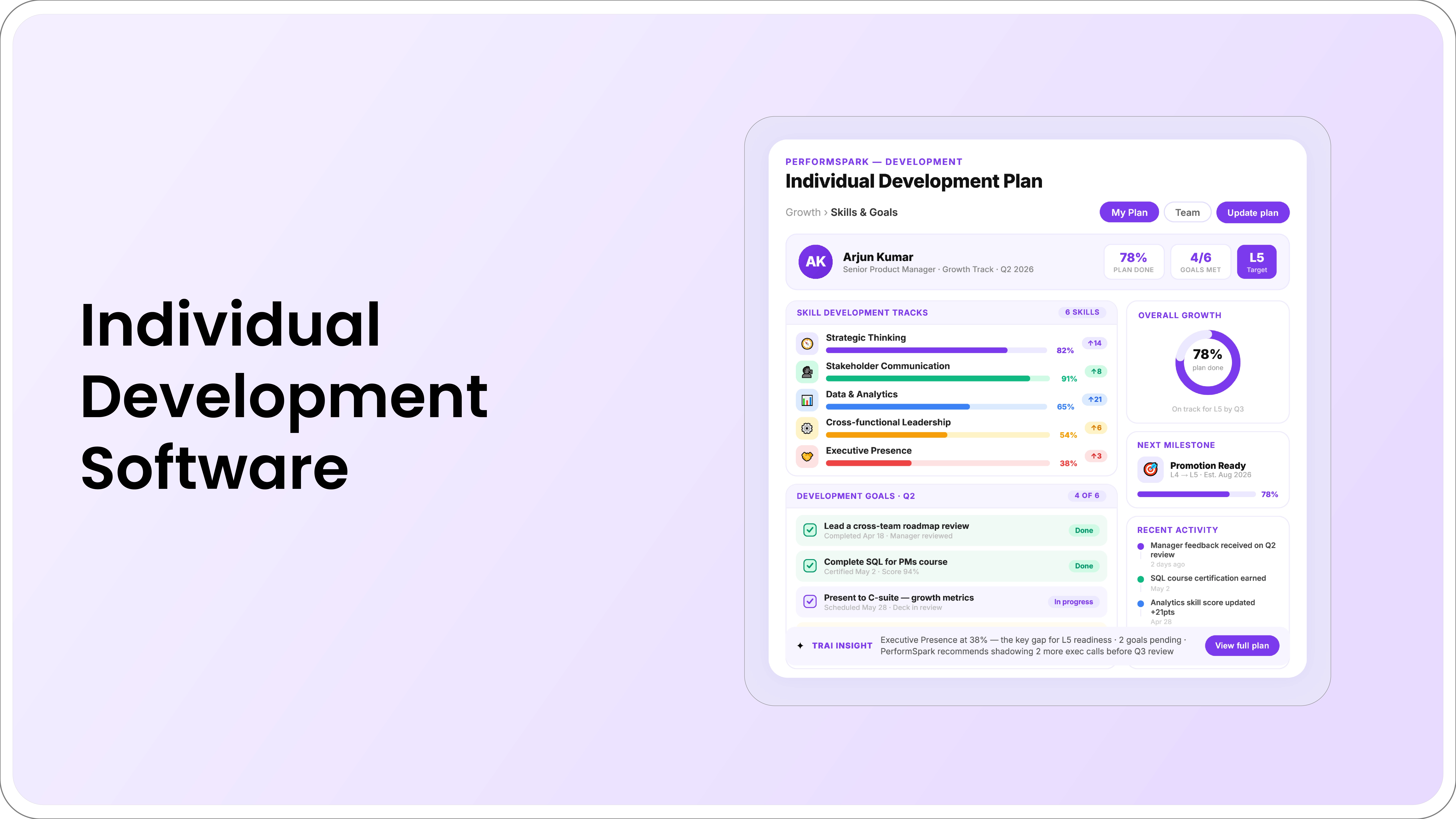
Individual development plan software is not a new category of tool it is a feature set that integrates IDP creation, tracking, and progress visibility into the same system where performance reviews, goals, and check-ins already live. The result is that development becomes a continuous process rather than an annual documentation event.
Practitioner Insight A common issue teams run into: HR builds an excellent IDP template, trains managers on how to use it, and then discovers 90 days later that only 30–40% of employees have an active IDP and most of those have not been discussed since creation. The template was not the problem. The disconnect from the check-in workflow was the problem. When IDP progress is not a standing agenda item in 1-on-1s, it becomes discretionary and discretionary development conversations reliably become the conversations that do not happen.
The Problem With Standalone IDPs
A Word document or spreadsheet IDP has four structural failures that software addresses:
No connection to the review that created it
The performance review identifies improvement areas and development opportunities. The IDP is then created in a separate system or more commonly, in a document that the manager attaches to an email and the employee saves somewhere. The relationship between the review finding and the development commitment is invisible to HR, to the next manager, and often to both the current manager and employee six months later.
No connection to the goals the employee is working toward
Development goals and performance goals are managed in separate places, if either is tracked at all. An employee working toward a promotion needs both their IDP milestones and their performance OKRs to be visible together. When they are in different systems or one is in a system and one is in a document neither the manager nor the employee has a complete picture.
No connection to check-in conversations
The check-in is where development progress should be discussed regularly. But if the IDP is a separate document, it requires someone to remember to open it before each 1-on-1 which means it frequently does not get discussed. When development is a tab in the same system where the check-in agenda lives, it surfaces automatically.
No visibility for HR
When IDPs live in individual documents, HR has no view of development plan completion rates across the organization, no ability to identify which managers are or are not conducting development conversations, and no data to correlate IDP engagement with retention outcomes. The data that could inform a meaningful people development strategy does not exist.
What IDP Software Changes
IDPs created directly from review outcomes
When a performance review identifies an improvement area or development opportunity, the employee and manager can create an IDP goal in the same session pulling the specific language from the review directly into the development plan. The relationship between the review finding and the development commitment is explicit and documented.
Development visible throughout the year
Both the manager and the employee see the IDP in the same place where they conduct check-ins and track goal progress. Development is not something that exists in a separate document it is part of the ongoing work record.
Progress tracked in check-in conversations
When IDP milestones are integrated into the check-in workflow, development progress becomes a standing agenda item rather than an afterthought. Managers are prompted to discuss IDP status in each 1-on-1. The documentation of those conversations creates a record of the development journey that is visible in the next review cycle.
HR visibility into development program health
HR can see IDP completion rates across the organization, identify which managers are conducting development conversations and which are not, and flag the teams where development plan engagement correlates with elevated voluntary turnover risk.
IDPs and Voluntary Attrition — The Research Signal
Research across multiple workforce analytics studies consistently shows that employees with active, regularly-discussed development plans have significantly lower voluntary attrition rates than those without. The signal makes intuitive sense: an employee who has a visible, supported development pathway within the organization has a concrete reason to stay that is missing for an employee with no development plan.
The effect is strongest when two conditions are met: the IDP is connected to the employee's career aspirations, not just the organization's competency requirements, and the development plan is discussed regularly in check-in conversations, not revisited only at the next review cycle.
An IDP that sits in a filing system is not a retention tool. An IDP that is a living agenda item in regular coaching conversations is because it signals to the employee that the organization is actively invested in their growth, not just documenting that they discussed it once.
- When IDP progress is part of the check-in workflow, not a separate document the manager has to remember to open — development becomes a standing agenda item rather than an annual event. PerformSpark connects IDP milestones to the check-in interface automatically, so development is visible in every 1-on-1 without requiring either party to navigate to a separate system. See how IDP and check-in workflows connect in PerformSpark->
What to Look for in IDP Software Features
Connection to the performance review workflow
IDP creation should be possible within or directly after the review session, with the ability to pull specific improvement areas and development goals from the review record into the IDP without re-entering them manually.
Integration with goal management
Development goals in the IDP should be visible alongside performance goals in the goal management view. An employee pursuing a development goal completing a technical certification, taking on a project lead role should see that progress alongside their performance OKRs.
Check-in integration
IDP progress should appear in the check-in workflow without requiring the manager or employee to navigate to a separate section. Development discussions are most consistent when the agenda includes IDP status automatically.
HR dashboard visibility
HR should be able to see IDP creation rates, milestone completion rates, and development conversation frequency across the organization. This is the data that connects development program investment to retention outcomes.
Milestone and timeline tracking
Development goals need structure. An IDP goal without milestones and a timeline is a wish, not a commitment. Look for software that requires at least a target date and a measurable milestone before a development goal can be saved.
Flexibility for different development types
IDPs cover formal training, on-the-job stretch assignments, mentoring relationships, and self-directed learning. The software should support all of these without forcing everything into a course-completion model.
PerformSpark connects IDPs to the check-in workflow, goal management, and performance review cycle so that development commitments created in a review session become standing agenda items in the manager's 1-on-1 coaching conversations automatically, without requiring a separate system or a manual reminder.
The difference between an IDP that reduces attrition and one that sits in a filing system is whether it is a living part of the coaching conversation.
PerformSpark connects IDPs to the check-in workflow, goal management, and the performance review cycle — so development commitments created in a review session become standing agenda items in the manager's 1-on-1s, tracked and visible to HR throughout the year.
For HR teams who have tried standalone IDP documents and found them abandoned by March, the demo shows what a connected IDP workflow actually looks like in practice.
Most organizations create individual development plans. Most organizations also know, if they are honest about it, that those IDPs rarely influence what actually happens in the year between reviews.
The problem is not that HR does not care about employee development. It is that the IDP creation process is disconnected from the check-in cadence, the goal management system, and the performance review that generated the development feedback in the first place. A Word document created in January is rarely opened in April.
Individual development plan software is not a new category of tool it is a feature set that integrates IDP creation, tracking, and progress visibility into the same system where performance reviews, goals, and check-ins already live. The result is that development becomes a continuous process rather than an annual documentation event.
Practitioner Insight A common issue teams run into: HR builds an excellent IDP template, trains managers on how to use it, and then discovers 90 days later that only 30–40% of employees have an active IDP and most of those have not been discussed since creation. The template was not the problem. The disconnect from the check-in workflow was the problem. When IDP progress is not a standing agenda item in 1-on-1s, it becomes discretionary and discretionary development conversations reliably become the conversations that do not happen.
The Problem With Standalone IDPs
A Word document or spreadsheet IDP has four structural failures that software addresses:
No connection to the review that created it
The performance review identifies improvement areas and development opportunities. The IDP is then created in a separate system or more commonly, in a document that the manager attaches to an email and the employee saves somewhere. The relationship between the review finding and the development commitment is invisible to HR, to the next manager, and often to both the current manager and employee six months later.
No connection to the goals the employee is working toward
Development goals and performance goals are managed in separate places, if either is tracked at all. An employee working toward a promotion needs both their IDP milestones and their performance OKRs to be visible together. When they are in different systems or one is in a system and one is in a document neither the manager nor the employee has a complete picture.
No connection to check-in conversations
The check-in is where development progress should be discussed regularly. But if the IDP is a separate document, it requires someone to remember to open it before each 1-on-1 which means it frequently does not get discussed. When development is a tab in the same system where the check-in agenda lives, it surfaces automatically.
No visibility for HR
When IDPs live in individual documents, HR has no view of development plan completion rates across the organization, no ability to identify which managers are or are not conducting development conversations, and no data to correlate IDP engagement with retention outcomes. The data that could inform a meaningful people development strategy does not exist.
What IDP Software Changes
IDPs created directly from review outcomes
When a performance review identifies an improvement area or development opportunity, the employee and manager can create an IDP goal in the same session pulling the specific language from the review directly into the development plan. The relationship between the review finding and the development commitment is explicit and documented.
Development visible throughout the year
Both the manager and the employee see the IDP in the same place where they conduct check-ins and track goal progress. Development is not something that exists in a separate document it is part of the ongoing work record.
Progress tracked in check-in conversations
When IDP milestones are integrated into the check-in workflow, development progress becomes a standing agenda item rather than an afterthought. Managers are prompted to discuss IDP status in each 1-on-1. The documentation of those conversations creates a record of the development journey that is visible in the next review cycle.
HR visibility into development program health
HR can see IDP completion rates across the organization, identify which managers are conducting development conversations and which are not, and flag the teams where development plan engagement correlates with elevated voluntary turnover risk.
IDPs and Voluntary Attrition — The Research Signal
Research across multiple workforce analytics studies consistently shows that employees with active, regularly-discussed development plans have significantly lower voluntary attrition rates than those without. The signal makes intuitive sense: an employee who has a visible, supported development pathway within the organization has a concrete reason to stay that is missing for an employee with no development plan.
The effect is strongest when two conditions are met: the IDP is connected to the employee's career aspirations, not just the organization's competency requirements, and the development plan is discussed regularly in check-in conversations, not revisited only at the next review cycle.
An IDP that sits in a filing system is not a retention tool. An IDP that is a living agenda item in regular coaching conversations is because it signals to the employee that the organization is actively invested in their growth, not just documenting that they discussed it once.
- When IDP progress is part of the check-in workflow, not a separate document the manager has to remember to open — development becomes a standing agenda item rather than an annual event. PerformSpark connects IDP milestones to the check-in interface automatically, so development is visible in every 1-on-1 without requiring either party to navigate to a separate system. See how IDP and check-in workflows connect in PerformSpark->
What to Look for in IDP Software Features
Connection to the performance review workflow
IDP creation should be possible within or directly after the review session, with the ability to pull specific improvement areas and development goals from the review record into the IDP without re-entering them manually.
Integration with goal management
Development goals in the IDP should be visible alongside performance goals in the goal management view. An employee pursuing a development goal completing a technical certification, taking on a project lead role should see that progress alongside their performance OKRs.
Check-in integration
IDP progress should appear in the check-in workflow without requiring the manager or employee to navigate to a separate section. Development discussions are most consistent when the agenda includes IDP status automatically.
HR dashboard visibility
HR should be able to see IDP creation rates, milestone completion rates, and development conversation frequency across the organization. This is the data that connects development program investment to retention outcomes.
Milestone and timeline tracking
Development goals need structure. An IDP goal without milestones and a timeline is a wish, not a commitment. Look for software that requires at least a target date and a measurable milestone before a development goal can be saved.
Flexibility for different development types
IDPs cover formal training, on-the-job stretch assignments, mentoring relationships, and self-directed learning. The software should support all of these without forcing everything into a course-completion model.
PerformSpark connects IDPs to the check-in workflow, goal management, and performance review cycle so that development commitments created in a review session become standing agenda items in the manager's 1-on-1 coaching conversations automatically, without requiring a separate system or a manual reminder.
The difference between an IDP that reduces attrition and one that sits in a filing system is whether it is a living part of the coaching conversation.
PerformSpark connects IDPs to the check-in workflow, goal management, and the performance review cycle — so development commitments created in a review session become standing agenda items in the manager's 1-on-1s, tracked and visible to HR throughout the year.
For HR teams who have tried standalone IDP documents and found them abandoned by March, the demo shows what a connected IDP workflow actually looks like in practice.




.svg)

.svg)
.svg)

