



Table of Contents
Quick answer: Employee engagement survey questions measure how employees experience their work, manager, growth opportunities, workload, culture, and leadership. Annual surveys provide a broad diagnostic across several themes. Pulse surveys use a short, repeatable set to track changes between larger surveys. eNPS adds a single workplace recommendation score. The strongest survey program uses each format for its intended purpose and follows every survey with visible, specific action.
Employee engagement surveys are easy to launch and surprisingly easy to design badly. A question can look clear while measuring two ideas at once. A survey can collect useful feedback and still fail because no one owns the response. A monthly pulse can become noise when its questions change every cycle.
This guide gives HR and people teams a practical library of more than 60 questions for annual engagement surveys, pulse checks, and eNPS. It also explains how to choose a scale, protect employee privacy, review comments, and turn results into actions employees can see.
The questions below are a planning library, not a validated psychometric instrument. If your organization needs external benchmarks or statistically validated results, use a documented methodology and avoid changing validated items. For an internal listening program, start with the survey format that matches the decision you need to make.
Annual, Pulse, and eNPS Surveys Serve Different Purposes
The right question set depends on whether you need a broad diagnosis, a frequent trend check, or a single advocacy metric. Treating the three formats as interchangeable makes the results harder to interpret.
| Dimension | Annual Survey | Pulse Survey | eNPS |
|---|---|---|---|
| Primary purpose | Diagnose engagement themes | Track movement and current issues | Track workplace advocacy |
| Practical length | About 30 to 50 rated items plus open text | About 5 to 12 items | One scored question plus follow-up |
| Common cadence | Once or twice per year | Monthly, quarterly, or after a change | With annual or pulse surveys |
| Keep questions stable? | Keep core items stable year to year | Repeat the same core each cycle | Keep wording and 0-to-10 scale stable |
| Best use | Theme and segment analysis | Fast course correction | Simple leadership trend |
| Main limitation | More time to complete and act on | Less diagnostic depth | Does not explain the reason by itself |
The ranges above are practical planning guidance, not universal rules. Shorten the survey when employees have limited time or when the organization lacks the capacity to respond to a large number of themes.
49 Annual Employee Engagement Survey Questions
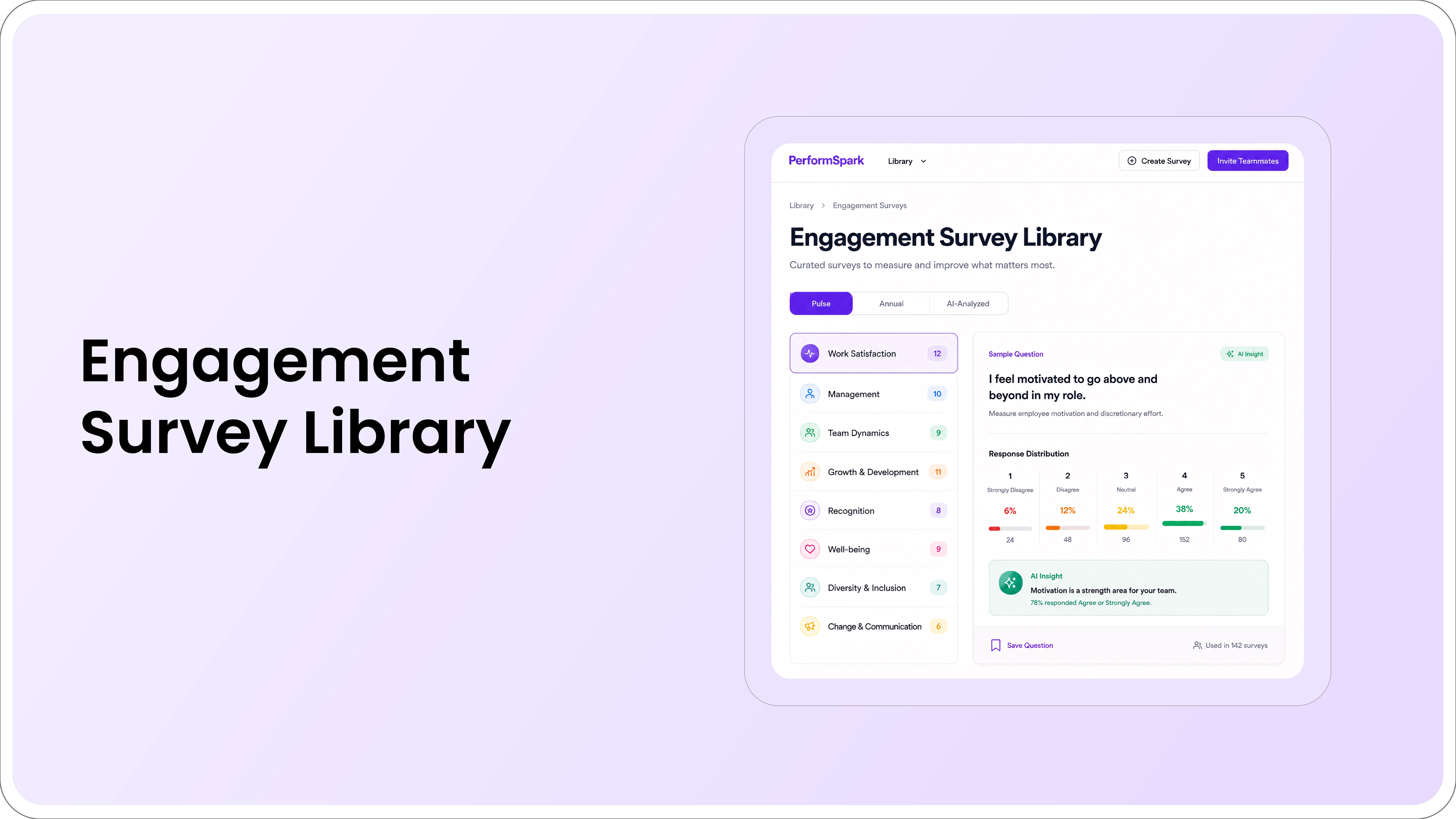
An annual or semiannual survey should cover the employee experience broadly enough to show where deeper review is needed. The library below contains 42 rated statements and seven open-ended prompts across seven themes. Use a consistent agreement scale for the rated statements, and keep the core items stable if you want year-over-year comparison.
A note on wording: most items below are written as agreement statements rather than as questions. This is standard practice for rated survey items, because employees respond on an agreement scale instead of answering in their own words. The open-ended prompt at the end of each theme is the exception, and those are phrased as questions.
1. Clarity, Purpose, and Motivation
- I understand the organization's priorities.
- I understand how my work contributes to those priorities.
- I know what is expected of me in my role.
- The work I do makes good use of my skills.
- I have the tools and information needed to do my job well.
- I feel motivated to do high-quality work.
- Open-ended: What would make your priorities or role expectations clearer?
How to review this theme: Review these results alongside role, function, and recent organizational changes. Low clarity may point to competing priorities, unclear decision rights, or weak communication. The primary owners are senior leaders for organizational priorities and managers for role expectations.
2. Manager Relationship and Support
- My manager communicates clear expectations.
- My manager provides feedback that helps me improve.
- I feel comfortable raising concerns or asking for help.
- My manager follows through on commitments.
- My manager gives me appropriate autonomy in how I work.
- My manager treats team members fairly and consistently.
- Open-ended: What is one thing your manager could do differently to support you?
How to review this theme: Compare team-level patterns only when the reporting group is large enough to protect privacy. Use the results to guide coaching and team conversations, not to make a conclusion about one manager from a single survey cycle. HR and the manager's leader share ownership.
Related workflow: structured check-ins and 1-on-1s can turn manager feedback into a recurring conversation.
3. Growth and Development
- I understand what growth could look like from my current role.
- I have opportunities to build skills that matter to my career.
- My development goals receive regular attention.
- I can access the resources needed to learn and improve.
- I have had a meaningful career conversation during the past six months.
- Promotion criteria are clear and understandable.
- Open-ended: Which development opportunity would be most valuable during the next year?
How to review this theme: Review access to resources separately from manager attention. Employees may have learning options but no clear plan for using them. HR owns the development framework and promotion criteria, while managers own recurring development conversations.
Related workflow: individual development plans help connect survey themes with clear development actions.
4. Culture, Belonging, and Collaboration
- I feel a sense of belonging on my team.
- People can disagree respectfully in this organization.
- Teams share the information needed to work together effectively.
- Leadership decisions are explained clearly enough to understand the reasoning.
- I can contribute a different point of view without being dismissed.
- When something goes wrong, we focus on solving the problem rather than assigning blame.
- Open-ended: What should the organization protect as it grows?
How to review this theme: Do not reduce culture to one overall score. Review belonging, information flow, respectful disagreement, and leadership communication as separate signals. Leadership owns the organizational response, with managers responsible for team norms.
5. Recognition, Performance, and Fairness
- Good work is recognized in a meaningful way.
- I understand how my performance is evaluated.
- Opportunities are distributed fairly within my team.
- I know where to ask questions about performance or promotion decisions.
- Recognition reflects contribution, not only visibility.
- The performance evaluation process is applied consistently.
- Open-ended: What would make recognition feel more useful or credible?
How to review this theme: Separate day-to-day recognition from confidence in the performance process. A recognition initiative cannot correct unclear evaluation standards. HR owns process consistency, while managers own timely and specific recognition.
Related workflow: employee recognition can support timely appreciation when the underlying performance process is clear.
6. Workload and Wellbeing
- My workload is sustainable over the long term.
- I can disconnect from work outside working hours.
- Priorities are clear enough that I know what to deprioritize when time is limited.
- Deadlines are set realistically.
- I have enough flexibility to manage work and personal responsibilities.
- I receive support when workload becomes difficult to manage.
- Open-ended: What is one change that would make your workload more manageable?
How to review this theme: Review workload with operational context such as staffing, deadlines, and recent changes. A low score does not explain the cause by itself. Managers own team-level prioritization, while leadership owns commitments and resourcing decisions.
7. Leadership, Trust, and Change
- I have confidence in the direction of the organization.
- Leadership communicates openly about challenges as well as successes.
- I understand the organization's priorities for the year.
- Organizational changes are communicated clearly.
- Leadership acts on employee feedback.
- Leadership decisions are applied consistently across the organization.
- Open-ended: What should leadership understand that may not be visible today?
How to review this theme: Use this theme to distinguish confidence in direction, communication quality, and trust in follow-through. The executive team owns the response and should communicate what will change, what will not change, and why.
15 Pulse Survey Questions for Frequent Check-ins
A pulse survey works best when the core questions remain stable. Repeat the same short set each cycle, then add one or two rotating questions only when you need feedback on a current change or decision. If every question changes, the survey becomes a series of snapshots instead of a trend.
Stable core questions
- I have a clear sense of my priorities right now.
- I know what is expected of me this month.
- I feel supported by my manager.
- My current workload is manageable.
- I can get help when work is blocked.
- I received useful feedback recently.
- I feel connected to my team.
- I feel positive about the work I am doing.
Open-ended pulse questions
- What is the biggest obstacle affecting your work right now?
- What is one action that would improve the next few weeks?
Rotating questions for a current issue
- The recent change was communicated clearly enough for me to know what to do.
- I have what I need to use the new tool or process effectively.
- I understand how the reorganization affects my role.
- Decision responsibilities are clear after the recent change.
- Our current meeting schedule leaves enough time for focused work.
Choose a cadence based on response capacity. A monthly pulse is useful only when the organization can review the result, communicate what it learned, and respond before the next cycle. A quarterly pulse may be more realistic during stable periods.
3 eNPS Questions and Follow-up Prompts
Employee Net Promoter Score, or eNPS, adapts the Net Promoter Score method to the workplace. Use the scored question on a 0-to-10 scale, then add a short reason prompt so the number has context.
- Scored question: On a scale from 0 to 10, how likely are you to recommend this organization as a place to work?
- Follow-up: What is the main reason for your score?
- Action prompt: What is one change that would most improve your score?
Calculation: Scores of 9 or 10 are promoters, 7 or 8 are passives, and 0 through 6 are detractors. Subtract the percentage of detractors from the percentage of promoters. The result ranges from -100 to +100. Qualtrics explains the same eNPS grouping and calculation.
Use eNPS as a trend, not as a complete diagnosis. A change in the score should lead to a review of theme results, comments, team context, and recent organizational events. Avoid ranking managers or making employment decisions from eNPS alone.
Related workflow: reporting and analytics can help HR review trends alongside broader performance information.
How to Write Survey Questions Employees Can Answer Clearly
Question wording determines whether the response can be interpreted. Before adding an item, check that it measures one idea, uses neutral language, fits the chosen scale, and has a clear owner.
Ask one idea at a time
"My manager communicates clearly and gives useful feedback" measures two different experiences. Split it into two items so an employee can answer each one honestly. Pew Research Center's survey-writing guidance similarly recommends asking only one concept at a time because double-barreled questions are difficult to answer and interpret.
Use neutral language
Avoid wording such as "How satisfied are you with our excellent benefits?" The word "excellent" leads the respondent toward a positive answer. Use "How satisfied are you with the benefits available to you?" instead.
Avoid absolute words
Words such as "always" and "never" make ordinary experiences difficult to rate. Ask about consistency or a defined period instead: "My manager usually communicates clear expectations" or "During the past month, I received feedback I could use."
Use a consistent response scale
- Use one primary agreement scale for rated statements, such as Strongly Disagree, Disagree, Neither Agree nor Disagree, Agree, and Strongly Agree.
- Label every point so respondents do not have to guess what a number means.
- Keep any 0-to-10 eNPS question visually separate from the agreement-scale questions.
- Do not change the scale between cycles if you need reliable trend comparison.
Remove questions that have no action owner
Before adding a question, identify who will review the result and what the first response step would be. If the organization cannot explain, investigate, or act on the topic, remove the question until a response process exists.
Set Privacy Rules Before the Survey Opens
Employees should know how responses will be handled before they participate. Use precise language and avoid promising anonymity if an administrator or system can identify a response.
- Anonymous survey: responses cannot be traced to an individual. Explain how open-text comments and small reporting groups will be handled.
- Confidential survey: a restricted administrator may be able to identify responses, but reports are shared only in aggregate. Name who can access raw responses.
- Reporting threshold: choose a minimum group size that protects privacy, state it in advance, and explain whether smaller groups are rolled up or suppressed.
For sensitive topics or jurisdictions with specific employee-data requirements, have HR leadership and qualified counsel review the survey introduction, access rules, retention period, and escalation process. This article is educational and is not legal advice.
How to Analyze Open-ended Responses
Open-ended comments explain the context behind a score, but they should be reviewed in a structured way. Start with the full response set, define a small theme list, preserve important minority views, and remove identifying details before wider reporting.
- Read a sample first and create initial themes.
- Code the full response set using the same theme definitions.
- Review comments that do not fit the dominant themes.
- Separate factual reports, suggestions, and sentiment.
- Summarize patterns without exposing an individual's wording or identity.
- Validate automated themes before presenting them to leaders.
PerformSpark connection: TrAI, PerformSpark's assistive AI layer, can cluster open-ended survey feedback into themes for HR review. It supports analysis without replacing human judgment. Explore TrAI's survey comment thematic analysis.
Turn Survey Results Into Visible Action
The survey is the start of the listening cycle. Employees should hear what was learned, what will be reviewed further, what will change, and when progress will be checked. Gallup's guidance on employee survey follow-through also emphasizes action planning and clear ownership after results are collected. See Gallup's follow-through guidance.
- Share the main themes. Explain the strongest results, the lowest results, and any important differences by group without compromising privacy.
- Choose a small number of priorities. Select issues that matter, can be influenced, and have an accountable owner.
- Name the action and review date. Replace vague promises with a specific next step, responsible person, and date for a pulse check.
- Report progress before the next survey. Tell employees what was completed, what changed, and what remains open.
Survey data identifies where to look. It does not prove why a score changed or justify a decision about an individual employee or manager. Use interviews, team conversations, operational data, and professional judgment to understand the cause.
Key Takeaways:
- Annual surveys provide depth across several engagement themes, while pulse surveys track a short, stable set over time.
- Use eNPS as a headline trend, then pair it with theme scores and an open-ended reason question to understand what changed.
- Ask one idea per question, use consistent response scales, and remove any item that has no clear action owner.
- Explain anonymity or confidentiality before the survey opens, including who can access responses and how small groups are reported.
- Share what was heard, name the actions being taken, and set a date to check progress before running the next survey.
Quick answer: Employee engagement survey questions measure how employees experience their work, manager, growth opportunities, workload, culture, and leadership. Annual surveys provide a broad diagnostic across several themes. Pulse surveys use a short, repeatable set to track changes between larger surveys. eNPS adds a single workplace recommendation score. The strongest survey program uses each format for its intended purpose and follows every survey with visible, specific action.
Employee engagement surveys are easy to launch and surprisingly easy to design badly. A question can look clear while measuring two ideas at once. A survey can collect useful feedback and still fail because no one owns the response. A monthly pulse can become noise when its questions change every cycle.
This guide gives HR and people teams a practical library of more than 60 questions for annual engagement surveys, pulse checks, and eNPS. It also explains how to choose a scale, protect employee privacy, review comments, and turn results into actions employees can see.
The questions below are a planning library, not a validated psychometric instrument. If your organization needs external benchmarks or statistically validated results, use a documented methodology and avoid changing validated items. For an internal listening program, start with the survey format that matches the decision you need to make.
Annual, Pulse, and eNPS Surveys Serve Different Purposes
The right question set depends on whether you need a broad diagnosis, a frequent trend check, or a single advocacy metric. Treating the three formats as interchangeable makes the results harder to interpret.
| Dimension | Annual Survey | Pulse Survey | eNPS |
|---|---|---|---|
| Primary purpose | Diagnose engagement themes | Track movement and current issues | Track workplace advocacy |
| Practical length | About 30 to 50 rated items plus open text | About 5 to 12 items | One scored question plus follow-up |
| Common cadence | Once or twice per year | Monthly, quarterly, or after a change | With annual or pulse surveys |
| Keep questions stable? | Keep core items stable year to year | Repeat the same core each cycle | Keep wording and 0-to-10 scale stable |
| Best use | Theme and segment analysis | Fast course correction | Simple leadership trend |
| Main limitation | More time to complete and act on | Less diagnostic depth | Does not explain the reason by itself |
The ranges above are practical planning guidance, not universal rules. Shorten the survey when employees have limited time or when the organization lacks the capacity to respond to a large number of themes.
49 Annual Employee Engagement Survey Questions
An annual or semiannual survey should cover the employee experience broadly enough to show where deeper review is needed. The library below contains 42 rated statements and seven open-ended prompts across seven themes. Use a consistent agreement scale for the rated statements, and keep the core items stable if you want year-over-year comparison.
A note on wording: most items below are written as agreement statements rather than as questions. This is standard practice for rated survey items, because employees respond on an agreement scale instead of answering in their own words. The open-ended prompt at the end of each theme is the exception, and those are phrased as questions.
1. Clarity, Purpose, and Motivation
- I understand the organization's priorities.
- I understand how my work contributes to those priorities.
- I know what is expected of me in my role.
- The work I do makes good use of my skills.
- I have the tools and information needed to do my job well.
- I feel motivated to do high-quality work.
- Open-ended: What would make your priorities or role expectations clearer?
How to review this theme: Review these results alongside role, function, and recent organizational changes. Low clarity may point to competing priorities, unclear decision rights, or weak communication. The primary owners are senior leaders for organizational priorities and managers for role expectations.
2. Manager Relationship and Support
- My manager communicates clear expectations.
- My manager provides feedback that helps me improve.
- I feel comfortable raising concerns or asking for help.
- My manager follows through on commitments.
- My manager gives me appropriate autonomy in how I work.
- My manager treats team members fairly and consistently.
- Open-ended: What is one thing your manager could do differently to support you?
How to review this theme: Compare team-level patterns only when the reporting group is large enough to protect privacy. Use the results to guide coaching and team conversations, not to make a conclusion about one manager from a single survey cycle. HR and the manager's leader share ownership.
Related workflow: structured check-ins and 1-on-1s can turn manager feedback into a recurring conversation.
3. Growth and Development
- I understand what growth could look like from my current role.
- I have opportunities to build skills that matter to my career.
- My development goals receive regular attention.
- I can access the resources needed to learn and improve.
- I have had a meaningful career conversation during the past six months.
- Promotion criteria are clear and understandable.
- Open-ended: Which development opportunity would be most valuable during the next year?
How to review this theme: Review access to resources separately from manager attention. Employees may have learning options but no clear plan for using them. HR owns the development framework and promotion criteria, while managers own recurring development conversations.
Related workflow: individual development plans help connect survey themes with clear development actions.
4. Culture, Belonging, and Collaboration
- I feel a sense of belonging on my team.
- People can disagree respectfully in this organization.
- Teams share the information needed to work together effectively.
- Leadership decisions are explained clearly enough to understand the reasoning.
- I can contribute a different point of view without being dismissed.
- When something goes wrong, we focus on solving the problem rather than assigning blame.
- Open-ended: What should the organization protect as it grows?
How to review this theme: Do not reduce culture to one overall score. Review belonging, information flow, respectful disagreement, and leadership communication as separate signals. Leadership owns the organizational response, with managers responsible for team norms.
5. Recognition, Performance, and Fairness
- Good work is recognized in a meaningful way.
- I understand how my performance is evaluated.
- Opportunities are distributed fairly within my team.
- I know where to ask questions about performance or promotion decisions.
- Recognition reflects contribution, not only visibility.
- The performance evaluation process is applied consistently.
- Open-ended: What would make recognition feel more useful or credible?
How to review this theme: Separate day-to-day recognition from confidence in the performance process. A recognition initiative cannot correct unclear evaluation standards. HR owns process consistency, while managers own timely and specific recognition.
Related workflow: employee recognition can support timely appreciation when the underlying performance process is clear.
6. Workload and Wellbeing
- My workload is sustainable over the long term.
- I can disconnect from work outside working hours.
- Priorities are clear enough that I know what to deprioritize when time is limited.
- Deadlines are set realistically.
- I have enough flexibility to manage work and personal responsibilities.
- I receive support when workload becomes difficult to manage.
- Open-ended: What is one change that would make your workload more manageable?
How to review this theme: Review workload with operational context such as staffing, deadlines, and recent changes. A low score does not explain the cause by itself. Managers own team-level prioritization, while leadership owns commitments and resourcing decisions.
7. Leadership, Trust, and Change
- I have confidence in the direction of the organization.
- Leadership communicates openly about challenges as well as successes.
- I understand the organization's priorities for the year.
- Organizational changes are communicated clearly.
- Leadership acts on employee feedback.
- Leadership decisions are applied consistently across the organization.
- Open-ended: What should leadership understand that may not be visible today?
How to review this theme: Use this theme to distinguish confidence in direction, communication quality, and trust in follow-through. The executive team owns the response and should communicate what will change, what will not change, and why.
15 Pulse Survey Questions for Frequent Check-ins
A pulse survey works best when the core questions remain stable. Repeat the same short set each cycle, then add one or two rotating questions only when you need feedback on a current change or decision. If every question changes, the survey becomes a series of snapshots instead of a trend.
Stable core questions
- I have a clear sense of my priorities right now.
- I know what is expected of me this month.
- I feel supported by my manager.
- My current workload is manageable.
- I can get help when work is blocked.
- I received useful feedback recently.
- I feel connected to my team.
- I feel positive about the work I am doing.
Open-ended pulse questions
- What is the biggest obstacle affecting your work right now?
- What is one action that would improve the next few weeks?
Rotating questions for a current issue
- The recent change was communicated clearly enough for me to know what to do.
- I have what I need to use the new tool or process effectively.
- I understand how the reorganization affects my role.
- Decision responsibilities are clear after the recent change.
- Our current meeting schedule leaves enough time for focused work.
Choose a cadence based on response capacity. A monthly pulse is useful only when the organization can review the result, communicate what it learned, and respond before the next cycle. A quarterly pulse may be more realistic during stable periods.
3 eNPS Questions and Follow-up Prompts
Employee Net Promoter Score, or eNPS, adapts the Net Promoter Score method to the workplace. Use the scored question on a 0-to-10 scale, then add a short reason prompt so the number has context.
- Scored question: On a scale from 0 to 10, how likely are you to recommend this organization as a place to work?
- Follow-up: What is the main reason for your score?
- Action prompt: What is one change that would most improve your score?
Calculation: Scores of 9 or 10 are promoters, 7 or 8 are passives, and 0 through 6 are detractors. Subtract the percentage of detractors from the percentage of promoters. The result ranges from -100 to +100. Qualtrics explains the same eNPS grouping and calculation.
Use eNPS as a trend, not as a complete diagnosis. A change in the score should lead to a review of theme results, comments, team context, and recent organizational events. Avoid ranking managers or making employment decisions from eNPS alone.
Related workflow: reporting and analytics can help HR review trends alongside broader performance information.
How to Write Survey Questions Employees Can Answer Clearly
Question wording determines whether the response can be interpreted. Before adding an item, check that it measures one idea, uses neutral language, fits the chosen scale, and has a clear owner.
Ask one idea at a time
"My manager communicates clearly and gives useful feedback" measures two different experiences. Split it into two items so an employee can answer each one honestly. Pew Research Center's survey-writing guidance similarly recommends asking only one concept at a time because double-barreled questions are difficult to answer and interpret.
Use neutral language
Avoid wording such as "How satisfied are you with our excellent benefits?" The word "excellent" leads the respondent toward a positive answer. Use "How satisfied are you with the benefits available to you?" instead.
Avoid absolute words
Words such as "always" and "never" make ordinary experiences difficult to rate. Ask about consistency or a defined period instead: "My manager usually communicates clear expectations" or "During the past month, I received feedback I could use."
Use a consistent response scale
- Use one primary agreement scale for rated statements, such as Strongly Disagree, Disagree, Neither Agree nor Disagree, Agree, and Strongly Agree.
- Label every point so respondents do not have to guess what a number means.
- Keep any 0-to-10 eNPS question visually separate from the agreement-scale questions.
- Do not change the scale between cycles if you need reliable trend comparison.
Remove questions that have no action owner
Before adding a question, identify who will review the result and what the first response step would be. If the organization cannot explain, investigate, or act on the topic, remove the question until a response process exists.
Set Privacy Rules Before the Survey Opens
Employees should know how responses will be handled before they participate. Use precise language and avoid promising anonymity if an administrator or system can identify a response.
- Anonymous survey: responses cannot be traced to an individual. Explain how open-text comments and small reporting groups will be handled.
- Confidential survey: a restricted administrator may be able to identify responses, but reports are shared only in aggregate. Name who can access raw responses.
- Reporting threshold: choose a minimum group size that protects privacy, state it in advance, and explain whether smaller groups are rolled up or suppressed.
For sensitive topics or jurisdictions with specific employee-data requirements, have HR leadership and qualified counsel review the survey introduction, access rules, retention period, and escalation process. This article is educational and is not legal advice.
How to Analyze Open-ended Responses
Open-ended comments explain the context behind a score, but they should be reviewed in a structured way. Start with the full response set, define a small theme list, preserve important minority views, and remove identifying details before wider reporting.
- Read a sample first and create initial themes.
- Code the full response set using the same theme definitions.
- Review comments that do not fit the dominant themes.
- Separate factual reports, suggestions, and sentiment.
- Summarize patterns without exposing an individual's wording or identity.
- Validate automated themes before presenting them to leaders.
PerformSpark connection: TrAI, PerformSpark's assistive AI layer, can cluster open-ended survey feedback into themes for HR review. It supports analysis without replacing human judgment. Explore TrAI's survey comment thematic analysis.
Turn Survey Results Into Visible Action
The survey is the start of the listening cycle. Employees should hear what was learned, what will be reviewed further, what will change, and when progress will be checked. Gallup's guidance on employee survey follow-through also emphasizes action planning and clear ownership after results are collected. See Gallup's follow-through guidance.
- Share the main themes. Explain the strongest results, the lowest results, and any important differences by group without compromising privacy.
- Choose a small number of priorities. Select issues that matter, can be influenced, and have an accountable owner.
- Name the action and review date. Replace vague promises with a specific next step, responsible person, and date for a pulse check.
- Report progress before the next survey. Tell employees what was completed, what changed, and what remains open.
Survey data identifies where to look. It does not prove why a score changed or justify a decision about an individual employee or manager. Use interviews, team conversations, operational data, and professional judgment to understand the cause.
Frequently Asked Questions
How many questions should an employee engagement survey include?
A practical annual engagement survey often includes about 30 to 50 rated questions plus a small number of open-ended prompts. A pulse survey should usually be much shorter, often 5 to 12 items. The right length depends on the survey purpose and the organization's ability to review and act on each theme.
What is the difference between an annual survey, a pulse survey, and eNPS?
An annual survey provides a broad diagnosis across several engagement themes. A pulse survey repeats a short core set more frequently to track change. eNPS uses one 0-to-10 recommendation question to produce a headline advocacy score. eNPS should be reviewed with theme results and comments.
What response scale should employee engagement surveys use?
A labeled 5-point agreement scale is a practical choice for rated statements. Use the same scale across the survey and between cycles. Keep any 0-to-10 eNPS question visually separate so employees do not confuse the two response formats.
What is eNPS and how is it calculated?
eNPS asks how likely employees are to recommend the organization as a place to work on a 0-to-10 scale. Ratings of 9 or 10 are promoters, 7 or 8 are passives, and 0 through 6 are detractors. Subtract the percentage of detractors from the percentage of promoters.
Should employee engagement surveys be anonymous or confidential?
Either model can work when it is explained accurately. Anonymous means responses cannot be traced to individuals. Confidential means a restricted administrator may identify responses but shares aggregated results. State access rules, reporting thresholds, and exceptions before the survey opens.


.webp)