



Feedback

360 Degree Feedback Examples: 100 Phrases for Every Competency Area

360 degree feedback examples are the specific phrases reviewers use to describe an employee's behavior from manager, peer, and direct report perspectives. The most useful phrases are behaviorally specific and observation-based. "Great team player" provides no developmental signal. "Proactively identifies cross-team dependencies before they create delays" does. Effective 360 feedback examples describe what the reviewer observed, not what they believe about the person's character or intent.‍

Updated :
May 15, 2026

Mahesh Kumar

Founder, TraineryHCM.com

Table of Contents

The 100 examples below are organized across 10 competency areas. Each competency contains 5 strength phrases and 5 development area phrases. Every phrase meets the behavioral specificity standard required for constructive feedback and calibration evidence. Adapt by replacing generic references with specific project names, dates, and outcomes from the actual review period.

Communication

Communication Strength Phrases

  • Consistently delivers written project updates at the level of detail required by the audience executive summaries for leadership, technical depth for cross-functional partners.
  • Prepares meeting agendas 24 hours in advance and distributes them to all participants, reducing average meeting time by an estimated 20 minutes per recurring session.
  • Asks clarifying questions before starting work on ambiguous tasks, reducing revision cycles on complex deliverables.
  • Escalates project risks in writing with clear impact statements and a proposed resolution, giving stakeholders time to act before deadlines are missed.
  • Maintains consistent communication with external partners during periods of internal ambiguity, preventing client-facing information gaps.

Communication Development Area Phrases

  • Written stakeholder updates have at times omitted the recommended action required for senior decision-making, resulting in follow-up requests that delayed decision timelines. Development area: adopting a structured executive summary format situation, implication, recommended action for all leadership communications.
  • Meeting facilitation has occasionally allowed discussions to run past the agenda without a checkpoint, affecting subsequent meetings. Development area: establishing a five-minute agenda warning practice in recurring facilitation.
  • Status updates on cross-functional deliverables have not consistently reached all stakeholders with enough lead time to act. Development area: establishing a standing communication protocol for cross-team handoffs.
  • Responses to async Slack messages from partner teams have averaged over four hours during peak periods, creating bottlenecks for colleagues waiting on decisions to proceed.
  • Presentation materials for senior leadership have included data without interpretation on three occasions this quarter, requiring follow-up clarification calls. Development area: ending every leadership presentation slide with a clear recommended action.

Leadership and People Management

Leadership and People Management Strength Phrases

  • Manages team capacity proactively, surfacing resourcing conflicts to leadership before they affect delivery timelines.
  • Develops direct reports by delegating ownership progressively supporting roles first, then lead roles with coaching, then independent ownership.
  • Creates an environment where concerns are raised early rather than escalated only after impact has occurred.
  • Provides specific, evidence-based feedback in 1-on-1 conversations rather than general impressions, giving direct reports a clear picture of what to continue and what to change.
  • Navigated two organizational changes during this review period without a reduction in team output or morale metrics.

Leadership and People Management Development Area Phrases

  • Decision-making authority has not always been communicated clearly to team members, resulting in duplicate work when two people assumed ownership of the same deliverable. Development area: publishing a clear ownership map for recurring team decisions at the start of each quarter.
  • Feedback conversations with direct reports have at times focused on outcomes rather than specific behaviors, making it difficult for team members to know exactly what to do differently.
  • Manager-level visibility into workload distribution has been inconsistent. Development area: establishing a weekly capacity check-in cadence to surface overload before it affects output quality.
  • Development conversations with direct reports have not been consistently documented in 1-on-1 records, making it difficult to track progress against commitments made in previous quarters.
  • Context behind project direction changes has not always been shared with the team, resulting in lower buy-in when direction shifts mid-project.

Collaboration

Collaboration Strength Phrases

  • Identifies and surfaces cross-team dependencies proactively, coordinating resolution before they create delivery delays.
  • Responds to requests from partner teams within the committed timeframes, maintaining the reliability required for cross-functional work to move at pace.
  • Shares relevant information with adjacent teams without waiting to be asked, reducing the information asymmetry that slows cross-functional projects.
  • Navigates disagreements with partner teams constructively, focusing discussions on outcomes rather than process ownership.
  • Has been cited by three partner team leads as a reliable coordination point for cross-functional work this quarter.

Collaboration Development Area Phrases

  • Cross-team deliverables have occasionally been submitted without notifying the receiving team, creating scheduling gaps for dependent work.
  • Engagement in cross-functional planning meetings has been primarily reactive contributing when asked rather than proactively raising considerations that affect the broader group.
  • Information sharing with adjacent teams has been inconsistent. Development area: establishing a standing protocol for notifying partner teams of decisions that affect their work within 24 hours of the decision.
  • Cross-team dependencies have at times been treated as the other team's responsibility to track, rather than a shared accountability. Development area: co-owning the dependency register with partner team leads.
  • Availability for cross-team coordination has been limited during peak periods. Development area: communicating a clear availability protocol during peak periods so partner teams can plan accordingly.

Problem Solving

Problem Solving Strength Phrases

  • Identified the root cause of a recurring customer escalation pattern and designed a resolution that reduced that ticket category by 74 percent within six weeks of implementation.
  • Brings proposed solutions to problem discussions rather than only surfacing issues, reducing the time from problem identification to resolution decision.
  • Tests assumptions before committing to a course of action on complex problems, reducing the frequency of mid-project pivots.
  • Applies structured root cause analysis before escalating, ensuring escalations arrive with a diagnosis rather than only a symptom report.
  • Resolved three critical production issues during on-call rotations this quarter without requiring escalation to senior engineers.

Problem Solving Development Area Phrases

  • Problem escalations have arrived without a proposed solution or root cause analysis on several occasions, requiring significant senior team time to diagnose issues the team member was closest to.
  • Has committed to a solution before fully validating the problem on two occasions this quarter, leading to one mid-project pivot that cost approximately two sprints.
  • Tends to address the symptom rather than the root cause of recurring issues. Development area: applying a five-why root cause analysis before proposing a resolution for any issue that has appeared more than once.
  • Risk identification is strong. Risk communication to stakeholders before impact occurs is a development area this period.
  • Has not yet developed the habit of documenting problem-resolution approaches for future reference. Development area: adding a brief post-resolution summary to the team knowledge base after each significant incident.

Adaptability

Adaptability Strength Phrases

  • Maintained delivery commitments through two significant scope changes during the Q3 project without requiring timeline extension.
  • Adopted the new project management methodology with minimal support and became an informal resource for colleagues navigating the transition.
  • Adjusts communication approach based on stakeholder context more structured in formal reviews, more flexible in working sessions.
  • Responds to changed priorities with constructive reorientation rather than friction, modeling the flexibility the team needs during high-change periods.
  • Proactively sought new technical skills when project requirements expanded beyond the original scope, closing the knowledge gap through self-directed learning.

Adaptability Development Area Phrases

  • Changes to project scope have at times been met with resistance that slowed team adaptation. Development area: distinguishing between resistance worth escalating and resistance worth accommodating before raising concerns.
  • Has occasionally required more transition time than the project schedule allowed when priorities shifted mid-cycle. Development area: building a personal rapid-reorientation practice for high-change situations.
  • Feedback received mid-project has not always been incorporated quickly enough to affect the relevant deliverable. Development area: establishing a weekly feedback integration checkpoint.
  • Technical tool changes have required additional support time that was not budgeted. Development area: building independent tool adoption capacity through peer learning rather than waiting for formal training.
  • Self-directed development has been primarily reactive this quarter. Development area: establishing a quarterly technical learning goal with defined completion criteria.

Accountability

Accountability Strength Phrases

  • Delivers on commitments consistently and communicates early when a commitment is at risk, rather than waiting until the deadline has passed.
  • Owns mistakes openly, identifies the root cause, and proposes a remediation without requiring manager intervention to initiate the accountability conversation.
  • Documents commitments made in meetings and follows up on open items without prompting.
  • Maintains a task tracker that partner teams can reference to understand delivery status without needing to ask.
  • Has not missed a review deadline across four consecutive review cycles.

Accountability Development Area Phrases

  • Three deliverables were submitted past the agreed deadline in Q3 without proactive communication before the deadline passed. Development area: flagging any at-risk commitment at least 48 hours before the deadline.
  • Post-incident documentation has not been consistently completed after production issues, making it harder for the team to build institutional knowledge from repeated events.
  • Has at times attributed delays to external factors without fully accounting for elements within personal control. Development area: applying a personal accountability framework before external attribution in retrospectives.
  • Commitment tracking in shared tools has been inconsistent. Development area: maintaining current task status in the team project management system, updated at least weekly.
  • Action items committed to in 1-on-1 conversations have not been consistently followed through this quarter. Development area: creating a personal action tracking practice following each 1-on-1.

Technical Skills

Technical Skills Strength Phrases

  • Designed and implemented an automated reconciliation workflow that reduced month-end close time from four business days to one, with zero errors in the three quarters since implementation.
  • Consistently delivers work that passes peer review with minimal revision requests, demonstrating strong technical standards without formal enforcement.
  • Completed three advanced technical certifications this review period and applied each to live project work within four weeks of completion.
  • Technical documentation is consistently detailed enough for a new team member to work from without additional guidance.
  • Mentored two junior team members on technical skills this quarter, with measurable improvement in their independent output quality.

Technical Skills Development Area Phrases

  • Technical implementations have required significant rework due to insufficient testing before deployment on two occasions. Development area: adding a personal testing checklist to the pre-deployment workflow.
  • Code review participation has been inconsistent this quarter. Development area: committing to a minimum of two peer reviews per sprint.
  • Documentation of technical decisions has not kept pace with implementation. Development area: adding a brief decision log entry for any significant technical decision as part of the implementation workflow.
  • Debugging approach has focused on resolution speed rather than root cause analysis, resulting in one recurring issue that a root cause investigation would have caught.
  • Technical skill development has been primarily reactive this quarter. Development area: establishing a quarterly technical learning commitment with defined completion criteria.

Emotional Intelligence

Emotional Intelligence Strength Phrases

  • Navigates high-pressure situations without visible impact on team morale, maintaining the calm others need to function effectively when circumstances are difficult.
  • Reads stakeholder context accurately in sensitive conversations adjusting directness, pacing, and tone based on the other person's signals.
  • Gives difficult feedback in a way that the recipient can hear and act on rather than in a way that triggers defensiveness.
  • Demonstrates genuine curiosity about colleagues' perspectives in disagreements seeking to understand before responding.
  • Handled three challenging employee relations situations this quarter with sensitivity that prevented escalation in each case.

Emotional Intelligence Development Area Phrases

  • Has at times responded to challenge or criticism in ways that closed the conversation rather than opening it. Development area: building a personal practice of pausing before responding to feedback that feels critical.
  • Reading team members' emotional state in remote settings has been an identified gap this quarter. Development area: adding a brief wellbeing check-in question to the opening of 1-on-1 conversations.
  • Directness in feedback delivery has at times landed as bluntness. Development area: adding one sentence of context before stating a development observation.
  • Urgency-under-pressure has not always been communicated to team members in a way that distinguishes genuine urgency from routine priorities. Development area: establishing a personal check-in before initiating high-urgency requests.
  • Disagreements with partner teams have been escalated before informal resolution was attempted on two occasions. Development area: committing to one direct conversation before formal escalation.

Initiative

Initiative Strength Phrases

  • Identified and resolved a data integrity issue three weeks before it would have surfaced in a client report, without being asked to investigate.
  • Proactively proposed a process improvement that has since been adopted org-wide, demonstrating initiative beyond the immediate role scope.
  • Took ownership of a project leadership vacuum during a team member's absence, ensuring continuity without requiring manager intervention.
  • Consistently brings new information, tools, or approaches to team discussions from external research, adding perspective that would not otherwise enter the team's view.
  • Volunteered for three cross-functional projects this quarter beyond core role responsibilities.

InitiativeDevelopment Area Phrases

  • Has identified risks during this period but raised them after impact occurred rather than when first identified. Development area: flagging any risk within 24 hours of identification.
  • Contribution to team discussions has been primarily responsive rather than proactive. Development area: committing to one proactive contribution per team meeting.
  • Has not yet extended initiative to areas adjacent to the core role. Development area: identifying one improvement opportunity outside immediate responsibilities each quarter.
  • Self-directed skill development has been limited this quarter. Development area: establishing a quarterly personal learning commitment with defined completion criteria.
  • Has flagged improvement opportunities informally without formal proposals. Development area: channeling observations into written proposals that stakeholders can evaluate and act on.

Results Orientation

Results Orientation Strength Phrases

  • Has delivered 100 percent of committed deliverables on schedule for three consecutive quarters, including during a significant team resourcing reduction in Q2.
  • Sets goals specific enough to assess objectively and tracks progress visibly enough that the team always knows where things stand.
  • Consistently connects individual work to business outcomes in status updates, giving stakeholders clarity on why the work matters beyond task completion.
  • Has maintained output quality during periods of high volume without requesting scope reduction or timeline extension.
  • Completed a project ahead of schedule by identifying and resolving a critical dependency three weeks before it would have caused delay.

Results Orientation Development Area Phrases

  • Focus on output volume has at times come at the expense of output quality, requiring rework that offset the speed advantage. Development area: establishing a personal quality checkpoint before marking deliverables complete.
  • Goal-setting at the start of the period did not include measurable success criteria for two of the five goals, making end-of-period assessment difficult.
  • Milestone progress has not been consistently communicated between check-in conversations. Development area: establishing a weekly progress signal in the shared project tracker.
  • Commitment scope has at times been over-estimated at the start of the period, creating an end-of-period gap that could have been avoided with more conservative planning.
  • Strong individual results this quarter. The development area is extending that quality to team-level outcomes identifying one team goal to own alongside individual commitments each quarter.

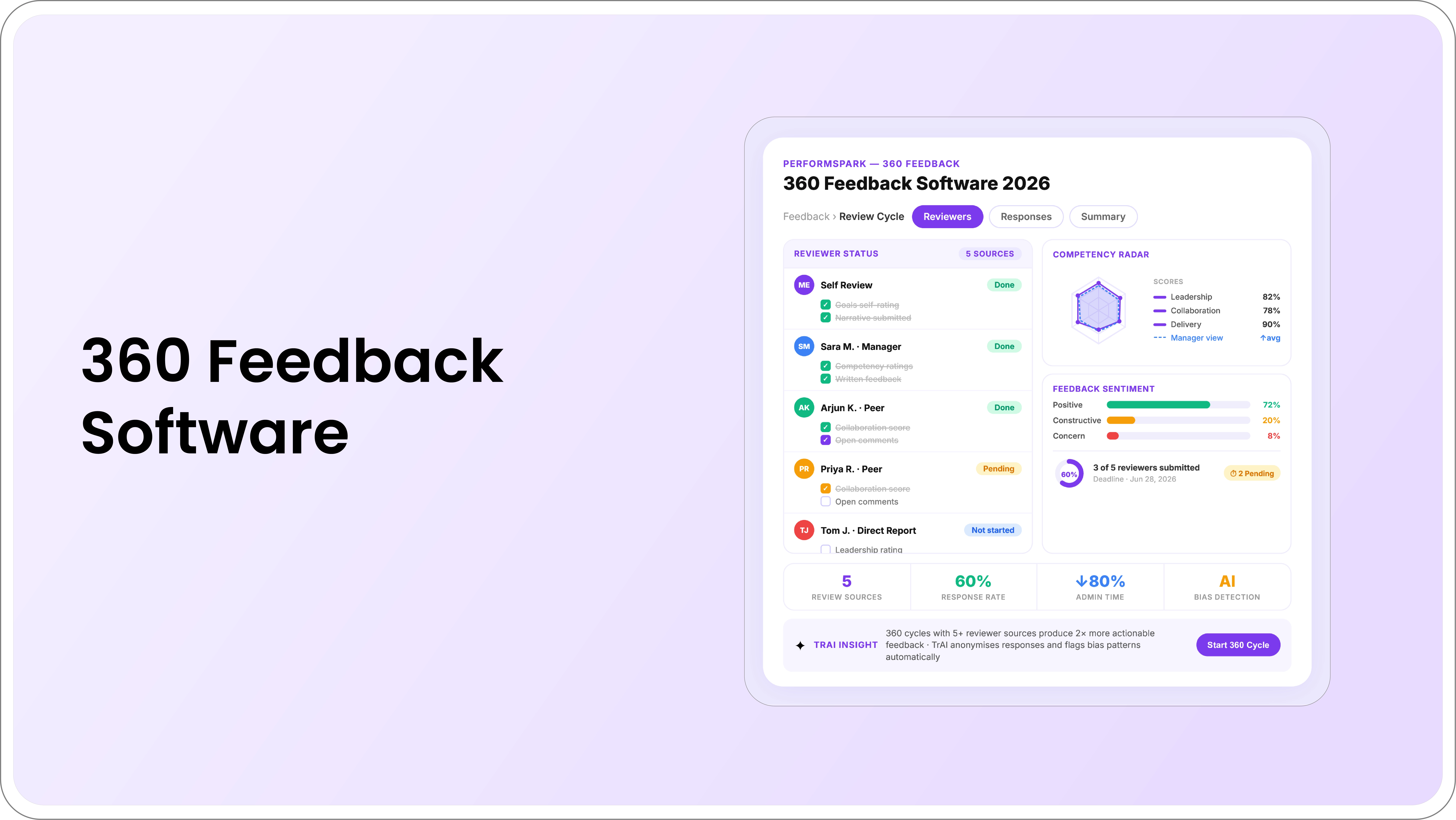
In PerformSpark, 360 feedback collected during the review cycle is available to the manager in the review drafting view and visible in the pre-calibration analysis alongside rating distributions and goal completion data. See how 360 feedback connects to calibration in PerformSpark β†’

How to Use These Examples Effectively

Adapt, do not copy

Replace generic references with specific project names, dates, and observable outcomes from the actual review period. A phrase referencing "the Q3 migration" is more credible than one that says "a project last quarter."

Lead with behavior, not judgment

The phrases above describe observable behaviors. Avoid adapting them in ways that move from behavior description to personality judgment. "Tends to take on more than can be completed" is a behavior observation. "Is unreliable" is a character judgment.

Pair development phrases with a pathway

Every development area phrase should be followed by a statement naming what the employee can specifically do to address the gap. This converts a 360 observation into an IDP input.

Use in calibration preparation

When 360 themes align with a manager's submitted rating, the rating is credible in calibration. When they diverge peers consistently noting strengths the manager rated lower the calibration session has a specific, evidence-based discussion point. Organize themes before the session, not after.

360 feedback that stays in a survey tool is not reaching calibration.

PerformSpark connects 360 feedback collected during the review cycle to the manager's review drafting view and the pre-calibration analysis. Managers arrive at calibration with behavioral evidence, not just a rating to defend from memory.See the 360-to-calibration workflow in a 20-minute demo. See the 360 feedback workflow in PerformSpark book-demo

The 100 examples below are organized across 10 competency areas. Each competency contains 5 strength phrases and 5 development area phrases. Every phrase meets the behavioral specificity standard required for constructive feedback and calibration evidence. Adapt by replacing generic references with specific project names, dates, and outcomes from the actual review period.

Communication

Communication Strength Phrases

  • Consistently delivers written project updates at the level of detail required by the audience executive summaries for leadership, technical depth for cross-functional partners.
  • Prepares meeting agendas 24 hours in advance and distributes them to all participants, reducing average meeting time by an estimated 20 minutes per recurring session.
  • Asks clarifying questions before starting work on ambiguous tasks, reducing revision cycles on complex deliverables.
  • Escalates project risks in writing with clear impact statements and a proposed resolution, giving stakeholders time to act before deadlines are missed.
  • Maintains consistent communication with external partners during periods of internal ambiguity, preventing client-facing information gaps.

Communication Development Area Phrases

  • Written stakeholder updates have at times omitted the recommended action required for senior decision-making, resulting in follow-up requests that delayed decision timelines. Development area: adopting a structured executive summary format situation, implication, recommended action for all leadership communications.
  • Meeting facilitation has occasionally allowed discussions to run past the agenda without a checkpoint, affecting subsequent meetings. Development area: establishing a five-minute agenda warning practice in recurring facilitation.
  • Status updates on cross-functional deliverables have not consistently reached all stakeholders with enough lead time to act. Development area: establishing a standing communication protocol for cross-team handoffs.
  • Responses to async Slack messages from partner teams have averaged over four hours during peak periods, creating bottlenecks for colleagues waiting on decisions to proceed.
  • Presentation materials for senior leadership have included data without interpretation on three occasions this quarter, requiring follow-up clarification calls. Development area: ending every leadership presentation slide with a clear recommended action.

Leadership and People Management

Leadership and People Management Strength Phrases

  • Manages team capacity proactively, surfacing resourcing conflicts to leadership before they affect delivery timelines.
  • Develops direct reports by delegating ownership progressively supporting roles first, then lead roles with coaching, then independent ownership.
  • Creates an environment where concerns are raised early rather than escalated only after impact has occurred.
  • Provides specific, evidence-based feedback in 1-on-1 conversations rather than general impressions, giving direct reports a clear picture of what to continue and what to change.
  • Navigated two organizational changes during this review period without a reduction in team output or morale metrics.

Leadership and People Management Development Area Phrases

  • Decision-making authority has not always been communicated clearly to team members, resulting in duplicate work when two people assumed ownership of the same deliverable. Development area: publishing a clear ownership map for recurring team decisions at the start of each quarter.
  • Feedback conversations with direct reports have at times focused on outcomes rather than specific behaviors, making it difficult for team members to know exactly what to do differently.
  • Manager-level visibility into workload distribution has been inconsistent. Development area: establishing a weekly capacity check-in cadence to surface overload before it affects output quality.
  • Development conversations with direct reports have not been consistently documented in 1-on-1 records, making it difficult to track progress against commitments made in previous quarters.
  • Context behind project direction changes has not always been shared with the team, resulting in lower buy-in when direction shifts mid-project.

Collaboration

Collaboration Strength Phrases

  • Identifies and surfaces cross-team dependencies proactively, coordinating resolution before they create delivery delays.
  • Responds to requests from partner teams within the committed timeframes, maintaining the reliability required for cross-functional work to move at pace.
  • Shares relevant information with adjacent teams without waiting to be asked, reducing the information asymmetry that slows cross-functional projects.
  • Navigates disagreements with partner teams constructively, focusing discussions on outcomes rather than process ownership.
  • Has been cited by three partner team leads as a reliable coordination point for cross-functional work this quarter.

Collaboration Development Area Phrases

  • Cross-team deliverables have occasionally been submitted without notifying the receiving team, creating scheduling gaps for dependent work.
  • Engagement in cross-functional planning meetings has been primarily reactive contributing when asked rather than proactively raising considerations that affect the broader group.
  • Information sharing with adjacent teams has been inconsistent. Development area: establishing a standing protocol for notifying partner teams of decisions that affect their work within 24 hours of the decision.
  • Cross-team dependencies have at times been treated as the other team's responsibility to track, rather than a shared accountability. Development area: co-owning the dependency register with partner team leads.
  • Availability for cross-team coordination has been limited during peak periods. Development area: communicating a clear availability protocol during peak periods so partner teams can plan accordingly.

Problem Solving

Problem Solving Strength Phrases

  • Identified the root cause of a recurring customer escalation pattern and designed a resolution that reduced that ticket category by 74 percent within six weeks of implementation.
  • Brings proposed solutions to problem discussions rather than only surfacing issues, reducing the time from problem identification to resolution decision.
  • Tests assumptions before committing to a course of action on complex problems, reducing the frequency of mid-project pivots.
  • Applies structured root cause analysis before escalating, ensuring escalations arrive with a diagnosis rather than only a symptom report.
  • Resolved three critical production issues during on-call rotations this quarter without requiring escalation to senior engineers.

Problem Solving Development Area Phrases

  • Problem escalations have arrived without a proposed solution or root cause analysis on several occasions, requiring significant senior team time to diagnose issues the team member was closest to.
  • Has committed to a solution before fully validating the problem on two occasions this quarter, leading to one mid-project pivot that cost approximately two sprints.
  • Tends to address the symptom rather than the root cause of recurring issues. Development area: applying a five-why root cause analysis before proposing a resolution for any issue that has appeared more than once.
  • Risk identification is strong. Risk communication to stakeholders before impact occurs is a development area this period.
  • Has not yet developed the habit of documenting problem-resolution approaches for future reference. Development area: adding a brief post-resolution summary to the team knowledge base after each significant incident.

Adaptability

Adaptability Strength Phrases

  • Maintained delivery commitments through two significant scope changes during the Q3 project without requiring timeline extension.
  • Adopted the new project management methodology with minimal support and became an informal resource for colleagues navigating the transition.
  • Adjusts communication approach based on stakeholder context more structured in formal reviews, more flexible in working sessions.
  • Responds to changed priorities with constructive reorientation rather than friction, modeling the flexibility the team needs during high-change periods.
  • Proactively sought new technical skills when project requirements expanded beyond the original scope, closing the knowledge gap through self-directed learning.

Adaptability Development Area Phrases

  • Changes to project scope have at times been met with resistance that slowed team adaptation. Development area: distinguishing between resistance worth escalating and resistance worth accommodating before raising concerns.
  • Has occasionally required more transition time than the project schedule allowed when priorities shifted mid-cycle. Development area: building a personal rapid-reorientation practice for high-change situations.
  • Feedback received mid-project has not always been incorporated quickly enough to affect the relevant deliverable. Development area: establishing a weekly feedback integration checkpoint.
  • Technical tool changes have required additional support time that was not budgeted. Development area: building independent tool adoption capacity through peer learning rather than waiting for formal training.
  • Self-directed development has been primarily reactive this quarter. Development area: establishing a quarterly technical learning goal with defined completion criteria.

Accountability

Accountability Strength Phrases

  • Delivers on commitments consistently and communicates early when a commitment is at risk, rather than waiting until the deadline has passed.
  • Owns mistakes openly, identifies the root cause, and proposes a remediation without requiring manager intervention to initiate the accountability conversation.
  • Documents commitments made in meetings and follows up on open items without prompting.
  • Maintains a task tracker that partner teams can reference to understand delivery status without needing to ask.
  • Has not missed a review deadline across four consecutive review cycles.

Accountability Development Area Phrases

  • Three deliverables were submitted past the agreed deadline in Q3 without proactive communication before the deadline passed. Development area: flagging any at-risk commitment at least 48 hours before the deadline.
  • Post-incident documentation has not been consistently completed after production issues, making it harder for the team to build institutional knowledge from repeated events.
  • Has at times attributed delays to external factors without fully accounting for elements within personal control. Development area: applying a personal accountability framework before external attribution in retrospectives.
  • Commitment tracking in shared tools has been inconsistent. Development area: maintaining current task status in the team project management system, updated at least weekly.
  • Action items committed to in 1-on-1 conversations have not been consistently followed through this quarter. Development area: creating a personal action tracking practice following each 1-on-1.

Technical Skills

Technical Skills Strength Phrases

  • Designed and implemented an automated reconciliation workflow that reduced month-end close time from four business days to one, with zero errors in the three quarters since implementation.
  • Consistently delivers work that passes peer review with minimal revision requests, demonstrating strong technical standards without formal enforcement.
  • Completed three advanced technical certifications this review period and applied each to live project work within four weeks of completion.
  • Technical documentation is consistently detailed enough for a new team member to work from without additional guidance.
  • Mentored two junior team members on technical skills this quarter, with measurable improvement in their independent output quality.

Technical Skills Development Area Phrases

  • Technical implementations have required significant rework due to insufficient testing before deployment on two occasions. Development area: adding a personal testing checklist to the pre-deployment workflow.
  • Code review participation has been inconsistent this quarter. Development area: committing to a minimum of two peer reviews per sprint.
  • Documentation of technical decisions has not kept pace with implementation. Development area: adding a brief decision log entry for any significant technical decision as part of the implementation workflow.
  • Debugging approach has focused on resolution speed rather than root cause analysis, resulting in one recurring issue that a root cause investigation would have caught.
  • Technical skill development has been primarily reactive this quarter. Development area: establishing a quarterly technical learning commitment with defined completion criteria.

Emotional Intelligence

Emotional Intelligence Strength Phrases

  • Navigates high-pressure situations without visible impact on team morale, maintaining the calm others need to function effectively when circumstances are difficult.
  • Reads stakeholder context accurately in sensitive conversations adjusting directness, pacing, and tone based on the other person's signals.
  • Gives difficult feedback in a way that the recipient can hear and act on rather than in a way that triggers defensiveness.
  • Demonstrates genuine curiosity about colleagues' perspectives in disagreements seeking to understand before responding.
  • Handled three challenging employee relations situations this quarter with sensitivity that prevented escalation in each case.

Emotional Intelligence Development Area Phrases

  • Has at times responded to challenge or criticism in ways that closed the conversation rather than opening it. Development area: building a personal practice of pausing before responding to feedback that feels critical.
  • Reading team members' emotional state in remote settings has been an identified gap this quarter. Development area: adding a brief wellbeing check-in question to the opening of 1-on-1 conversations.
  • Directness in feedback delivery has at times landed as bluntness. Development area: adding one sentence of context before stating a development observation.
  • Urgency-under-pressure has not always been communicated to team members in a way that distinguishes genuine urgency from routine priorities. Development area: establishing a personal check-in before initiating high-urgency requests.
  • Disagreements with partner teams have been escalated before informal resolution was attempted on two occasions. Development area: committing to one direct conversation before formal escalation.

Initiative

Initiative Strength Phrases

  • Identified and resolved a data integrity issue three weeks before it would have surfaced in a client report, without being asked to investigate.
  • Proactively proposed a process improvement that has since been adopted org-wide, demonstrating initiative beyond the immediate role scope.
  • Took ownership of a project leadership vacuum during a team member's absence, ensuring continuity without requiring manager intervention.
  • Consistently brings new information, tools, or approaches to team discussions from external research, adding perspective that would not otherwise enter the team's view.
  • Volunteered for three cross-functional projects this quarter beyond core role responsibilities.

InitiativeDevelopment Area Phrases

  • Has identified risks during this period but raised them after impact occurred rather than when first identified. Development area: flagging any risk within 24 hours of identification.
  • Contribution to team discussions has been primarily responsive rather than proactive. Development area: committing to one proactive contribution per team meeting.
  • Has not yet extended initiative to areas adjacent to the core role. Development area: identifying one improvement opportunity outside immediate responsibilities each quarter.
  • Self-directed skill development has been limited this quarter. Development area: establishing a quarterly personal learning commitment with defined completion criteria.
  • Has flagged improvement opportunities informally without formal proposals. Development area: channeling observations into written proposals that stakeholders can evaluate and act on.

Results Orientation

Results Orientation Strength Phrases

  • Has delivered 100 percent of committed deliverables on schedule for three consecutive quarters, including during a significant team resourcing reduction in Q2.
  • Sets goals specific enough to assess objectively and tracks progress visibly enough that the team always knows where things stand.
  • Consistently connects individual work to business outcomes in status updates, giving stakeholders clarity on why the work matters beyond task completion.
  • Has maintained output quality during periods of high volume without requesting scope reduction or timeline extension.
  • Completed a project ahead of schedule by identifying and resolving a critical dependency three weeks before it would have caused delay.

Results Orientation Development Area Phrases

  • Focus on output volume has at times come at the expense of output quality, requiring rework that offset the speed advantage. Development area: establishing a personal quality checkpoint before marking deliverables complete.
  • Goal-setting at the start of the period did not include measurable success criteria for two of the five goals, making end-of-period assessment difficult.
  • Milestone progress has not been consistently communicated between check-in conversations. Development area: establishing a weekly progress signal in the shared project tracker.
  • Commitment scope has at times been over-estimated at the start of the period, creating an end-of-period gap that could have been avoided with more conservative planning.
  • Strong individual results this quarter. The development area is extending that quality to team-level outcomes identifying one team goal to own alongside individual commitments each quarter.

In PerformSpark, 360 feedback collected during the review cycle is available to the manager in the review drafting view and visible in the pre-calibration analysis alongside rating distributions and goal completion data. See how 360 feedback connects to calibration in PerformSpark β†’

How to Use These Examples Effectively

Adapt, do not copy

Replace generic references with specific project names, dates, and observable outcomes from the actual review period. A phrase referencing "the Q3 migration" is more credible than one that says "a project last quarter."

Lead with behavior, not judgment

The phrases above describe observable behaviors. Avoid adapting them in ways that move from behavior description to personality judgment. "Tends to take on more than can be completed" is a behavior observation. "Is unreliable" is a character judgment.

Pair development phrases with a pathway

Every development area phrase should be followed by a statement naming what the employee can specifically do to address the gap. This converts a 360 observation into an IDP input.

Use in calibration preparation

When 360 themes align with a manager's submitted rating, the rating is credible in calibration. When they diverge peers consistently noting strengths the manager rated lower the calibration session has a specific, evidence-based discussion point. Organize themes before the session, not after.

360 feedback that stays in a survey tool is not reaching calibration.

PerformSpark connects 360 feedback collected during the review cycle to the manager's review drafting view and the pre-calibration analysis. Managers arrive at calibration with behavioral evidence, not just a rating to defend from memory.See the 360-to-calibration workflow in a 20-minute demo. See the 360 feedback workflow in PerformSpark book-demo

Frequently Asked Questions

What are 360 degree feedback examples?

How do you write effective 360 feedback?

What competency areas should 360 feedback cover?

How is 360 feedback used in performance calibration?

What is the difference between 360 feedback and a performance review?

Make performance reviews your growth lever

No credit card required β€’ Free setup & training included β€’ Cancel anytime

CTA ShapeCTA Shape