

Table of Contents
360-degree feedback is one of the most misapplied tools in performance management. Done well, it surfaces behavioral patterns invisible to a single manager and provides richer evidence for calibration discussions. Done poorly, it becomes a time-consuming, politically fraught process that produces feedback no one acts on.
The difference is almost always in how the feedback is structured, who reviews whom, and whether the results connect to anything that actually influences performance outcomes.
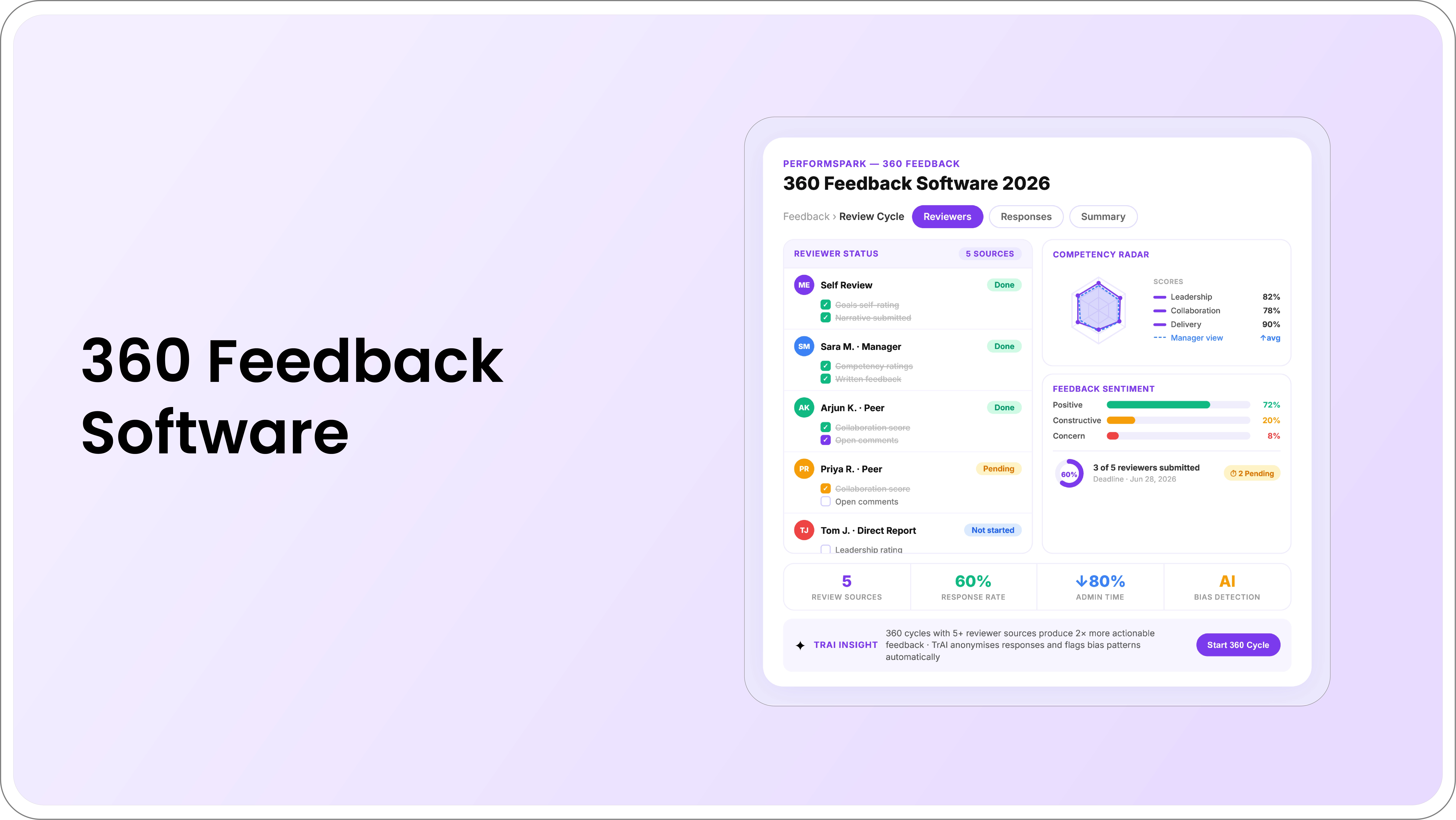
This guide covers what 360-degree feedback software actually automates, how the major platforms compare on the criteria that matter for mid-market HR teams, and how 360 data connects to the calibration process.
Practitioner Insight: A common issue teams run into with 360 programs: the feedback is collected, summarized, and then shared with the employee in a document that sits in their inbox. No IDP. No follow-up in check-ins. No connection to the calibration rating. The operational value of 3360-degree feedback comes from what happens after it is collected, not from the collection itself.
What 360 Degree Feedback Software Actually Automates
Without dedicated software, each step in the 360 cycle involves manual coordination: configuring reviewer lists, sending invitations, tracking response rates, chasing late reviewers, aggregating feedback by competency, and presenting the compiled view in a format managers can use. For a 50-person team running a 360 cycle, this can easily consume two to three days of HR time per cycle.
The key operational question is not whether a platform automates the feedback collection that most do. The meaningful distinction is whether the platform automates reviewer nomination approval, aggregates feedback without manual export and formatting, and connects the 360 results to the performance review and calibration workflow.
Top 360 Feedback Platforms Compared
How 360 Feedback Connects to Performance Calibration
360-degree feedback data is most valuable when it informs rather than replaces the manager's performance rating. In a well-designed review process, the 360-degree feedback report is available to the manager before they write their rating, providing a broader perspective on the employee's behaviors and impact across the organization.
In organizations that run performance calibration, 360-degree feedback becomes additional evidence in the calibration discussion. A manager who can reference specific peer feedback themes to support a rating holds a stronger position in the calibration room than one relying on individual observation alone.
PerformSpark connects 360 review data to the calibration view so managers can access feedback summaries before the calibration session begins. This is the workflow that makes 360-degree feedback operationally significant rather than a standalone exercise.
How to Run a 360 Review That Actually Produces Useful Feedback
Most 360 programs fail not because of the software but because of the design decisions made before a single review is sent.
Select reviewers based on working relationship, not seniority
The most common reviewer selection mistake is choosing reviewers based on organizational proximity rather than actual working relationships. A reviewer who has had minimal direct interaction with the employee during the review period adds noise, not signal.
Use 3 to 7 reviewers, not more
Fewer than three reviewers provide insufficient perspective diversity. More than seven creates reviewer fatigue and dilutes the signal with noise. For most roles, four to five reviewers who have direct working experience with the employee is the optimal range.
Structure questions around observable behaviors
Questions that ask about general impressions produce general answers. Questions that ask about specific observable behaviors, "How effectively does this person communicate when a project is at risk?" produce actionable feedback.
Protect anonymity at the group level
Individual reviewer responses should never be visible to the manager or employee. But anonymity is only meaningful if reviewer groups are large enough that individual responses cannot be reverse-engineered from the aggregate.
Quick Takeaways
- 360 feedback informs rather than replaces the manager's rating. It provides context on behavioral patterns that a single manager cannot observe directly.
- The most common 360 failure is reviewer fatigue. More than seven reviewers per employee adds noise without adding signal.
- Anonymous peer reviews produce more honest responses, but anonymity must be protected at the group size level, not just in the interface.
- In calibration sessions, managers with 360-degree feedback data to reference hold stronger positions than those relying on individual observation alone.
- Development areas identified by three or more independent reviewers are higher-confidence signals than those identified by a single manager.
360-degree feedback is one of the most misapplied tools in performance management. Done well, it surfaces behavioral patterns invisible to a single manager and provides richer evidence for calibration discussions. Done poorly, it becomes a time-consuming, politically fraught process that produces feedback no one acts on.
The difference is almost always in how the feedback is structured, who reviews whom, and whether the results connect to anything that actually influences performance outcomes.
This guide covers what 360-degree feedback software actually automates, how the major platforms compare on the criteria that matter for mid-market HR teams, and how 360 data connects to the calibration process.
Practitioner Insight: A common issue teams run into with 360 programs: the feedback is collected, summarized, and then shared with the employee in a document that sits in their inbox. No IDP. No follow-up in check-ins. No connection to the calibration rating. The operational value of 3360-degree feedback comes from what happens after it is collected, not from the collection itself.
What 360 Degree Feedback Software Actually Automates
Without dedicated software, each step in the 360 cycle involves manual coordination: configuring reviewer lists, sending invitations, tracking response rates, chasing late reviewers, aggregating feedback by competency, and presenting the compiled view in a format managers can use. For a 50-person team running a 360 cycle, this can easily consume two to three days of HR time per cycle.
The key operational question is not whether a platform automates the feedback collection that most do. The meaningful distinction is whether the platform automates reviewer nomination approval, aggregates feedback without manual export and formatting, and connects the 360 results to the performance review and calibration workflow.
Top 360 Feedback Platforms Compared
How 360 Feedback Connects to Performance Calibration
360-degree feedback data is most valuable when it informs rather than replaces the manager's performance rating. In a well-designed review process, the 360-degree feedback report is available to the manager before they write their rating, providing a broader perspective on the employee's behaviors and impact across the organization.
In organizations that run performance calibration, 360-degree feedback becomes additional evidence in the calibration discussion. A manager who can reference specific peer feedback themes to support a rating holds a stronger position in the calibration room than one relying on individual observation alone.
PerformSpark connects 360 review data to the calibration view so managers can access feedback summaries before the calibration session begins. This is the workflow that makes 360-degree feedback operationally significant rather than a standalone exercise.
How to Run a 360 Review That Actually Produces Useful Feedback
Most 360 programs fail not because of the software but because of the design decisions made before a single review is sent.
Select reviewers based on working relationship, not seniority
The most common reviewer selection mistake is choosing reviewers based on organizational proximity rather than actual working relationships. A reviewer who has had minimal direct interaction with the employee during the review period adds noise, not signal.
Use 3 to 7 reviewers, not more
Fewer than three reviewers provide insufficient perspective diversity. More than seven creates reviewer fatigue and dilutes the signal with noise. For most roles, four to five reviewers who have direct working experience with the employee is the optimal range.
Structure questions around observable behaviors
Questions that ask about general impressions produce general answers. Questions that ask about specific observable behaviors, "How effectively does this person communicate when a project is at risk?" produce actionable feedback.
Protect anonymity at the group level
Individual reviewer responses should never be visible to the manager or employee. But anonymity is only meaningful if reviewer groups are large enough that individual responses cannot be reverse-engineered from the aggregate.
.webp)




.svg)

.svg)
.svg)

