
PerformSpark for HR Teams of One: Run a Full Review Cycle Without a Full HRTeam
Most performance management software was built for HR teams with dedicated program managers, implementation specialists, and ongoing administrative support. The product experience assumes someone will configure, maintain, and operate the system continuously.
Key Takeaways

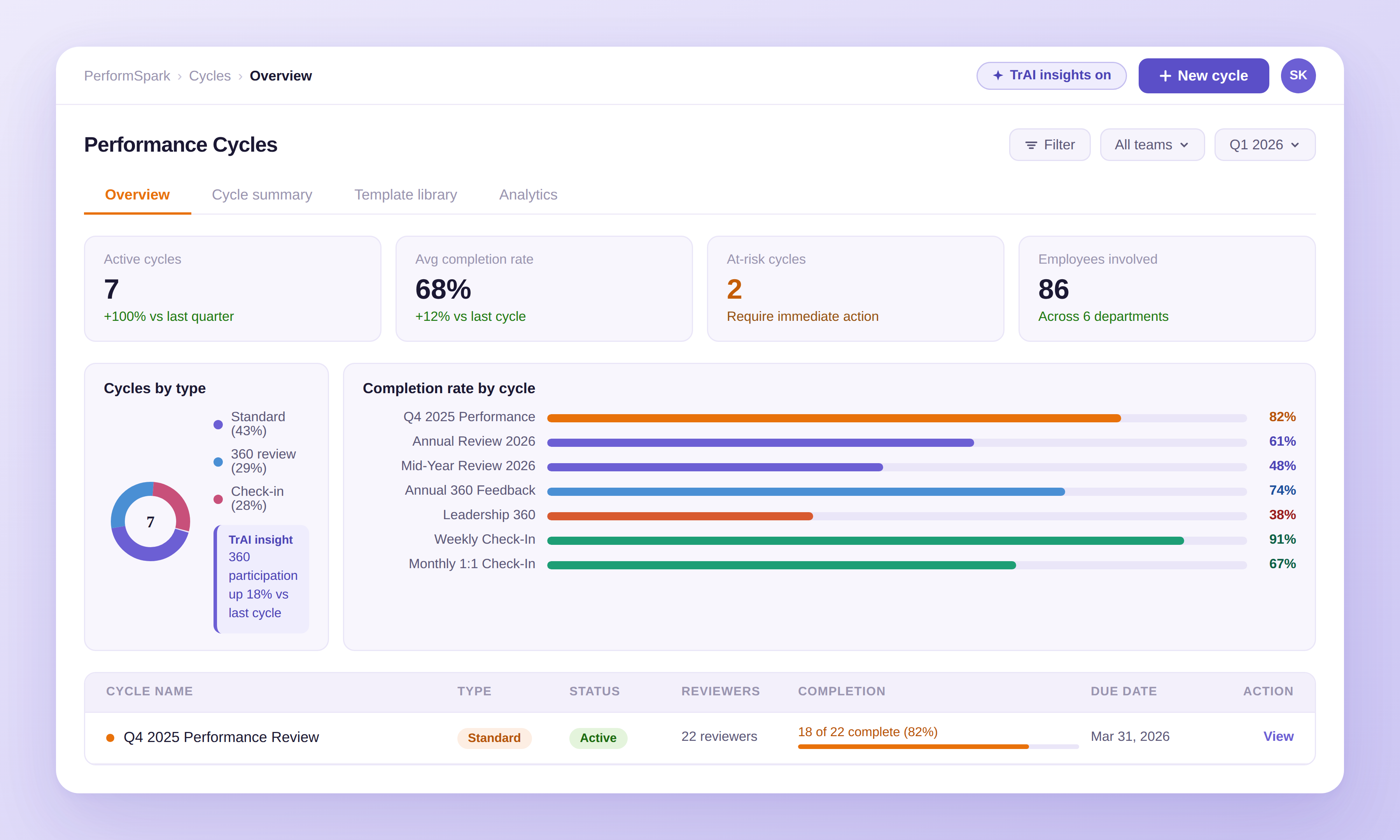
For a 200-person organization, manual review cycle tracking and follow-up consume 4 to 6 hours of HR time per cycle. Automated notifications eliminate this entirely, the single largest time recovery in performance management for solo HR.

TrAI eliminates 2 to 3 days of manual calibration data preparation per cycle. For an HR team of one running two calibration cycles per year, that is 4 to 6 days of capacity recovered annually.

One-session implementation means the first review cycle can launch within two weeks of signing, not two months. This matters when the organization's review deadline is approaching and HR has no runway for a long implementation.
A solo HR practitioner cannot afford a platform that requires ongoing program management to sustain. PerformSpark's automated cadence, smart notifications, goal reminders, and check-in alerts, runs continuously without HR manual intervention.
The Four Time Drains PerformSpark Eliminates for Solo HR
.svg)
Manual review, deadline tracking, and follow-up
Two weeks before the deadline, HR opens a spreadsheet and starts tracking who has and has not submitted. Then the emails begin.
PerformSpark's smart notifications send automated role-based reminders to managers and employees at defined points in the review cycle. Escalations fire automatically to HR when a manager has not completed by the threshold date. HR does not track this manually.

Calibration data preparation
HR pulls rating data, builds distribution views by manager, calculates cohort averages, flags outliers, and prepares the pre-session analysis manually from a spreadsheet.
TrAI generates the complete pre-session calibration analysis automatically before every session: rating distribution by manager, outlier flags, leniency and severity bias patterns. The 2 to 3 day preparation is eliminated.

IDP and PIP documentation coordination
HR tracks which employees have active IDPs, which managers are conducting development conversations, and which PIPs are in progress, typically through a manual tracker or a separate document system.
PerformSpark's IDP and PIP workflows are connected to check-in records and the performance review. HR sees IDP creation rates, milestone completion, and development conversation frequency across the full manager cohort in one dashboard view — without a manual tracker.

Check-in cadence monitoring
HR has no visibility into which managers are holding regular 1-on-1s without manually asking or running a survey. The attrition signal that comes from declining check-in frequency is invisible.
PerformSpark tracks check-in frequency by manager and team in real time. HR receives an automated alert when a manager's cadence drops below the configured threshold, the leading indicator of voluntary attrition that typically appears 8 to 12 weeks before a resignation.
What a Full Review Cycle Looks Like for an HR Team of One Using PerformSpark
One-Session Configuration
HR configures the review cycle in one session review type, timeline, rating scale, questions, calibration dates, notification thresholds. PerformSpark launches the cycle automatically.
Autopilot Tracking
Automated reminders go to employees for self-assessments, managers for review drafting, and escalation alerts go to HR for any completions past the threshold date. HR does not manually track any of this.
TrAI Anomaly Engine
TrAI generates the pre-session analysis automatically, rating distributions, outlier flags, bias patterns. HR distributes it to managers 48 hours before the session. No manual data preparation.
Decision Alignment
HR facilitates an evidence-based discussion using the TrAI analysis. All rating changes are documented in real time in PerformSpark.
Seamless Offboarding/Locking
PerformSpark notifies managers of any rating changes and provides the communication support. HR prepares for review conversations rather than spending the day sending individual emails with rating outcomes.
PerformSpark for Specific HR Team of One Contexts
Series A and B Tech Startups
Engineering and product teams at growth-stage companies outpace HR capacity faster than any other organizational type. The first dedicated HR hire is often responsible for implementing performance management from scratch, building a review cadence that engineers will actually complete, and running calibration across a manager cohort that has never done it before.
Professional Services Firms
Consulting and professional services firms have a structural performance management problem: client deadlines override internal review deadlines consistently. A solo HR practitioner managing reviews for a 200-person consulting firm cannot manually chase 40 managers across active client engagements.
Healthcare and Non-profit Organizations
Healthcare and non-profit HR teams routinely operate as teams of one or two managing performance for 100 to 500 employees across multiple departments and locations. Budget constraints make enterprise platforms prohibitive. PerformSpark's flat $6/user/month pricing and zero implementation overhead make it the only platform in the full-stack PM category that fits the budget and operational reality of most healthcare and non-profit HR teams.

FAQ
Your questions answered
Have questions about PerformSpark? Here are some of the most common queries to help you get started.
Ready to Manage Performance Fairly and Effectively?
Create structured, transparent PIPs that guide improvement and protect your organization.
Can one person manage performance reviews for 200 employees?
What performance management software is best for a small HR team?
How long does it take to implement PerformSpark?
Does PerformSpark work for a company of 50 employees?
Ready to manage performance fairly and effectively?
Run structured review cycles that improve performance and deliver measurable growth.
Related Blogs
.webp)
.webp)
.webp)

Make performance reviews your growth lever
No credit card required • Free setup & training included • Cancel anytime


.svg)

.svg)
.svg)

