



Table of Contents
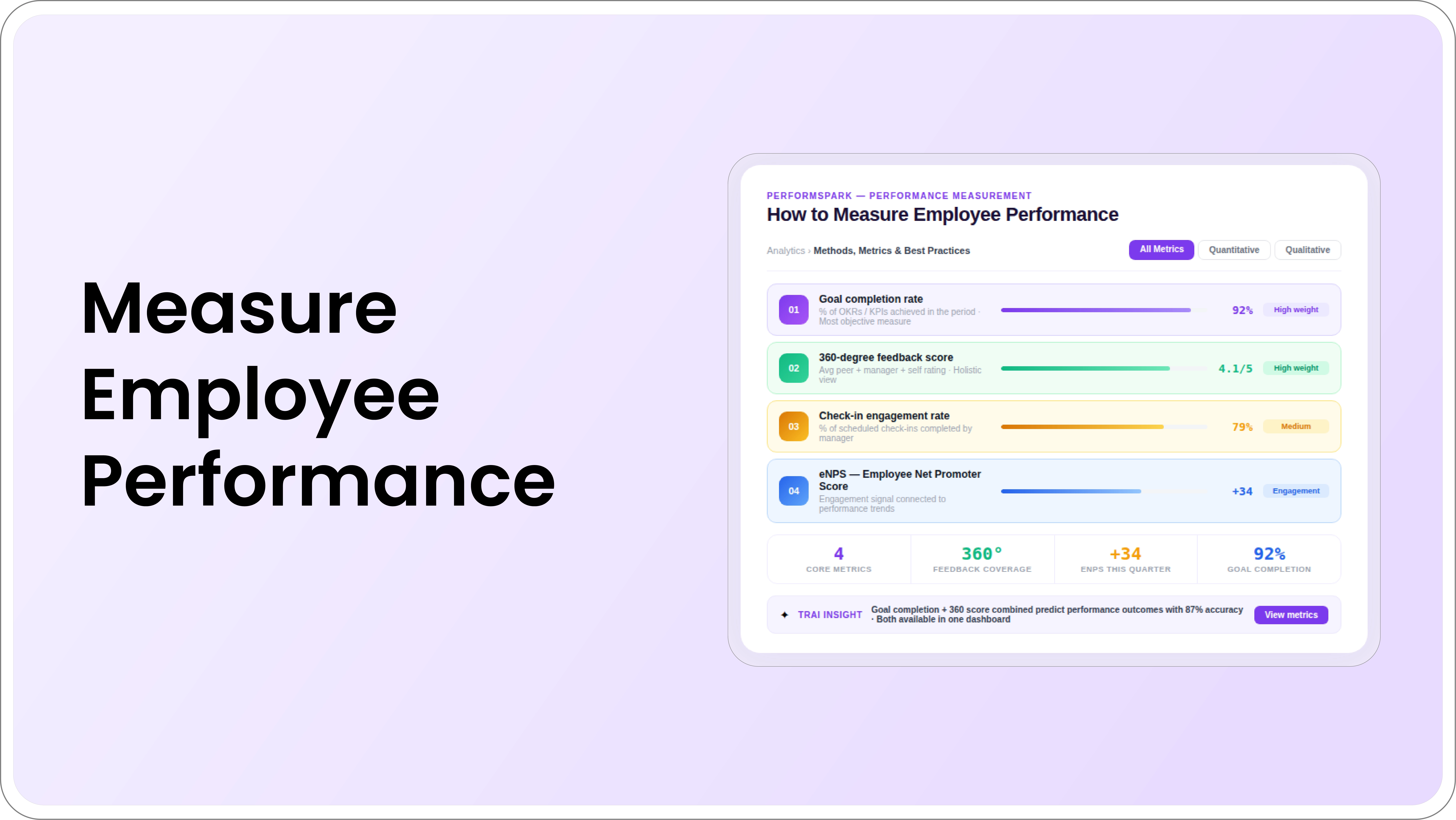
Measuring employee performance means evaluating how well a person fulfills the expectations of the role, achieves agreed goals, produces quality work, and demonstrates relevant workplace behaviors. A useful measurement system combines numbers with context rather than treating one metric or manager rating as the complete picture.
The purpose is not to measure every activity. It is to create enough reliable evidence for coaching, development, recognition, performance reviews, workforce decisions, and process improvement.
This guide explains what to measure, how to select role-specific metrics, how to combine quantitative and qualitative evidence, and how to avoid common measurement errors.
Performance Measurement vs. Performance Management
Performance measurement is the process of collecting and evaluating evidence about work. Performance management is the broader cycle that includes:
- Role expectations and goals
- Ongoing check-ins and feedback
- Performance measurement
- Formal reviews and ratings
- Calibration
- Recognition and development
- Support for performance gaps
Measurement without follow-up creates reports but little improvement. The employee performance management guide explains how the full cycle works.
Five Dimensions of Employee Performance
1. Results and goal achievement
Results measure whether the employee delivered the agreed outcome. Examples include completed milestones, revenue, project delivery, customer retention, resolved cases, process improvements, or implementation outcomes.
Results should be connected to a documented goal management process. Record changes to scope, timing, dependencies, and available resources so the final assessment does not compare the employee with an outdated target.
2. Quality
Quality measures the accuracy, completeness, reliability, or usefulness of the work. Potential indicators include:
- Error or defect rate
- Rework required
- Compliance with an approved standard
- Customer or stakeholder acceptance
- Audit or quality-review results
- Accuracy of forecasts, reports, or records
Quantity without quality can reward activity that creates downstream problems. Pair output metrics with at least one relevant quality measure.
3. Efficiency and execution
Efficiency measures how effectively the employee uses time, resources, and process to produce the expected result. Examples include cycle time, on-time delivery, cost against plan, capacity utilization, or resolution time.
Efficiency should not reward unsafe shortcuts, hidden overtime, or work transferred to others. The metric needs guardrails for quality and sustainability.
4. Role behaviors and competencies
Some important work cannot be captured by output volume alone. Collaboration, communication, judgment, leadership, customer focus, adaptability, and technical practice may require behavior-based assessment.
Define what the competency looks like in the role. Use examples such as βraises delivery risks before they affect dependent teamsβ rather than broad labels such as βcommunicates well.β
5. Broader contribution
Broader contribution includes mentoring, knowledge sharing, process improvement, cross-functional influence, risk reduction, and support for team capability. This dimension should be relevant to the role and level. It should not become a vague expectation that every employee perform unpaid work outside their responsibilities.
Quantitative and Qualitative Measurement Methods
Quantitative methods
- KPIs with defined targets and data sources
- Goal or milestone completion
- Quality, error, or rework rates
- Revenue, margin, retention, or pipeline measures
- Delivery, response, or resolution time
- Customer or stakeholder scores
- Completion and adoption rates
Numbers make trends easier to compare, but they may not explain why the result occurred. A metric can also be distorted by seasonality, case complexity, role changes, data quality, or factors outside the employee's control.
Qualitative methods
- Manager observations documented close to the event
- Project retrospectives and work samples
- Employee self-assessment
- Peer, customer, or direct-report input
- 360-degree feedback
- Behaviorally anchored rating scales
- Development and coaching records
Qualitative evidence adds context and captures behavior, but it should be specific enough for another reviewer to understand what occurred.
How to Choose Employee Performance Metrics
- Start with the purpose of the role. Identify the outcomes the position exists to produce.
- Select a small number of important measures. Too many metrics dilute attention and create conflicting incentives.
- Balance results and quality. Do not measure speed without accuracy or volume without customer impact.
- Confirm employee control. Separate the employee's contribution from outcomes driven mainly by market conditions, staffing, approvals, or another team.
- Define the data source. State where the number comes from, who owns it, and how often it is updated.
- Set the review cadence. Some measures should be checked weekly, while others need a monthly, quarterly, or project-cycle view.
- Test for gaming and unintended consequences. Ask how a person could hit the metric while harming the real outcome.
- Document changes. Update targets when scope, resources, or business priorities materially change.
Role-Based Performance Metric Examples
Sales
- Revenue or bookings against an agreed target
- Pipeline coverage and quality
- Win rate
- Forecast accuracy
- Customer handoff quality
- Retention or expansion where the role influences it
Customer success
- Renewal and retention outcomes
- Customer health and risk management
- Time to value
- Escalation resolution
- Adoption of agreed product capabilities
- Quality and consistency of customer plans
Engineering
- Delivery against agreed scope and milestones
- Defect and rework patterns
- Reliability or service-level contribution
- Code review and technical quality
- Documentation and knowledge sharing
- Collaboration on dependencies and incidents
Operations
- Cycle time
- Accuracy and exception rate
- Cost or resource use against plan
- Process adherence
- Service-level performance
- Process improvements implemented
HR
- Delivery against the HR program plan
- Hiring, onboarding, review, or development process completion
- Quality and timeliness of employee support
- Data accuracy
- Manager adoption
- Stakeholder feedback on HR service
People managers
- Team goal progress
- Quality and cadence of manager check-ins
- Timeliness and quality of feedback
- Follow-through on development commitments
- Team delivery and operating health
- Appropriate escalation and risk management
Team turnover or engagement may provide context, but these outcomes should not automatically be treated as an individual manager score without considering team composition, organizational changes, labor-market conditions, and employee-specific circumstances.
How to Build a Balanced Performance Scorecard
A practical scorecard can include four sections:
- Results: Two to four role outcomes or goals
- Quality: One or two measures that protect the standard of work
- Behaviors: Two to four competencies relevant to the role
- Development: One agreed capability or growth commitment
For each measure, document:
- Definition
- Target or expected behavior
- Data source
- Employee influence
- Review cadence
- Known limitations
- Manager support
A connected performance analytics dashboard can bring current goals, review data, and workflow completion into one view while leaving case-specific interpretation to managers and HR.
How to Measure Roles Without Simple Output Metrics
For strategy, leadership, advisory, creative, and complex knowledge-work roles, define deliverables and decision quality rather than inventing activity counts.
Possible evidence includes:
- Quality and usefulness of recommendations
- Decisions enabled
- Stakeholder outcomes
- Programs or systems built
- Risk identified and managed
- Adoption of a new process
- Capability developed in others
- Quality of judgment under uncertainty
Use project milestones, work samples, stakeholder evidence, and behaviorally anchored competencies. Multi-source feedback may help where the manager cannot directly observe much of the work.
Common Employee Performance Measurement Mistakes
Measuring activity instead of value
Hours online, messages sent, meetings attended, or tasks opened may describe activity without showing useful output. Use activity measures only when they genuinely connect to the role outcome.
Using one metric as the entire assessment
A single number can hide quality, complexity, teamwork, customer impact, and changing conditions. Use a balanced set of evidence.
Setting metrics the employee cannot influence
Targets primarily controlled by another team, manager approval, market conditions, or missing resources produce misleading assessments. Record dependencies and evaluate the employee's contribution.
Changing expectations after the work
Employees should know what will be measured and how success is defined before the assessment period ends. Document approved changes as they occur.
Comparing different roles without context
Raw output across different territories, product areas, project complexity, or customer segments may not be comparable. Calibrate expectations and evidence before comparing employees.
Relying on year-end memory
Regular check-ins, feedback, goal updates, and recognition records help managers review the full period instead of overemphasizing recent events.
How Calibration Improves Measurement Consistency
Performance calibration allows managers and HR to compare how standards are being applied. Participants can review rating distributions, role context, goal evidence, and uncertain cases before final ratings are communicated.
Calibration should test the interpretation of evidence, not erase legitimate differences or force a curve. The calibration best practices guide explains how to prepare and run the discussion.
Turn Measurement Into Coaching and Development
Measurement should lead to action. Strong performance may result in recognition, expanded responsibility, or a new goal. A skill gap may move into an individual development plan. A current performance concern may require coaching, clarified expectations, or a formal process after HR review.
Managers can use the performance review phrases guide to convert evidence into clear comments and the areas of improvement guide to define actionable next steps.
Measure Performance With Connected Evidence
PerformSpark connects goals, reviews, check-ins, feedback, development, calibration, and reporting so managers can work from an ongoing record rather than an isolated spreadsheet.
Plans start at $8 per user per month. Review PerformSpark pricing or book a personalized demo to see how role-based performance evidence can be configured.
Quick Takeaways: Measuring Employee Performance
- Combine results, quality, efficiency, role behaviors, and broader contribution instead of relying on one metric.
- Select a small set of role-relevant measures with clear data sources, employee influence, and review cadences.
- Use qualitative evidence to explain context that numbers cannot capture.
- Measurement should lead to coaching, recognition, development, or clarified expectations.
Measuring employee performance means evaluating how well a person fulfills the expectations of the role, achieves agreed goals, produces quality work, and demonstrates relevant workplace behaviors. A useful measurement system combines numbers with context rather than treating one metric or manager rating as the complete picture.
The purpose is not to measure every activity. It is to create enough reliable evidence for coaching, development, recognition, performance reviews, workforce decisions, and process improvement.
This guide explains what to measure, how to select role-specific metrics, how to combine quantitative and qualitative evidence, and how to avoid common measurement errors.
Performance Measurement vs. Performance Management
Performance measurement is the process of collecting and evaluating evidence about work. Performance management is the broader cycle that includes:
- Role expectations and goals
- Ongoing check-ins and feedback
- Performance measurement
- Formal reviews and ratings
- Calibration
- Recognition and development
- Support for performance gaps
Measurement without follow-up creates reports but little improvement. The employee performance management guide explains how the full cycle works.
Five Dimensions of Employee Performance
1. Results and goal achievement
Results measure whether the employee delivered the agreed outcome. Examples include completed milestones, revenue, project delivery, customer retention, resolved cases, process improvements, or implementation outcomes.
Results should be connected to a documented goal management process. Record changes to scope, timing, dependencies, and available resources so the final assessment does not compare the employee with an outdated target.
2. Quality
Quality measures the accuracy, completeness, reliability, or usefulness of the work. Potential indicators include:
- Error or defect rate
- Rework required
- Compliance with an approved standard
- Customer or stakeholder acceptance
- Audit or quality-review results
- Accuracy of forecasts, reports, or records
Quantity without quality can reward activity that creates downstream problems. Pair output metrics with at least one relevant quality measure.
3. Efficiency and execution
Efficiency measures how effectively the employee uses time, resources, and process to produce the expected result. Examples include cycle time, on-time delivery, cost against plan, capacity utilization, or resolution time.
Efficiency should not reward unsafe shortcuts, hidden overtime, or work transferred to others. The metric needs guardrails for quality and sustainability.
4. Role behaviors and competencies
Some important work cannot be captured by output volume alone. Collaboration, communication, judgment, leadership, customer focus, adaptability, and technical practice may require behavior-based assessment.
Define what the competency looks like in the role. Use examples such as βraises delivery risks before they affect dependent teamsβ rather than broad labels such as βcommunicates well.β
5. Broader contribution
Broader contribution includes mentoring, knowledge sharing, process improvement, cross-functional influence, risk reduction, and support for team capability. This dimension should be relevant to the role and level. It should not become a vague expectation that every employee perform unpaid work outside their responsibilities.
Quantitative and Qualitative Measurement Methods
Quantitative methods
- KPIs with defined targets and data sources
- Goal or milestone completion
- Quality, error, or rework rates
- Revenue, margin, retention, or pipeline measures
- Delivery, response, or resolution time
- Customer or stakeholder scores
- Completion and adoption rates
Numbers make trends easier to compare, but they may not explain why the result occurred. A metric can also be distorted by seasonality, case complexity, role changes, data quality, or factors outside the employee's control.
Qualitative methods
- Manager observations documented close to the event
- Project retrospectives and work samples
- Employee self-assessment
- Peer, customer, or direct-report input
- 360-degree feedback
- Behaviorally anchored rating scales
- Development and coaching records
Qualitative evidence adds context and captures behavior, but it should be specific enough for another reviewer to understand what occurred.
How to Choose Employee Performance Metrics
- Start with the purpose of the role. Identify the outcomes the position exists to produce.
- Select a small number of important measures. Too many metrics dilute attention and create conflicting incentives.
- Balance results and quality. Do not measure speed without accuracy or volume without customer impact.
- Confirm employee control. Separate the employee's contribution from outcomes driven mainly by market conditions, staffing, approvals, or another team.
- Define the data source. State where the number comes from, who owns it, and how often it is updated.
- Set the review cadence. Some measures should be checked weekly, while others need a monthly, quarterly, or project-cycle view.
- Test for gaming and unintended consequences. Ask how a person could hit the metric while harming the real outcome.
- Document changes. Update targets when scope, resources, or business priorities materially change.
Role-Based Performance Metric Examples
Sales
- Revenue or bookings against an agreed target
- Pipeline coverage and quality
- Win rate
- Forecast accuracy
- Customer handoff quality
- Retention or expansion where the role influences it
Customer success
- Renewal and retention outcomes
- Customer health and risk management
- Time to value
- Escalation resolution
- Adoption of agreed product capabilities
- Quality and consistency of customer plans
Engineering
- Delivery against agreed scope and milestones
- Defect and rework patterns
- Reliability or service-level contribution
- Code review and technical quality
- Documentation and knowledge sharing
- Collaboration on dependencies and incidents
Operations
- Cycle time
- Accuracy and exception rate
- Cost or resource use against plan
- Process adherence
- Service-level performance
- Process improvements implemented
HR
- Delivery against the HR program plan
- Hiring, onboarding, review, or development process completion
- Quality and timeliness of employee support
- Data accuracy
- Manager adoption
- Stakeholder feedback on HR service
People managers
- Team goal progress
- Quality and cadence of manager check-ins
- Timeliness and quality of feedback
- Follow-through on development commitments
- Team delivery and operating health
- Appropriate escalation and risk management
Team turnover or engagement may provide context, but these outcomes should not automatically be treated as an individual manager score without considering team composition, organizational changes, labor-market conditions, and employee-specific circumstances.
How to Build a Balanced Performance Scorecard
A practical scorecard can include four sections:
- Results: Two to four role outcomes or goals
- Quality: One or two measures that protect the standard of work
- Behaviors: Two to four competencies relevant to the role
- Development: One agreed capability or growth commitment
For each measure, document:
- Definition
- Target or expected behavior
- Data source
- Employee influence
- Review cadence
- Known limitations
- Manager support
A connected performance analytics dashboard can bring current goals, review data, and workflow completion into one view while leaving case-specific interpretation to managers and HR.
How to Measure Roles Without Simple Output Metrics
For strategy, leadership, advisory, creative, and complex knowledge-work roles, define deliverables and decision quality rather than inventing activity counts.
Possible evidence includes:
- Quality and usefulness of recommendations
- Decisions enabled
- Stakeholder outcomes
- Programs or systems built
- Risk identified and managed
- Adoption of a new process
- Capability developed in others
- Quality of judgment under uncertainty
Use project milestones, work samples, stakeholder evidence, and behaviorally anchored competencies. Multi-source feedback may help where the manager cannot directly observe much of the work.
Common Employee Performance Measurement Mistakes
Measuring activity instead of value
Hours online, messages sent, meetings attended, or tasks opened may describe activity without showing useful output. Use activity measures only when they genuinely connect to the role outcome.
Using one metric as the entire assessment
A single number can hide quality, complexity, teamwork, customer impact, and changing conditions. Use a balanced set of evidence.
Setting metrics the employee cannot influence
Targets primarily controlled by another team, manager approval, market conditions, or missing resources produce misleading assessments. Record dependencies and evaluate the employee's contribution.
Changing expectations after the work
Employees should know what will be measured and how success is defined before the assessment period ends. Document approved changes as they occur.
Comparing different roles without context
Raw output across different territories, product areas, project complexity, or customer segments may not be comparable. Calibrate expectations and evidence before comparing employees.
Relying on year-end memory
Regular check-ins, feedback, goal updates, and recognition records help managers review the full period instead of overemphasizing recent events.
How Calibration Improves Measurement Consistency
Performance calibration allows managers and HR to compare how standards are being applied. Participants can review rating distributions, role context, goal evidence, and uncertain cases before final ratings are communicated.
Calibration should test the interpretation of evidence, not erase legitimate differences or force a curve. The calibration best practices guide explains how to prepare and run the discussion.
Turn Measurement Into Coaching and Development
Measurement should lead to action. Strong performance may result in recognition, expanded responsibility, or a new goal. A skill gap may move into an individual development plan. A current performance concern may require coaching, clarified expectations, or a formal process after HR review.
Managers can use the performance review phrases guide to convert evidence into clear comments and the areas of improvement guide to define actionable next steps.
Measure Performance With Connected Evidence
PerformSpark connects goals, reviews, check-ins, feedback, development, calibration, and reporting so managers can work from an ongoing record rather than an isolated spreadsheet.
Plans start at $8 per user per month. Review PerformSpark pricing or book a personalized demo to see how role-based performance evidence can be configured.
Frequently Asked Questions
What are the best methods for measuring employee performance?
Use a balanced combination of goal results, quality measures, efficiency, role-relevant behaviors, work samples, manager observations, employee input, and multi-source feedback where useful. The right mix depends on the role and should be defined before the review period ends.
How do you measure performance for roles without clear output metrics?
Define the outcomes, decisions, deliverables, stakeholder value, risk management, and role behaviors that matter. Use project milestones, work samples, stakeholder evidence, and behaviorally anchored competencies rather than inventing activity counts that do not reflect value.
How does ongoing feedback improve performance measurement?
Ongoing feedback creates a record across the full review period. Managers can use check-in notes, goal updates, recognition, and specific observations instead of reconstructing performance from recent memory at year-end.
What is the difference between performance measurement and performance management?
Performance measurement collects and evaluates evidence about work. Performance management is the complete cycle of setting expectations, monitoring progress, giving feedback, reviewing performance, calibrating ratings, recognizing contribution, and supporting development or improvement.
How can organizations make performance ratings more consistent across managers?
Define clear standards, train managers, require specific evidence, review complete performance records, and use calibration to compare how the standards are being applied. Calibration should examine context and evidence without forcing identical rating distributions.