



Manager 1-on-1 Templates

Skip-Level Meeting Questions: 35 Questions That Surface What Managers Cannot See

A skip-level meeting is a structured conversation between a senior leader and an employee who reports to one of that leader's direct reports. The purpose is to surface information about team health, manager effectiveness, and employee experience that does not travel up the management chain organically. Skip-level meetings are not investigations into managers. They are a structured signal-gathering practice.

Updated :
April 30, 2026

Mahesh Kumar

Founder, TraineryHCM.com
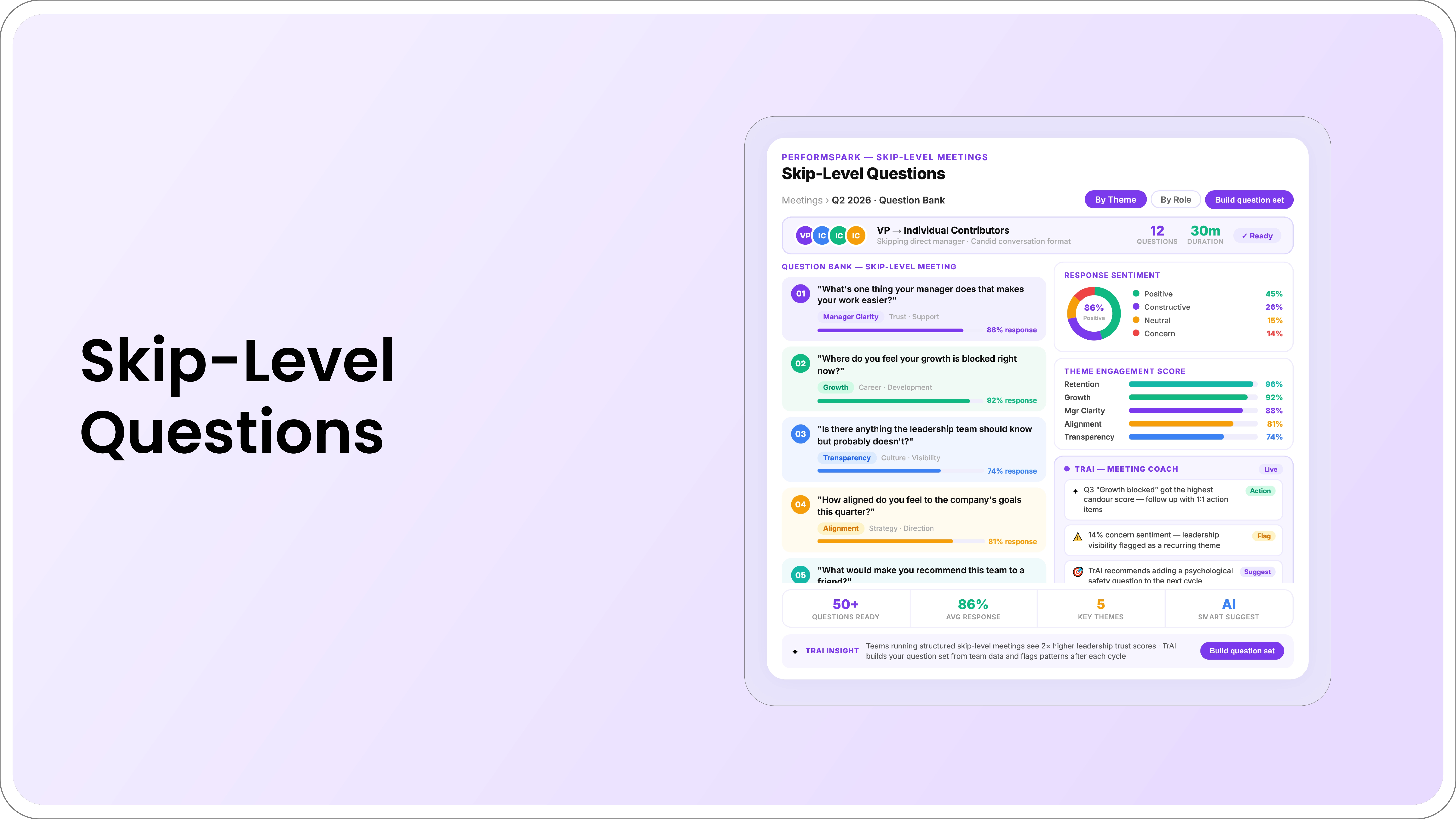
Skip-Level Meeting Questions

Table of Contents

There is information about how your organization actually works that does not travel up the management chain. Not because employees are hiding it but because most organizations do not have a structured mechanism for surfacing it.

A manager who is inconsistent with feedback, unclear with priorities, or creates friction on the team is unlikely to be accurately represented in the reports they write or the updates they give their own manager. The employees who experience that dynamic have the clearest view of it. Skip-level meetings are how senior leaders access that view without bypassing the management structure entirely.

This guide gives you 35 specific skip-level meeting questions organized across four categories, a framework for running skip-level meetings in a way that protects the manager relationship, and guidance on how to act on what you hear without creating the impression that skip-levels are a grievance process.

Practitioner Insight: A common issue teams run into: the skip-level meeting is announced as a routine listening exercise, but employees experience it as an opportunity to surface concerns that were not addressed by their manager. Both things can be true simultaneously. The difference is in the framing. Leaders who open with "I do these to understand what is working, not to investigate anything specific" get richer, more balanced feedback than leaders who open with "tell me what is going wrong."

When to Hold Skip-Level Meetings β€” and When Not To

Skip-level meetings work best as a scheduled, recurring practice rather than a reactive response to a specific concern. When they are only triggered by performance problems or complaints, employees correctly read them as investigations, which reduces candor.

When to hold them

  • Quarterly or biannually as a routine listening cadence, not linked to any specific event.
  • When a new leader takes over a team and wants to establish a direct line of communication without disrupting the management structure.
  • When engagement survey scores drop for a specific team, a qualitative context is needed to understand the cause.
  • When a team is going through significant change, restructure, new manager, product pivot, and leadership wants a direct read on how it is landing.

When not to hold them

  • As a direct response to a specific complaint about a specific manager, without being transparent about the purpose.
  • When there is no plan for what to do with the feedback a skip-level meeting that produces no visible action is worse than not holding one.
  • When the leader does not have the time to follow up with the manager after the meeting with relevant, non-attributable themes.

How to Run a Skip-Level Meeting That Produces Honest Feedback

The quality of a skip-level meeting is determined before the meeting begins, in how it is framed to the employee and the manager.

Tell the manager it is happening

The manager should know that skip-level meetings are scheduled with their team. Not the specific questions being asked, and not the individual responses. But the practice itself should not be a surprise. A manager who discovers their leader has been meeting with their team without their knowledge will lose trust in both the leader and the process.

Frame it correctly for the employee

Open with: "I hold these meetings with everyone across the organization on a regular basis. They are not about anything specific. I want to hear what is working well and what you think leadership should know about. Everything you share with me is used to identify themes I won't be attributing specific quotes to you or using this as a way to evaluate your manager directly."

Take notes on themes, not quotes

Document what you hear at the theme level. "Three people mentioned that cross-team dependency visibility is a problem" is useful for a manager development conversation. "Sarah told me that James is not good at communicating" is not.

Follow up with the manager

After a round of skip-level meetings with a team, the leader should meet with the manager to share the themes observed framed as useful feedback for the manager, not as a performance concern. This closes the loop and demonstrates that the practice is developmental rather than investigative.

  • The patterns that skip-level meetings surface, manager coaching gaps, team health signals, development gaps that are not visible in performance data β€” are most actionable when they can be connected to what the data already shows. PerformSpark's check-in frequency records and pulse survey scores give skip-level conversations an evidence baseline: you know before the meeting whether a manager's coaching cadence has dropped, and you know after it whether what you heard matches the signal the data was already showing. See how check-in and pulse data connects to skip-level programs in PerformSpark β†’

35 Skip-Level Meeting Questions by Category

Use 5 to 8 questions per meeting not all 35. Select the category most relevant to the current organizational context. Let the employee's responses guide which follow-up questions are worth pursuing.

Team Health Questions:

Use these to understand how the team is functioning, what is working, and where operational friction exists.

  1. What is working particularly well for the team right now that you want to make sure leadership is aware of?
  2. If you could change one thing about how the team operates, what would have the biggest positive impact?
  3. Are there resource or process constraints that are slowing the team down that have not been raised with leadership?
  4. How would you describe the team's energy and motivation at the moment?
  5. Are there cross-team dynamics creating friction for your work that you think leadership should know about?
  6. When the team faces a challenge, what typically happens? How does the team navigate it?
  7. Is there anything the team has tried that worked well but has since been dropped that you think is worth revisiting?
  8. What is the biggest operational risk the team is carrying right now that leadership may not have full visibility into?
  9. Is there anything about how the team is structured or organized that you think limits its effectiveness?

Manager Effectiveness Questions:

Use these to understand the quality of the employee's day-to-day management experience. These are the most sensitive questions lead with them only after the employee appears comfortable.

  1. Do you feel you receive clear expectations from your manager about what success looks like in your role?
  2. How often do you have a meaningful development conversation with your manager, beyond project status updates?
  3. When you raise a concern or challenge with your manager, do you feel it is heard and acted on?
  4. Does your manager give you the information and context you need to understand how your work connects to the broader direction?
  5. If you have given feedback to your manager, how has it been received?
  6. Do you feel your manager advocates for you for your work, your development, and your recognition?
  7. When your manager gives you feedback, is it specific enough to be actionable?
  8. How often do you and your manager discuss your longer-term career trajectory, not just your current role?
  9. Is there support you need from your manager that you are not currently getting?

Career Development Questions:

Use these to understand how connected the employee feels to their own growth trajectory within the organization.

  1. Do you have a clear sense of what your next growth opportunity within the company could look like?
  2. Is there a skill or capability you are trying to develop where you need more support or access to resources?
  3. Do you feel your contributions during this period have been recognized appropriately?
  4. Are there projects or responsibilities you would like to take on that you have not been given the opportunity to pursue?
  5. Do you feel the company invests meaningfully in your development, or does it feel more like something that happens when time permits?
  6. Is there a person in the organization inside or outside your team who you think could be a useful mentor for your development?
  7. When you think about where you want to be in two or three years, does this organization feel like the right place to get there?
  8. If you were designing your own development plan for the next 12 months, what would it include?

Company Culture Questions:

Use these later in the conversation, once the employee is comfortable. These questions often surface the most candid organizational intelligence.

  1. Is there anything about how we work as a company that you feel we should examine or change?
  2. Do you feel the company's stated values are reflected in how decisions actually get made day to day?
  3. Is there anything you think leadership does not understand about what it is like to work here?
  4. Are there things that happen regularly here that you think would surprise people outside the organization?
  5. Do you feel employees are treated equitably that similar contributions lead to similar recognition and opportunity?
  6. Is there a decision the company has made recently that you did not understand the reasoning behind?
  7. If a friend were considering joining the company, what would you tell them that you would not say publicly?
  8. What is one thing the company does consistently well that you think should be protected as we grow?
  9. What would need to be different for you to feel even more committed to staying here long-term?

How to Act on Skip-Level Feedback Without Undermining the Manager

The most common failure mode in skip-level programs is not the meeting itself it is what happens afterward. Employees who surface concerns in a skip-level and observe nothing change will not participate meaningfully in the next cycle. And managers who feel ambushed by feedback they did not know was being collected will lose trust in the process.

What to share with the manager

After completing a round of skip-level meetings with a team, schedule a conversation with the manager framed as: "I've done a round of skip-levels with your team. I want to share what I heard because I think some of it is useful for your development. This is not a performance conversation it's a signal-sharing conversation."

Share themes. Do not share attribution. "A few people mentioned that the expectation-setting around project priorities is sometimes unclear" is useful. "James said he never knows what he is supposed to be working on" is not.

What to escalate to HR

If skip-level conversations surface consistent themes about a specific manager that suggest performance concerns persistent lack of clarity, patterns of non-responsiveness, or team members reporting they are considering leaving because of the manager that is a signal for HR to be involved, not handled as a skip-level feedback loop.

PerformSpark's check-in tracking makes this cross-referencing possible in practice. When skip-level themes about a manager correlate with low check-in frequency for that manager's team, HR has both the qualitative signal and the behavioral data needed to design a targeted development intervention.

If your skip-level conversations are surfacing patterns about manager effectiveness or team health, PerformSpark gives you the data layer that makes those conversations more than anecdotal.

Check-in frequency records, pulse survey trends, and goal progress data are visible before the skip-level happens β€” so the question becomes not "is there a problem?" but "which specific manager and which specific team, and how long has the signal been there?"

See how PerformSpark connects coaching cadence and engagement data for HR leaders who run skip-level programs β†’ Book a demo

There is information about how your organization actually works that does not travel up the management chain. Not because employees are hiding it but because most organizations do not have a structured mechanism for surfacing it.

A manager who is inconsistent with feedback, unclear with priorities, or creates friction on the team is unlikely to be accurately represented in the reports they write or the updates they give their own manager. The employees who experience that dynamic have the clearest view of it. Skip-level meetings are how senior leaders access that view without bypassing the management structure entirely.

This guide gives you 35 specific skip-level meeting questions organized across four categories, a framework for running skip-level meetings in a way that protects the manager relationship, and guidance on how to act on what you hear without creating the impression that skip-levels are a grievance process.

Practitioner Insight: A common issue teams run into: the skip-level meeting is announced as a routine listening exercise, but employees experience it as an opportunity to surface concerns that were not addressed by their manager. Both things can be true simultaneously. The difference is in the framing. Leaders who open with "I do these to understand what is working, not to investigate anything specific" get richer, more balanced feedback than leaders who open with "tell me what is going wrong."

When to Hold Skip-Level Meetings β€” and When Not To

Skip-level meetings work best as a scheduled, recurring practice rather than a reactive response to a specific concern. When they are only triggered by performance problems or complaints, employees correctly read them as investigations, which reduces candor.

When to hold them

  • Quarterly or biannually as a routine listening cadence, not linked to any specific event.
  • When a new leader takes over a team and wants to establish a direct line of communication without disrupting the management structure.
  • When engagement survey scores drop for a specific team, a qualitative context is needed to understand the cause.
  • When a team is going through significant change, restructure, new manager, product pivot, and leadership wants a direct read on how it is landing.

When not to hold them

  • As a direct response to a specific complaint about a specific manager, without being transparent about the purpose.
  • When there is no plan for what to do with the feedback a skip-level meeting that produces no visible action is worse than not holding one.
  • When the leader does not have the time to follow up with the manager after the meeting with relevant, non-attributable themes.

How to Run a Skip-Level Meeting That Produces Honest Feedback

The quality of a skip-level meeting is determined before the meeting begins, in how it is framed to the employee and the manager.

Tell the manager it is happening

The manager should know that skip-level meetings are scheduled with their team. Not the specific questions being asked, and not the individual responses. But the practice itself should not be a surprise. A manager who discovers their leader has been meeting with their team without their knowledge will lose trust in both the leader and the process.

Frame it correctly for the employee

Open with: "I hold these meetings with everyone across the organization on a regular basis. They are not about anything specific. I want to hear what is working well and what you think leadership should know about. Everything you share with me is used to identify themes I won't be attributing specific quotes to you or using this as a way to evaluate your manager directly."

Take notes on themes, not quotes

Document what you hear at the theme level. "Three people mentioned that cross-team dependency visibility is a problem" is useful for a manager development conversation. "Sarah told me that James is not good at communicating" is not.

Follow up with the manager

After a round of skip-level meetings with a team, the leader should meet with the manager to share the themes observed framed as useful feedback for the manager, not as a performance concern. This closes the loop and demonstrates that the practice is developmental rather than investigative.

  • The patterns that skip-level meetings surface, manager coaching gaps, team health signals, development gaps that are not visible in performance data β€” are most actionable when they can be connected to what the data already shows. PerformSpark's check-in frequency records and pulse survey scores give skip-level conversations an evidence baseline: you know before the meeting whether a manager's coaching cadence has dropped, and you know after it whether what you heard matches the signal the data was already showing. See how check-in and pulse data connects to skip-level programs in PerformSpark β†’

35 Skip-Level Meeting Questions by Category

Use 5 to 8 questions per meeting not all 35. Select the category most relevant to the current organizational context. Let the employee's responses guide which follow-up questions are worth pursuing.

Team Health Questions:

Use these to understand how the team is functioning, what is working, and where operational friction exists.

  1. What is working particularly well for the team right now that you want to make sure leadership is aware of?
  2. If you could change one thing about how the team operates, what would have the biggest positive impact?
  3. Are there resource or process constraints that are slowing the team down that have not been raised with leadership?
  4. How would you describe the team's energy and motivation at the moment?
  5. Are there cross-team dynamics creating friction for your work that you think leadership should know about?
  6. When the team faces a challenge, what typically happens? How does the team navigate it?
  7. Is there anything the team has tried that worked well but has since been dropped that you think is worth revisiting?
  8. What is the biggest operational risk the team is carrying right now that leadership may not have full visibility into?
  9. Is there anything about how the team is structured or organized that you think limits its effectiveness?

Manager Effectiveness Questions:

Use these to understand the quality of the employee's day-to-day management experience. These are the most sensitive questions lead with them only after the employee appears comfortable.

  1. Do you feel you receive clear expectations from your manager about what success looks like in your role?
  2. How often do you have a meaningful development conversation with your manager, beyond project status updates?
  3. When you raise a concern or challenge with your manager, do you feel it is heard and acted on?
  4. Does your manager give you the information and context you need to understand how your work connects to the broader direction?
  5. If you have given feedback to your manager, how has it been received?
  6. Do you feel your manager advocates for you for your work, your development, and your recognition?
  7. When your manager gives you feedback, is it specific enough to be actionable?
  8. How often do you and your manager discuss your longer-term career trajectory, not just your current role?
  9. Is there support you need from your manager that you are not currently getting?

Career Development Questions:

Use these to understand how connected the employee feels to their own growth trajectory within the organization.

  1. Do you have a clear sense of what your next growth opportunity within the company could look like?
  2. Is there a skill or capability you are trying to develop where you need more support or access to resources?
  3. Do you feel your contributions during this period have been recognized appropriately?
  4. Are there projects or responsibilities you would like to take on that you have not been given the opportunity to pursue?
  5. Do you feel the company invests meaningfully in your development, or does it feel more like something that happens when time permits?
  6. Is there a person in the organization inside or outside your team who you think could be a useful mentor for your development?
  7. When you think about where you want to be in two or three years, does this organization feel like the right place to get there?
  8. If you were designing your own development plan for the next 12 months, what would it include?

Company Culture Questions:

Use these later in the conversation, once the employee is comfortable. These questions often surface the most candid organizational intelligence.

  1. Is there anything about how we work as a company that you feel we should examine or change?
  2. Do you feel the company's stated values are reflected in how decisions actually get made day to day?
  3. Is there anything you think leadership does not understand about what it is like to work here?
  4. Are there things that happen regularly here that you think would surprise people outside the organization?
  5. Do you feel employees are treated equitably that similar contributions lead to similar recognition and opportunity?
  6. Is there a decision the company has made recently that you did not understand the reasoning behind?
  7. If a friend were considering joining the company, what would you tell them that you would not say publicly?
  8. What is one thing the company does consistently well that you think should be protected as we grow?
  9. What would need to be different for you to feel even more committed to staying here long-term?

How to Act on Skip-Level Feedback Without Undermining the Manager

The most common failure mode in skip-level programs is not the meeting itself it is what happens afterward. Employees who surface concerns in a skip-level and observe nothing change will not participate meaningfully in the next cycle. And managers who feel ambushed by feedback they did not know was being collected will lose trust in the process.

What to share with the manager

After completing a round of skip-level meetings with a team, schedule a conversation with the manager framed as: "I've done a round of skip-levels with your team. I want to share what I heard because I think some of it is useful for your development. This is not a performance conversation it's a signal-sharing conversation."

Share themes. Do not share attribution. "A few people mentioned that the expectation-setting around project priorities is sometimes unclear" is useful. "James said he never knows what he is supposed to be working on" is not.

What to escalate to HR

If skip-level conversations surface consistent themes about a specific manager that suggest performance concerns persistent lack of clarity, patterns of non-responsiveness, or team members reporting they are considering leaving because of the manager that is a signal for HR to be involved, not handled as a skip-level feedback loop.

PerformSpark's check-in tracking makes this cross-referencing possible in practice. When skip-level themes about a manager correlate with low check-in frequency for that manager's team, HR has both the qualitative signal and the behavioral data needed to design a targeted development intervention.

If your skip-level conversations are surfacing patterns about manager effectiveness or team health, PerformSpark gives you the data layer that makes those conversations more than anecdotal.

Check-in frequency records, pulse survey trends, and goal progress data are visible before the skip-level happens β€” so the question becomes not "is there a problem?" but "which specific manager and which specific team, and how long has the signal been there?"

See how PerformSpark connects coaching cadence and engagement data for HR leaders who run skip-level programs β†’ Book a demo

Frequently Asked Questions

What is a skip-level meeting?

How often should skip-level meetings be held?

Should the manager know their direct report is having a skip-level meeting?

How do you handle sensitive feedback from a skip-level meeting?

What is the difference between a skip-level meeting and an employee engagement survey?

How do you ensure employees feel safe being honest in skip-level meetings?

Make performance reviews your growth lever

No credit card required β€’ Free setup & training included β€’ Cancel anytime

CTA ShapeCTA Shape