
.svg)





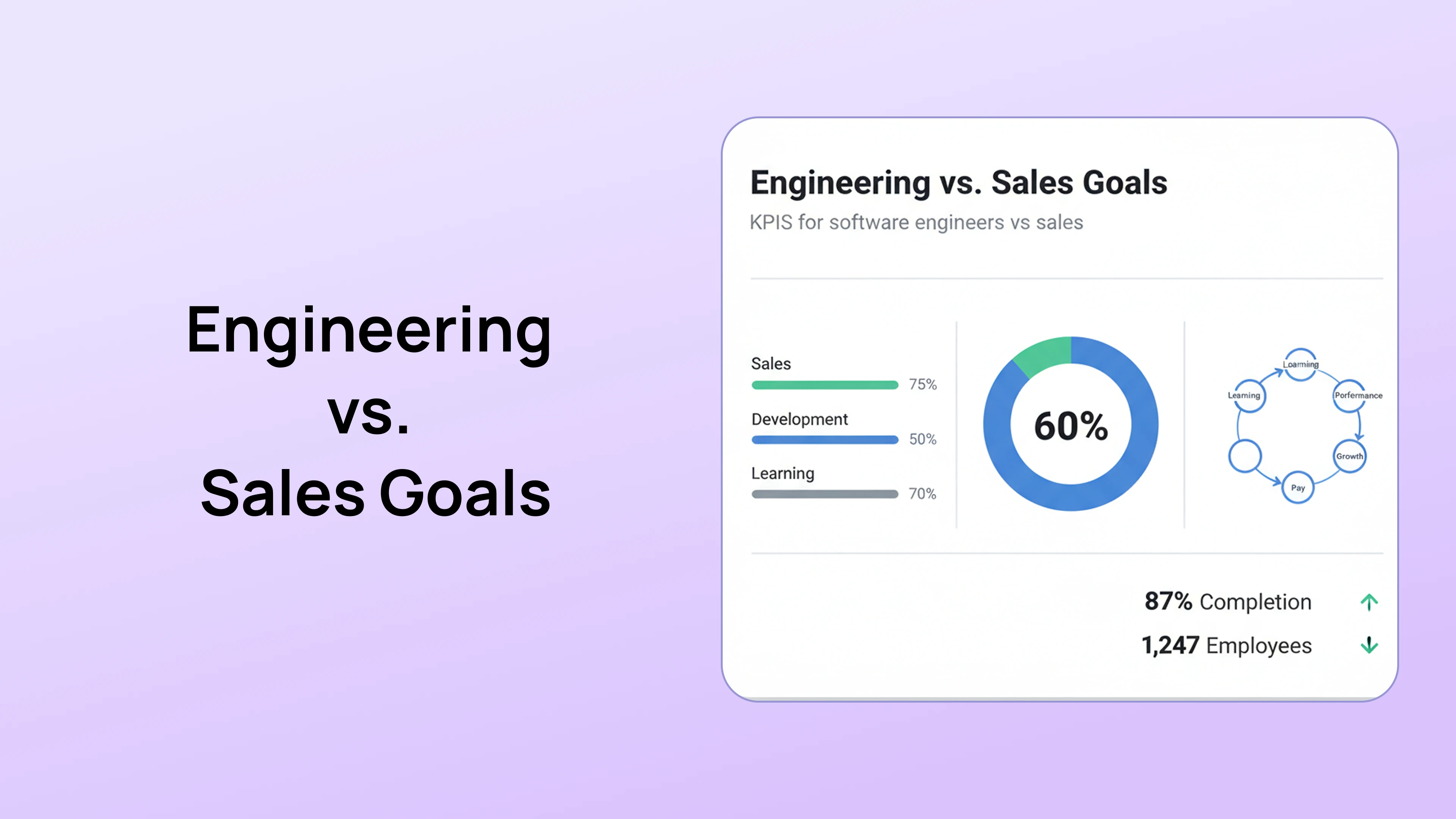
Table of Contents

Key Takeaways: Engineering vs. Sales Goals
- Sales and Engineering require different goal-setting methodologies because Sales work is deterministic and volume-driven, while Engineering work is probabilistic and milestone-driven. Using a single goal framework for both teams reduces performance and creates misalignment.
- Effective Sales goals focus on quotas, pipeline activity, and revenue outcomes, while Engineering goals focus on platform stability, delivery milestones, and operational efficiency. Each department should be measured using metrics that reflect the nature of its work.
- High-performing organizations align departments through a shared strategic theme rather than identical goals. Sales, Engineering, Product, and Support can use different goal structures while contributing to the same business objective, such as improving customer trust or reducing customer churn.
There is a cold war happening in your executive meetings.
The VP of Sales thinks the Engineering team is too slow and lacks accountability. The CTO thinks the Sales team is chaotic and obsessed with short-term wins at the expense of long-term stability.
This friction does not exist because people are difficult. It exists because they are playing two completely different games with two completely different scoreboards.
Yet, most HR teams try to force both departments into the exact same goal-setting template. They ask an Engineer to "hit a quota" and a Sales Rep to "follow a roadmap."
This is the "Universal Goal" Trap.
In the PerformSpark Strategy, we believe that treating a Software Architect like an Account Executive is the fastest way to destroy culture.
This guide breaks down the mathematical difference between Sales and Engineering goals and how to build a system that respects the "Tribal Dialects" of your company while keeping everyone aligned.
The Core Conflict: Deterministic vs. Probabilistic Work
To set the right goals, you must understand the nature of the work.
Sales is Deterministic.
If you make 100 calls, you will get 10 demos. If you get 10 demos, you will get 2 deals. It is a math problem. The inputs generally predict the outputs. Therefore, Sales goals should be Binary and Volume-based.
Engineering is Probabilistic.
You can write code for two weeks and discover a fatal flaw in the library that forces a total rewrite. You can work 100 hours and ship nothing, or work 1 hour and solve a million-dollar bug. The inputs do not always predict the outputs. Therefore, Engineering goals must be Milestone-based and Agile.
When HR forces an Engineer to commit to a hard "Quota" of features, they effectively ask them to lie. The Engineer pads their estimates (sandbagging) to stay safe, and velocity slows down.
The Sales Methodology: The Binary Quota
Sales goals are simple. You hit the number, or you miss the number. There is very little gray area.
The Structure of a Sales OKR
Sales goals should not be creative. They should be tied directly to the Goals Management Software and the CRM.
- Objective: Dominate the Enterprise Sector in Q1.
- Key Result 1 (Lagging): Close $1.2M in New ARR.
- Key Result 2 (Leading): Complete 45 Demos with Fortune 500 prospects.
- Key Result 3 (Efficiency): Decrease Sales Cycle from 90 days to 75 days.
The "Sandbagging" Risk
The danger in Sales goals is "Sandbagging." A rep knows they can hit $1.5M, but they negotiate the goal down to $1M to ensure they get their commission accelerator.
- The Fix: Separate the "Commission Quota" (The minimum to get paid) from the "OKR" (The stretch goal for growth). The OKR should always be 20% higher than the Quota.
The Engineering Methodology: The Agile Milestone
Engineering goals are complex. You cannot measure lines of code (that encourages bloat). You cannot measure "bugs fixed" (that encourages writing buggy code so you can fix it).
The Structure of an Engineering OKR
Engineering goals must focus on Health and Velocity.
- Objective: Increase Platform Stability for the Holiday Rush.
- Key Result 1 (Outcome): Maintain 99.99% uptime during peak traffic.
- Key Result 2 (Efficiency): Reduce CI/CD deployment time from 45 minutes to 15 minutes.
- Key Result 3 (Milestone): Ship the new Payment Gateway v2 by Feb 15th.
Note the difference. Key Result 3 is a date-based milestone, but it is supported by quality metrics (KR 1 and 2). If they ship on time but break the site, the goal is failed.
The "Unknown Unknowns" Risk
Engineers hate committing to dates because of "Unknown Unknowns." A project looks simple until you open the legacy code and find a mess.
The Fix: Use "Confidence Scores."
When setting the goal in the OKR Failure Rate Guide (Redirect to: Month 2, Blog 19), ask the engineer: "What is your confidence level on this date?" If it is below 70%, the goal is too risky. Break it down into smaller, research-based "Spikes" first.
The "Hybrid" Bridge: Product Management
Sitting between these two warring factions is the Product Manager. Their goals must bridge the gap.
- Sales Goal: Sell the feature.
- Eng Goal: Build the feature.
- Product Goal: Ensure the feature is used.
Example Product OKR:
- Objective: Launch the Mobile App successfully.
- Key Result: 20% of existing web users log in to the mobile app within 30 days.
This forces Product to align with Marketing (to drive logins) and Engineering (to ensure it works).
How to align them without forcing them?
You do not need identical goals. You need a North Star Alignment.
Every goal in the company, regardless of the department, must ladder up to the CEO's strategic theme.
The "Translation Layer"
- CEO Theme: "Improve Customer Trust."
- Sales Translation: "Stop selling features we don't have yet (reduce churn)."
- Engineering Translation: "Fix the top 10 critical bugs (reduce tickets)."
- Support Translation: "Lower response time to under 1 hour."
They are doing different things, but they are fighting the same war. As a leader, your job is to enforce the Theme, not the Tactic. This is a core part of our Manager Enablement Guide (Redirect to: Month 1, Blog 5).
How TrAI customizes the experience per Department
Most software forces a Sales VP to fill out the same form as a QA Tester. TrAI adapts the interface based on the user's role.
The Sales Interface (Speed)
When a Sales Rep logs in, TrAI asks:
"Salesforce shows you closed 3 deals. Do you want to update your OKR progress automatically?"
- The Focus: Auto-updating numbers. Zero friction.
The Engineering Interface (Context)
When an Engineer logs in, TrAI asks:
"Jira indicates the 'Payment Gateway' epic is delayed. Do you want to flag this goal as 'At Risk' and add a blocker note for your manager?"
- The Focus: Flagging risks and explaining context.
Conclusion
Respect the Tribe.
If you try to make your Engineers act like Salespeople, they will quit. If you try to make your Salespeople act like Engineers, they will stop selling.
The goal of a performance management system is not "Uniformity." It is "Unity."
You want different methodologies that aim at the same target. Sales delivers the revenue. Engineering delivers the product. HR delivers the framework that lets them speak different languages but tell the same story.
Book a Consultative Demo and let us show you how to configure Department-Specific Goal Templates in minutes.




.svg)

.svg)
.svg)

