


Table of Content
The End of the "9-to-5": Managing Performance in the Asynchronous Age
The eight hour workday was invented by Henry Ford in 1926 to maximize the output of factory workers. Exactly one hundred years later, companies are still using the same industrial framework to manage software engineers, marketing strategists, and data scientists.
This is a massive operational failure.
The transition to remote work was just phase one. Phase two is the transition to Asynchronous Work. In a globalized economy, your lead developer might be in India, your marketing director in London, and your CEO in San Francisco. Forcing them to be online at the exact same time is not just inefficient. It is impossible.
Yet, most performance management systems are still built for the physical office. They rely on "managing by walking around" and visual verification of effort.
In the PerformSpark Strategy, we view time tracking as a vanity metric.
This guide explains how to transition your leadership style and your HR technology from measuring "time in seat" to measuring actual business impact in an asynchronous world.
The Core Problem: Managing Presence vs. Managing Outcomes
To manage an asynchronous team, you must first unlearn a century of management conditioning. You must stop caring about when the work happens and start caring exclusively about what gets delivered.
The "Green Dot" Fallacy
Many managers suffer from productivity paranoia when they cannot see their team. They cope by monitoring the "Green Dot" on Slack or Microsoft Teams. If the dot is green, the employee is working. If the dot is hollow, the employee is slacking off.
This leads to "Performative Presence." Employees install mouse jigglers or keep Slack open on their phones while doing laundry just to appear active. You are not measuring productivity. You are measuring anxiety.
The Shift to "Outcome-Based" Evaluation
In an asynchronous environment, effort is invisible. You only see the result.
If an engineer writes brilliant, bug free code at 2:00 AM on a Sunday, and then takes Tuesday afternoon off, a legacy manager will penalize them for being offline on Tuesday. A high performance manager will promote them for shipping the code flawlessly.
You must build a system that rewards the outcome, regardless of the hours it took to achieve it.
The 3 Pillars of Asynchronous Performance Management
You cannot run a distributed team on vibes and occasional Zoom calls. You need a rigid operational framework. High flexibility for the employee requires high discipline from the organization.
Pillar 1: Extreme Goal Clarity
When you cannot tap your boss on the shoulder to ask a clarifying question, the initial instructions must be perfect. Ambiguity is the enemy of asynchronous speed.
If a manager assigns a vague task like "Improve the onboarding flow," the employee will waste three days guessing what that means. By the time they sync up, the week is lost.
You must use Goals Management Software (Redirect to: Product Page) to define the exact parameters of success. We teach managers to use the "Definition of Done." A goal is only assigned when both parties agree on what the final, shipped product looks like.
Pillar 2: The Written Culture
Asynchronous companies write everything down. If a decision is made on a phone call, it does not officially exist until it is documented in a shared workspace.
This applies heavily to performance management. You cannot rely on casual hallway conversations to provide feedback. You must build a Continuous Feedback Loop where feedback is written, categorized, and stored centrally. This ensures that an employee in a different time zone wakes up to clear, actionable coaching notes rather than a vague request for a meeting.
Pillar 3: Eradicating "Proximity Bias"
Proximity bias is the unconscious tendency to favor employees who are physically closer to you or who share your time zone. If the CEO is in New York, the New York team often gets the best projects and the highest performance ratings simply because they have more casual access to leadership.
To fight this, you must rely on objective data rather than subjective impressions. You must evaluate the global workforce based on their documented Key Results, not their water cooler banter.
How to Run a High-Velocity Async Team
Moving to asynchronous management requires replacing traditional synchronous meetings with structured digital rituals.
The Asynchronous Stand-up
Kill the daily morning Zoom call. It interrupts deep work and is a nightmare to schedule across time zones.
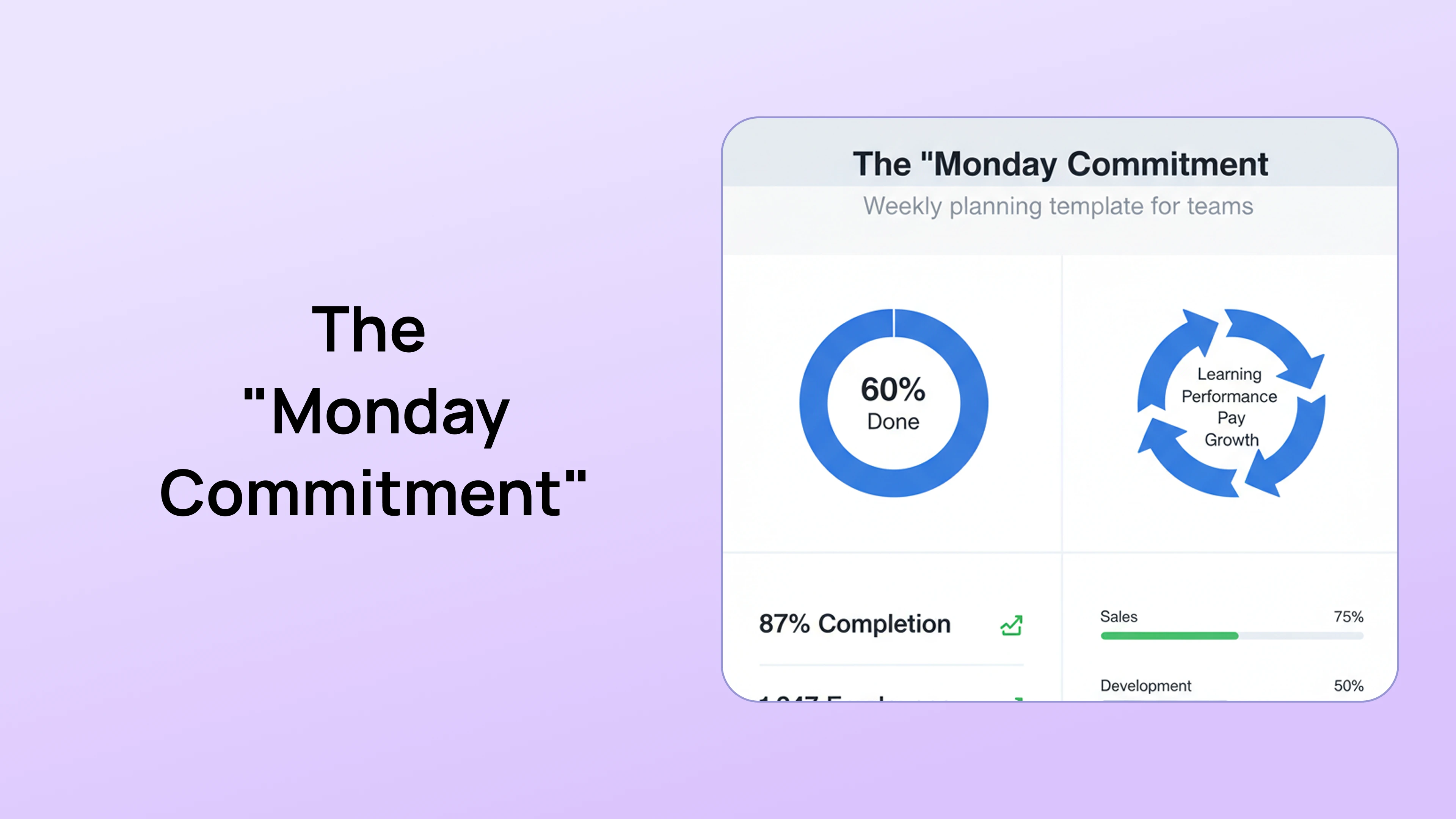
Instead, implement The Monday Commitment. Every Monday, regardless of their time zone, each employee posts a written update answering three questions:
- What is my primary outcome for this week?
- How does it connect to our quarterly objectives?
- What blockers do I foresee?
The manager reviews these asynchronously and clears the blockers. This creates a public ledger of accountability without forcing anyone onto a video call.
The "Overlap Window"
Asynchronous does not mean zero communication. It means intentional communication.
Identify a two to three hour "Overlap Window" where the maximum number of global time zones intersect. For example, 9:00 AM to 11:00 AM EST often works for US, European, and Indian teams. Reserve this highly valuable time strictly for complex problem solving, strategic debates, and sensitive 1-on-1 performance conversations. Protect the rest of the day for deep, uninterrupted work.
How TrAI Bridges the Global Time Zone Gap
Managing asynchronous performance creates a massive administrative burden. Managers have to parse through hundreds of written updates, Jira tickets, and Slack threads to figure out who is actually performing.
PerformSpark built TrAI to solve this exact data fragmentation problem.
The Context Synthesizer
When a manager in London logs in on Friday morning, they do not have to read every message sent by their team in Asia overnight.
TrAI scans the connected systems (Jira, GitHub, Slack) and provides a highly condensed Executive Summary.
- "Your engineering team completed 4 major milestones while you were offline. However, two team members flagged blockers regarding the new API structure. TrAI suggests intervening on these specific tickets today."
Automated Bias Detection
To combat proximity bias, TrAI acts as a neutral third party auditor. Before a performance review cycle begins, TrAI analyzes the feedback data.
If a manager is consistently rating employees in their own time zone higher than remote employees despite similar objective outputs, TrAI flags this discrepancy to the HR Director via the Analytics Dashboard. This allows the People Team to coach the manager on bias before the compensation decisions are finalized.
H2: Conclusion
The future of work is not a place. It is a protocol.
Companies that insist on managing by presence will lose their top performers to companies that manage by outcomes. High performing talent demands autonomy. They want to be judged by the quality of their work, not the time they clocked in.
To survive the asynchronous age, you must strip away the subjective noise of the physical office. You must implement extreme goal clarity, default to written communication, and leverage AI to synthesize performance data across the globe.
Stop managing the clock. Start managing the output.
Book a Consultative Demo and see how PerformSpark aligns distributed global teams in a single, asynchronous platform.
The End of the "9-to-5": Managing Performance in the Asynchronous Age
The eight hour workday was invented by Henry Ford in 1926 to maximize the output of factory workers. Exactly one hundred years later, companies are still using the same industrial framework to manage software engineers, marketing strategists, and data scientists.
This is a massive operational failure.
The transition to remote work was just phase one. Phase two is the transition to Asynchronous Work. In a globalized economy, your lead developer might be in India, your marketing director in London, and your CEO in San Francisco. Forcing them to be online at the exact same time is not just inefficient. It is impossible.
Yet, most performance management systems are still built for the physical office. They rely on "managing by walking around" and visual verification of effort.
In the PerformSpark Strategy, we view time tracking as a vanity metric.
This guide explains how to transition your leadership style and your HR technology from measuring "time in seat" to measuring actual business impact in an asynchronous world.
The Core Problem: Managing Presence vs. Managing Outcomes
To manage an asynchronous team, you must first unlearn a century of management conditioning. You must stop caring about when the work happens and start caring exclusively about what gets delivered.
The "Green Dot" Fallacy
Many managers suffer from productivity paranoia when they cannot see their team. They cope by monitoring the "Green Dot" on Slack or Microsoft Teams. If the dot is green, the employee is working. If the dot is hollow, the employee is slacking off.
This leads to "Performative Presence." Employees install mouse jigglers or keep Slack open on their phones while doing laundry just to appear active. You are not measuring productivity. You are measuring anxiety.
The Shift to "Outcome-Based" Evaluation
In an asynchronous environment, effort is invisible. You only see the result.
If an engineer writes brilliant, bug free code at 2:00 AM on a Sunday, and then takes Tuesday afternoon off, a legacy manager will penalize them for being offline on Tuesday. A high performance manager will promote them for shipping the code flawlessly.
You must build a system that rewards the outcome, regardless of the hours it took to achieve it.
The 3 Pillars of Asynchronous Performance Management
You cannot run a distributed team on vibes and occasional Zoom calls. You need a rigid operational framework. High flexibility for the employee requires high discipline from the organization.
Pillar 1: Extreme Goal Clarity
When you cannot tap your boss on the shoulder to ask a clarifying question, the initial instructions must be perfect. Ambiguity is the enemy of asynchronous speed.
If a manager assigns a vague task like "Improve the onboarding flow," the employee will waste three days guessing what that means. By the time they sync up, the week is lost.
You must use Goals Management Software (Redirect to: Product Page) to define the exact parameters of success. We teach managers to use the "Definition of Done." A goal is only assigned when both parties agree on what the final, shipped product looks like.
Pillar 2: The Written Culture
Asynchronous companies write everything down. If a decision is made on a phone call, it does not officially exist until it is documented in a shared workspace.
This applies heavily to performance management. You cannot rely on casual hallway conversations to provide feedback. You must build a Continuous Feedback Loop where feedback is written, categorized, and stored centrally. This ensures that an employee in a different time zone wakes up to clear, actionable coaching notes rather than a vague request for a meeting.
Pillar 3: Eradicating "Proximity Bias"
Proximity bias is the unconscious tendency to favor employees who are physically closer to you or who share your time zone. If the CEO is in New York, the New York team often gets the best projects and the highest performance ratings simply because they have more casual access to leadership.
To fight this, you must rely on objective data rather than subjective impressions. You must evaluate the global workforce based on their documented Key Results, not their water cooler banter.
How to Run a High-Velocity Async Team
Moving to asynchronous management requires replacing traditional synchronous meetings with structured digital rituals.
The Asynchronous Stand-up
Kill the daily morning Zoom call. It interrupts deep work and is a nightmare to schedule across time zones.
Instead, implement The Monday Commitment. Every Monday, regardless of their time zone, each employee posts a written update answering three questions:
- What is my primary outcome for this week?
- How does it connect to our quarterly objectives?
- What blockers do I foresee?
The manager reviews these asynchronously and clears the blockers. This creates a public ledger of accountability without forcing anyone onto a video call.
The "Overlap Window"
Asynchronous does not mean zero communication. It means intentional communication.
Identify a two to three hour "Overlap Window" where the maximum number of global time zones intersect. For example, 9:00 AM to 11:00 AM EST often works for US, European, and Indian teams. Reserve this highly valuable time strictly for complex problem solving, strategic debates, and sensitive 1-on-1 performance conversations. Protect the rest of the day for deep, uninterrupted work.
How TrAI Bridges the Global Time Zone Gap
Managing asynchronous performance creates a massive administrative burden. Managers have to parse through hundreds of written updates, Jira tickets, and Slack threads to figure out who is actually performing.
PerformSpark built TrAI to solve this exact data fragmentation problem.
The Context Synthesizer
When a manager in London logs in on Friday morning, they do not have to read every message sent by their team in Asia overnight.
TrAI scans the connected systems (Jira, GitHub, Slack) and provides a highly condensed Executive Summary.
- "Your engineering team completed 4 major milestones while you were offline. However, two team members flagged blockers regarding the new API structure. TrAI suggests intervening on these specific tickets today."
Automated Bias Detection
To combat proximity bias, TrAI acts as a neutral third party auditor. Before a performance review cycle begins, TrAI analyzes the feedback data.
If a manager is consistently rating employees in their own time zone higher than remote employees despite similar objective outputs, TrAI flags this discrepancy to the HR Director via the Analytics Dashboard. This allows the People Team to coach the manager on bias before the compensation decisions are finalized.
H2: Conclusion
The future of work is not a place. It is a protocol.
Companies that insist on managing by presence will lose their top performers to companies that manage by outcomes. High performing talent demands autonomy. They want to be judged by the quality of their work, not the time they clocked in.
To survive the asynchronous age, you must strip away the subjective noise of the physical office. You must implement extreme goal clarity, default to written communication, and leverage AI to synthesize performance data across the globe.
Stop managing the clock. Start managing the output.
Book a Consultative Demo and see how PerformSpark aligns distributed global teams in a single, asynchronous platform.




.svg)

.svg)
.svg)