

Table of Content
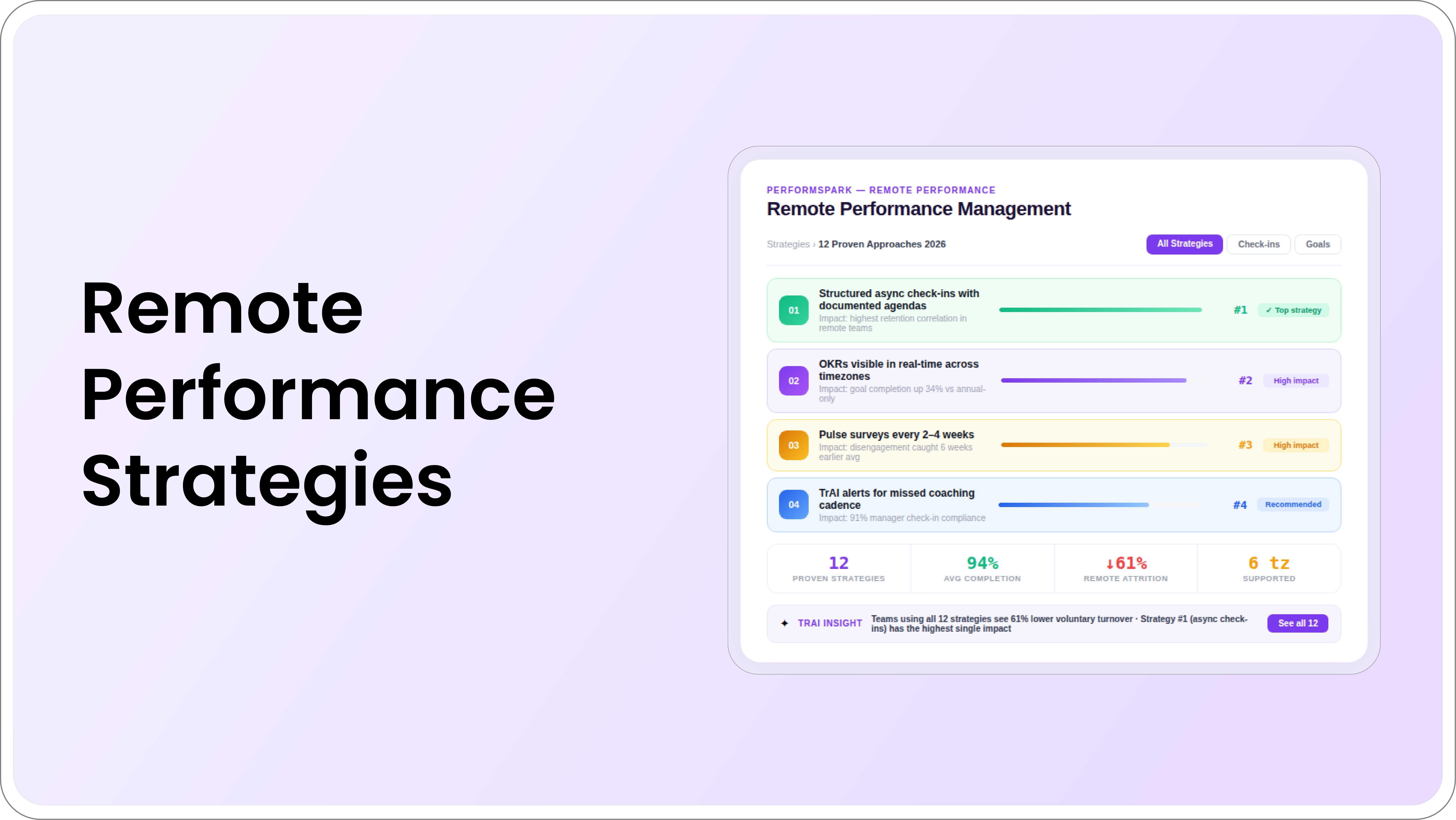
Remote Performance Management: 12 Proven Strategies (2026)
Remote and hybrid work has fundamentally changed what performance management needs to do. In an office, managers rely on ambient signals, they see who is engaged, who is struggling, who is staying late, and who seems disconnected. These informal observations feed into performance impressions that managers often cannot articulate but act on constantly.
Distributed teams have none of this. Every performance signal must be deliberately created, documented, and shared. Managers who try to run the same informal performance management approach they used in an office will find that remote teams feel unseen, under-supported, and directionless, because the invisible infrastructure that made informal management work simply does not exist across distance.
These twelve strategies cover every part of the remote performance management cycle, from goal-setting and check-in design to review writing and calibration.
Why Does Performance Management Change for Remote Teams?
Three specific things break when a co-located team goes remote or hybrid:
- Feedback proximity disappears. In an office, feedback often happens close to the event that triggered it, a manager observes a meeting, pulls the employee aside afterward, and gives specific input. Remote feedback must be deliberate, scheduled, and documented to serve the same function.
- Visibility becomes uneven. Employees who communicate frequently in Slack or on video tend to be perceived as higher performers regardless of their actual output. This proximity bias disadvantages quieter, deeper-working employees who produce excellent results but do not perform their presence.
- Calibration diverges faster. Remote managers have less peer visibility into each other's teams. Without calibration sessions using pre-computed rating data, rating standards drift more quickly across distributed manager groups than across co-located ones.
12 Proven Remote Performance Management Strategies
1. Replace presence metrics with outcome metrics
The single most important shift in remote performance management is measuring what employees produce, not when they are online. Login times, message frequency, and camera-on rates measure activity, not performance. Before each review cycle, define role-specific outcome criteria: what does a strong quarter look like for this role, in terms of deliverables, quality, and impact?
OKRs and SMART goals force this definition by requiring specific, measurable outcomes rather than activity descriptions. When ratings are grounded in documented outcomes, they are more accurate, more fair, and more defensible.
2. Set explicit goals collaboratively at the start of every cycle
Remote employees cannot pick up on the informal priority signals that in-office employees receive constantly. Every remote employee needs to begin each review cycle with explicitly documented goals, written, agreed upon, and accessible in the performance platform. Goals set collaboratively, where the employee has input into the key results they are accountable for, drive significantly higher engagement and ownership than top-down assigned goals.
3. Run biweekly structured 1-on-1 check-ins without exception
The structured 1-on-1 is the most important tool in a remote manager's toolkit. It replaces the ambient daily feedback that proximity provides with a scheduled, consistent, documented forum for goal progress, feedback, blockers, and development. Biweekly is the right default for most roles, consistent enough to catch issues early, spaced enough for meaningful progress between conversations.
The critical rule: never cancel without rescheduling immediately. A cancelled check-in signals that performance conversations are optional. For remote employees, this signal is louder and more damaging than it is for co-located employees who have other informal touchpoints.
4. Document every check-in in the performance platform, not in chat
Check-in notes that live in Slack threads, email inboxes, or personal notebooks are lost within weeks. Notes documented in the performance management platform are searchable, visible to both the manager and employee, and form the evidence base for review writing at year-end.
This documentation is also the primary defense against recency bias, the tendency to weight the last few weeks disproportionately when writing an annual review. A manager who documents check-in notes throughout the year has the full-year record needed to write an accurate, evidence-based review.
5. Deliver continuous feedback close to the event
Saving feedback for formal reviews is one of the most damaging patterns in remote performance management. Without proximity to deliver in-the-moment feedback, remote managers must be intentional about logging specific, behavioral feedback in the performance platform as close to the event as possible.
Specific and recent feedback is more credible, more actionable, and more useful to the employee than a summary judgment delivered six months after the fact. It also builds the documented feedback record that makes formal reviews more useful and more defensible.
6. Establish asynchronous communication protocols
For distributed teams across multiple time zones, real-time feedback is not always possible. Establish clear asynchronous communication standards: which channels are used for what purpose, what the expected response time is for different types of communication, and what constitutes a formal performance documentation entry versus a casual team message.
Without these protocols, performance information gets scattered across tools, some in Slack, some in email, some in project management software, and managers cannot build a complete picture of an employee's performance when review time arrives.
7. Run calibration with pre-computed distribution data
Calibration is more important for remote teams than for co-located ones because managers have less peer visibility into each other's teams. Rating standards diverge more quickly when managers cannot observe each other's teams informally.
Virtual calibration sessions should use pre-computed rating distribution data, which managers are outliers relative to their peer group, so the session can focus on resolving inconsistencies rather than building the comparison from scratch. TrAI in PerformSpark identifies distribution outliers automatically before the session begins, reducing calibration prep time and improving consistency.
8. Protect equity across remote and in-office employees
In hybrid teams, the most dangerous performance management failure is proximity bias, the tendency for managers to rate in-office employees more favorably than equivalent remote employees, simply because they are more visible. Address this directly by using outcome-based performance criteria that are evaluated identically regardless of location, and by flagging proximity bias specifically in manager calibration training.
9. Separate performance conversations from development conversations
Remote employees who only receive structured feedback during formal performance reviews experience a feedback gap that is felt more acutely than in co-located teams. Separate development conversations, focused on growth, career goals, and skill development, from performance evaluation conversations and run them on a different cadence. A monthly or quarterly development check-in, separate from the biweekly performance check-in, gives remote employees the career investment signal that in-office employees receive more informally.
10. Build performance documentation habits early
The biggest risk for remote teams at review time is managers writing reviews from memory because documentation was not built throughout the year. Make documentation a team habit from day one: check-in notes are always logged in the platform, feedback is always recorded close to the event, and goal progress is always updated in the system rather than discussed and forgotten.
Teams that build this habit in the first 90 days of a remote management relationship maintain it consistently. Teams that skip it rarely recover by year-end review time.
11. Train managers specifically on remote performance skills
Managing performance remotely requires different skills than managing it in person, not better or worse, but different. Managers need training in asynchronous feedback delivery, virtual coaching conversation structure, bias recognition specific to remote work, and documentation discipline. Without this training, managers default to what they know from in-office environments, which does not transfer to distributed teams.
12. Use a performance platform built for async workflows
Remote performance management requires software that works asynchronously, where check-in notes, feedback, and goal updates can be captured outside of a shared meeting, and where the record is accessible to both manager and employee regardless of time zone. A platform where everything is centralized and searchable eliminates the documentation gaps that produce poor reviews and unfair ratings.
The Biggest Remote Performance Management Mistakes
Performance Management Built for Distributed Teams
PerformSpark gives remote and hybrid teams the full performance cycle, goals, async check-ins, continuous feedback, calibration, IDPs, and TrAI, at $6/user/month. Setup in one to two weeks.Book a Demo
Remote Performance Management: 12 Proven Strategies (2026)
Remote and hybrid work has fundamentally changed what performance management needs to do. In an office, managers rely on ambient signals, they see who is engaged, who is struggling, who is staying late, and who seems disconnected. These informal observations feed into performance impressions that managers often cannot articulate but act on constantly.
Distributed teams have none of this. Every performance signal must be deliberately created, documented, and shared. Managers who try to run the same informal performance management approach they used in an office will find that remote teams feel unseen, under-supported, and directionless, because the invisible infrastructure that made informal management work simply does not exist across distance.
These twelve strategies cover every part of the remote performance management cycle, from goal-setting and check-in design to review writing and calibration.
Why Does Performance Management Change for Remote Teams?
Three specific things break when a co-located team goes remote or hybrid:
- Feedback proximity disappears. In an office, feedback often happens close to the event that triggered it, a manager observes a meeting, pulls the employee aside afterward, and gives specific input. Remote feedback must be deliberate, scheduled, and documented to serve the same function.
- Visibility becomes uneven. Employees who communicate frequently in Slack or on video tend to be perceived as higher performers regardless of their actual output. This proximity bias disadvantages quieter, deeper-working employees who produce excellent results but do not perform their presence.
- Calibration diverges faster. Remote managers have less peer visibility into each other's teams. Without calibration sessions using pre-computed rating data, rating standards drift more quickly across distributed manager groups than across co-located ones.
12 Proven Remote Performance Management Strategies
1. Replace presence metrics with outcome metrics
The single most important shift in remote performance management is measuring what employees produce, not when they are online. Login times, message frequency, and camera-on rates measure activity, not performance. Before each review cycle, define role-specific outcome criteria: what does a strong quarter look like for this role, in terms of deliverables, quality, and impact?
OKRs and SMART goals force this definition by requiring specific, measurable outcomes rather than activity descriptions. When ratings are grounded in documented outcomes, they are more accurate, more fair, and more defensible.
2. Set explicit goals collaboratively at the start of every cycle
Remote employees cannot pick up on the informal priority signals that in-office employees receive constantly. Every remote employee needs to begin each review cycle with explicitly documented goals, written, agreed upon, and accessible in the performance platform. Goals set collaboratively, where the employee has input into the key results they are accountable for, drive significantly higher engagement and ownership than top-down assigned goals.
3. Run biweekly structured 1-on-1 check-ins without exception
The structured 1-on-1 is the most important tool in a remote manager's toolkit. It replaces the ambient daily feedback that proximity provides with a scheduled, consistent, documented forum for goal progress, feedback, blockers, and development. Biweekly is the right default for most roles, consistent enough to catch issues early, spaced enough for meaningful progress between conversations.
The critical rule: never cancel without rescheduling immediately. A cancelled check-in signals that performance conversations are optional. For remote employees, this signal is louder and more damaging than it is for co-located employees who have other informal touchpoints.
4. Document every check-in in the performance platform, not in chat
Check-in notes that live in Slack threads, email inboxes, or personal notebooks are lost within weeks. Notes documented in the performance management platform are searchable, visible to both the manager and employee, and form the evidence base for review writing at year-end.
This documentation is also the primary defense against recency bias, the tendency to weight the last few weeks disproportionately when writing an annual review. A manager who documents check-in notes throughout the year has the full-year record needed to write an accurate, evidence-based review.
5. Deliver continuous feedback close to the event
Saving feedback for formal reviews is one of the most damaging patterns in remote performance management. Without proximity to deliver in-the-moment feedback, remote managers must be intentional about logging specific, behavioral feedback in the performance platform as close to the event as possible.
Specific and recent feedback is more credible, more actionable, and more useful to the employee than a summary judgment delivered six months after the fact. It also builds the documented feedback record that makes formal reviews more useful and more defensible.
6. Establish asynchronous communication protocols
For distributed teams across multiple time zones, real-time feedback is not always possible. Establish clear asynchronous communication standards: which channels are used for what purpose, what the expected response time is for different types of communication, and what constitutes a formal performance documentation entry versus a casual team message.
Without these protocols, performance information gets scattered across tools, some in Slack, some in email, some in project management software, and managers cannot build a complete picture of an employee's performance when review time arrives.
7. Run calibration with pre-computed distribution data
Calibration is more important for remote teams than for co-located ones because managers have less peer visibility into each other's teams. Rating standards diverge more quickly when managers cannot observe each other's teams informally.
Virtual calibration sessions should use pre-computed rating distribution data, which managers are outliers relative to their peer group, so the session can focus on resolving inconsistencies rather than building the comparison from scratch. TrAI in PerformSpark identifies distribution outliers automatically before the session begins, reducing calibration prep time and improving consistency.
8. Protect equity across remote and in-office employees
In hybrid teams, the most dangerous performance management failure is proximity bias, the tendency for managers to rate in-office employees more favorably than equivalent remote employees, simply because they are more visible. Address this directly by using outcome-based performance criteria that are evaluated identically regardless of location, and by flagging proximity bias specifically in manager calibration training.
9. Separate performance conversations from development conversations
Remote employees who only receive structured feedback during formal performance reviews experience a feedback gap that is felt more acutely than in co-located teams. Separate development conversations, focused on growth, career goals, and skill development, from performance evaluation conversations and run them on a different cadence. A monthly or quarterly development check-in, separate from the biweekly performance check-in, gives remote employees the career investment signal that in-office employees receive more informally.
10. Build performance documentation habits early
The biggest risk for remote teams at review time is managers writing reviews from memory because documentation was not built throughout the year. Make documentation a team habit from day one: check-in notes are always logged in the platform, feedback is always recorded close to the event, and goal progress is always updated in the system rather than discussed and forgotten.
Teams that build this habit in the first 90 days of a remote management relationship maintain it consistently. Teams that skip it rarely recover by year-end review time.
11. Train managers specifically on remote performance skills
Managing performance remotely requires different skills than managing it in person, not better or worse, but different. Managers need training in asynchronous feedback delivery, virtual coaching conversation structure, bias recognition specific to remote work, and documentation discipline. Without this training, managers default to what they know from in-office environments, which does not transfer to distributed teams.
12. Use a performance platform built for async workflows
Remote performance management requires software that works asynchronously, where check-in notes, feedback, and goal updates can be captured outside of a shared meeting, and where the record is accessible to both manager and employee regardless of time zone. A platform where everything is centralized and searchable eliminates the documentation gaps that produce poor reviews and unfair ratings.
The Biggest Remote Performance Management Mistakes
Performance Management Built for Distributed Teams
PerformSpark gives remote and hybrid teams the full performance cycle, goals, async check-ins, continuous feedback, calibration, IDPs, and TrAI, at $6/user/month. Setup in one to two weeks.Book a Demo





.svg)

.svg)
.svg)