

Table of Content
Eliminating Rating Drift: How Visual 9-Box Calibration Protects Your Pay Equity
The fastest way to lose a top performer is to pay them like an average performer.
This happens not because of budget cuts, but because of Rating Drift.
In every organization, there are two types of managers. The Easy Grader gives everyone a 5 out of 5 to avoid conflict. The Hard Grader rarely gives above a 3 because they believe perfection is impossible.
When you link these subjective ratings to compensation, you create an inequitable system. The employee with the Easy Grader manager gets a bigger bonus than the high performer with the Hard Grader manager.
In the PerformSpark Strategy, we believe fairness is not a feeling. It is a mathematical process.
This guide explains how to use Visual 9-Box Calibration to normalize ratings, eliminate drift, and protect your company from pay equity lawsuits
What is Rating Drift and why is it dangerous?
Rating Drift is the statistical variance caused by manager subjectivity rather than employee performance. It destroys trust in the compensation model.
The Idiosyncratic Rater Effect
- Definition: Research shows that 60% of a performance rating reflects the rater, not the ratee.
The Easy Grader (Leniency Error):
- Behavior: Rates everyone highly to be liked.
- Impact: Inflates the budget and rewards mediocrity.
The Hard Grader (Severity Error):
- Behavior: Rates everyone low to assert high standards.
- Impact: Demotivates high performers and drives attrition.
The Central Tendency Error:
- Behavior: Rates everyone down the middle (3/5) to play it safe.
- Impact: Makes it impossible to distinguish talent.
The Legal and Financial Risk
Pay Equity Lawsuits:
If female employees consistently receive lower ratings than male employees for the same output due to unconscious bias, you are liable.
Uncalibrated ratings are the smoking gun in discrimination cases.
Budget Blowouts:
Without calibration, Grade Inflation occurs.
If 80% of your company is rated Exceeds Expectations, your bonus pool will be exhausted before you pay your actual top talent.
What is the Visual 9-Box Grid?
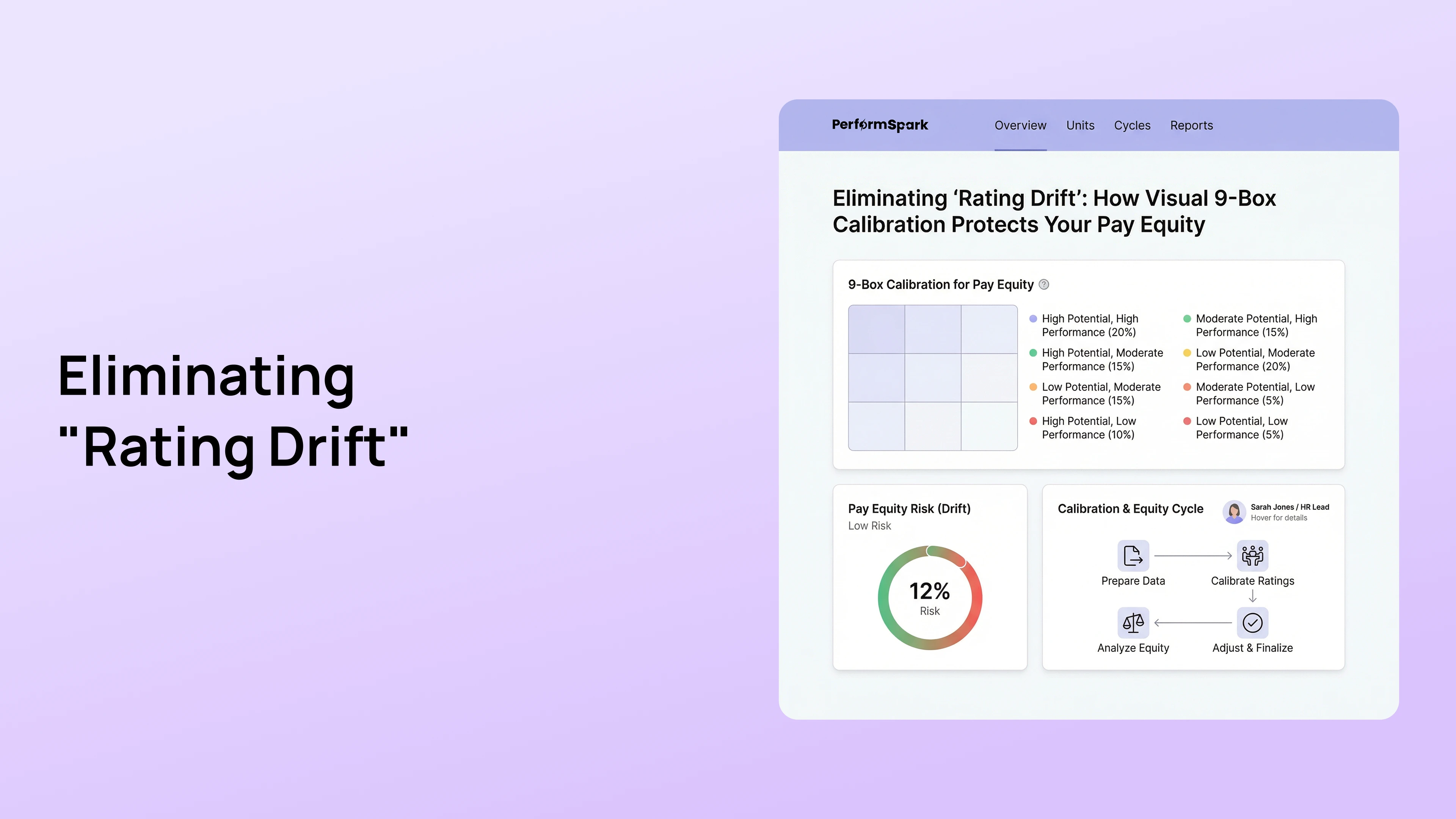
The 9-Box Grid is the industry standard tool for visualizing talent density. It moves performance management from a spreadsheet list to a strategic map.
The Two Axes of Talent
X-Axis: Performance (Past):
- Question: What results did they deliver today?
- Data Source: Goal Achievement and KPI data.
Y-Axis: Potential (Future):
- Question: Can they scale into a larger role tomorrow?
- Data Source: Manager assessment of agility and leadership skills.
The Critical Quadrants
To calibrate effectively, you must agree on the definitions of the boxes.
The Star (Top Right)
- Rating: High Performance / High Potential.
- Definition: Your future leaders.
- Action: Retain, promote, and pay significantly above market.
The Core Performer (Center)
- Rating: Moderate Potential / High Performance.
- Definition: The engine of the company. Reliable and steady.
- Action: Retain and keep engaged, but do not force into management.
The Iceberg (Bottom Right)
- Rating: Low Potential / High Performance.
- Definition: High technical output but low cultural fit or leadership ability.
- Action: Keep in an individual contributor role. Do not promote management.
The Risk (Bottom Left)
- Rating: Low Potential / Low Performance.
- Definition: Bad hire or wrong role.
- Action: Move to a Performance Improvement Plan (PIP) or exit.
How to run a Calibration Session using PerformSpark?
A calibration session is a meeting where managers defend their ratings against their peers. PerformSpark transforms this from a 10-hour spreadsheet nightmare into a 60-minute visual exercise.
Step 1: The Aggregate View (Pre-Meeting)
- The Dashboard: HR pulls up the 9-Box view for the entire department (e.g., Sales).
- The Visual Check:
- Problem: If 50% of the team is in the Top Right box, you have Grade Inflation.
- Goal: The distribution should roughly follow a Bell Curve (or Power Law for high-growth teams).
Step 2: The Drag and Drop Adjustment (During Meeting)
- The Process: Managers project the grid on the screen.
- The Challenge:
- Manager A: I put Sarah in the Star box.
- Manager B: But Sarah missed her Q3 quota. That is not a Star.
- The Action: The facilitator physically drags Sarah's avatar from Star to Core Performer.
- The Result: The rating is updated instantly in the system without navigating complex menus.
Step 3: The Budget Impact (Real-Time)
- The Feature: As you move employees between boxes, the Total Bonus Spend updates in the sidebar.
- The Value:
- You can see if you are over budget immediately.
- You can force trade-offs (e.g., We can only afford 5 Stars. Who are the real top 5?).
How does TrAI enforce Pay Equity?
Humans are biased. TrAI, our ethical intelligence engine, acts as the impartial auditor during the calibration process.
The Bias Detective
- The Scan: TrAI analyzes the 9-Box distribution by Gender, Ethnicity, and Age.
- The Alert:
- Notification: Warning: Female employees are 30% less likely to be placed in the High Potential quadrant compared to Male employees in this department.
- The Action: The facilitator pauses the meeting to investigate if this is a performance reality or unconscious bias.
The Anomaly Flag
- The Scan: TrAI looks for mismatches between Data and Rating.
- The Alert:
- Notification: Employee John Doe has 100% Goal Completion but is rated Low Performance. Please justify.
- The Benefit: This prevents managers from punishing employees for personal reasons unrelated to data.
Conclusion
Rating drift destroys trust, creates legal liability, and is the fastest way to lose your top performers to competitors who pay fairly. By replacing subjective opinions with Visual 9-Box Calibration, you ensure that a "5" in Marketing means the exact same thing as a "5" in Engineering. This isn't just about administrative cleanup; it is about building a culture of mathematical fairness where compensation is aligned with actual performance, protecting your budget and your reputation simultaneously.
Book a Consultative Demo and see how PerformSpark protects your pay equity with one click.
Eliminating Rating Drift: How Visual 9-Box Calibration Protects Your Pay Equity
The fastest way to lose a top performer is to pay them like an average performer.
This happens not because of budget cuts, but because of Rating Drift.
In every organization, there are two types of managers. The Easy Grader gives everyone a 5 out of 5 to avoid conflict. The Hard Grader rarely gives above a 3 because they believe perfection is impossible.
When you link these subjective ratings to compensation, you create an inequitable system. The employee with the Easy Grader manager gets a bigger bonus than the high performer with the Hard Grader manager.
In the PerformSpark Strategy, we believe fairness is not a feeling. It is a mathematical process.
This guide explains how to use Visual 9-Box Calibration to normalize ratings, eliminate drift, and protect your company from pay equity lawsuits
What is Rating Drift and why is it dangerous?
Rating Drift is the statistical variance caused by manager subjectivity rather than employee performance. It destroys trust in the compensation model.
The Idiosyncratic Rater Effect
- Definition: Research shows that 60% of a performance rating reflects the rater, not the ratee.
The Easy Grader (Leniency Error):
- Behavior: Rates everyone highly to be liked.
- Impact: Inflates the budget and rewards mediocrity.
The Hard Grader (Severity Error):
- Behavior: Rates everyone low to assert high standards.
- Impact: Demotivates high performers and drives attrition.
The Central Tendency Error:
- Behavior: Rates everyone down the middle (3/5) to play it safe.
- Impact: Makes it impossible to distinguish talent.
The Legal and Financial Risk
Pay Equity Lawsuits:
If female employees consistently receive lower ratings than male employees for the same output due to unconscious bias, you are liable.
Uncalibrated ratings are the smoking gun in discrimination cases.
Budget Blowouts:
Without calibration, Grade Inflation occurs.
If 80% of your company is rated Exceeds Expectations, your bonus pool will be exhausted before you pay your actual top talent.
What is the Visual 9-Box Grid?
The 9-Box Grid is the industry standard tool for visualizing talent density. It moves performance management from a spreadsheet list to a strategic map.
The Two Axes of Talent
X-Axis: Performance (Past):
- Question: What results did they deliver today?
- Data Source: Goal Achievement and KPI data.
Y-Axis: Potential (Future):
- Question: Can they scale into a larger role tomorrow?
- Data Source: Manager assessment of agility and leadership skills.
The Critical Quadrants
To calibrate effectively, you must agree on the definitions of the boxes.
The Star (Top Right)
- Rating: High Performance / High Potential.
- Definition: Your future leaders.
- Action: Retain, promote, and pay significantly above market.
The Core Performer (Center)
- Rating: Moderate Potential / High Performance.
- Definition: The engine of the company. Reliable and steady.
- Action: Retain and keep engaged, but do not force into management.
The Iceberg (Bottom Right)
- Rating: Low Potential / High Performance.
- Definition: High technical output but low cultural fit or leadership ability.
- Action: Keep in an individual contributor role. Do not promote management.
The Risk (Bottom Left)
- Rating: Low Potential / Low Performance.
- Definition: Bad hire or wrong role.
- Action: Move to a Performance Improvement Plan (PIP) or exit.
How to run a Calibration Session using PerformSpark?
A calibration session is a meeting where managers defend their ratings against their peers. PerformSpark transforms this from a 10-hour spreadsheet nightmare into a 60-minute visual exercise.
Step 1: The Aggregate View (Pre-Meeting)
- The Dashboard: HR pulls up the 9-Box view for the entire department (e.g., Sales).
- The Visual Check:
- Problem: If 50% of the team is in the Top Right box, you have Grade Inflation.
- Goal: The distribution should roughly follow a Bell Curve (or Power Law for high-growth teams).
Step 2: The Drag and Drop Adjustment (During Meeting)
- The Process: Managers project the grid on the screen.
- The Challenge:
- Manager A: I put Sarah in the Star box.
- Manager B: But Sarah missed her Q3 quota. That is not a Star.
- The Action: The facilitator physically drags Sarah's avatar from Star to Core Performer.
- The Result: The rating is updated instantly in the system without navigating complex menus.
Step 3: The Budget Impact (Real-Time)
- The Feature: As you move employees between boxes, the Total Bonus Spend updates in the sidebar.
- The Value:
- You can see if you are over budget immediately.
- You can force trade-offs (e.g., We can only afford 5 Stars. Who are the real top 5?).
How does TrAI enforce Pay Equity?
Humans are biased. TrAI, our ethical intelligence engine, acts as the impartial auditor during the calibration process.
The Bias Detective
- The Scan: TrAI analyzes the 9-Box distribution by Gender, Ethnicity, and Age.
- The Alert:
- Notification: Warning: Female employees are 30% less likely to be placed in the High Potential quadrant compared to Male employees in this department.
- The Action: The facilitator pauses the meeting to investigate if this is a performance reality or unconscious bias.
The Anomaly Flag
- The Scan: TrAI looks for mismatches between Data and Rating.
- The Alert:
- Notification: Employee John Doe has 100% Goal Completion but is rated Low Performance. Please justify.
- The Benefit: This prevents managers from punishing employees for personal reasons unrelated to data.
Conclusion
Rating drift destroys trust, creates legal liability, and is the fastest way to lose your top performers to competitors who pay fairly. By replacing subjective opinions with Visual 9-Box Calibration, you ensure that a "5" in Marketing means the exact same thing as a "5" in Engineering. This isn't just about administrative cleanup; it is about building a culture of mathematical fairness where compensation is aligned with actual performance, protecting your budget and your reputation simultaneously.
Book a Consultative Demo and see how PerformSpark protects your pay equity with one click.
.webp)
.webp)
.webp)




.svg)

.svg)
.svg)