


Table of Content
Onboarding and Performance Management: How to Connect Them From Day One (2026)
Most organizations treat onboarding and performance management as separate processes. Onboarding is an HR function, paperwork, system access, company culture introduction. Performance management starts later, when the employee is settled in and the first formal review cycle begins.
This separation is one of the most expensive mistakes an organization can make. The first 90 days of employment are the most consequential performance management window in the entire employee lifecycle. The goals set in week one, the check-in cadence established in the first month, and the feedback quality delivered in the first formal review all set the performance patterns, expectations, and manager-employee relationship that persist for years.
Organizations that connect onboarding to performance management from day one see faster time to productivity, significantly higher retention, and stronger employee engagement from the start. This guide covers exactly how to build that connection.
Why Onboarding Is a Performance Management Problem
The statistics on poor onboarding reveal it as primarily a performance management failure, not an administrative one. When new hires leave within the first six months, the most common reasons they cite are not about paperwork or IT access, they are about unclear role expectations, insufficient feedback, lack of development support, and feeling disconnected from their manager.
These are performance management failures. Unclear role expectations means goals were not set clearly. Insufficient feedback means check-ins were not structured or frequent enough. Lack of development support means development planning did not begin early enough. Disconnection from the manager means the 1-on-1 relationship was not established effectively in the early weeks.
Fixing onboarding means fixing the performance management processes that should begin on day one.
The Onboarding Performance Management Timeline
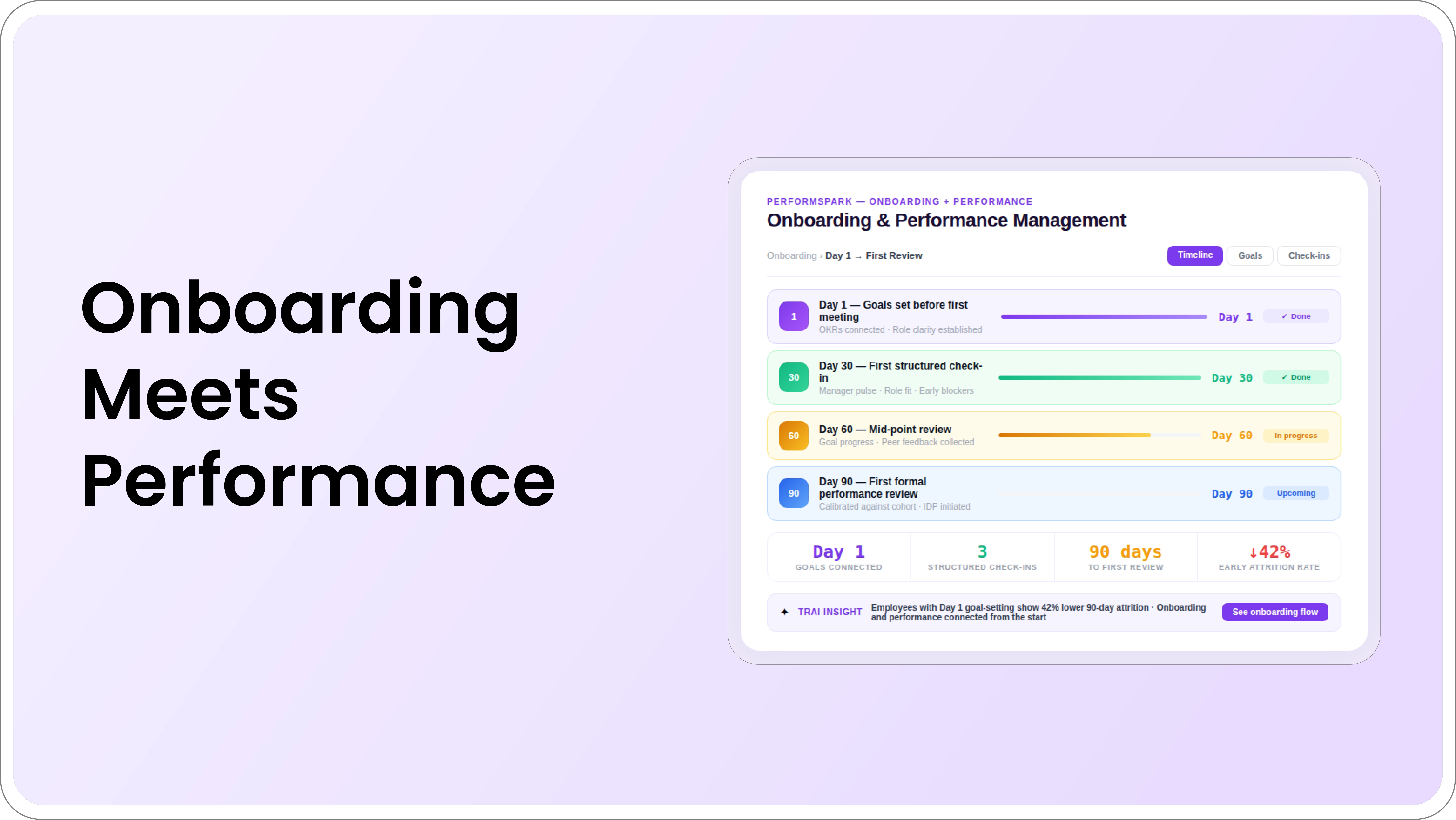
Before day one: Pre-boarding goal alignment
The performance management relationship begins before the employee walks through the door. The hiring manager should use the period between offer acceptance and start date to:
- Share the 30-60-90 day plan so the employee arrives knowing what success looks like in the first three months.
- Set up the employee's profile in the performance management platform so goals and check-ins can begin from the first week.
- Send a brief welcome message that introduces the check-in cadence, when 1-on-1s will happen, how they will be structured, and what documentation the employee can expect.
Pre-boarding goal alignment reduces first-day anxiety, signals that performance management here is structured and supportive, and ensures the employee arrives ready to engage with the performance system immediately.
Week one: Role clarity and initial goal-setting
The most damaging onboarding failure is the one that 39% of new hires experience, having to figure out their responsibilities independently because no one communicated them clearly (APQC via AIHR, 2025). The first week must produce explicit, documented clarity on three things:
- What the role is responsible for, not a job description, but a specific picture of what success looks like in this role at this organization.
- What the 30-day goals are, two to three specific, measurable things the employee should accomplish or learn in the first month.
- How the performance management relationship works, when check-ins happen, how feedback is delivered, and where all of this is documented.
These are not HR onboarding tasks. They are manager tasks, and they determine the performance trajectory that follows.
Days 30, 60, 90: Structured milestone reviews
The 30-60-90 day review structure is the most effective tool for connecting onboarding to performance management. Each milestone review is a brief, structured conversation with a specific purpose.
The 90-day review is the first formal performance assessment and should be treated as such, documented in the performance platform, connected to the initial goals set in week one, and used to launch the individual development plan that will guide the employee's first year.
Month 2 onward: Establishing the check-in cadence
The check-in cadence established during onboarding tends to persist. Managers who run structured, documented biweekly check-ins during the first 90 days maintain that cadence. Managers who skip check-ins or run them informally during onboarding rarely establish a structured rhythm afterward.
This matters because the check-in cadence during onboarding directly determines whether the employee builds the performance documentation habit that makes year-end reviews accurate and useful. New hires who receive regular structured check-ins from day one understand that performance is tracked continuously, not evaluated once a year.
What Makes Onboarding Check-Ins Different
Onboarding check-ins are structured differently from standard biweekly check-ins because the employee is still learning the role, the team, and the organization. They need more space for questions, more explicit feedback on what good looks like, and more guidance on priorities.
Three specific adjustments for onboarding check-ins:
- Lead with role clarity questions, not goal progress. In the first 30 days, the most important check-in question is often "Is the role as clear as it needs to be?" rather than "How are your goals tracking?" because unclear role expectations are the primary source of early performance problems.
- Give more directive feedback than usual. New employees do not yet have the context to interpret ambiguous feedback correctly. "That approach worked well because..." is more useful during onboarding than "Good job," and "I would do that differently because..." is more useful than a vague "try to improve that."
- Always close with a clear next-step. New employees carry more cognitive load than experienced ones. End every onboarding check-in with one or two specific agreed actions and timeline, documented in the platform, rather than an open-ended conversation that trails off.
The 90-Day Performance Review: How to Do It Right
The 90-day review is the most consequential early performance management event. Done well, it establishes the performance conversation as a structured, fair, development-focused process. Done poorly, it signals that performance management here is bureaucratic, disconnected from reality, or a judgment exercise rather than a coaching tool.
A well-structured 90-day review includes:
- Assessment against the documented 30-60-90 day goals, specific, behavioral, tied to observable examples where possible.
- Employee self-assessment, what went well, what was harder than expected, what support would help most in the next 90 days.
- Forward-looking development plan, two to three specific development priorities for the next period, with agreed support from the manager.
- Explicit confirmation of role expectations going forward, what does the next quarter look like, what are the goals, and what does success look like.
The 90-day review should be documented in the performance platform and referenced in every check-in that follows it. It is the first data point in the employee's performance record, and it sets the documentation standard for everything that comes after.
Common Onboarding Performance Management Failures
- No goals in the first week. Employees who begin without documented goals spend the first month figuring out their own interpretation of the role, which often diverges from what the manager expects. Set goals in week one, in writing, in the performance platform.
- Check-ins that skip performance topics. Onboarding check-ins that focus only on "how are you settling in?" and "do you have what you need?" miss the performance management purpose. Include goal progress, specific feedback, and development topics in every check-in from week two onward.
- 90-day reviews that are too late. Many organizations schedule the formal 90-day review at 90 days exactly, which means that if there is a performance concern, it is often not surfaced until almost the end of the critical early window. Run a brief 30-day check and a 60-day check before the formal 90-day review so there are no surprises.
- No documentation in the performance platform. Onboarding check-in notes, 90-day goals, and the first formal review that live in email or a manager's notebook cannot be referenced, calibrated, or built upon. Everything goes in the platform from day one.
Start Performance Management on Day One
PerformSpark's built-in 30-60-90 day review templates, new hire check-in module, and goal-setting tools connect onboarding to the full performance cycle from day one, at $6/user/month. Book a Demo
Onboarding and Performance Management: How to Connect Them From Day One (2026)
Most organizations treat onboarding and performance management as separate processes. Onboarding is an HR function, paperwork, system access, company culture introduction. Performance management starts later, when the employee is settled in and the first formal review cycle begins.
This separation is one of the most expensive mistakes an organization can make. The first 90 days of employment are the most consequential performance management window in the entire employee lifecycle. The goals set in week one, the check-in cadence established in the first month, and the feedback quality delivered in the first formal review all set the performance patterns, expectations, and manager-employee relationship that persist for years.
Organizations that connect onboarding to performance management from day one see faster time to productivity, significantly higher retention, and stronger employee engagement from the start. This guide covers exactly how to build that connection.
Why Onboarding Is a Performance Management Problem
The statistics on poor onboarding reveal it as primarily a performance management failure, not an administrative one. When new hires leave within the first six months, the most common reasons they cite are not about paperwork or IT access, they are about unclear role expectations, insufficient feedback, lack of development support, and feeling disconnected from their manager.
These are performance management failures. Unclear role expectations means goals were not set clearly. Insufficient feedback means check-ins were not structured or frequent enough. Lack of development support means development planning did not begin early enough. Disconnection from the manager means the 1-on-1 relationship was not established effectively in the early weeks.
Fixing onboarding means fixing the performance management processes that should begin on day one.
The Onboarding Performance Management Timeline
Before day one: Pre-boarding goal alignment
The performance management relationship begins before the employee walks through the door. The hiring manager should use the period between offer acceptance and start date to:
- Share the 30-60-90 day plan so the employee arrives knowing what success looks like in the first three months.
- Set up the employee's profile in the performance management platform so goals and check-ins can begin from the first week.
- Send a brief welcome message that introduces the check-in cadence, when 1-on-1s will happen, how they will be structured, and what documentation the employee can expect.
Pre-boarding goal alignment reduces first-day anxiety, signals that performance management here is structured and supportive, and ensures the employee arrives ready to engage with the performance system immediately.
Week one: Role clarity and initial goal-setting
The most damaging onboarding failure is the one that 39% of new hires experience, having to figure out their responsibilities independently because no one communicated them clearly (APQC via AIHR, 2025). The first week must produce explicit, documented clarity on three things:
- What the role is responsible for, not a job description, but a specific picture of what success looks like in this role at this organization.
- What the 30-day goals are, two to three specific, measurable things the employee should accomplish or learn in the first month.
- How the performance management relationship works, when check-ins happen, how feedback is delivered, and where all of this is documented.
These are not HR onboarding tasks. They are manager tasks, and they determine the performance trajectory that follows.
Days 30, 60, 90: Structured milestone reviews
The 30-60-90 day review structure is the most effective tool for connecting onboarding to performance management. Each milestone review is a brief, structured conversation with a specific purpose.
The 90-day review is the first formal performance assessment and should be treated as such, documented in the performance platform, connected to the initial goals set in week one, and used to launch the individual development plan that will guide the employee's first year.
Month 2 onward: Establishing the check-in cadence
The check-in cadence established during onboarding tends to persist. Managers who run structured, documented biweekly check-ins during the first 90 days maintain that cadence. Managers who skip check-ins or run them informally during onboarding rarely establish a structured rhythm afterward.
This matters because the check-in cadence during onboarding directly determines whether the employee builds the performance documentation habit that makes year-end reviews accurate and useful. New hires who receive regular structured check-ins from day one understand that performance is tracked continuously, not evaluated once a year.
What Makes Onboarding Check-Ins Different
Onboarding check-ins are structured differently from standard biweekly check-ins because the employee is still learning the role, the team, and the organization. They need more space for questions, more explicit feedback on what good looks like, and more guidance on priorities.
Three specific adjustments for onboarding check-ins:
- Lead with role clarity questions, not goal progress. In the first 30 days, the most important check-in question is often "Is the role as clear as it needs to be?" rather than "How are your goals tracking?" because unclear role expectations are the primary source of early performance problems.
- Give more directive feedback than usual. New employees do not yet have the context to interpret ambiguous feedback correctly. "That approach worked well because..." is more useful during onboarding than "Good job," and "I would do that differently because..." is more useful than a vague "try to improve that."
- Always close with a clear next-step. New employees carry more cognitive load than experienced ones. End every onboarding check-in with one or two specific agreed actions and timeline, documented in the platform, rather than an open-ended conversation that trails off.
The 90-Day Performance Review: How to Do It Right
The 90-day review is the most consequential early performance management event. Done well, it establishes the performance conversation as a structured, fair, development-focused process. Done poorly, it signals that performance management here is bureaucratic, disconnected from reality, or a judgment exercise rather than a coaching tool.
A well-structured 90-day review includes:
- Assessment against the documented 30-60-90 day goals, specific, behavioral, tied to observable examples where possible.
- Employee self-assessment, what went well, what was harder than expected, what support would help most in the next 90 days.
- Forward-looking development plan, two to three specific development priorities for the next period, with agreed support from the manager.
- Explicit confirmation of role expectations going forward, what does the next quarter look like, what are the goals, and what does success look like.
The 90-day review should be documented in the performance platform and referenced in every check-in that follows it. It is the first data point in the employee's performance record, and it sets the documentation standard for everything that comes after.
Common Onboarding Performance Management Failures
- No goals in the first week. Employees who begin without documented goals spend the first month figuring out their own interpretation of the role, which often diverges from what the manager expects. Set goals in week one, in writing, in the performance platform.
- Check-ins that skip performance topics. Onboarding check-ins that focus only on "how are you settling in?" and "do you have what you need?" miss the performance management purpose. Include goal progress, specific feedback, and development topics in every check-in from week two onward.
- 90-day reviews that are too late. Many organizations schedule the formal 90-day review at 90 days exactly, which means that if there is a performance concern, it is often not surfaced until almost the end of the critical early window. Run a brief 30-day check and a 60-day check before the formal 90-day review so there are no surprises.
- No documentation in the performance platform. Onboarding check-in notes, 90-day goals, and the first formal review that live in email or a manager's notebook cannot be referenced, calibrated, or built upon. Everything goes in the platform from day one.
Start Performance Management on Day One
PerformSpark's built-in 30-60-90 day review templates, new hire check-in module, and goal-setting tools connect onboarding to the full performance cycle from day one, at $6/user/month. Book a Demo




.svg)

.svg)
.svg)