


Table of Content
OKR vs KPI: What's the Difference? (With Examples)
Whatis the difference between OKRs and KPIs?
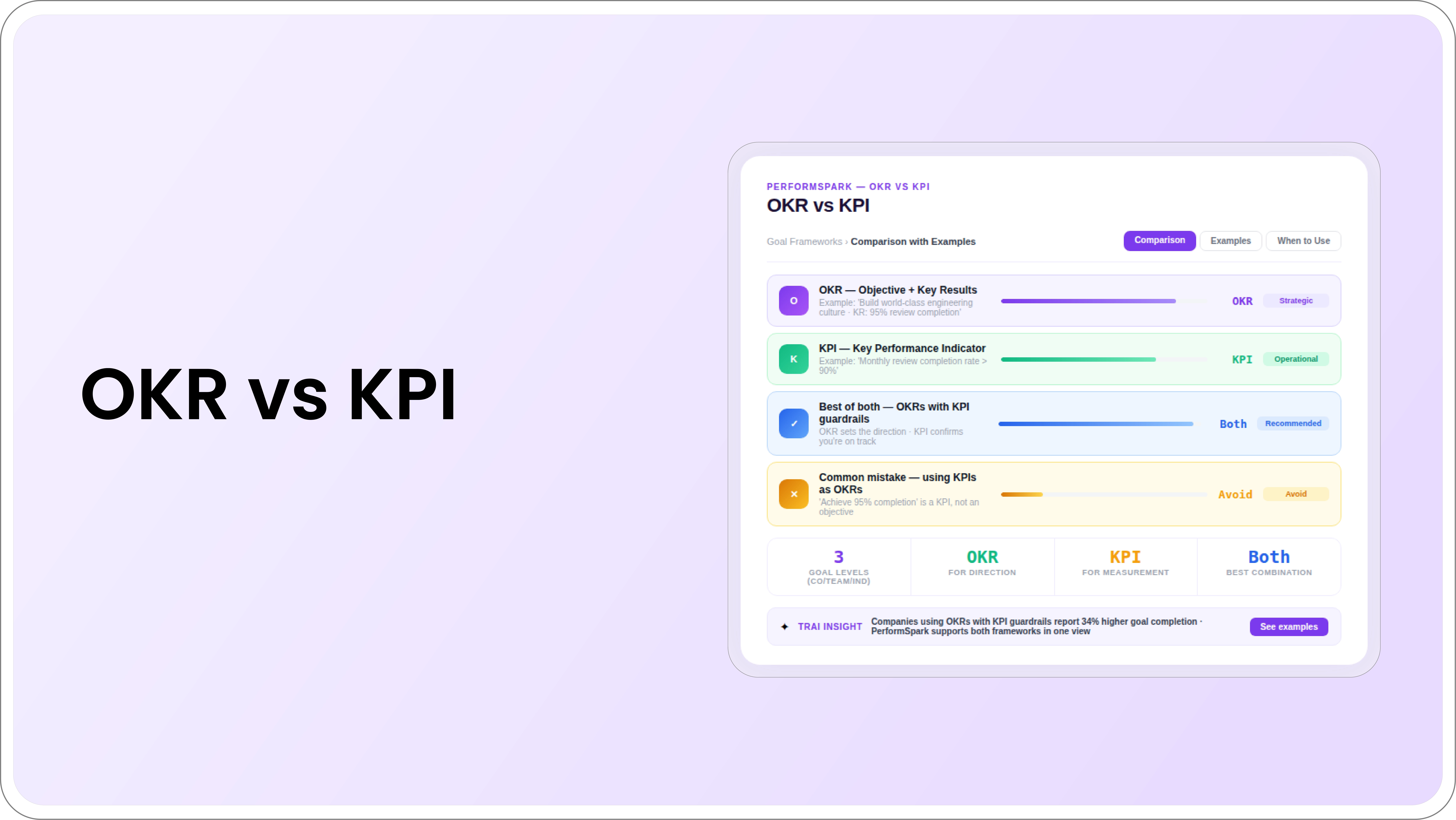
OKRs (Objectives and Key Results) are a goal-setting framework thatdefines where you want to go and how you will measure whether you got there.KPIs (Key Performance Indicators) are standalone metrics that measure theongoing health of a business process or function. OKRs drive change andimprovement. KPIs monitor performance and signal when something needsattention. The simplest version: a KPI tells you how you are doing right now.An OKR tells you where you are going and why it matters to get there.
KeyTakeaways
- OKRs and KPIs are not competitors they arecomplementary. KPIs monitor the steady state; OKRs drive improvement. Mostorganizations need both.
- An OKR consists of a qualitative Objective paired withtwo to five measurable Key Results. A KPI is a standalone metric with a target,a data source, and a cadence.
- OKRs are time-bound (quarterly or annual) and changeeach cycle. KPIs are ongoing the same KPI tracks the same metric consistentlyover time.
- Use OKRs when you need to achieve something new, fix asignificant problem, or drive a strategic shift. Use KPIs to monitor businessas usual and signal when an OKR is needed.
If your organization is setting the same OKRs every quarter, they areprobably KPIs with extra steps not true stretch objectives.
OKR and KPI are two of the most commonly used acronyms in performance management conversations, and two of the most frequently confused. Organizations set OKRs that are actually KPIs. They track KPIs without the strategic context that would make them useful. They argue about which framework is better rather than using both for what they are designed for.
The confusion is understandable. Both OKRs and KPIs involve numbers. Both are used to evaluate performance. Both appear in goal-setting conversations and performance reviews. But they serve fundamentally different purposes, and using one where the other is needed produces predictably poor results.
This guide explains what each framework does, where each one belongs, how they work together, and how to set them correctly.
What Is a KPI?
A Key Performance Indicator is a measurable metric that tracks the ongoing health or performance of a specific business function, process, or role. KPIs answer one question: how are we doing right now?
KPIs have four essential elements:
- A clear metric definition, exactly what is being measured and how it is calculated.
- A target, what level of performance indicates success.
- A data source, where the measurement comes from.
- A cadence, how often it is reviewed.
KPIs monitor business as usual. They are the gauges on the dashboard that tell you whether the engine is running within normal parameters. When a KPI falls outside its target range, it signals that something needs attention, possibly an OKR designed to fix it.
KPI examples across functions
What Is an OKR?
An OKR is a goal-setting framework consisting of an Objective, a qualitative, inspiring statement of what you want to achieve, and two to five Key Results, specific, measurable outcomes that indicate progress toward the Objective.
OKRs answer a different question from KPIs: not "how are we doing?" but "where are we going, and how will we know when we get there?"
The essential components:
- Objective: Qualitative and motivating. It describes a future state that does not yet exist. Example: "Become the performance management platform that mid-market HR teams recommend to peers."
- Key Results: Specific, measurable, time-bound outcomes. Each KR should describe a result, not a task or an activity. Example: "Reach 50 verified G2 reviews with an average rating above 4.5 by end of Q3."
- Timeframe: OKRs are time-bound, typically quarterly, sometimes annual. They change each cycle as objectives are achieved or reprioritized.
- Stretch orientation: Google's standard is a 70% achievement rate on OKRs. 100% achievement means the objective was not ambitious enough.
OKR examples across functions
OKR vs KPI: The Key Differences
The OKR vs KPI Confusion: What Goes Wrong
Setting OKRs that are actually KPIs
The most common mistake: organizations set OKRs that look like "Maintain NPS above 45" or "Keep churn below 8%." These are KPIs, they measure ongoing performance against a standard. An OKR version of the same concern would be: "Objective: Become the most trusted partner in our customers' renewal decisions. Key Result 1: NPS increases from 38 to 52. Key Result 2: Renewal rate improves from 82% to 90%. Key Result 3: Customers cite proactive support as the primary renewal reason in 30% of exit surveys."
The OKR version is harder, more specific, and more actionable because it describes an outcome that requires change, not just maintenance of the current state.
Tracking KPIs without strategic context
A KPI without context is just a number. A KPI that falls below its target for three consecutive months but produces no response is a KPI that no one owns. KPIs become powerful when they are connected to OKRs, when a KPI signals a problem, an OKR provides the strategic response.
Choosing one and ignoring the other
Some organizations go all-in on OKRs and stop tracking KPIs, which means they lose visibility into the ongoing health of their operations. Others track only KPIs and never set stretch objectives, which means they optimize for the status quo rather than driving improvement. Effective performance management uses both: KPIs to monitor, OKRs to improve.
How OKRs and KPIs Work Together
The relationship between KPIs and OKRs follows a clear pattern:
- A KPI signals a problem. Monthly churn rate has been above 12% for three months. That is a KPI telling you that something is wrong.
- An OKR addresses it. "Objective: Reduce churn by building the customer success muscle we do not yet have. KR1: Implement proactive health scoring for all accounts by week four. KR2: 80% of at-risk accounts receive a success call within 48 hours of flagging. KR3: Churn rate drops from 12% to 8% by end of Q3."
- A new KPI monitors the outcome. Once the OKR achieves its aim, churn rate returns to ongoing KPI monitoring at the new target level.
This cycle, KPI signals, OKR fixes, KPI monitors the new standard, is what effective goal management looks like in practice.
How to Set OKRs Correctly
- Start with the Objective. Write it as a qualitative, motivating description of a future state that does not currently exist. If it sounds like your current state, it is not an Objective, it is a KPI.
- Write Key Results that describe outcomes, not tasks. "Launch the new onboarding module" is a task. "New hire 90-day retention reaches 92%" is a Key Result.
- Limit to three to five Key Results per Objective. More than five means the Objective is too broad or the Key Results are too granular.
- Set a stretch target. If your team can achieve the OKR by doing what they are already doing, it is not ambitious enough.
- Review quarterly. OKRs that are set and not reviewed monthly become irrelevant by quarter-end.
How to Set KPIs Correctly
- Choose metrics that are directly tied to outcomes you care about. If you cannot explain why a KPI matters to business performance, remove it.
- Limit your KPI scorecard. 15 to 25 KPIs is the recommended maximum. More than that means you are tracking everything and prioritizing nothing.
- Set a specific target, a data source, and a review cadence for each KPI. A KPI without these three elements is just a metric, it cannot drive accountability.
- Review KPIs on a consistent cadence. Weekly for fast-moving operational metrics, monthly for strategic business health indicators.
- Connect KPIs to OKRs. When a KPI consistently underperforms, it should trigger an OKR designed to fix it.
Manage OKRs and KPIs in One Place
PerformSpark connects individual OKRs to team and company objectives, tracks goal progress in real time, and connects goal outcomes to performance reviews, all at $6/user/month. Book a Demo
OKR vs KPI: What's the Difference? (With Examples)
Whatis the difference between OKRs and KPIs?
OKRs (Objectives and Key Results) are a goal-setting framework thatdefines where you want to go and how you will measure whether you got there.KPIs (Key Performance Indicators) are standalone metrics that measure theongoing health of a business process or function. OKRs drive change andimprovement. KPIs monitor performance and signal when something needsattention. The simplest version: a KPI tells you how you are doing right now.An OKR tells you where you are going and why it matters to get there.
KeyTakeaways
- OKRs and KPIs are not competitors they arecomplementary. KPIs monitor the steady state; OKRs drive improvement. Mostorganizations need both.
- An OKR consists of a qualitative Objective paired withtwo to five measurable Key Results. A KPI is a standalone metric with a target,a data source, and a cadence.
- OKRs are time-bound (quarterly or annual) and changeeach cycle. KPIs are ongoing the same KPI tracks the same metric consistentlyover time.
- Use OKRs when you need to achieve something new, fix asignificant problem, or drive a strategic shift. Use KPIs to monitor businessas usual and signal when an OKR is needed.
If your organization is setting the same OKRs every quarter, they areprobably KPIs with extra steps not true stretch objectives.
OKR and KPI are two of the most commonly used acronyms in performance management conversations, and two of the most frequently confused. Organizations set OKRs that are actually KPIs. They track KPIs without the strategic context that would make them useful. They argue about which framework is better rather than using both for what they are designed for.
The confusion is understandable. Both OKRs and KPIs involve numbers. Both are used to evaluate performance. Both appear in goal-setting conversations and performance reviews. But they serve fundamentally different purposes, and using one where the other is needed produces predictably poor results.
This guide explains what each framework does, where each one belongs, how they work together, and how to set them correctly.
What Is a KPI?
A Key Performance Indicator is a measurable metric that tracks the ongoing health or performance of a specific business function, process, or role. KPIs answer one question: how are we doing right now?
KPIs have four essential elements:
- A clear metric definition, exactly what is being measured and how it is calculated.
- A target, what level of performance indicates success.
- A data source, where the measurement comes from.
- A cadence, how often it is reviewed.
KPIs monitor business as usual. They are the gauges on the dashboard that tell you whether the engine is running within normal parameters. When a KPI falls outside its target range, it signals that something needs attention, possibly an OKR designed to fix it.
KPI examples across functions
What Is an OKR?
An OKR is a goal-setting framework consisting of an Objective, a qualitative, inspiring statement of what you want to achieve, and two to five Key Results, specific, measurable outcomes that indicate progress toward the Objective.
OKRs answer a different question from KPIs: not "how are we doing?" but "where are we going, and how will we know when we get there?"
The essential components:
- Objective: Qualitative and motivating. It describes a future state that does not yet exist. Example: "Become the performance management platform that mid-market HR teams recommend to peers."
- Key Results: Specific, measurable, time-bound outcomes. Each KR should describe a result, not a task or an activity. Example: "Reach 50 verified G2 reviews with an average rating above 4.5 by end of Q3."
- Timeframe: OKRs are time-bound, typically quarterly, sometimes annual. They change each cycle as objectives are achieved or reprioritized.
- Stretch orientation: Google's standard is a 70% achievement rate on OKRs. 100% achievement means the objective was not ambitious enough.
OKR examples across functions
OKR vs KPI: The Key Differences
The OKR vs KPI Confusion: What Goes Wrong
Setting OKRs that are actually KPIs
The most common mistake: organizations set OKRs that look like "Maintain NPS above 45" or "Keep churn below 8%." These are KPIs, they measure ongoing performance against a standard. An OKR version of the same concern would be: "Objective: Become the most trusted partner in our customers' renewal decisions. Key Result 1: NPS increases from 38 to 52. Key Result 2: Renewal rate improves from 82% to 90%. Key Result 3: Customers cite proactive support as the primary renewal reason in 30% of exit surveys."
The OKR version is harder, more specific, and more actionable because it describes an outcome that requires change, not just maintenance of the current state.
Tracking KPIs without strategic context
A KPI without context is just a number. A KPI that falls below its target for three consecutive months but produces no response is a KPI that no one owns. KPIs become powerful when they are connected to OKRs, when a KPI signals a problem, an OKR provides the strategic response.
Choosing one and ignoring the other
Some organizations go all-in on OKRs and stop tracking KPIs, which means they lose visibility into the ongoing health of their operations. Others track only KPIs and never set stretch objectives, which means they optimize for the status quo rather than driving improvement. Effective performance management uses both: KPIs to monitor, OKRs to improve.
How OKRs and KPIs Work Together
The relationship between KPIs and OKRs follows a clear pattern:
- A KPI signals a problem. Monthly churn rate has been above 12% for three months. That is a KPI telling you that something is wrong.
- An OKR addresses it. "Objective: Reduce churn by building the customer success muscle we do not yet have. KR1: Implement proactive health scoring for all accounts by week four. KR2: 80% of at-risk accounts receive a success call within 48 hours of flagging. KR3: Churn rate drops from 12% to 8% by end of Q3."
- A new KPI monitors the outcome. Once the OKR achieves its aim, churn rate returns to ongoing KPI monitoring at the new target level.
This cycle, KPI signals, OKR fixes, KPI monitors the new standard, is what effective goal management looks like in practice.
How to Set OKRs Correctly
- Start with the Objective. Write it as a qualitative, motivating description of a future state that does not currently exist. If it sounds like your current state, it is not an Objective, it is a KPI.
- Write Key Results that describe outcomes, not tasks. "Launch the new onboarding module" is a task. "New hire 90-day retention reaches 92%" is a Key Result.
- Limit to three to five Key Results per Objective. More than five means the Objective is too broad or the Key Results are too granular.
- Set a stretch target. If your team can achieve the OKR by doing what they are already doing, it is not ambitious enough.
- Review quarterly. OKRs that are set and not reviewed monthly become irrelevant by quarter-end.
How to Set KPIs Correctly
- Choose metrics that are directly tied to outcomes you care about. If you cannot explain why a KPI matters to business performance, remove it.
- Limit your KPI scorecard. 15 to 25 KPIs is the recommended maximum. More than that means you are tracking everything and prioritizing nothing.
- Set a specific target, a data source, and a review cadence for each KPI. A KPI without these three elements is just a metric, it cannot drive accountability.
- Review KPIs on a consistent cadence. Weekly for fast-moving operational metrics, monthly for strategic business health indicators.
- Connect KPIs to OKRs. When a KPI consistently underperforms, it should trigger an OKR designed to fix it.
Manage OKRs and KPIs in One Place
PerformSpark connects individual OKRs to team and company objectives, tracks goal progress in real time, and connects goal outcomes to performance reviews, all at $6/user/month. Book a Demo
.webp)
.webp)
.webp)




.svg)

.svg)
.svg)